Home Beijing China Beijing Hotels About
Home  ›  Asia  ›  China  ›  Beijing  ›  Old-Beijing Home Cooking
🇨🇳 Old-Beijing Food · 2026

Beyond the duck
eat what locals actually eat

Beijing isn't only roast duck. Inside a 老北京菜 restaurant, the local tables are stacked with plates the tour guides rarely mention — shredded pork to wrap in pancakes, braised meatballs, pan-braised tofu, a warm bowl of ma doufu. This is the taste that tells you you've really arrived.

The tradition

老北京菜 — the food Beijing calls home

Here's the thing: most visitors land in Beijing and eat just a handful of things — roast duck, hotpot, maybe a bowl of zhajiangmian, done. But step into a 老北京菜馆 (lǎo běijīng cài guǎn — an old-Beijing restaurant) and you'll see the local tables loaded with dishes the tours skip over entirely: the everyday plates Beijingers have grown up eating their whole lives.

Old-Beijing cooking grew from two sources — the working-class kitchen of the hutong alleys, and Shandong (Lu) cuisine (鲁菜 lǔ cài), which has been the backbone of restaurant cooking across the capital since the Qing dynasty. Shandong chefs were the ones cooking for the court and the big restaurants, so a lot of dishes we now call "Beijing" actually have Shandong roots. The core flavours are savoury and fragrant — deep soy, garlic-and-scallion oil, never the fiery chilli of Sichuan or the fresh-ingredient focus of Cantonese. This is comfort food you can eat with rice every day.

A level above that sits the legacy of the Qing court and the aristocratic households. When the dynasty fell, the palace chefs scattered and opened restaurants, and Manchu-Han banquet cooking and aristocrat cuisines like 谭家菜 (the Tan family) and 厉家菜 (the Li family) became another layer of Beijing's food culture you can still taste today. This guide walks through 9 sit-down dishes worth ordering — the street snacks like tanghulu and jianbing get their own separate guides.

9 sit-down dishes

The home-style plates worth ordering

What's on the local tables inside a 老北京菜 restaurant — not street food, but a proper sit-down meal.
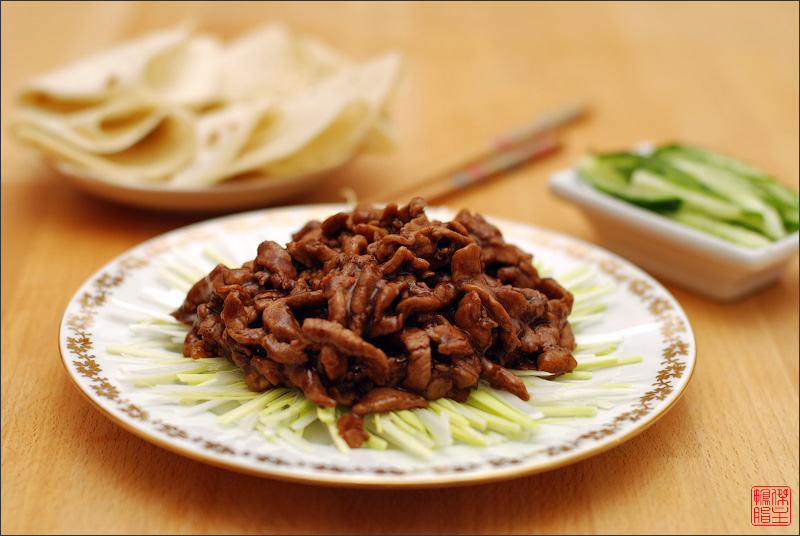
Jing jiang rou si — shredded pork in dark glossy sweet bean sauce on a bed of shredded scallion, with thin pancakes and cucumber on the side 1
Jing jiang rou si
京酱肉丝 · shredded pork in sweet bean sauce, wrap-it-yourself — the opening dish

If you want to start understanding home-style Beijing cooking, order this first. Pork tenderloin is cut into fine strips and stir-fried with sweet bean sauce (甜面酱 tian mian jiang), a paste fermented from wheat flour, until it turns dark, glossy and rounded between sweet and savoury. It arrives over a heap of shredded scallion, with thin tofu sheets (豆皮) or soft wrappers on the side. You lay some pork and scallion on a wrapper and roll it up — basically a Peking-duck pancake in miniature. The first bite is the sweet sauce against the sharp freshness of raw scallion, and somehow the plate empties before you notice.

Where: almost every 老北京菜 restaurant · Najia Xiaoguan · Siji Minfu · Huajia Yiyuan
Price: ¥38–68 / plate (~฿190–340) · shares between 2–3
Tip: ask for extra wrappers if pork is left over · best eaten hot
🍢2
Si xi wan zi
四喜丸子 · four-joy meatballs, braised in soy-sugar sauce

Four fist-sized pork meatballs in a single dish — the name "four joys" (四喜) refers to four blessings: happiness, wealth, health and long life. It's an auspicious dish that turns up at banquets and Lunar New Year. The pork is minced at just the right fat-to-lean ratio, hand-rolled into big balls, fried so the outside takes on aroma, then braised in soy-and-sugar sauce until tender and plump, soaked through with gravy and set over leafy greens or napa cabbage. The inside stays juicy; you spoon it apart and eat it with hot steamed rice. This is the kind of homey comfort Beijingers grew up on.
Where: Najia Xiaoguan · Huajia Yiyuan · most old-Beijing restaurants
Price: ¥48–88 / dish (~฿240–440) · 4 balls, shares around the table
Note: an auspicious dish — ordered often at festivals · it's the main meat plate
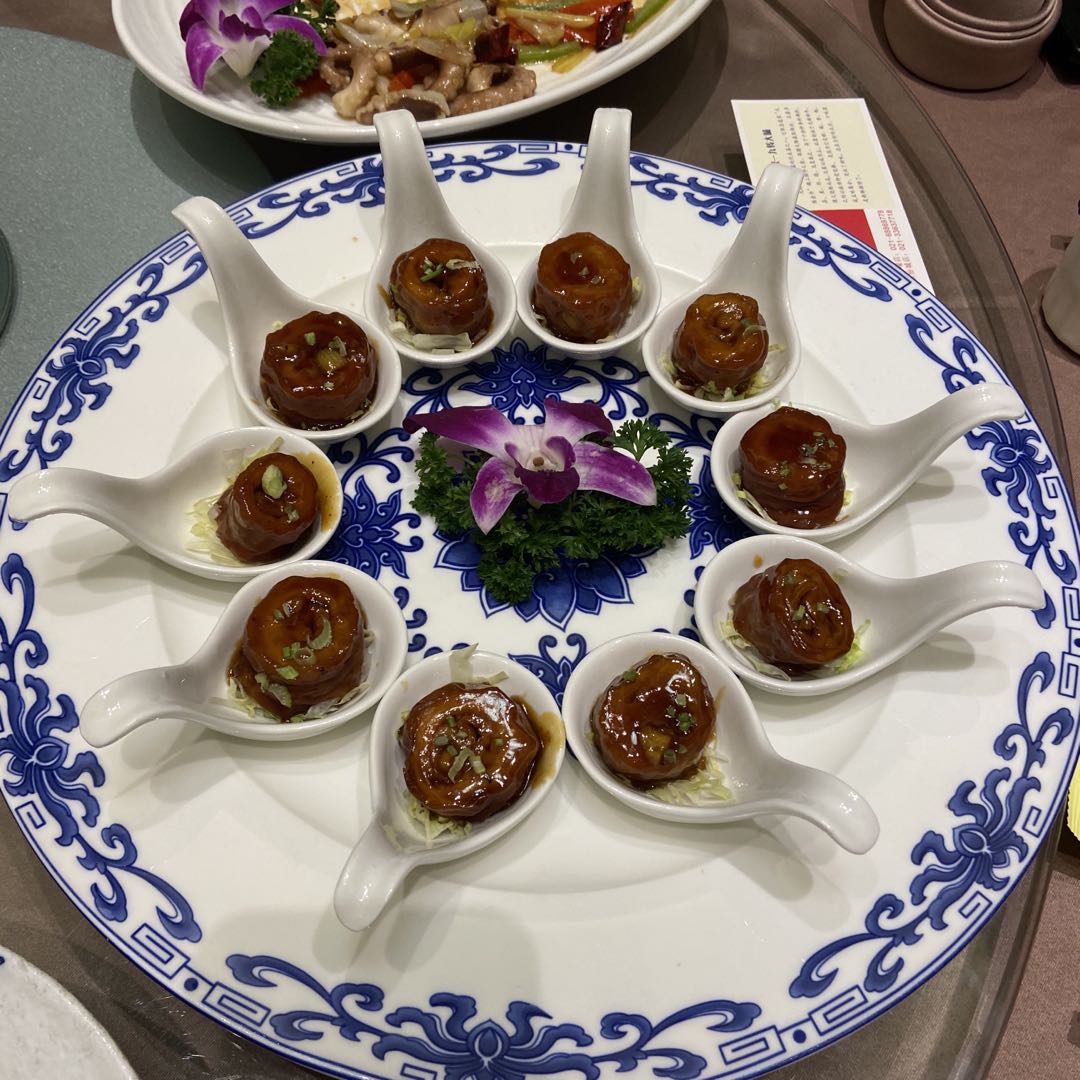
Jiu zhuan da chang — glossy reddish-brown braised pork intestine coils served individually on porcelain spoons, arranged in a circle 3
Jiu zhuan da chang
九转大肠 · nine-turn braised intestine — the dish that tests a kitchen (offal)

Let's be honest: this is offal — but don't skip past it, because it's the plate locals use to judge a kitchen. Pork large intestine is cleaned several times over, blanched, deep-fried, then braised in soy, sugar, vinegar and more than ten seasonings until a single bite carries sour, sweet, savoury, fragrant and a faint heat all at once. The name "nine turns" (九转) nods both to the coiled shape and to a process so elaborate it's likened to alchemy. It's a classic of Shandong (Lu) cuisine that became a Beijing-restaurant staple. Done well, the intestine is tender and springy with no off smell at all.

Where: good Shandong / old-Beijing kitchens · Najia Xiaoguan · hutong restaurants
Price: ¥58–98 / dish (~฿290–490)
Tip: one for offal lovers · easy to skip if it's not your thing
🍳4
Guo ta doufu
锅塌豆腐 · egg-coated pan-braised tofu — crisp edge, silky middle

Picture slabs of tofu, lightly seasoned, dipped in beaten egg and pan-fried until golden, then simmered in a gentle chicken stock until they drink up the broth right through. The outside keeps a little crispness; the inside turns soft and custardy. "Guo ta" (锅塌) is a Shandong technique in itself — coat in egg, fry, then braise down until the stock is nearly gone. The dish was even elevated to court cooking back in the Qianlong era. It's mellow and gentle, the perfect light counterpoint to the heavier meatballs and intestine.

Where: Shandong restaurants · old-Beijing kitchens · Najia Xiaoguan
Price: ¥38–68 / dish (~฿190–340)
Good for: part-veg diners (contains egg) · a light plate to balance richer ones
🥟5
Da lian huo shao
褡裢火烧 · pan-fried stuffed pastry purses — the order-a-plate snack

They look like golden fried bricks — the name "da lian" (褡裢) comes from a long cloth money-pouch worn over the shoulder in old times, because the shape is similar. Thin dough is wrapped tight around a filling (minced pork with fennel, pork and cabbage, or lamb and scallion) and pan-fried so the wrapper and filling cook together: crisp on the outside, juicy and soft within. You dip them in black vinegar just like jiaozi. They've been a Beijing restaurant snack for over 300 years, going back to the early Qing — order a plate alongside a soup or a stir-fry and you're nicely full.

Where: old-Beijing snack houses · hutong sit-down spots · Huguosi Snacks
Price: ¥15–35 / plate (~฿75–175)
Tip: dip in Shanxi / Zhenjiang black vinegar · crispest straight off the pan
🫛6
Ma doufu
麻豆腐 · stir-fried fermented mung-bean dregs — an old Beijinger's favourite

This is the plate that separates a real Beijinger from a tourist. Ma doufu is made from the mung-bean residue left over from making vermicelli and douzhi (the strong-smelling sour drink Beijingers have at breakfast) — except here the solid dregs are stir-fried with oil (often mutton fat), soybeans and dried red chilli until thick, soft and grey-green, mildly sour and richly savoury. The aroma is far gentler than douzhi. Older Beijingers call it something like "Beijing hummus", and it's superb with hot steamed rice. A warm, nostalgic side dish that tastes of the city itself.

Where: old-Beijing restaurants · Huguosi Snacks · hutong kitchens
Price: ¥18–38 / dish (~฿90–190)
Note: a distinctive sour tang · try a bite before judging · usually has mutton fat
🍜7
Zhajiangmian
炸酱面 · noodles in soybean-paste sauce — the Beijing home noodle

The bowl every Beijing household can make at home. Fresh noodles are topped with zhajiang (炸酱) — fatty minced pork fried down with fermented yellow soybean paste (黄酱) until deep and savoury — then crowned with a ring of fresh toppings: shredded cucumber, bean sprouts, soybeans, radish. You toss everything together before eating, the salty-rich sauce meeting the crunch of raw vegetables. In a sit-down restaurant it usually arrives with the toppings in a circle of little dishes around the bowl. Have it as the carb to close a meal, or as a one-bowl lunch on its own — we go deeper on zhajiangmian in the main Beijing food guide.

Where: Siji Minfu Zhajiangmian (noodle-only branch) · old-Beijing restaurants
Price: ¥18–38 / bowl (~฿90–190)
Tip: toss thoroughly before eating · the more toppings the better
🍒8
Chao hong guo
炒红果 · sweet-and-sour stewed hawthorn — the dessert to finish

Close the meal with a cool sweet that Beijingers have loved for generations. Hawthorn fruit (红果 hong guo, the small tart red berry) is pitted, sliced and stewed in sugar with a little ginger until it turns glossy and jelly-like, bright red and refreshingly sweet-sour, served chilled. It was a favourite dessert in the imperial palace, and locals eat it to cut the richness after a heavy meal — and because they reckon it helps digestion. It looks plain, but the flavour sticks with you: just-tart, never cloying. A neat, balanced way to end an old-Beijing meal.

Where: most old-Beijing restaurants · on the dessert / cold-dish menu
Price: ¥18–32 / bowl (~฿90–160)
Note: served chilled · good for digestion after a rich meal · cuts the grease
👑9
Aristocrat cuisine
谭家菜 · 厉家菜 · the legacy of the Qing court kitchen

A level above the home plates sits "aristocrat cuisine" — when the Qing dynasty fell, the palace chefs scattered and opened restaurants. Tan family cuisine (谭家菜) grew out of the household of a Cantonese official who served in Beijing, so it marries southern Cantonese flavours with northern technique: light seasoning, the true taste of premium ingredients (today it's famously served at the Beijing Hotel). Li family cuisine (厉家菜) descends from an ancestor who ran the kitchen for the last emperor, served as set menus in a small hutong courtyard. These aren't everyday plates — but if you want to know how high Beijing's kitchen can reach, this is the top floor.

Where: Li Family Cuisine (厉家菜 · Yangfang Hutong · Houhai) · Bai Family Mansion · Beijing Hotel (Tan family cuisine)
Price: set menus from ¥300 (~฿1,500+) up to several thousand yuan / person
Note: book days to weeks ahead · this is a special-occasion meal
A note on origins: several of the classics on an old-Beijing menu — jiu zhuan da chang, guo ta doufu, si xi wan zi — actually trace their roots to Shandong (Lu) cuisine, which has long been the backbone of the capital's restaurant cooking. We group them under "old-Beijing home cooking" because they're what you'll genuinely find on a 老北京菜 menu, not because they were born in Beijing alone.
Eating like a local

How an old-Beijing meal actually runs

The ordering rhythm — a shared sit-down meal

An old-Beijing meal opens with a couple of cold appetiser plates set out first — ma doufu, chao hong guo, or cold soybeans. Then the hot dishes come in waves: jing jiang rou si is the crowd-pleaser everyone reaches for first, followed by a heavier meat plate like si xi wan zi or jiu zhuan da chang, and finally a carb — zhajiangmian or da lian huo shao — to round things off just right.

Every dish goes in the middle of the table to share; plain rice is ordered separately. Group size: two people pick 3 dishes plus a bowl of noodles · four people order 5–6 comfortably · Per person: a regular spot runs ¥80–150 (~฿400–750) · atmospheric places like Najia or Huajia run ¥150–300 (~฿750–1,500).

Paying + language — sort it out first

Most old-Beijing restaurants take WeChat Pay and Alipay as the default; some accept cash in yuan, but many won't take foreign credit cards — set up Alipay or WeChat Pay with a Visa/Mastercard via tourist mode before you go. Imperial-court restaurants like Bai Family Mansion or Li Family Cuisine usually do accept foreign cards.

Plenty of hutong places have no English menu — just show the staff the dish photos from this article, or point at a picture menu. Tourist-friendly spots like Huajia Yiyuan and Siji Minfu generally have picture or English menus and staff who can recommend.

Old-Beijing restaurants

Where to go — every budget

Sit-down spots that locals and food guides have recommended for years, confirmed still open (as of May 2026 — do check opening hours again before you go).

1
Najia Xiaoguan (那家小馆)
Manchu / court-style home cooking · old-China setting · Chaoyang

If you want old-Beijing food in a genuinely old Chinese setting, Najia Xiaoguan is the name food guides keep coming back to. The restaurant cooks "Najia cuisine" (那家菜), said to follow recipes from an imperial cookbook dating to 1748 — signatures include a thick soup slow-cooked for over 18 hours and braised venison, alongside a full run of home-style classics. The two-storey rooms are dressed in old-Chinese style and reservations are needed; the whole place feels like stepping back into Beijing a century ago.

Address: near Yong'anli / Jianguomenwai (several branches, including out toward Fragrant Hills) · check the branch first
Price: ¥150–300/person (~฿750–1,500) · booking recommended
2
Huajia Yiyuan (花家怡园)
Siheyuan courtyard on Ghost Street · live Chinese music · Dongcheng

A courtyard (四合院) restaurant on Ghost Street (Gui Jie) that has the location, the architecture, the atmosphere and the food all in one place — you sit in an open courtyard ringed by little courtyard rooms and private dining spaces, with live traditional-music performances in the evening. The menu leans into a wide range of local Beijing dishes, and it's a consistently top-ranked spot in the city. Ideal for a dinner where you want flavour and setting together. Ghost Street stays open late and is busiest after dark.

Address: 235 Dongzhimen Nei Dajie (Ghost Street / Gui Jie) · near Beixinqiao (Line 5)
Price: ¥150–280/person (~฿750–1,400) · open late · busy in the evening
3
Siji Minfu (四季民福)
Popular chain · does both duck and home-style plates · great value · many branches

Plenty of people know Siji Minfu as the roast-duck spot with Forbidden City views, but it does home-style Beijing plates very well and at great value too — jing jiang rou si, local stir-fries and Beijing desserts all on the menu. There are more than 19 branches across the city; queues are long at peak meal times, especially the palace-view branch. If you'd rather not hunt down a hutong, this is the easy, reliable choice for home-style food. The chain even runs a separate zhajiangmian noodle shop in Dazhalan.

Address: many branches — Forbidden City (palace view) · Wangfujing · Dengshikou · pick one near your hotel
Price: ¥80–150/person (~฿400–750) · picture menu available · long queues at peak
4
Li Family Cuisine (厉家菜) · Bai Family Mansion (白家大院)
Imperial-court cuisine, special-occasion level · book ahead

If you want to see how high the Beijing kitchen reaches, here are two names. Li Family Cuisine (厉家菜) is a small place in a Houhai hutong courtyard, descended from an ancestor who ran the kitchen for the last emperor; it serves imperial-court set menus in an unassuming home-like setting marked only by a house number — book at least two weeks ahead. Bai Family Mansion (白家大院) in Haidian is a former Qing prince's palace, a garden courtyard around a pond, staff in dynasty-era dress, with face-changing (bian lian) and Beijing opera in the evening — a special-occasion meal where you pay for the setting and the experience as much as the food.

Address: Li Family Cuisine — No.11 Yangfang Hutong, Houhai · Bai Family Mansion — Suzhou St, Haidian
Price: set menus from ¥300 (~฿1,500+) up to several thousand yuan/person · booking essential · foreign cards accepted
Frequently asked

FAQ · what to know before eating old-Beijing food

What is old-Beijing home cooking (老北京菜), and how is it different from Peking duck?
Peking duck is the famous showpiece everyone knows, but old-Beijing home cooking (老北京菜 lǎo běijīng cài) is what locals actually eat every day in sit-down restaurants — shredded pork in sweet bean sauce, braised meatballs, braised intestine, pan-braised tofu. Its roots run through the working-class hutong kitchen and Shandong (Lu) cuisine, which has been the backbone of the capital's restaurant cooking since the Qing dynasty. The flavours are savoury and fragrant — deep soy, garlic-and-scallion oil, comfort over flash — quite unlike duck, which is a special-occasion dish.
Which old-Beijing home-style restaurants are still open and worth a visit?
Sit-down spots locals and food guides have recommended for years: Najia Xiaoguan (那家小馆), Manchu court-style home cooking in an old-China setting, ¥150–300/person · Huajia Yiyuan (花家怡园), a courtyard restaurant on Ghost Street with live music · Siji Minfu (四季民福), a popular chain doing both duck and home-style plates at great value · and at the high end, Bai Family Mansion (白家大院) in a former prince's palace, and Li Family Cuisine (厉家菜) in a hutong courtyard.
How do you eat jing jiang rou si (京酱肉丝) the right way?
Jing jiang rou si is pork tenderloin cut into fine strips and stir-fried with sweet bean sauce (甜面酱 tian mian jiang) until dark, glossy and savoury-sweet. It comes with thin tofu sheets (豆皮 doupi) or soft wrappers and a pile of shredded scallion. You lay some pork and scallion on a wrapper and roll it into a small parcel — basically a mini Peking-duck pancake. The first bite hits with the sweet sauce against the fresh bite of raw scallion. Every 老北京菜 restaurant serves it.
Is jiu zhuan da chang (braised intestine) safe to eat — does it smell strong?
Jiu zhuan da chang (九转大肠) is pork large intestine that's cleaned and cooked with great care — blanched, deep-fried, then braised in soy, sugar, vinegar and more than ten seasonings until it's sour, sweet, savoury, fragrant and faintly spicy all at once. It's a classic of Shandong (Lu) cuisine that became a staple in Beijing restaurants. Done well, the intestine is tender and springy with no off smell — a piece of offal that surprises many people by being far better than they expected. If offal isn't your thing, it's an easy one to skip.
How much does an old-Beijing home-style meal cost per person?
A regular sit-down spot like Siji Minfu or a hutong home-style place runs roughly ¥80–150 per person (~฿400–750) when you share several dishes with rice. Atmospheric restaurants like Najia Xiaoguan or Huajia Yiyuan are about ¥150–300 per person (~฿750–1,500). Imperial-court restaurants like Bai Family Mansion or Li Family Cuisine start around ¥300 and climb to several thousand yuan per head. Most places take WeChat Pay and Alipay; the higher-end ones usually accept foreign cards.
What's the difference between ma doufu (麻豆腐) and douzhi?
Both come from the same raw material — the mung-bean residue left over from making vermicelli. But douzhi (豆汁) is the sour liquid you drink at breakfast (and it smells very strong), while ma doufu (麻豆腐) is the solid dregs stir-fried with oil, mutton, soybeans and red chilli — mildly sour, rich and far gentler in aroma than douzhi. Old Beijingers love it as a warm side dish, and it goes beautifully with plain steamed rice. It's a sit-down restaurant plate, not street food.
Klook · Food tour

Beijing Food Tour — the right places, with someone who knows

A Beijing food tour with a local guide who walks you through the hutong lanes and into 老北京菜 restaurants that are hard to find on your own — no language barrier, no guessing at the menu.

See Beijing Food Tours on Klook →
Wherebest is a Klook affiliate partner — we may earn a commission when you book through our link, at no extra cost to you.