Home Beijing China Beijing Hotels About
Home  ›  China  ›  Beijing  ›  Beijing Hotpot
🍲 Beijing Hotpot Guide · 2026

Beijing hotpot
copper-pot mutton, done properly

Forget the red, fiery málà pot for a moment — Beijing has its own. A charcoal-fired copper pot with a chimney, a broth so clear you can see the jujubes floating, paper-thin hand-sliced mutton swished for the count of three, and a rich sesame sauce to dip it in. This is the winter flavour Beijingers wait for all year.

Why it's built this way

Beijing hotpot is not the spicy red kind

Say "Chinese hotpot" and most people picture a roiling red broth thick with dried chillies and Sichuan peppercorns, a numbing heat that lingers on the lips — that's Sichuan and Chongqing hotpot. Beijing plays a completely different game. The city's own version is called shuàn yángròu (涮羊肉), literally "swished mutton", and every part of it is designed to let the flavour of the lamb take centre stage with nothing to mask it.

The heart of it is a doughnut-shaped copper pot with a chimney down the middle, packed with white-hot charcoal that keeps the broth at a constant simmer. The broth itself is almost startlingly plain — just water, a stalk of scallion, a few slices of ginger and a handful of jujubes. No chilli, no heavy spice, because any of that would drown out the quality mutton the restaurant has gone to such lengths to source. The tradition traces back to Mongol kitchens and the Qing court, and Beijingers have eaten it this way for centuries — and still do, every winter.

This guide walks you through the ritual of eating it — the pot, the broth, the meat, and the dipping sauce that is the soul of the dish — and then through the legendary mutton houses that are genuinely still open. We've checked which ones the tour crowds flock to and which ones locals quietly love, with prices, areas and the nearest subway station for each.

The ritual

5 things that make Beijing hotpot Beijing hotpot

Know these elements before you sit down, and you'll eat like a local.

1
The chimney copper pot

A doughnut-shaped pot with a central flue packed with glowing charcoal, keeping the broth around it at a rolling simmer — not the induction burner of a modern chain. The faint whisper of charcoal smoke and the steady heat are the irreplaceable part.

2
A clear, deliberately plain broth

Just water, scallion, ginger and a few jujubes — some houses add a little dried mushroom or shrimp. No chilli, no málà. The whole pot is built to showcase the mutton, not bury it.

3
Hand-sliced mutton, three seconds in

Fresh mutton sliced paper-thin (good houses cut it by hand, almost translucent). Pick up a slice, swish it in the boiling broth for just three to five seconds until it changes colour, and lift it straight out. Overcook it and the meat goes tough.

4
Sesame sauce — the soul of the dish

Thick ground-sesame paste mixed with red fermented tofu, shrimp oil, chopped scallion, coriander and pickled chive flower. Stir it smooth and coat each slice of meat. The rich, nutty sauce against the clean-boiled lamb is exactly right.

5
The sides and the shaobing

Frozen tofu riddled with holes that soak up the broth, napa cabbage, potato glass noodles, tofu skin, and the one thing you can't skip — sesame shaobing (烧饼), a crisp-outside, soft-inside baked flatbread to alternate with the meat and cut the richness.

Beginner's tip: Don't tip the whole plate of meat into the pot at once. Cook two or three slices at a time and eat them hot — Beijing mutton is at its best the moment it leaves the broth, dipped straight into the sesame sauce. There's no rush; going slowly is the right way.
What's on the table

Meat, vegetables, sauce — order it the local way

Almost every traditional house has these. Order along these lines and you'll cover every flavour.
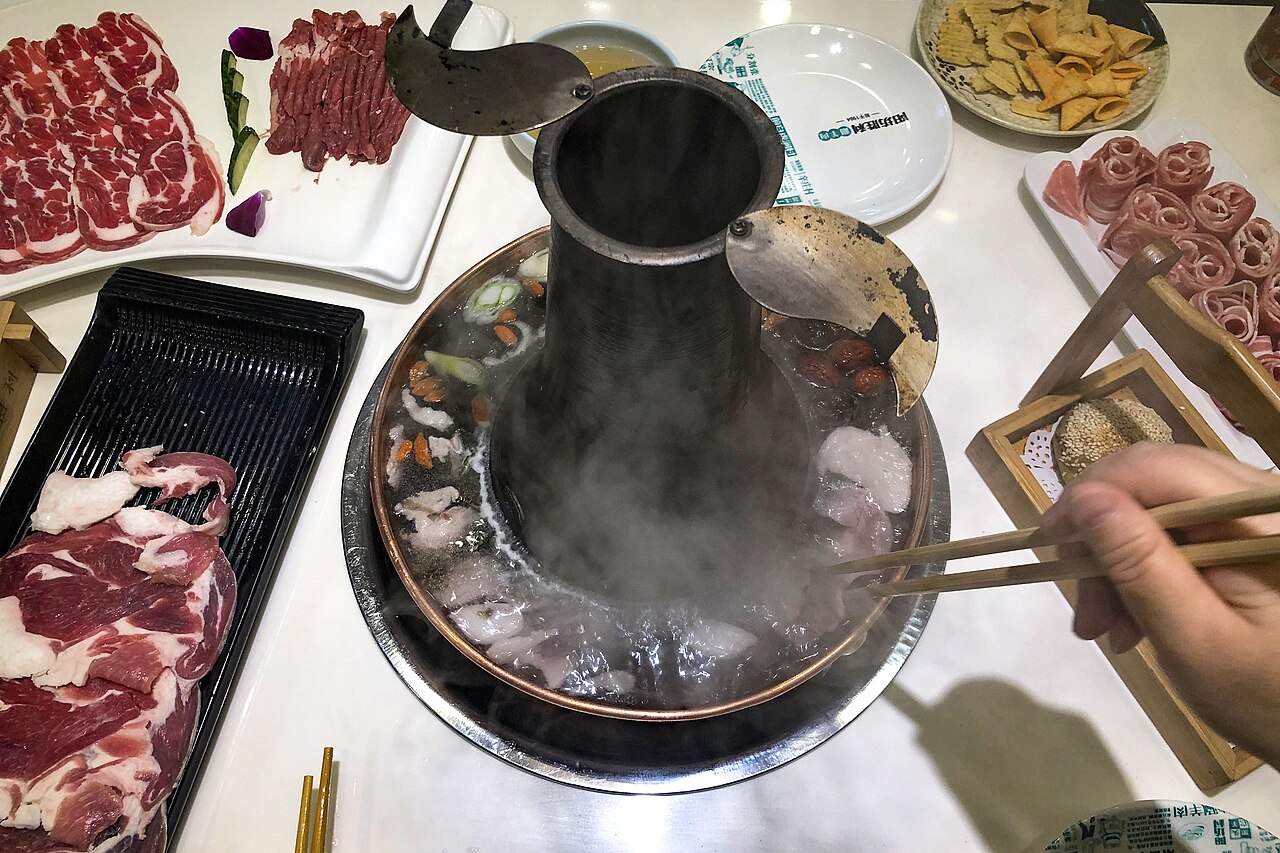
A Beijing-style charcoal copper pot with a tall chimney and clear broth dotted with jujubes, surrounded by plates of hand-sliced mutton and sesame shaobing
Hand-sliced mutton
手切羊肉 · the star of the pot

The centre of the whole meal. Good houses slice it by hand, fresh, in front of you — paper-thin slices fanned out like a flower. The favoured cuts are loin, leg and the slightly fattier pieces that turn meltingly tender. The heritage houses will talk you through the sheep breed and where it was raised (many use lamb from Inner Mongolia or Hebei). Swish for three seconds, then straight into the sesame sauce.

hand-slicedswish 3–5 sec¥40–70/plate
🥬
The classic sides
配菜 · the supporting cast

Non-negotiable is frozen tofu (冻豆腐), riddled with holes that soak up the broth so it bursts when you bite. Then napa cabbage, potato glass noodles, tofu skin, mushrooms and spinach. Cook the vegetables after the meat, when the broth has sweetened from the mutton, and finish with the glass noodles, which soak up everything good in the pot.

frozen tofuglass noodlesnapa cabbage
🥣
The sesame sauce
麻酱 · mix it your way

A bowl of thick sesame paste arrives with add-ins: red fermented tofu, shrimp oil, chopped scallion, coriander, pickled chive flower and chilli oil for those who want heat. The base is sesame paste plus a spoon of fermented tofu and a little shrimp oil, stirred smooth — some add crushed garlic. There's no wrong answer; tune it until it tastes right to you.

ground sesamefermented tofuchive flower
🫓
Shaobing and the extras
烧饼 · the bread that cuts the richness

Shaobing (烧饼) is a round sesame-baked flatbread, crisp outside and soft inside, that Beijingers alternate with the meat to refresh the palate. Houses that began as shaobing shops (like Ya'er Liji) do it especially well. Finish the meal with a small bottle of Beijing yogurt — its tangy-sweet tartness settles the stomach after all that rich meat.

sesame shaobingbaodu (boiled tripe)Beijing yogurt
The legendary houses

Beijing mutton houses that are still open

We've checked that every one is still trading and serves the traditional charcoal-fired copper-pot style — and we're honest about which draw the tour crowds and which the locals quietly love.

1
Donglaishun (东来顺)
The institution
Trading since 1903 · Wangfujing flagship · halal

The first name all of China reaches for when you say shuàn yángròu. It began as a small porridge-and-flatbread stall on Wangfujing Street in 1903 and grew into a mutton-hotpot institution more than a century old. The signature is its hand-sliced mutton, famed for its "four perfections" — as thin as paper, as even as crystal, as neat as thread and as beautiful as a flower — that cooks in seconds, tender and never gamy. It's a tourist magnet with real queues, but it's also the original, and worth seeing once.

Where: Flagship at 138 Wangfujing St (inside APM mall) · several branches including Qianmen and Xidan
Subway: Line 1, Wangfujing station · Price: around ¥150–200+ pp (roughly ฿750–1,000+) · Order: the four-perfections hand-sliced mutton
2
Nanmen Shuanrou (南门涮肉)
Locals' benchmark
Trading since 1994 · named after the Temple of Heaven's South Gate · halal

Ask a Beijinger where the real traditional mutton hotpot is and Nanmen comes up again and again. It holds rigidly to the classic method — clear broth, charcoal-fired copper pots, no compromise. It's serious enough that it built its own pasture in Hebei and brings in lambs from Inner Mongolia under standardised breeding. The house sesame sauce is a signature recipe the founder developed by tasting the sauces of every hotpot place in Beijing and refining his own. Around 19 branches across the city; the Houhai one sits prettily by the lake.

Where: ~19 branches · Houhai branch: South Guanfang Hutong, Shichahai, Xicheng District · watch for copycats, look for the official logo
Subway: Houhai branch near Line 8, Shichahai station · Price: around ¥150 pp (roughly ฿750) · Hours: 10:30–22:30 (varies by branch)
3
Man Hen Ji (满恒记)
Locals' favourite
Authentic charcoal copper pot · Xicheng District · famous for boiled tripe

A house veteran Beijing eaters revere for keeping the essence of real Beijing hotpot — a perfectly balanced charcoal fire and copper pot, and a broth kept plain so the lamb stays the star. But the thing that actually makes people queue is the baodu (爆肚, quick-boiled beef tripe), so crisp and snappy that old-timers wait for it. The house is known for high-quality halal offal, and feels more genuinely old-Beijing than fancy.

Where: West intersection of Ping'anli West St and Zhaodengyu Rd, Xicheng District
Subway: Line 4, Ping'anli station · Price: around ¥120 pp (roughly ฿600) · Order: baodu (boiled tripe) and hand-sliced mutton
4
Yang Da Ye Shuanrou (羊大爷涮肉)
Michelin Bib Gourmand
Several branches · famous for its one-metre mutton plate

A Beijing mutton-hotpot house with a Michelin Bib Gourmand (listed under the cheeky English name "Bad Ass Lamb Hot Pot"). What made it go viral is the metre-long plate of mutton that lands on the table demanding a photo before you eat. Generous portions, good fresh meat, and friendlier prices than the big heritage brands. Branches at Liangmaqiao, Shichahai, near Beijing Zoo and Wangjing — a solid balance of quality, fun and value.

Where: Liangmaqiao branch: 39 Maizidian St · Shichahai branch near Di'anmen Outer St
Subway: Liangmaqiao branch — Line 10, Liangmaqiao station, Exit C · Price: around ¥108–112 pp (roughly ฿540–560) · Order: the one-metre mutton plate
5
Ya'er Liji (鸦儿李记)
Locals' favourite
Born in Ya'er Hutong, Houhai · renowned for its sesame shaobing

It started as a tiny sesame-flatbread shop in Ya'er Hutong by Houhai, then grew into a full hotpot house with more than 20 branches. The trait it carries from those roots is exceptional sesame shaobing — layered flatbread laced with sesame paste that pairs beautifully with the pot. Prices are the friendliest in this group, which makes it a fine choice if you want quality Beijing mutton hotpot alongside traditional Beijing snacks (Beijing yogurt and local sweets included).

Where: 20+ branches · born in Ya'er Hutong, Houhai, Xicheng District
Subway: Houhai branch near Line 8, Shichahai station · Price: around ¥100 pp (roughly ฿500) · Order: sesame shaobing, hand-sliced mutton and Beijing yogurt
And Haidilao? Haidilao (海底捞) is a modern Sichuan-style chain famous for its service and divided broth bowls, with branches worldwide (Thailand included). It's great if you want an easy, well-served, picture-menu meal — but it's a different lineage from traditional Beijing hotpot. If you've come to taste the winter heritage of this city specifically, pick one of the five copper-pot houses above instead.
Before you go

The real stuff — money, timing and how to order

Winter is prime season — but you can eat it all year
Beijing hotpot has always been a northern Chinese winter dish. The best season is November to February, when the city is bitterly cold and gathering around a hot copper pot in an old dining room is the comfort Beijingers wait for all year. That's also when the famous houses have the longest queues. The legendary spots open year-round, so you can eat it in summer in an air-conditioned room too — it just won't feel quite as magical.
How much per person, and how to pay
Most traditional houses run around ¥100–150 per person (roughly ฿500–750) for a full meal: two or three plates of mutton, vegetables, frozen tofu, glass noodles, shaobing and sauce (Ya'er Liji ~¥100 · Yang Da Ye / Man Hen Ji ~¥108–120 · Nanmen ~¥150 · Donglaishun flagship ~¥200+). A good plate of mutton is ¥40–70. Paying: most places take WeChat Pay and Alipay, which is the easiest by far — set up Alipay with a foreign card before you arrive. Some larger branches accept foreign credit cards.
How to order a full spread if you can't read the menu
Keep it simple: one or two plates of hand-sliced mutton (手切羊肉) + frozen tofu (冻豆腐) + napa cabbage (白菜) + glass noodles (粉丝) + shaobing (烧饼) + a bowl of sesame sauce (麻酱) for two. Most houses have a picture menu or an English one; if not, point at photos or ask staff to recommend. The dipping sauce is usually charged per person, and some places add a small charcoal or pot fee.
Not eating mutton, or eating vegetarian
The clear copper-pot broth cooks anything, so order thinly sliced beef, meatballs, beef offal, a spread of vegetables, tofu, mushrooms and glass noodles instead. Vegetarians can ask for a separate pot or a vegetable order — but be honest with yourself: many mutton houses are halal places built around lamb, and a shared broth always carries some mutton flavour. If you're strict, check with the restaurant first.
Etiquette and pacing
Don't dump the whole plate of meat in at once — cook two or three slices at a time and eat them hot. Beijing mutton is best the instant it leaves the broth. Cook the meat first, then the vegetables and glass noodles (the broth keeps getting sweeter), alternate shaobing to cut the richness, and finish with a small bottle of Beijing yogurt. Beijing hotpot is a slow meal — you talk, you cook, you eat. No need to hurry.
Frequently asked

FAQ · what people ask before they gather round the pot

How is Beijing hotpot different from Sichuan or Chongqing hotpot?
Almost everything is different. Beijing hotpot (涮羊肉, shuàn yángròu) uses a doughnut-shaped copper pot with a chimney in the centre, fired by white-hot charcoal. The broth is strikingly clear — just water, scallion, ginger and a few jujubes — with no chilli and no heavy spice. The star is paper-thin hand-sliced mutton swished for just three to five seconds, then dipped in a sesame-paste sauce (麻酱) with fermented tofu. Sichuan and Chongqing hotpot, by contrast, is a roiling red broth loaded with dried chillies, Sichuan peppercorns (málà) and chilli oil, built to deliver a numbing heat that overwhelms the ingredients. They are opposite ends of the spectrum.
How much does a Beijing hotpot meal cost?
Most traditional mutton-hotpot houses run around ¥100–150 per person (roughly ฿500–750) for a full meal, including two or three plates of hand-sliced mutton, vegetables, frozen tofu, glass noodles, sesame shaobing and the dipping sauce. Ya'er Liji is about ¥100 per person; Yang Da Ye and Man Hen Ji around ¥108–120; Nanmen Shuanrou about ¥150; and the Donglaishun flagship at Wangfujing is pricier as a heritage brand, often ¥200 or more. A good plate of mutton is ¥40–70.
Do I have to go in winter, or can I eat it in summer?
Beijing hotpot has always been a northern Chinese winter dish. The best season is November to February, when the city is bitterly cold and gathering around a hot copper pot is the comfort Beijingers wait for all year — and when the famous houses have the longest queues. That said, the legendary spots open year-round, so you can absolutely eat it in summer in an air-conditioned dining room. It just won't feel quite as magical as it does in deep winter.
What goes into the Beijing hotpot dipping sauce, and how do you mix it?
The heart of it is sesame paste (麻酱, májiàng) — a thick blend of ground sesame and peanut. The base recipe is a scoop of sesame paste, a spoonful of red fermented tofu (腐乳), a little shrimp oil (虾油), chopped scallion and coriander, plus chilli oil if you like heat. Stir until smooth and thick. Many houses also set out pickled chive flower (韭菜花) and crushed garlic to add yourself. Swish the mutton, then dip it so the sauce coats the whole slice — the rich, nutty sauce against the clean-boiled meat is what makes the dish.
If I don't eat mutton, what else can I order?
Plenty. Mutton is the star, but the clear copper-pot broth cooks anything — thinly sliced beef, meatballs, beef offal (Man Hen Ji is famous for its baodu, the snappy quick-boiled tripe), napa cabbage, spinach, mushrooms, frozen tofu that soaks up the broth, potato glass noodles, tofu skin, and sesame shaobing to cut the richness. Vegetarians can ask for a separate pot or a vegetable order, but be honest with yourself: many mutton houses are halal places built around lamb, and a shared broth will always carry some mutton flavour.
Is Haidilao the same as traditional Beijing hotpot?
Not at all. Haidilao (海底捞) is a modern Sichuan-style chain famous for its service, with divided broth bowls — spicy málà, mushroom, tomato — cooked on induction burners, and branches worldwide including Thailand. It's a good, easy, picture-menu experience. But it is a different lineage from traditional Beijing hotpot. If you want the real winter heritage of this city — a charcoal-fired copper pot with a chimney, clear broth, hand-sliced mutton and sesame sauce — choose one of the copper-pot houses instead. This guide is about the latter.
Klook · Food Tour

Beijing Food Tour — eat at the right places, with someone who knows

A Beijing food tour with a local guide, through the hutongs for hotpot, roast duck and traditional snacks — eat the real thing, no fear of an all-Chinese menu.

See Beijing Food Tours on Klook →
Wherebest is a Klook affiliate partner — we may earn a commission when you book through our link, at no extra cost to you.