Home Beijing China Beijing Hotels About
Home  ›  China  ›  Beijing  ›  Food Guide
Beijing Food Guide · 2026

What to eat in Beijing
11 dishes, from roast duck to street food

The duck that's carved at your table, skin shattering with every bite. The noodles every Beijing household eats for lunch. The clear copper-pot hotpot that gets you through a brutal winter. And the back-lane classics that take a little courage. Here's where to start.

Why eat here

The taste of an old imperial capital

Beijing has been a capital for centuries, and its kitchen wears that history on its sleeve. On one side is the refined, palace-bred cooking that produced the city's signature dish — Peking duck. On the other is a deep bench of street food and old-Beijing classics: hearty, honest, and eaten by locals for generations — fried-sauce noodles, steaming offal stews, and a famously funky fermented mung-bean drink that makes most visitors recoil.

Beijing is also a cold city. The winters are long and they bite, so much of the food exists to warm you up — copper-pot mutton hotpot simmered in a clear broth, and tanghulu, candied hawthorn on a stick sold on street corners when the air turns sharp. We picked 11 dishes and snacks that tell both halves of the story, from the white-tablecloth duck houses to the carts in the back lanes — and we'll tell you plainly which ones are easy and which take an open mind.

The essential dishes

11 things to eat before you leave Beijing

Ordered from the dishes everyone can enjoy to the local classics that take some nerve — and we'll flag which is which.
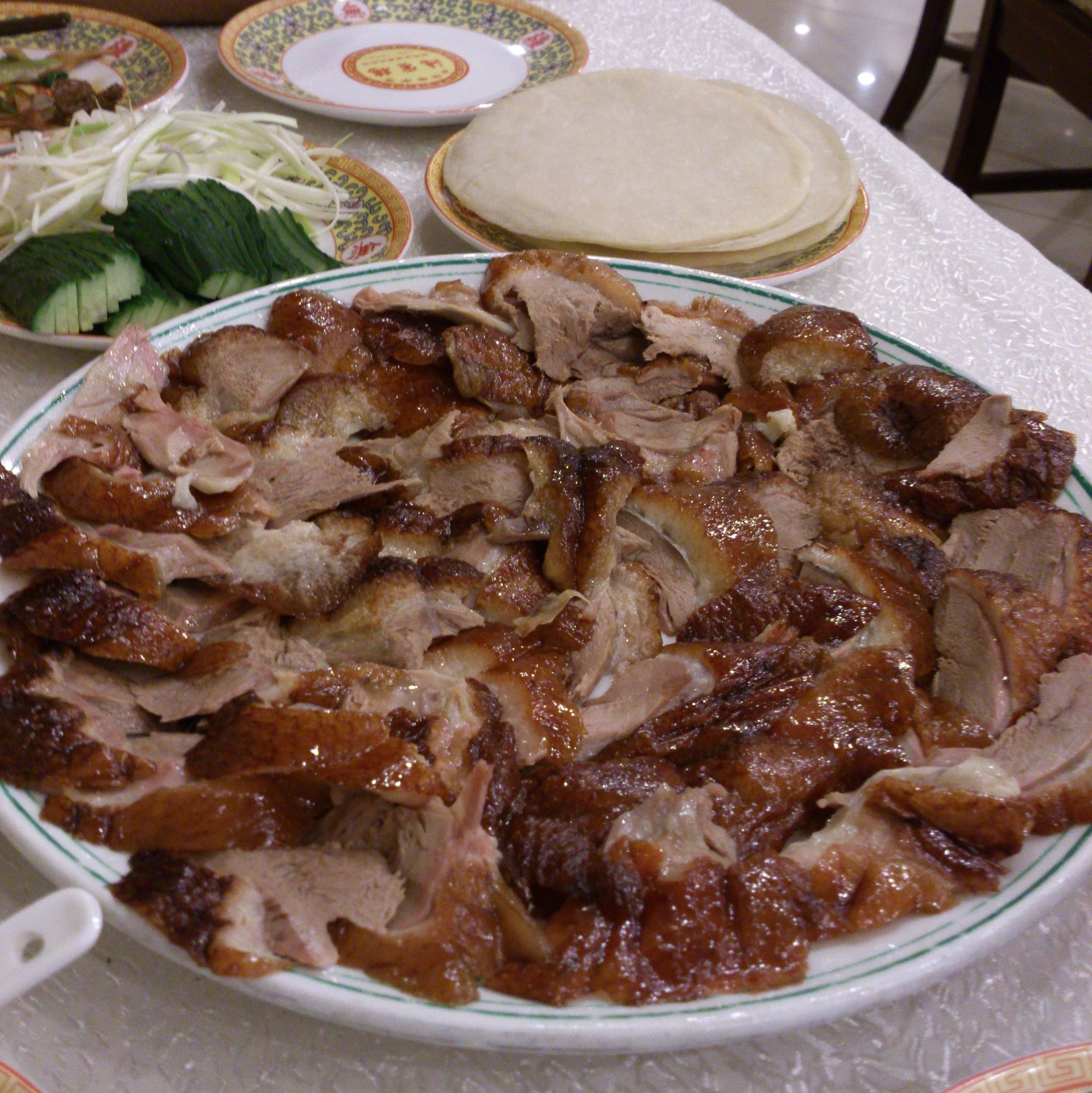
Peking duck sliced into thin pieces with glossy golden-brown crispy skin, served with thin pancakes, julienned cucumber and spring onion 1
Peking duck
北京烤鸭 · the dish the city owns

This is what Beijing is known for the world over. A specially raised duck is roasted until the skin turns a glossy mahogany, then a skilled chef carves it into more than a hundred slices in minutes, each with a sliver of crisp skin. How to eat it: dip a piece of crisp skin in sugar first, then lay duck on a thin pancake, smear on sweet bean sauce, add cucumber and spring onion, and roll it up. One dish tells the whole story of the imperial capital.

Where: Siji Minfu (四季民福 · best value, Forbidden City branch has the view) · Quanjude (全聚德 · Qianmen, since 1864) · Da Dong (大董 · premium, lean crisp skin)
Price: Siji Minfu ~¥198 (~฿990)/duck · Quanjude ~¥258 · Da Dong ¥600+/duck
Tip: Book ahead everywhere, especially dinner and weekends · one duck feeds 2–3
🍜2
Zhajiangmian
炸酱面 · Beijing's home-style noodle

If duck is the special-occasion dish, zhajiangmian is the everyday lunch that every Beijing household eats. Thick, chewy wheat noodles topped with a rich, salty sauce of fried yellow soybean paste (tianmianjiang) and minced pork, served with a generous pile of shredded raw vegetables — cucumber, bean sprouts, radish — that change with the season. Toss it all together before you eat; the fresh veg cuts through the heavy sauce. Cheap, filling, and satisfying in the most unfussy way.
Where: Fangzhuanchang 69 (方砖厂69号 · 13 toppings to choose from) · Jiuchengju (九城居 · hand-pulled) · noodle shops citywide
Price: ¥15–35 (~฿75–175)/bowl
Tip: Mix the sauce through the noodles and veg before the first bite
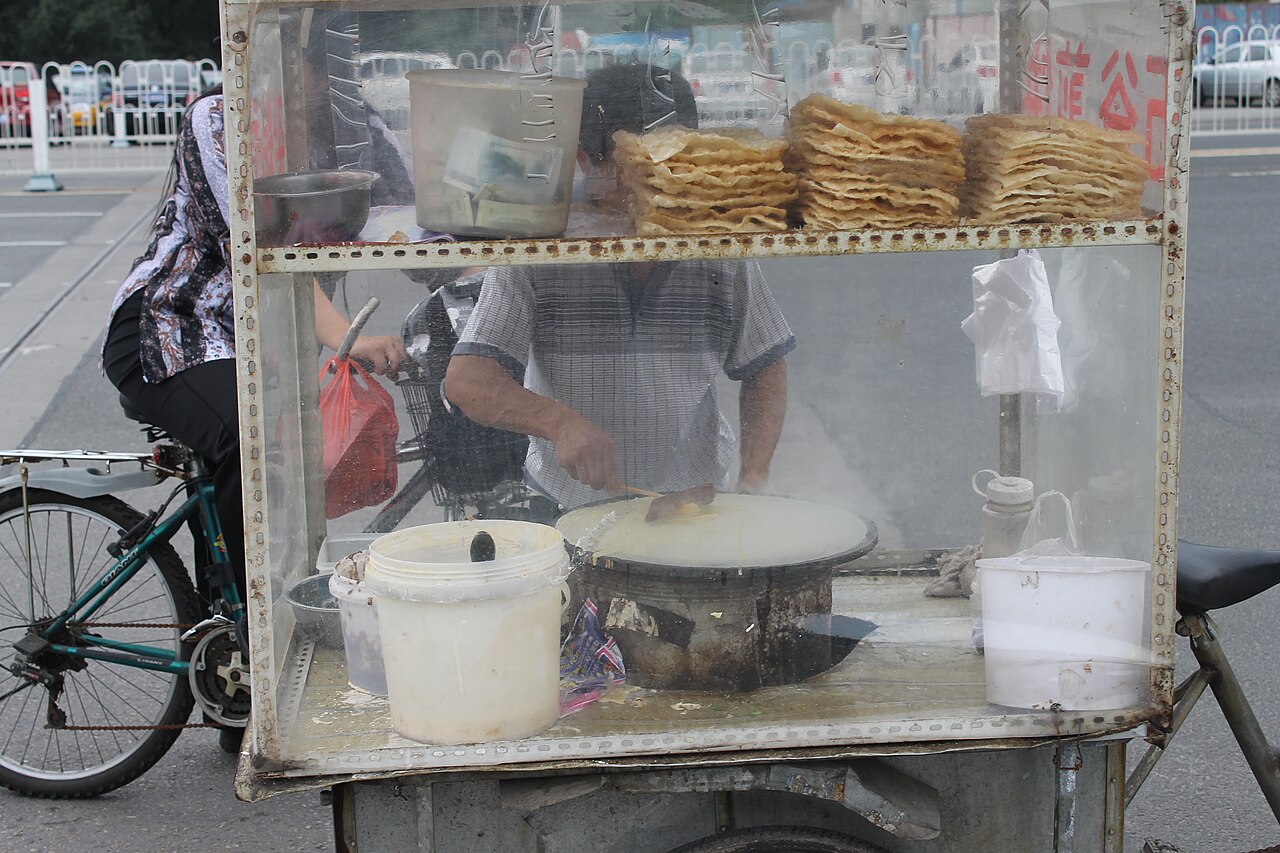
A street vendor making jianbing, spreading thin batter on a round griddle, with stacks of crispy fried crackers above the cart 3
Jianbing
煎饼 · the breakfast everyone loves

Beijing's most iconic street breakfast. A thin wheat-and-mung-bean batter is spread across a hot round griddle, an egg cracked and smeared over it, then scattered with scallions and cilantro, brushed with soybean and chili sauce, and folded around a crisp fried cracker (baocui). Your first bite hits all of it at once — soft crêpe, crunchy cracker, fragrant egg, all in one parcel. Made hot to order and handed over to eat on the move, for under ten yuan.
Where: Carts in residential lanes citywide (mornings) · near subway exits · local breakfast shops
Price: ¥8–15 (~฿40–75)/each
When: Breakfast 06:30–10:00 mainly; some carts run later
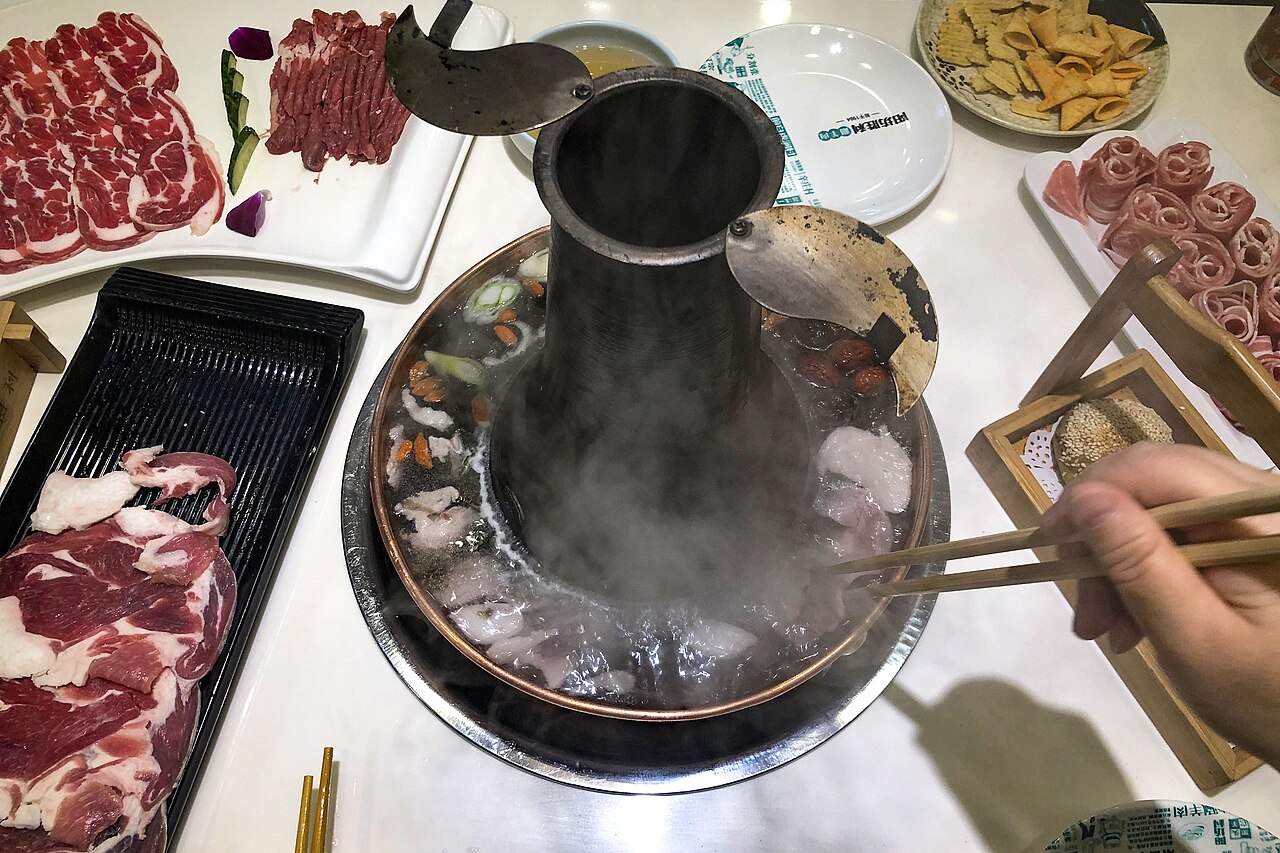
A donut-shaped copper hotpot with a central chimney steaming over charcoal, surrounded by plates of thinly sliced mutton and dipping sauce 4
Instant-boiled mutton hotpot
涮羊肉 · copper pot, clear broth, sesame dip

Real Beijing hotpot isn't the fiery red Sichuan kind — it's a donut-shaped copper pot with a central chimney heated by charcoal, holding a clear broth seasoned with little more than ginger, scallion, jujube and a few mushrooms. The star is paper-thin mutton, swished through the boiling broth for seconds until it changes colour, then dipped in a rich sesame sauce with garlic, chives and fermented tofu. Simple, warming, exactly right when Beijing turns bitterly cold — locals say late autumn into winter is the time for it.

Where: Donglaishun (东来顺 · since 1903) · Nanmen Shuanrou (南门涮肉) · Manfutang (满福楼 · real charcoal copper pots)
Price: ¥100–150 (~฿500–750)/person · hand-cut mutton ¥48–68/plate
Tip: Order the hand-cut mutton (手切) — it's more tender than the frozen machine-sliced kind
🥤5
Douzhi + jiaoquan
豆汁 + 焦圈 · an acquired taste — be warned

Let's be upfront: douzhi is a fermented mung-bean drink, greyish-green, sour and powerfully pungent. Older Beijingers adore it and have drunk it for breakfast their whole lives — but most visitors take one sip and grimace. It's sour and funky enough that plenty of people can't finish the cup. This is a flavour you genuinely have to be open-minded about. Locals drink it with jiaoquan (crisp fried dough rings) dipped in, plus salty pickles to balance it out. If you want a real taste of old Beijing, order a small cup first. Don't force it if it's not for you — and that's completely normal.

Where: Huguosi Snacks (护国寺小吃) · old-Beijing snack halls in Xicheng · local morning markets
Price: ¥3–8 (~฿15–40)/cup · jiaoquan ¥2–4/each
Heads-up: Strong and funky — order a small cup to try. Not everyone likes it
🍲6
Luzhu huoshao
卤煮火烧 · offal-and-flatbread stew, a true local classic

This is old Beijing's life story in a bowl — pork offal (intestine, lung, belly) simmered in a deep, savoury broth alongside fried tofu and thick baked flatbread (huoshao) that soaks up the soup until it's tender and dripping. Served piping hot, heavy with spice and full-flavoured. To be honest, this one is offal-forward: if you're comfortable with organ meats, you'll find a hearty, deeply satisfying dish that locals have eaten for generations. If offal isn't your thing, it probably shouldn't be your first stop.

Where: Chenji Luzhu Xiaochang (陈记卤煮小肠 · in Langfang Ertiao lane, Qianmen) · old-lane luzhu shops
Price: ¥25–40 (~฿125–200)/bowl
Good for: Anyone who enjoys offal and wants the genuine old-Beijing flavour
🥢7
Baodu
爆肚 · quick-blanched tripe with sesame sauce

An old-school Beijing street food — tripe (beef or lamb stomach) cut into bite-sized pieces and blanched in boiling water for just a few seconds, so it comes out springy and crunchy rather than chewy or tough, then dipped in a rich sesame sauce with garlic and scallion, much like the hotpot dip. The skill is all in the timing: too long and it's rubbery, too short and it's raw, so the old shops nail the seconds exactly. It goes brilliantly with a cold beer in a lane at night. A real Beijing flavour for anyone who likes offal.
Where: Baodu Feng (爆肚冯) · Baodu Man (爆肚满) · shops in the Niujie area and old lanes
Price: ¥30–60 (~฿150–300)/plate depending on the cut
Tip: Different parts of the stomach have different textures — try a few in one plate
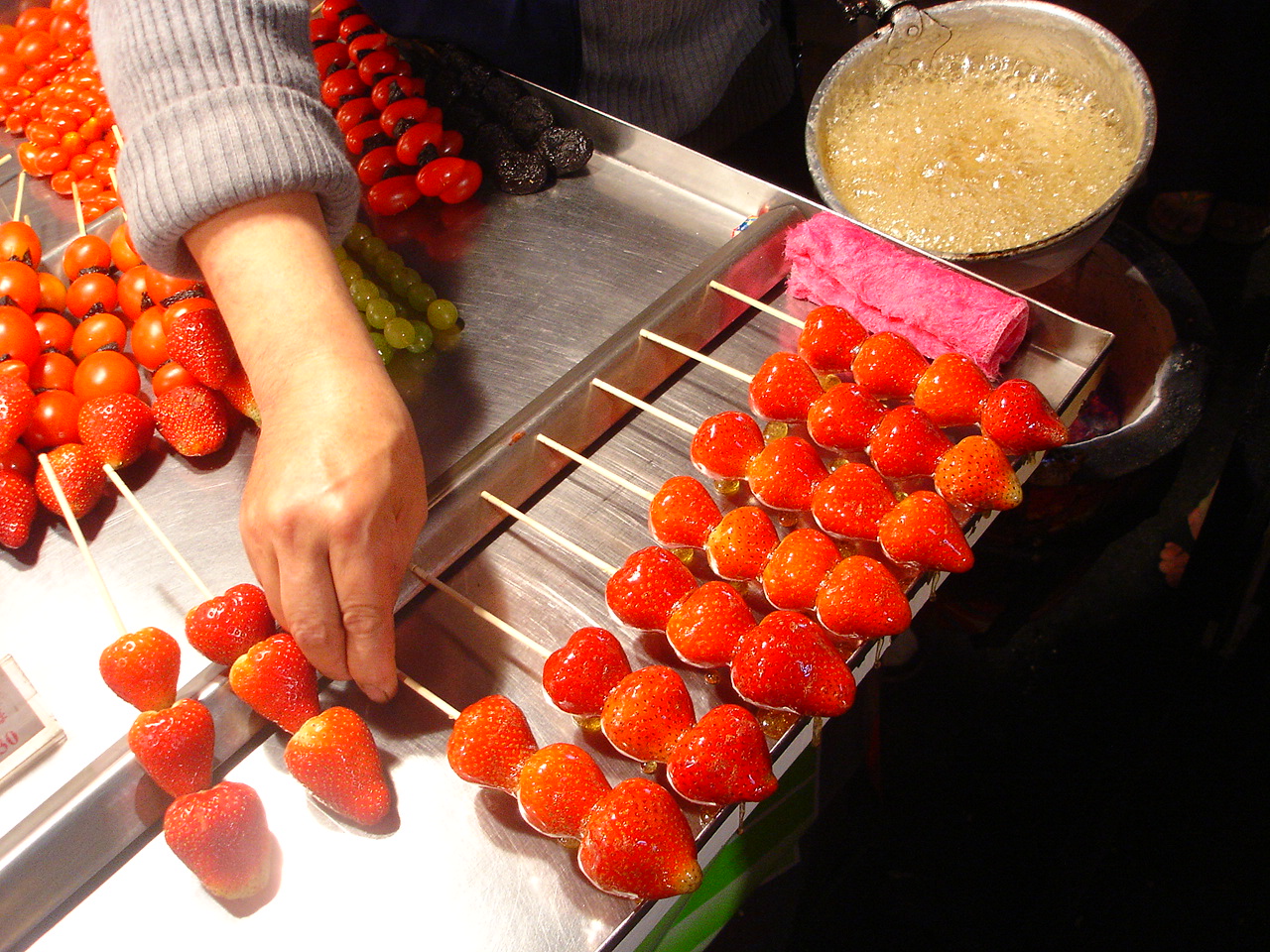
Tanghulu — fruit coated in hardened sugar on bamboo skewers lined up on a stall, including glossy red hawthorn and strawberries 8
Tanghulu
糖葫芦 · candied hawthorn, the winter street sweet

The street sweet that defines a Beijing winter — hawthorn berries (small, tart, red) threaded onto a stick and dipped in hot molten sugar that sets into a hard, clear shell. You bite through with a satisfying crack, then hit the sharp, fruity hawthorn underneath, which balances the sugar perfectly. The colder the air, the harder and crisper the candy sets. These days you'll also see strawberries, grapes and kumquats on skewers, but the classic hawthorn version is still the favourite. Look for them on street corners and at temple fairs.

Where: Carts and stalls citywide · Wangfujing Street · temple fairs around Lunar New Year · Qianmen area
Price: ¥10–20 (~฿50–100)/skewer
Season: Best in winter (Nov–Feb) when the cold sets the sugar crisp
🍡9
Old-Beijing snacks
老北京小吃 · lvdagunr + wandouhuang + aiwowo

Beijing has a roster of old palace-era snacks and sweets you rarely find done well elsewhere — lvdagunr (驴打滚, "rolling donkey"), a glutinous-rice roll filled with red bean and dusted in toasted soybean flour until golden · wandouhuang (豌豆黄), a chilled, silky-smooth pea-flour cake that's barely sweet and melts in the mouth · and aiwowo (艾窝窝), soft white glutinous-rice balls with a sweet filling. All three were once court treats, all cost a few yuan, and you can find the full set in one place at Huguosi Street.

Where: Huguosi Snacks (护国寺小吃 · the fullest set of old snacks) · Daoxiangcun (稻香村 · historic confectioner) · old-quarter snack halls
Price: ¥5–15 (~฿25–75)/item
Tip: Order a small sampler to try several in one sitting
🍚10
Chao gan
炒肝 · liver and intestine in a garlicky gravy

The name means "stir-fried liver," but it's really a thick stew of pork liver and intestine in a glossy, starch-thickened gravy that's powerfully garlicky. It's a classic Beijing breakfast, traditionally eaten with pork-filled steamed buns (baozi). The texture is silky from the starch, with soft liver and springy intestine. To be honest, this is another offal-forward dish — and the local way to eat it is to sip from the rim of the bowl, turning it as you go, no spoon. If you're fine with organ meats and a hit of garlic, this is a genuine Beijing breakfast for a few yuan.

Where: Yao Ji Chaogan (姚记炒肝 · the famous one in the Gulou area) · old-Beijing breakfast shops
Price: ¥8–20 (~฿40–100)/bowl + baozi ¥2–4/each
Good for: Anyone happy with offal who wants a true local breakfast
🥟11
Jiaozi
饺子 · boiled dumplings, the crowd-friendly pick

To round things out, a dish everyone at the table will happily eat — jiaozi, plump boiled dumplings, are a staple of northern China and Beijing. People here eat them on important occasions, especially Lunar New Year's Eve. Favourite fillings are pork and cabbage, pork with chives and egg, and beef with onion, all wrapped in hand-rolled dough and boiled until they bob to the surface. Dip them in black vinegar with a little garlic and chili oil. They're warming, filling and friendly to everyone. If you're travelling as a group and want a shared dish that pleases the whole table, jiaozi is the safe answer.

Where: Baoyuan Dumplings (宝源饺子屋 · famous for naturally coloured wrappers) · Mr Shi's Dumplings · dumpling houses citywide
Price: ¥20–50 (~฿100–250)/plate (about 10–15 pieces)
Tip: Order several fillings to share · Zhenjiang black vinegar is the best dip
Where to eat

Which area suits the mood

Beijing is huge — know what each area does well, and which lean touristy, before you set off.

Gui Jie (Ghost Street)
簋街 · Subway Line 5, Beixinqiao station

Beijing's liveliest late-night food street — more than 150 restaurants strung along one stretch, open deep into the night under rows of red lanterns. Famous for fiery mala crayfish, hotpot, frog and Sichuan-style grilled fish. The atmosphere is loud and brilliant after dark, and it's where locals actually go to eat and drink into the small hours.

Best for: Spicy crayfish · hotpot · late-night eats · Hours: 18:00–very late (many 24h)
Wangfujing Snack Street
王府井小吃街 · Subway Line 1, Wangfujing station

The most convenient, easiest-to-find snack street for visitors — tanghulu, mahua (fried dough twists), jianbing and curiosities to photograph. Honestly, this area is tourist-leaning and pricier than the back lanes, and the food isn't always as good as a neighbourhood shop. It's better for soaking up the atmosphere and taking photos than for a serious meal.

Best for: A wander · photos · tanghulu · Hours: 10:00–22:00
Qianmen & Dashilan
前门 · 大栅栏 · Subway Line 2, Qianmen station

The area just south of Tiananmen Square, where legendary old institutions sit alongside newer shops. The original Quanjude is around here, and the Langfang Ertiao lane hides veteran luzhu shops. The pedestrian street has an old-world look, making it an easy place to eat and stroll straight after visiting the Forbidden City.

Best for: Quanjude duck · luzhu in the lanes · Hours: 10:00–21:00
Huguosi Street
护国寺 · Subway Line 4/6, Ping'anli station

The single best place for genuine old-Beijing snacks. Huguosi Snacks is an institution where locals come for the heritage sweets — lvdagunr, wandouhuang, aiwowo, and douzhi for the brave. Prices are gentle and the vibe is plain and unpolished, not dressed up for tourists. This is where you get the real old-Beijing flavour without paying over the odds.

Best for: Old snacks · palace-era sweets · Hours: 09:00–20:00
The institutions

The places not to miss

Restaurants Beijingers and serious eaters have recommended for decades — put them in the plan.

1
Siji Minfu (四季民福烤鸭店)
The value roast duck people queue for · several branches

The roast-duck house serious eaters point to in the value bracket — crisp skin, juicy meat, a whole duck around ¥198, less than half the price of the premium houses. The most popular branch sits at the south-east corner of the Forbidden City (Nanchizi), where the upstairs tables look out over the palace wall at sunset — pretty enough that you'll want to book. Queues form at almost every service, so arrive before opening or book ahead through an app.

Address: Several branches · famous one: 11 Nanchizi Dajie (beside the Forbidden City)
Hours: 11:00–14:30 / 17:00–21:30 · Signature: whole duck ~¥198 · booking advised
2
Quanjude (全聚德)
The legendary duck house · Qianmen · since 1864

Beijing's oldest and most famous open-oven roast-duck house, going since 1864, having served countless state guests and foreign leaders. The Qianmen branch is the original — classic surroundings, the duck carved tableside, a whole bird around ¥258. Honestly, you come here for the name and the history first; some find the flavour less remarkable than the newer rivals, but the sense of dining inside an institution is worth doing once.

Address: 30 Qianmen Dajie, Dongcheng · Subway Line 2, Qianmen station
Hours: 11:00–14:00 / 16:30–20:30 · Price: whole duck ~¥258 · booking advised
3
Da Dong (大董)
Premium roast duck · lean, crisp skin · several branches

If you want the fine-dining take on roast duck, Da Dong is the name people mention — its "super-lean" duck has glass-thin crisp skin and meat that's never greasy, plated like art in sleek, modern rooms. A whole duck starts at ¥600 and up, with seasonal dishes to order alongside. It suits a special meal, or anyone who wants to compare how a top-tier duck differs from the everyday version. Always book ahead.

Address: Several branches (Jinbao Place · Wangfujing, etc.) · central
Hours: 11:00–22:00 · Price: whole duck ¥600+ · booking essential
4
Donglaishun (东来顺)
The legendary copper-pot mutton house · since 1903

The institution of Beijing-style mutton hotpot, going since 1903 — the first name that comes to mind for an authentic copper pot. The mutton is hand-sliced thin enough to melt in the mouth, the broth clean and clear, the house sesame sauce rich. Old-world and warm, with several branches across the city, it's ideal when Beijing is cold — order hand-cut mutton, napa cabbage, glass noodles and tofu, then huddle around the copper pot until you've warmed right through.

Address: Several branches · original in the Wangfujing area
Hours: 11:00–21:30 · Price: ~¥120–180/person · hand-cut mutton ¥48–68/plate
5
Huguosi Snacks (护国寺小吃)
The fullest set of old-Beijing snacks · Xicheng

If you want to try a spread of old-Beijing snacks in one sitting without hunting shop to shop, Huguosi Snacks is the answer — a veteran snack hall that has everything, from lvdagunr, wandouhuang and aiwowo to jianbing and douzhi for the brave. Order at the counter and eat in. Prices are gentle, the room is plain and full of locals, and it gives you the real old-Beijing flavour without anything dressed up for tourists.

Address: 93 Huguosi Dajie, Xicheng · Subway Line 4/6, Ping'anli station
Hours: 06:30–20:00 · Signature: full set of old snacks ¥5–15/item · WeChat Pay / Alipay
Frequently asked

FAQ · what people ask before they go eating

How much does a meal in Beijing cost?
Beijing works on any budget. A street breakfast (jianbing, or chao gan with a steamed bun) runs ¥8–20 (~฿40–100). A bowl of zhajiangmian or a plate of boiled dumplings is ¥15–35. Street snacks like tanghulu or baodu are ¥10–30 per skewer or plate. A sit-down local restaurant is ¥50–100 per person. A whole roast duck at a mid-range place like Siji Minfu is ¥198 (~฿990); a premium duck at Da Dong starts around ¥600. Copper-pot mutton hotpot is ¥100–150 per person.
Where should I eat Peking duck in Beijing?
Three tiers people recommend: Siji Minfu (四季民福) is the best value and always has a queue — its branch beside the Forbidden City has a fine view, with a whole duck around ¥198. Quanjude (全聚德) is the historic name at Qianmen, open since 1864, oven-roasted duck around ¥258 (you go for the heritage; some find the flavour less impressive than newer rivals). Da Dong (大董) is the premium, lean-skin version from ¥600 up. Book ahead at all three, especially for dinner and weekends.
What is douzhi, and why the warning that it's an acquired taste?
Douzhi is a fermented mung-bean drink, a breakfast staple that older Beijingers genuinely love. It's sour, funky and strong-smelling — most visitors find it pungent and hard to finish on the first sip. To be honest, this is a flavour you have to be open-minded about. Locals drink it with jiaoquan (crisp fried dough rings) dipped in, plus salty pickles to balance it. If you want to try it, order a small cup first — not everyone likes it, and that's completely normal.
Do Beijing restaurants take credit cards, or do I need cash?
Street stalls and small shops mostly take only WeChat Pay or Alipay — many accept no cash and no foreign cards. Download Alipay or WeChat Pay before you arrive and link an overseas card (Visa/Mastercard work through the tourist mode). Roast-duck houses and mid-to-upper sit-down restaurants generally accept foreign credit cards, but for street food you'll want a Chinese payment app on your phone.
Where do I find Beijing street food?
Gui Jie (簋街, Ghost Street) near Beixinqiao station runs late into the night and is famous for spicy crayfish and hotpot. Wangfujing Snack Street is convenient but tourist-leaning and pricier than other areas. Qianmen and Dashilan mix old institutions with newer shops. Huguosi Street is the place for genuine old-Beijing snacks — lvdagunr, wandouhuang and aiwowo all in one spot. Honestly, some tourist streets are overpriced and not as good as the back-lane shops — picking a place where locals are queueing is the safer bet.
How do you eat Peking duck properly?
The chef carves the duck at the table into thin slices, each with a sliver of crisp skin. Start by dipping a piece of crisp skin in sugar to taste it on its own. Then lay a thin pancake on your plate, smear on sweet bean sauce (tianmianjiang), add duck, julienned cucumber and slivers of spring onion, and roll it up to eat in one bite. Many restaurants serve the leftover carcass as a duck-and-napa-cabbage soup to finish.
Klook · food tour

Beijing Food Tour — the right shops, with someone who knows

A Beijing food tour with a local guide who walks you through the old lanes — old-Beijing snacks, street eats, and a famous roast-duck house — so you can taste it all without worrying about the language or paying.

See Beijing food tours on Klook →
Wherebest is a Klook affiliate partner — we may earn a commission when you book through our link, at no extra cost to you.