Home Zhangjiajie China Zhangjiajie Hotels About
Home  ›  China  ›  Zhangjiajie  ›  Tujia Cuisine
🇨🇳 Zhangjiajie Tujia Cuisine · 2026

Tujia Mountain Food
8 smoked & fermented dishes

High in the cold Xiangxi mountains, with no fridge in the old days, the Tujia preserved their food with smoke and fermentation — pork belly hung over the fire-pit until deeply smoky, fish and pork buried in rice bran until pleasantly sour, smoked blood tofu, and rare rock fungus prised from the cliffs of Wulingyuan. This is the real mountain table — more than the famous three-in-one pot can tell.

Why try the Tujia kitchen

A mountain flavour born ofsmoke and fermentation

Honestly, most people come to Zhangjiajie for the Avatar mountains and the glass bridge, eat the three-in-one pot (三下锅) and call it done — and miss a kitchen with much deeper roots. Zhangjiajie sits in the Xiangxi region (湘西) of northwest Hunan, home to the Tujia people (土家族) and the Miao. The food is therefore Hunan-style: fragrant-hot and sour (香辣/酸辣), not the tongue-numbing málà of Sichuan, and a world away from gentle Cantonese cooking. But what really defines the Tujia kitchen is mountain preservation — smoking, fermenting and foraging.

Picture a mountain village where winter is long and hard, and where, before electricity or refrigeration, families had to make their meat and fish last across the seasons. The Tujia answer was to hang the meat over the fire-pit to be cured by woodsmoke, turning it into la-rou, and to ferment fish and pork in rice bran for a long-keeping sour flavour. So the sour-and-smoky taste in a Tujia dish today isn't just about deliciousness — it's mountain survival wisdom, passed down until it became the local palate. We picked the 8 dishes and regional foods that tell the Tujia story best, from smoked pork to translucent kudzu jelly.

The dishes

8 Tujia dishes that taste of Xiangxi

From the smoked pork every mountain household hangs, to the pounded glutinous-rice cake of festival days.
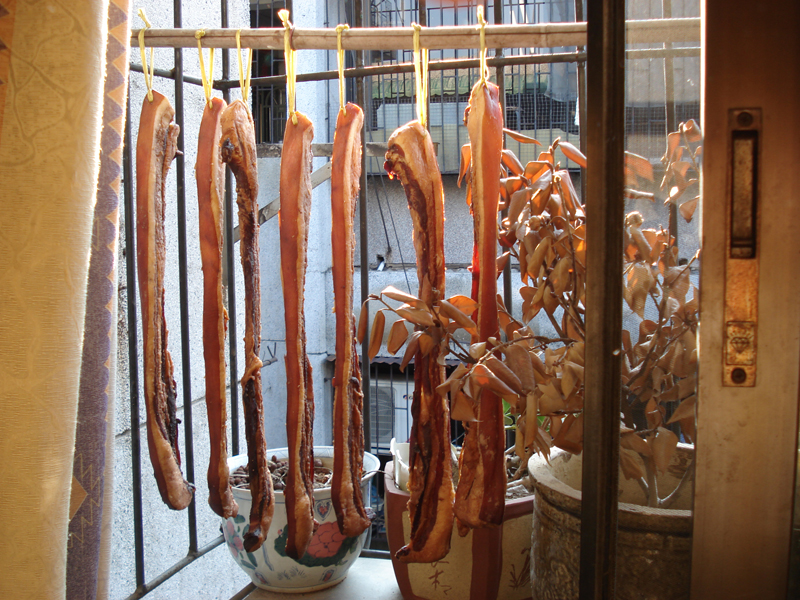
Long strips of smoked cured la-rou pork belly in reddish-brown colour, hung to cure by a mountain home window 1
Tujia La-rou
土家腊肉 · pork salt-cured and smoked over the fire-pit

This is the cornerstone of the Tujia kitchen and the very image of mountain food preservation. Villagers rub pork belly (and sausage, chicken and fish) with salt and seasonings, then hang it over the household fire-pit so woodsmoke cures it continuously for weeks or even months. The smoke slowly drives out the moisture until the meat is dense, deep reddish-brown, and carries a woodsmoke aroma all the way through. It's usually sliced thin and stir-fried with garlic stems, dried chilli or mountain vegetables — a fine balance of salt, smoke and fat, and one of the flavours Zhangjiajie locals are most attached to.

Where: Tujia restaurants in town · Dayong Fucheng · farmhouse spots near the park
Price: ¥38–68 (฿190–340) a plate (stir-fried with garlic stems or veg)
Tip: order it with garlic stems to cut the richness · best with hot rice
🐟2
Sour Fish
酸鱼 · fish fermented in rice bran for months

Another piece of Tujia preservation wisdom — fresh freshwater fish is coated in toasted rice bran (糟) and fermented in a sealed jar for months until it turns naturally sour. It's often made in summer because it keeps for ages without any need for cold. To serve, it's fried or stir-fried in local tea-seed oil: the taste leads with sour, then salt and the toasty fragrance of the rice bran, with firm flesh and no fishy smell. Anyone who enjoys fermented-sour flavours — the same idea as much of Southeast Asia's preserved fish — will take to it more easily than they'd expect.

Where: Tujia restaurants · farmhouse kitchens (土菜馆) · Dayong Fucheng
Price: ¥45–75 (฿225–375) a plate
Tip: start with a small bite · if you like the sour tang you'll reorder
🥓3
Sour Pork
酸肉 · pork belly fermented in rice bran until tangy

The sister dish to sour fish, made with pork instead — the Tujia coat cut pork belly in rice bran and salt and ferment it in a jar until sour, so it keeps right through the winter. To eat, it's stir-fried until fragrant, and the flavour is tangy and salty with a touch of fat and the scent of rice bran. The sourness cuts the richness of the pork belly just right, and it's wonderful with plain rice. Together with sour fish, this is the dish that best explains the Tujia fermenting kitchen — not loud or fiery, but a deep flavour drawn out by time.

Where: Tujia restaurants · farmhouse spots near the park · Dayong Fucheng
Price: ¥45–75 (฿225–375) a plate
Tip: eat it with white rice · the sour cuts the fat, good if you're tired of rich food
🧀4
Blood Tofu
血豆腐 · tofu mixed with pig blood, smoked and dried

The name may give you pause, but this is everyday home food the Tujia have made for generations — mashed tofu mixed with pig blood and seasonings, shaped into blocks and then smoked over the fire-pit or air-dried just like la-rou, until you have a dense, dark block. Sliced and stir-fried with la-rou, garlic stems and chilli, it turns smoky, savoury and pleasantly chewy, with none of the off-putting smell you might fear. It's another clever Tujia way to waste nothing and turn it into a long-keeping side dish — give it one open-minded bite and the mountain kitchen makes sense.

Where: Tujia restaurants · farmhouse spots · usually stir-fried with la-rou
Price: ¥25–40 (฿125–200) a plate
Tip: order it stir-fried with la-rou · try one bite before you judge
🍲5
Rock Fungus
岩耳 · rare cliff lichen of Wulingyuan

This is the finest foraged delicacy in all of Zhangjiajie — yan'er (岩耳), or cliff "ear fungus", is a black lichen that grows on damp sandstone cliffs in the Wulingyuan area, named for its ear-like shape. It genuinely is pricey and rare, because harvesting it means climbing high cliffs to prise off one piece at a time, gathering only a little each trip. The Tujia usually stew it in soup with free-range chicken or duck, drawing a deep, fragrant broth and a slippery, crunchy texture. On a menu it costs noticeably more than ordinary plates — but it's a true taste of the mountains that's hard to find elsewhere, and worth trying once if the budget stretches.

Where: Tujia restaurants that do foraged food · specialist spots in town
Price: ¥120–280 (฿600–1,400) a pot (the splurge item)
Tip: ask the price first · it's a shared pot, one is enough for the table
🫘6
Hezha
合渣 · soybean mash simmered with wild greens

If la-rou is the heavy side of the Tujia kitchen, hezha is the warmest and lightest — finely ground soybeans simmered with foraged or chopped leafy greens until the pot turns thick and smooth, with some families adding a little chilli for a fragrant kick. The flavour is creamy from the soybeans, fresh with greens, and comforting. The Tujia have eaten hezha as an everyday staple forever — there's even a local saying that a day without hezha leaves you unsettled, which tells you just how much it's the mountain people's comfort food. Order it as a pot in the middle of the table for everyone to share.

Where: Tujia restaurants · farmhouse spots · Dayong Fucheng
Price: ¥20–35 (฿100–175) a pot (shares the whole table)
Tip: a light dish to balance the rich ones · good for non-spicy eaters
🍠7
Kudzu
葛根 · mountain kudzu root, jelly and health snacks

Gegen (葛根) is the root of a vine that grows in the mountain forests; the Tujia dig it up and grind it into a powder that becomes several things. The most popular is to stir the kudzu powder into hot water until it sets into a translucent jelly, drizzled with sugar or honey — smooth, cool and refreshing. Some places sell it as kudzu cakes or tea. In Chinese tradition kudzu is considered a cooling tonic, so it's sold everywhere around the park gates as powder, jelly and health snacks. It's a regional food you can take home as a gift, and a gentle sweet note quite unlike ordinary desserts.

Where: stalls around the park gates · markets in town · souvenir shops
Price: ¥10–30 (฿50–150) a cup or bag of powder
When: sold all year · the powder makes a good take-home gift
🍚8
Ciba
糍粑 · pounded glutinous-rice cakes, grilled or fried

A regional food tied to Tujia festivals to finish — ciba (糍粑) is steamed glutinous rice pounded in a mortar until smooth and sticky, then shaped into round cakes. By tradition it's pounded around New Year and big celebrations, the whole village taking turns at the pestle. To eat, it's grilled over the fire-pit until the surface puffs and crisps, or fried golden, then dipped in sugar or ground peanuts; the inside turns chewy and stretchy, fragrant with glutinous rice. Hot off the fire it's lovely, and you'll find it at snack stalls around the park and in town — the warm street snack that suits the cool mountain air best.

Where: snack stalls around the park · food streets in town · Dayong Fucheng
Price: ¥8–20 (฿40–100) a piece or bag
When: sold all year · pounded most around New Year and festivals
A taste note: look closely and you'll see many Tujia dishes are "stir-fried together" on the fragrance of la-rou — smoked pork, blood tofu, garlic stems and mountain greens often hit the same wok, because this is how the mountains cook: take what's been preserved and turn it into one delicious meal. If you don't eat spicy, just tell the kitchen 微辣 (mild) or 不要辣 (no chilli) — the smoke and the ferment will all still be there.
Eat all of Zhangjiajie

Read on for Zhangjiajie's other dishes

Tujia food is only one part — Zhangjiajie also has its legendary three-in-one pot, bold Hunan plates and street eats waiting.

Where to eat

Where to go for a real Tujia kitchen

The best Tujia food usually isn't in a tourist restaurant — know what each area does best.

Dayong Fucheng
大庸府城 · food-culture block in central Zhangjiajie city

Dayong Fucheng is a culture block that gathers Tujia restaurants and regional foods in one place — la-rou, sour fish, hezha, and snacks like ciba all here. It's an easy start for visitors who want to taste several things in one outing, and it's set up for grazing. It leans touristy, but it's a convenient base to begin from.

Best for: la-rou · hezha · ciba · assorted regional food · When: 11:00–22:00
Farmhouse restaurants in town
土菜馆 · 农家菜 · in residential lanes, off the tourist streets

For real home-style Tujia flavour at local prices, look for small farmhouse restaurants (土菜馆 / 农家菜) in residential lanes. Watch for the one with la-rou hanging in the window and locals filling every table — that's the sign it's good and won't cost much. These places do sour pork, sour fish and stir-fried la-rou with more punch than the spots in the tourist quarter. Order several dishes to share for the best value.

Best for: stir-fried la-rou · sour fish/pork · blood tofu · When: lunch–dinner
Foraged-food & rock-fungus soup spots
山珍 · specialist restaurants in town doing mountain produce

If you've come specifically to try yan'er rock fungus or mountain produce, look for restaurants advertising "shanzhen" (山珍, mountain treasures). These do rock fungus stewed with free-range chicken, seasonal wild mushrooms and other foraged items that cost more than ordinary plates. Ask the price before ordering, as it's reckoned by weight and rarity. Ideal for a special meal when you want to taste the true mountain flavour once.

Best for: rock-fungus soup · seasonal wild mushrooms · stewed chicken · When: lunch–dinner
Snack stalls around Wulingyuan
武陵源 · the park gate and the pedestrian streets nearby

Honestly, the restaurants right by the Wulingyuan park gate are a tourist zone and cost more than in the city — but they're handy while you're up there, perfect for grabbing a hot grilled ciba, kudzu jelly or a snack during the day. The simple rule: eat your main, home-style meals in the city, and only convenience-eat near the park for snacks while you're actually inside.

Best for: grilled ciba · kudzu jelly · snacks · When: park opening hours
Frequently asked

FAQ · what people ask before heading out to eat

What is Tujia food, and how is it different from Sichuan or Cantonese food?
Tujia food (土家族) is the mountain cooking of the Tujia people in the Xiangxi region (湘西) of northwest Hunan, so the flavour is Hunan-style: fragrant-hot and sour (香辣/酸辣), not the tongue-numbing málà of Sichuan, and not the gentle, sweeter style of Cantonese cooking. What really defines the Tujia kitchen is preservation — smoking, fermenting and foraging. Living high in cold mountains with no refrigeration in the old days, villagers smoked meat over the fire-pit and fermented fish and pork in rice bran so it would keep across the seasons, and that sour-and-smoky character became the region's signature taste.
How is Tujia la-rou (腊肉) made, and why is it so intensely flavoured?
Tujia la-rou starts with pork belly (also sausage, chicken and fish) rubbed with salt and seasonings, then hung over the household fire-pit so woodsmoke cures it continuously for weeks or even months. The smoke and heat slowly drive out the moisture until the meat is dense, deep reddish-brown, and carries a woodsmoke aroma all the way through. It's usually sliced thin and stir-fried with garlic stems, dried chilli or mountain vegetables, giving a balance of salt, smoke and fat. It is the cornerstone of mountain food preservation and one of the flavours Zhangjiajie locals are most attached to.
What is rock fungus (岩耳), and why is it pricey and rare?
Yan'er (岩耳), or cliff "ear fungus", is a black lichen that grows on damp sandstone cliffs in the Wulingyuan area, named for its ear-like shape. It genuinely is pricey and rare, because harvesting it means climbing high cliffs to prise off one piece at a time, and you only gather a little each trip. The Tujia treat it as a top foraged delicacy, usually stewing it in soup with free-range chicken or duck for a fragrant broth and a slippery, crunchy texture. If you see it on a menu it costs noticeably more than ordinary dishes — but it's a true taste of the mountains that's hard to find anywhere else.
What do sour fish and sour pork (酸鱼/酸肉) taste like, and will I like them?
Tujia sour fish (酸鱼) and sour pork (酸肉) are made by coating fresh fish or pork in toasted rice bran (糟) and fermenting it in a sealed jar for months until it turns naturally tangy. To serve, it's fried or stir-fried in local tea-seed oil — the taste leads with sour, followed by salt and the toasty fragrance of the rice bran, without any fishy smell, and it keeps for a long time. Anyone who enjoys fermented-sour flavours will likely take to it, since the principle is similar to many Southeast Asian preserved fish and meats. Start with a small bite, and if you like the fermented tang you'll want more.
Where should you go for authentic home-style Tujia food in Zhangjiajie?
Zhangjiajie city has a food-culture block called Dayong Fucheng (大庸府城) that gathers Tujia restaurants and regional foods in one place — an easy start for visitors. But for real home-style flavour at local prices, look for small farmhouse restaurants (土菜馆 / 农家菜) with la-rou hanging in the window and locals filling the tables. The restaurants right by the Wulingyuan park gate are tourist-facing and cost more. The simple rule is to eat home-style in the city, and only convenience-eat near the park while you're actually up there. Ordering several dishes to share is the best value.
How much does a Tujia meal cost — is it expensive?
Home-style Tujia food is affordable. A plate of la-rou stir-fried with vegetables runs ¥38–68 (฿190–340), sour fish or sour pork ¥45–75 (฿225–375), a pot of hezha soybean mash ¥20–35 (฿100–175), and stir-fried blood tofu ¥25–40 (฿125–200). Rock-fungus (yan'er) soup is the splurge item — usually ¥120–280 (฿600–1,400) a pot depending on size and how much fungus goes in. Come as a group, order several dishes to share, and it works out around ¥50–90 (฿250–450) per person to eat well and taste a lot — except on a day you order the rock fungus, which pushes it up.
Klook · Zhangjiajie Tours & Trips

Zhangjiajie Tour — Avatar mountains, with a taste of Tujia food

A Zhangjiajie and Wulingyuan tour handles the tickets, glass elevators and shuttle transport for you, and many include a home-style Tujia lunch so you can try la-rou and regional dishes between sights — convenient, and no headache over the queues.

See Zhangjiajie tours on Klook →
Wherebest is a Klook affiliate partner — we may earn a commission when you book through our link, at no extra cost to you.