Home Zhangjiajie China Zhangjiajie Hotels About
Home  ›  China  ›  Zhangjiajie  ›  Hunan Spicy Food
🇨🇳 Zhangjiajie Hunan Spicy Food · 2026

Zhangjiajie Hunan Spicy Food
fragrant-hot & sour, not Sichuan numbing

Zhangjiajie sits in Hunan, the province all of China agrees eats the spiciest — fish head steamed under a blanket of chopped red chilli, beans seared until fragrant, pork stir-fried with chilli, pounded green chilli to mix into rice. The heat here is pure, drawn from fresh, dried and pickled chilli; it doesn't numb the tongue like málà, but it's more direct and heavier. If you think you handle spice, this is worth a go — and we've put the milder-ordering phrases right here.

Why eat here

Fragrant heat, sour heata different thing from Sichuan

Honestly, plenty of people come to Zhangjiajie to climb Tianmen Mountain and walk the Avatar peaks, and forget it sits in Hunan province (湖南) — the part of China most famous for eating spicy. Hunan cooking is called Xiang cuisine (湘菜), and its heat is a different story from the Sichuan food you might know. Sichuan and Chongqing food is málà (麻辣) — hot plus numbing, from Sichuan peppercorn — but Hunan is xiangla (香辣, fragrant-hot) and suanla (酸辣, sour-hot): pure heat from fresh chilli, dried chilli and pickled chilli, with no buzzing numbness, but more direct and harder-hitting.

Zhangjiajie sits in Xiangxi (湘西), the northwest corner of Hunan, so its kitchen mixes that Hunan heat with the mountain ingredients of the local Tujia people — smoked pork, freshwater fish, garden vegetables. There's a local saying that "Sichuan people fear food that isn't spicy, but Hunan people don't fear spice at all", which is to say the heat here goes all the way up. The farmhouse dishes (土菜/农家菜) of Zhangjiajie are genuinely fiery, with chilli as the star and not the supporting act. We've picked the 7 Hunan spicy-sour dishes you'll meet most often on a table here, told the story of each, and flagged how hot each one is — plus how to ask for it milder.

What kind of spicy

Hunan vs Sichuan two different burns

Before you order, know how these two kinds of heat feel different in the mouth.

湘菜 · Hunan (here in Zhangjiajie)

Xiangla + suanla — fragrant and sour heat

Pure heat from fresh chilli, dried chilli and pickled chilli, with no Sichuan peppercorn to numb the tongue. It feels direct, hot and lingering, and some dishes carry a sour note from pickled chilli and pickled vegetables. The amount of chilli can be huge — on some plates you'll see more chilli than main ingredient — so it's bold and aromatic, but your tongue doesn't go numb.

川菜 · Sichuan-Chongqing (for comparison)

Málà — heat plus numbing

Hot heat plus the tingle of Sichuan peppercorn (花椒), so your tongue buzzes and goes slightly numb, like a mild electric current. The heat comes wrapped in chilli oil and richness — this is the flavour of a Chongqing hotpot and most "mala" dishes, and it's clearly a different sensation from Hunan. If a mala hotpot has ever left your tongue numb, you won't feel that here in Zhangjiajie; you'll meet a straight, fiery heat instead.

The short version for spice-lovers: if you eat fiery Thai food happily, Hunan heat is around the same level or a notch hotter, but it's a dry, direct burn without the sour-sweet balance of, say, a tom yum, so it builds and stings faster — ease into it, get plenty of plain rice, and keep water or soy milk to hand.
The dishes

7 Hunan spicy dishes you'll meet on a Zhangjiajie table

From the bold, fragrant signature down to the pounded chilli and pickles no meal goes without.
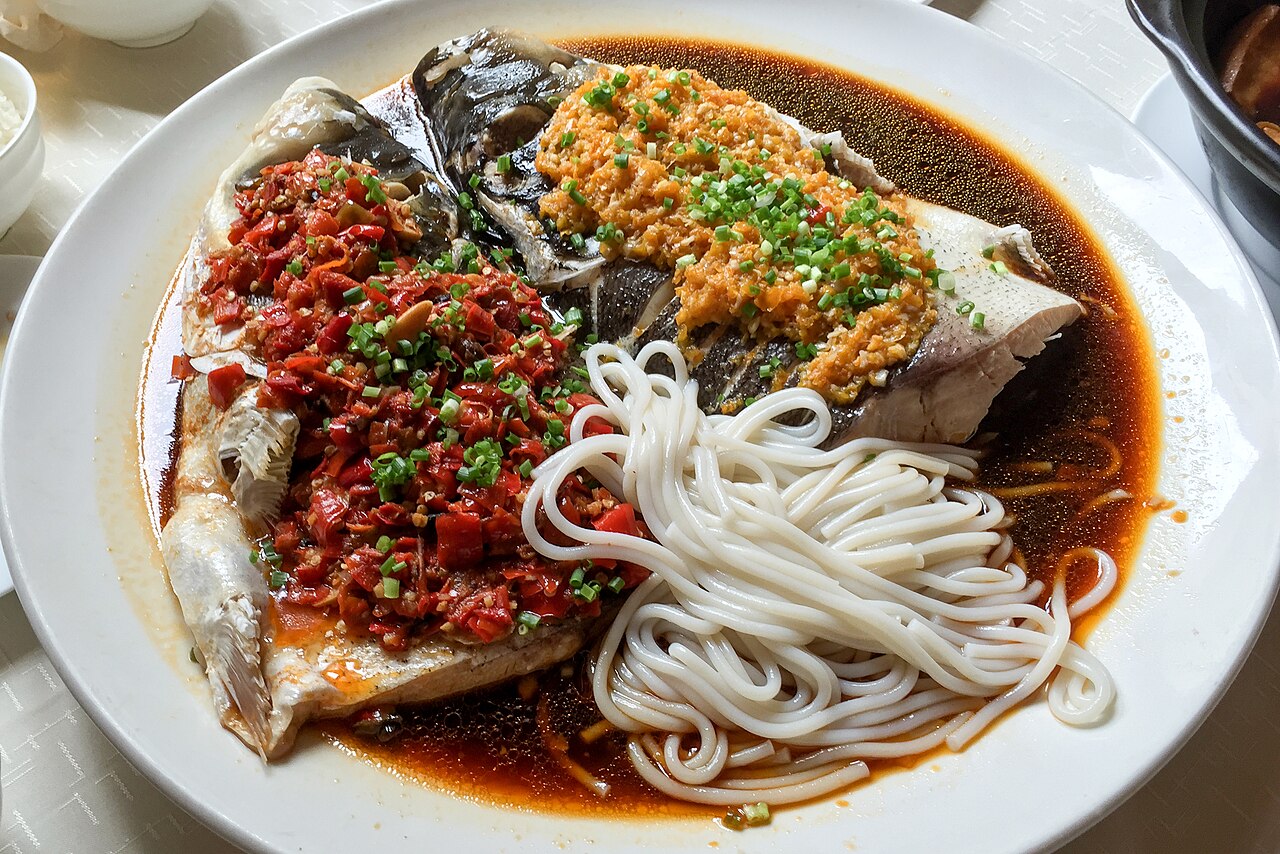
Hunan-style chopped-chilli fish head split in half, topped with chopped red chilli and yellow pickled chilli and scattered with scallion, served with a coil of white rice noodles on the plate 1
Chopped-Chilli Fish Head
剁椒鱼头 · fish head steamed under chopped red chilli

This is the signature dish of Hunan cuisine, the one everyone orders. A big-headed fish is split in half and topped with duojiao (剁椒) — fresh red chilli chopped fine and salt-cured — and some places use both red and yellow pickled chilli for two colours. It's scattered with garlic, ginger and scallion, then steamed until the flesh is just-set and springy. The sweet, fresh fish drinks up the salty, fragrant chilli; it's bold and aromatic but never numbing. The move is to order rice noodles to toss through the chilli juices at the bottom once the fish is gone. It's properly spicy — if you'd rather tone it down, ask for less chilli (少辣).

Where: Hunan farmhouse restaurants in town · Dayong Fucheng · fresh-fish places
Price: ¥58–128 (฿290–640) per head (by size, shares the table)
Heat: 🌶️🌶️🌶️ properly spicy · order noodles to finish the chilli juices
🌶️2
Pounded Green Chilli
擂辣椒 · fire-roasted chillies pounded with garlic

The simplest dish here and one of the most addictive — fresh green chillies are fire-roasted until the skins blister and char a little, then pounded in a mortar with garlic, salt and oil. Some kitchens add a roasted aubergine, or century egg (擂辣椒皮蛋). It's a standing table condiment for Hunan people, good enough to mix through a whole bowl of plain rice. The flavour is hot and fragrant from the roasted chilli, sharp with garlic, fresher and rawer than fried chilli. It's the clearest proof of how much Hunan loves chilli — even the condiment is pure chilli. Try a little over rice first; it's hotter than it looks.

Where: every farmhouse restaurant · usually served as a side
Price: ¥12–25 (฿60–125) a plate
Heat: 🌶️🌶️🌶️ fresh, raw heat · mix into rice a little at a time
🫛3
Dry-Fried Green Beans
干煸四季豆 · beans seared until wrinkled and fragrant

The gan bian (干煸, dry-frying) technique means searing over high heat with little oil until the skins of the beans wrinkle and smell toasted, then stir-frying with minced pork, dried chilli, garlic and slivers of pickled chilli. You get green beans that are crisp outside and tender within, fragrant, nicely spicy and a touch salty from black beans. It's a vegetable plate you keep going back to with rice — and one of the least spicy of the true Hunan dishes, which makes it a good starting point if you're not used to the heat. Order it alongside a fiery plate like the fish head and alternate between them.

Where: farmhouse restaurants · made-to-order places in town
Price: ¥22–38 (฿110–190) a plate
Heat: 🌶️🌶️ medium · a good plate to start with
🥘4
Farmhouse Stir-Fried Pork
农家小炒肉 · Hunan's most-ordered home-style plate

If you had to pick one dish to explain Hunan farmhouse cooking, it's this — thin-sliced pork belly stir-fried over high heat with green "vegetable" chillies (mild, sweet long peppers with a little kick), pickled chilli, garlic and black beans. It's seasoned salty and savoury, the pork has just enough fat, and the peppers come out crisp, sweet and lightly hot. Hunan people eat this with rice at just about every meal. The heat is mostly from the peppers and pickled chilli — not as extreme as the fish head, but still hotter than outsiders expect. It's easy to order, reliably delicious, and the best plate for getting through a bowl of rice.

Where: every farmhouse restaurant · Hunan restaurants in town
Price: ¥32–58 (฿160–290) a plate
Heat: 🌶️🌶️ medium · can be ordered with less chilli (少辣)
🍗5
Chilli Chicken
辣子鸡 · free-range chicken with dried chilli

Free-range chicken chopped into bite-size pieces and stir-fried over high heat with a generous pile of dried chilli, garlic, ginger and pickled chilli until the edges of the meat catch and crisp. It comes out hot, fragrant and coated in chilli oil. The Hunan version leans on fresh and pickled chilli more than the Sichuan one, which adds numbing peppercorn, so this is a straight heat without the tingle. The free-range chicken is chewy and full of flavour. It's a much-loved plate to share or eat with rice — some kitchens make it hot enough that you'll fish a few chillies out, so if you don't want it scorching, ask for less chilli (少辣) or ask how hot it is before you order.

Where: farmhouse restaurants · snack-and-beer spots · Dayong Fucheng
Price: ¥38–68 (฿190–340) a plate
Heat: 🌶️🌶️🌶️ properly spicy · lots of chilli, easy to push aside
🥬6
Pickled Vegetables & Chilli
酸菜 · 酸辣椒 · the sour pickles that cut richness

Hunan is a land of pickling — pickled mustard greens, pickled long beans, and above all pickled chilli (酸辣椒/剁辣椒), fresh chilli salt-fermented until sour, used both in cooking and as a relish. These sour pickles are the reason Hunan food has a "sour" dimension (suanla) and isn't only about heat. Stir-fried with minced pork or other meat, they make a sharp, appetite-opening sour-spicy plate; left beside a dish, they're there to cut richness. Hunan people can no more do without pickled chilli than a Thai cook can do without fish sauce and chilli. Spoon some pickle over rice between fiery plates and you'll find you can keep eating longer.

Where: comes with most meals at farmhouse places · fresh markets (to take home)
Price: ¥15–30 (฿75–150) a plate (if ordered separately)
Heat: 🌶️🌶️ sour first, heat second · helps cut the richness
🐟7
Stir-Fried River Fish
小炒鱼 · freshwater fish stir-fried with fresh chilli

Beyond the steamed fish head, Hunan cooks also take small freshwater fish, fry them until the skin crisps, then stir-fry with fresh chilli, pickled chilli, garlic and scallion. The fish comes out fragrant and firm-fleshed, with a sharp, aromatic heat; some kitchens do a sour-spicy (酸辣) version with pickled vegetables stirred in. It's slightly less fiery than the steamed fish head and very good with rice. But if you want fish with no chilli at all, order steamed-with-soy fish (清蒸鱼) instead — you'll get the sweet, fresh fish flavour on its own, which is a good palate-rest when you've ordered several spicy plates.

Where: farmhouse restaurants · fresh-fish places · streamside spots in Wulingyuan
Price: ¥45–88 (฿225–440) a plate (by weight)
Heat: 🌶️🌶️ medium · for no heat, order it steamed-with-soy
🍚+
Palate-Rest Dishes (for non-spice-eaters)
不辣的菜 · the no-chilli plates to order alongside

If you're a group and some of you can't take the heat, don't worry — Hunan restaurants always have non-spicy dishes to order alongside. The ones to know are steamed-with-soy fish (清蒸鱼), blanched or simply-fried greens (清炒时蔬), tomato-and-egg (番茄炒蛋), clear soup (例汤) and braised tofu. These are mellow, chilli-free, and let anyone who doesn't eat spice eat happily while resting everyone's palate. The trick is to order spicy and non-spicy plates roughly half and half, add plenty of plain rice, and the whole table eats well no matter how much heat each person can take.

Order: steamed fish 清蒸鱼 · fried greens 清炒时蔬 · tomato-egg 番茄炒蛋
Price: ¥18–48 (฿90–240) a plate
Heat: ⬜ no chilli · the table's palate-rest plates
A taste note: many Hunan farmhouse kitchens season to local standards, which are far spicier than most travellers are used to — even if you ask for "less spicy", it may still be hot, because chilli is the root of the food here. If you really want to play it safe, choose dishes that have no chilli to begin with, like steamed or clear-soup options, rather than trying to dial back a dish that's already fiery.
Order it milder

3 Chinese phrases to save your tongue

Can't say them? Open a translation app and show the characters — they work in any restaurant in Zhangjiajie.

微辣
wēi là
Less spicy — still some chilli, but turned down; good if you eat moderate heat.
少辣
shǎo là
Less chilli — ask for less chilli than usual; the phrase staff understand most easily.
不要辣
bú yào là
No chilli — say it plainly (or just 不辣, bù là, for "not spicy").
Extra tip: if there's chilli oil or chilli flakes on the table, order a dish "no chilli" and add your own afterwards — you'll control the level far better that way. Soy milk (豆浆), plain rice or yoghurt cool the burn better than water. And remember that "less spicy" by a Hunan cook's definition is still hotter than outsiders imagine, so leave yourself a little margin.
Eat all of Zhangjiajie

Read on for Zhangjiajie's other food

Hunan heat is only one side — Zhangjiajie also has Tujia mountain cooking, the dry "three-in-one pot", and street eats waiting.

Where to eat

Where to go for a real Hunan kitchen

Eat your main meals in the city for better, cheaper and more authentic food — restaurants in the parks are convenient but pricier. Know it before you plan.

Dayong Fucheng (food & culture block)
大庸府城 · central Zhangjiajie city

A restored food-and-culture block in the city that gathers Hunan and Tujia restaurants and snacks in one place — chopped-chilli fish head, chilli chicken, sanxiaguo and more. It leans touristy but it's an easy start, and you can walk past several places before choosing. Good atmosphere, and a fine pick for a first dinner the night you arrive.

Best for: steamed fish head · chilli chicken · sanxiaguo · When: 11:00–22:00
Huilong Road & Renmin Road
回龙路 · 人民路 · the local eating streets in town

To eat the way locals do, at local prices, head for Huilong Road and Renmin Road in the city centre — full of farmhouse restaurants (土菜馆), made-to-order places and snack-and-beer spots packed with locals. It's clearly cheaper than the parks. Look for a place that's busy and has fiery Hunan plates on display, then order several dishes to share with rice for the best value.

Best for: stir-fried pork · stir-fried fish · pounded chilli · When: lunch–late
Wulingyuan gateway town
武陵源 · the gateway to the national forest park

The small town at the park entrance is lined with tourist restaurants, handy if you're staying near here and tired from a full day of hiking. The menu covers both Hunan heat and non-spicy plates, but it's around 1.5–2 times the price of the city, and the flavours may be tuned for visitors rather than locals. Best to eat conveniently here and save the serious meals for town.

Best for: convenience after a hike · a full menu · When: lunch–dinner
Up on the mountain & in the park
在山上 · while hiking Tianmen / Yuanjiajie

Up on the peaks there are food kiosks and instant-noodle stops to refuel, but honestly the food up there is expensive and ordinary, because everything has to be hauled up. It's there to stop you going hungry rather than to chase flavour. Bring snacks, water and nibbles of your own, and save your appetite for a good plate of fiery Hunan food back down in the city.

Best for: refuelling mid-hike · instant noodles · When: park opening hours
Frequently asked

FAQ · what people ask before heading out to eat

How is Hunan spicy food different from Sichuan food?
They're clearly different. Sichuan and Chongqing food is málà (麻辣) — hot plus numbing, with the tingle coming from Sichuan peppercorn (花椒), so your tongue buzzes and goes slightly numb. Hunan food is xiangla (香辣, fragrant-hot) and suanla (酸辣, sour-hot) — pure heat from fresh chilli, dried chilli and pickled chilli, with no numbing at all, but a more direct and heavier burn. Locals joke that "Sichuan people fear food that isn't spicy, but Hunan people don't fear spice at all", meaning Hunan handles heat at every level. Zhangjiajie's farmhouse dishes are genuinely fiery, with chilli as the star rather than a garnish.
What is chopped-chilli fish head (剁椒鱼头) and why is it so good?
Chopped-chilli fish head (剁椒鱼头, duojiao yutou) is the signature dish of Hunan cuisine. A big-headed fish (usually a bighead carp) is split in half and topped with duojiao — fresh red chilli chopped fine and salt-cured — and some restaurants use both red and yellow pickled chilli. It's scattered with garlic, ginger and scallion, then steamed until the flesh is just-set and springy. The sweet, fresh fish soaks up the salty, fragrant chilli, so it's bold and aromatic but never numbing. People love ordering rice noodles to toss through the chilli juices left at the bottom of the dish. It's properly spicy, so ask for less chilli (少辣) if you'd rather tone it down.
I can handle spicy food — will Hunan food be too much?
Most people who eat a lot of chilli still find Hunan heat is its own kind. Thai-style spice usually comes balanced with sour, sweet and salty notes that cut it; Hunan food is pure heat with a genuinely large amount of chilli, and some plates have more chilli than main ingredient. The burn builds and lingers. Ease into it: order spicy plates alongside non-spicy ones (steamed soy fish, blanched greens, clear soup) to rest your palate, get plenty of plain rice, and keep water or soy milk on hand to cool down. If you're not sure, ask for it "less spicy" (微辣) or with "less chilli" (少辣) to be safe.
How do you ask for food to be less spicy?
Learn a few short Chinese phrases. "Less spicy" is wei la (微辣); "less chilli" is shao la (少辣); "no chilli" is bu yao la (不要辣) or simply bu la (不辣). If you can't say them, open a translation app and show the staff the characters 微辣 / 少辣 / 不要辣. Be honest with yourself, though: in a real Hunan farmhouse kitchen, even "less spicy" can still be hotter than outsiders expect, because chilli is the backbone of the food here. The safest option for anyone who doesn't eat spice is to order dishes that have no chilli to begin with — steamed-with-soy or clear-soup style — rather than trying to dial back a dish that's already fiery.
How much does a Hunan farmhouse meal in Zhangjiajie cost?
It's affordable if you eat in Zhangjiajie city. Chopped-chilli fish head is priced by the size of the head at ¥58–128 (฿290–640) and shares the whole table. Everyday farmhouse stir-fries (pork with chilli, dry-fried beans, chilli chicken) run ¥28–58 (฿140–290) a plate, and stir-fried or pickled vegetables ¥18–32 (฿90–160). Come as a group, order several dishes to share with rice, and it works out around ¥45–80 (฿225–400) per person to eat well. Restaurants inside Wulingyuan and up on Tianmen Mountain cost 1.5–2 times more than in the city, so it's best to eat your main meals in town and grab convenience food near the parks.
What are the pickled chilli and pounded chilli on every table?
Hunan is famous for chilli in many forms. The ones you'll see most are pickled chilli (酸辣椒/剁辣椒), fresh chilli salt-fermented until sour, used both in cooking and as a relish; and pounded green chilli (擂辣椒, leijiao), where green chillies are fire-roasted until lightly charred and fragrant, then pounded in a mortar with garlic and salt — sometimes with aubergine or century egg — and good just mixed into plain rice. Pickled chilli cuts richness and adds a sour dimension, which is the heart of Hunan's xiangla–suanla flavour. Spoon a little over rice and you'll understand why Hunan people can't do without chilli.
Klook · Zhangjiajie tours & tickets

Book Zhangjiajie tours & tickets — hike hard, then come back for Hunan heat

Make planning Zhangjiajie easier with tickets and tours on Klook — the national forest park, Tianmen Mountain and the glass bridge. Walk the peaks until you're properly hungry, then come back to chopped-chilli fish head and the farmhouse Hunan plates in town.

See Zhangjiajie tours & tickets on Klook →
Wherebest is a Klook affiliate partner — we may earn a commission when you book through our link, at no extra cost to you.