Home Xi'an China Xi'an Hotels About
Home  ›  Asia  ›  China  ›  Xi'an  ›  Getting Around
🚇 Xi'an Transport Guide · 2026

Getting Around Xi'an
Metro, DiDi, the Terracotta Bus & More

Line 2 links the Bell Tower to the South Gate in minutes, Line 14 runs straight from the airport, and a ¥7 bus takes you to the Terracotta Army. Scan Alipay at the gate — this 3,000-year-old capital is far easier to cross than you'd expect, once you know the system.

Before you go

An ancient capital you can reach by subway

Xi'an was the capital of thirteen dynasties, the start of the Silk Road, and the burial place of the Terracotta Army — yet beneath that ancient city wall runs a metro that is clean, fast and startlingly cheap. More than ten lines are now in service (Lines 1, 2, 3, 4, 5, 6, 9, 14, 15 and 16), reaching almost everything a visitor wants: the Bell Tower, the South Gate of the City Wall, the Big Wild Goose Pagoda, the airport and the high-speed-rail station.

The good news for visitors: every station has English signage, ticket machines have English menus, and you can scan an Alipay QR code at the gate without buying a ticket at all. Fares are distance-based and start at just ¥2 (about ฿10) for the first 6 km; most rides across the centre cost ¥2–4, and even the long run to the airport tops out at ¥9. Two things to know first: every entrance has a bag X-ray security check, and the last trains leave before 23:00.

This guide covers every way to get around Xi'an — the cheap, fast metro, metered taxis, DiDi for when you have luggage, bike-share, and the tourist bus 游5/306 that runs directly to the Terracotta Army. A little preparation, and nothing about this trip will slow you down.

The main event

The Metro — fast, cheap, bilingual

Your first choice for almost every journey across the city. Clean trains, English signage throughout, and fares that start at ¥2 — most central rides stay under ¥4.

Hours are roughly 06:00–23:00, though this varies by line and terminus, and last trains on the longer lines leave earlier — check the timetable at the station before a late return. Fares are distance-based: ¥2 for the first 6 km, ¥3 for 6–10 km, ¥4 for 10–14 km, rising to about ¥9 for the longest routes such as the airport run (¥1 ≈ ฿5 — almost every in-city ride costs under ฿20).
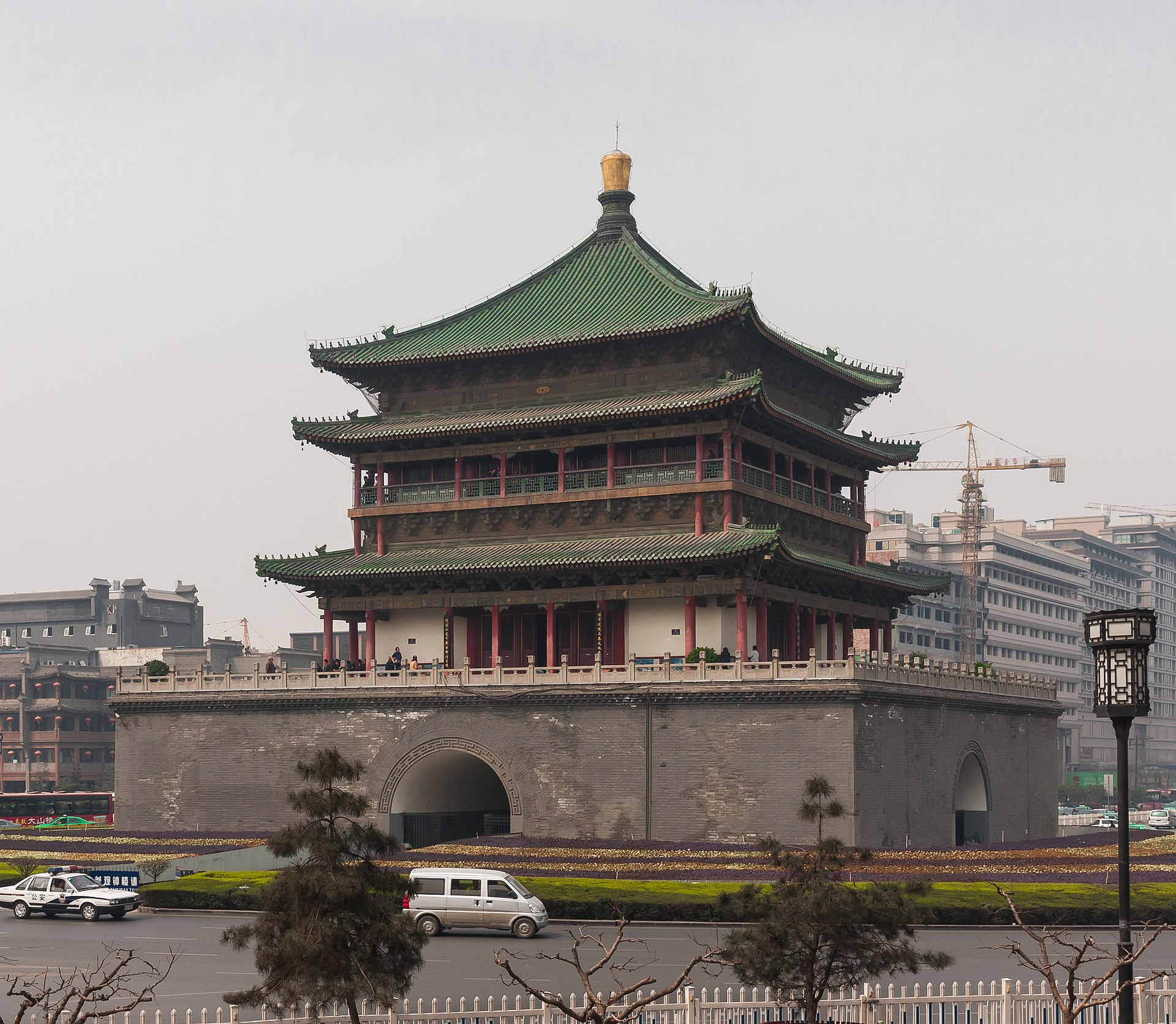
The Bell Tower (钟楼) at the heart of old Xi'an — the most-used metro interchange for visitors, on Line 2
Bell Tower station on Line 2 brings you up directly beneath the Bell Tower in the heart of the old city — a few minutes' walk from the Muslim Quarter and its food streets.
Key lines

Routes visitors use most

Line Route Key stops
Line 2 (red · the spine) North ↔ south through the centre Bell Tower (钟楼) · South Gate / Yongningmen (永宁门) · Xiaozhai · Xi'an North Railway Station (北客站)
Line 3 (purple) Southwest ↔ northeast Muslim Quarter area · Big Wild Goose Pagoda (大雁塔 Dayanta) · Tonghuamen
Line 4 North ↔ south (east side) Big Wild Goose Pagoda (Dayanta) · Xi'an North Railway Station (北客站) · Datang Everbright City
Line 1 West ↔ east Links the eastern and western districts · change to Line 2 at Beidajie
Line 14 (airport line) Airport XIY ↔ Xi'an North Xianyang Airport (XIY) · Xi'an North Railway Station (北客站) — change to Line 2/4 for the centre
Bus 游5 / 306 Xi'an Railway Station (old) ↔ Terracotta Army East Square, Xi'an Railway Station · Terracotta Army Museum · Huaqing Palace
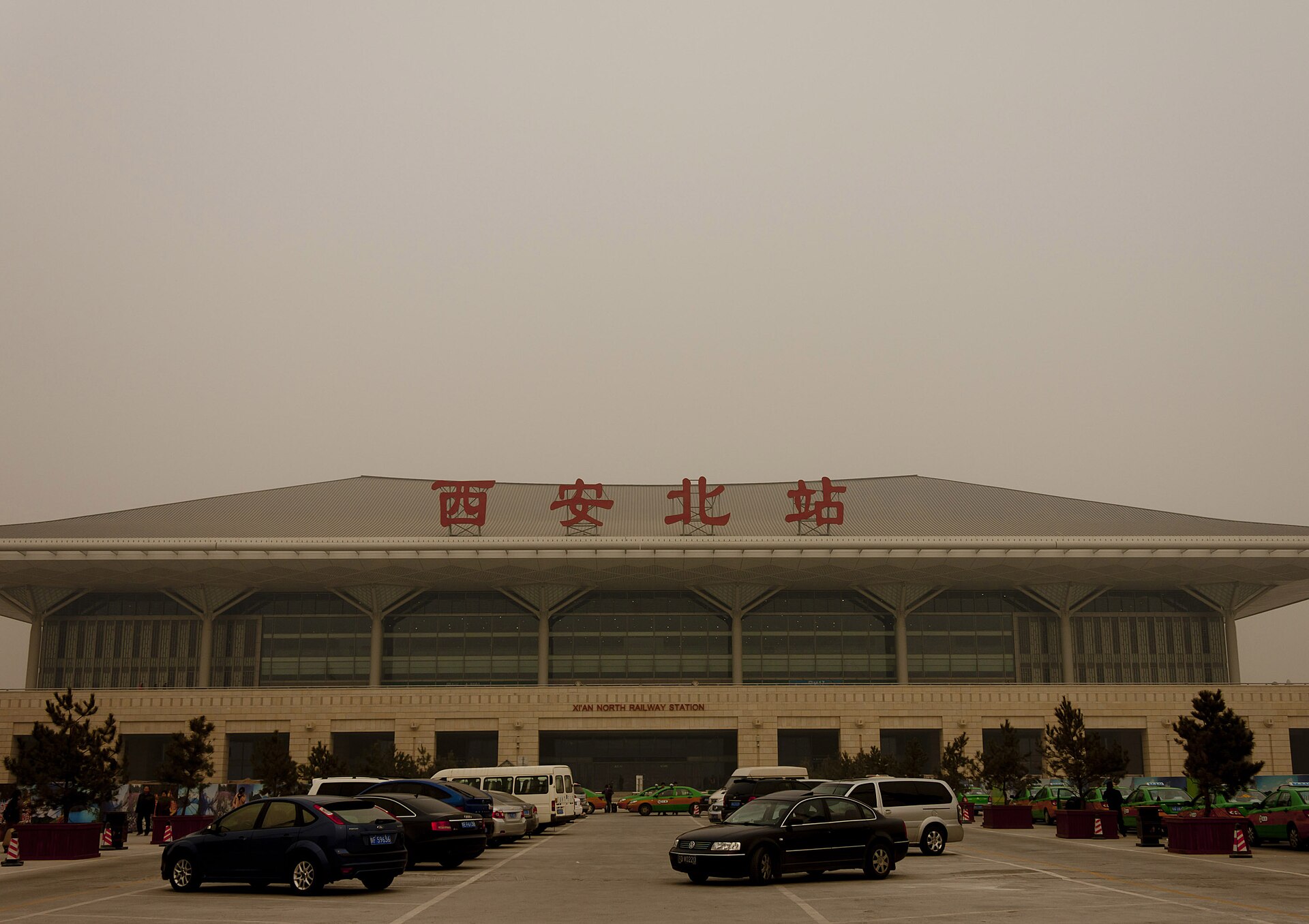
Don't confuse the two railway stations: Xi'an has two similarly named stations. Xi'an North (西安北 / 北客站) is the high-speed-rail hub for Huashan, Luoyang, Beijing and Chengdu, served by Lines 2, 4 and 14. Xi'an Railway Station (西安站, the old central one) is where you catch the bus to the Terracotta Army. If you're taking a train out of the city, head to the North station — see the China high-speed rail guide.
Paying for the metro

Four ways to pay — pick what suits you

📱
Alipay QR

Easiest for visitors. Open Alipay, tap Metro or Transport, scan at the gate. No token, no card. Set this up before you travel.

💬
WeChat Pay

Same concept via a WeChat mini-program. Open WeChat, find the Xi'an Metro mini-program, scan at the gate. Works on all lines.

🎫
Single-journey token

Buy from machines in every station. English menus, takes coins and notes. A good fallback if Alipay isn't set up yet.

💳
Chang'an Tong card

A rechargeable card (长安通) valid on the metro and buses, with a 50% bus discount and 10% off metro fares. Buy and top up at station windows.

Honest summary: Alipay is worth setting up even if the metro is your only reason, because it also handles taxis, DiDi, the food stalls in the Muslim Quarter, and nearly every shop in the city. Read the step-by-step setup for foreign cards in the Alipay & WeChat Pay guide before you travel.

Other options

Taxis, DiDi, the Terracotta Bus and Bike-Share

🚕
Metered Taxis
出租车 · always on the meter

Xi'an taxis are metered, with a flag-fall of around ¥9–10 for the first 3 km, then roughly ¥2–2.4 per km after that — noticeably cheaper than big cities like Shanghai. Traffic in the old-city core around the Bell Tower gets heavy, so fares climb during congestion as the waiting charge ticks up. A small late-night surcharge applies.

The one practical tip that makes taxis work: have your destination written in Chinese characters. Most drivers speak little or no English. A hotel business card, or a Google Translate screenshot of the address in Chinese, sorts this every time.

Sample fares: Bell Tower → Big Wild Goose Pagoda ~¥20–28 · Airport → city ~¥120–150
Payment: Cash · Alipay · WeChat Pay (varies by car)
Note: No surge pricing — the meter is the meter
🚗
DiDi — China's ride-hail
滴滴出行 · English app, Alipay payment

DiDi is the dominant ride-hail app in China, with an English-language interface. Type your destination in English or Chinese; the app locates it and shows a fare estimate before you confirm. Payment links directly to Alipay. DiDi is the right call when the metro has closed for the night, when you have luggage, or when your route needs several line changes.

In Xi'an, DiDi is especially good value when you're travelling as a group or with bags — for example, from the centre out to the Terracotta Army (about 40 km), split between a few people it can beat a private tour. Travelling solo, though, the ¥7 bus 游5 is still the cheapest option.

DiDi: Download the app and link Alipay before travelling
Best for: Late nights · luggage · groups · routes off the metro lines
Fares: Shown in-app before you confirm — no haggling
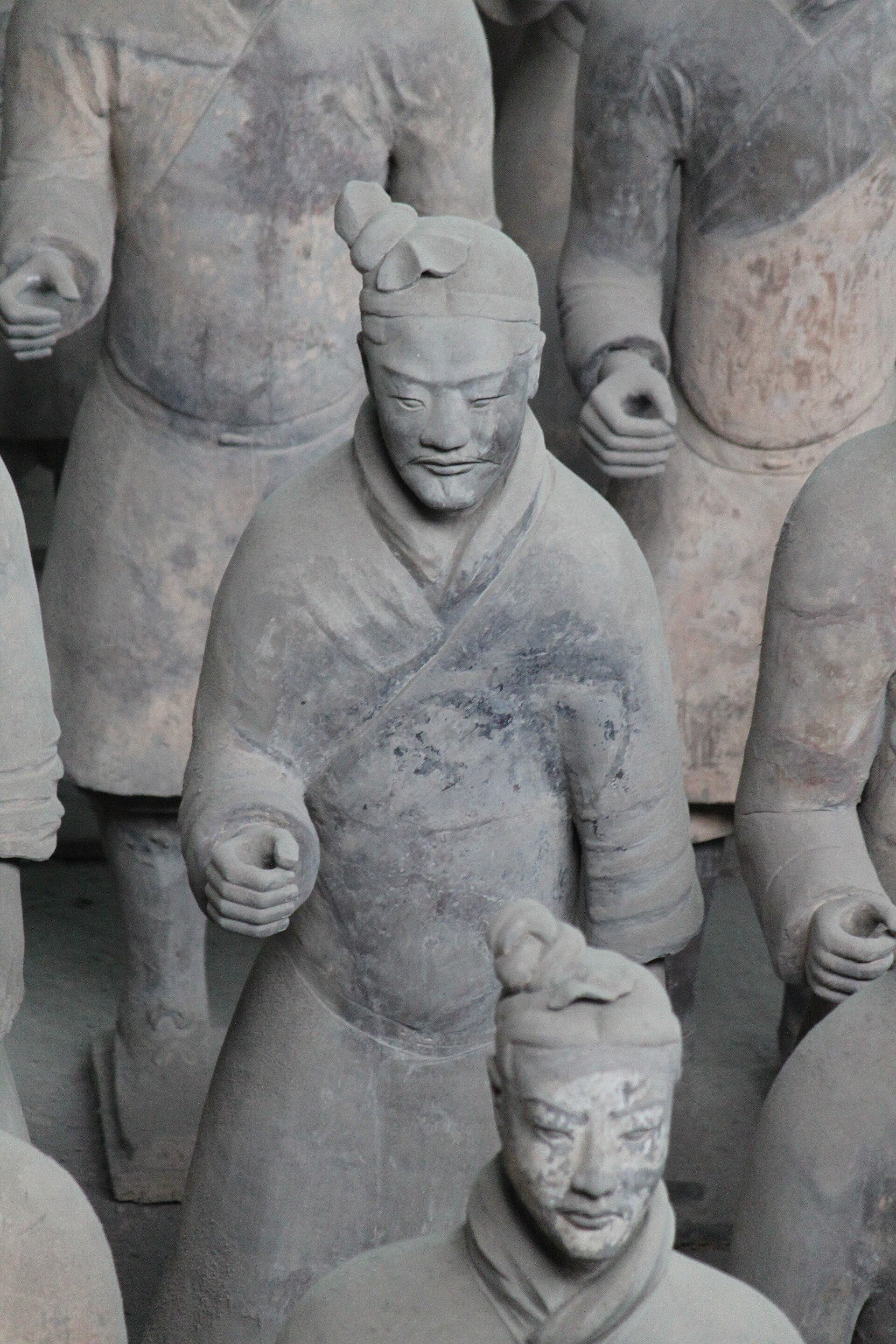
The Terracotta Army, Xi'an — ranks of clay warriors in Pit 1, the destination of tourist bus 游5/306 Bus 游5 / 306
The Terracotta Army Bus
游5 (306) · ¥7, direct to the warriors

The cheapest and most direct way to the Terracotta Army is tourist bus 游5 (route number 306), which departs from the East Square of Xi'an Railway Station. The fare is ¥7 each way, the trip takes about 1–1.5 hours, and buses run frequently from 08:00 to 19:00. No advance booking — just board, sit down, and someone will collect the cash fare on board. The same route also stops at Huaqing Palace along the way.

A real warning: fake 306 buses and touts operate here, steering visitors onto pricier services. The genuine service has nobody soliciting passengers — if someone approaches you, walk past them to the official 游5 sign at the East Square.

Fare: ¥7 each way (cash, paid on board)
Catch it at: East Square, Xi'an Railway Station (the old station, not Xi'an North)
Hours: 08:00–19:00 · ~1–1.5 hr · beware fake buses
🚲
Bike-Share & Cycling the Wall
共享单车 · for short hops

Xi'an is covered with QR-code bike-share (yellow Meituan, blue HelloBike), unlocked through Alipay or WeChat for around ¥1.5 per 15–30 minutes. It's handy for short hops across the flat old town, but you'll need a Chinese-linked account first, and some apps ask for a deposit — check before you ride.

The highlight not to miss: renting a bicycle to ride along the top of the ancient City Wall. The wall runs 13.7 km around the old city, with its own rental stands up on the rampart (about ¥45 for 2 hours, separate from the street bike-share) — a view of the city you can't get anywhere else. Details in the Xi'an City Wall guide.

Street bike-share: ~¥1.5 per 15–30 min · unlock via Alipay/WeChat
Cycling the wall: ~¥45 per 2 hr (rented on the wall itself, separate)
Note: Some apps need a Chinese account or deposit — check first
Navigation

Which map app actually works in Xi'an

This matters more than people expect. Google Maps' public-transit data for mainland China is unreliable — even with a VPN, route guidance for the metro and buses is frequently wrong or simply absent. Two apps give accurate, real-time transit directions without any workaround:

🗺️
Amap (Gaode / 高德地图)
The app most Chinese residents use

Amap has accurate, live data for every metro line, bus route and intercity train in China. You can search destinations in English; the transit planner gives step-by-step directions, right down to which exit to use. Download it from the App Store or Play Store before you arrive — no VPN required to use it.

Tip: Download before departure. Some app stores in China require a VPN to access.
🍎
Apple Maps
iPhone users already have this

Apple Maps in China uses Amap's data as its backend, which means its transit directions for the Xi'an metro are accurate. If you have an iPhone, this is the path of least resistance — no extra app, no VPN, and it integrates with your existing Maps workflow.

Android note: Google Maps transit doesn't work well in China — install Amap instead.

If you want LINE, Instagram, Gmail or full Google Maps while in China, you'll need a VPN installed and tested before you fly — most VPN websites are blocked once you're inside the country. See the full breakdown in the China internet, VPN and eSIM guide.

Xi'an North Railway Station (北客站) — the high-speed-rail hub and metro interchange for Lines 2, 4 and 14
Xi'an North Railway Station — the high-speed-rail hub for Huashan, Luoyang and Beijing, where Line 14 runs straight to the airport without re-entering the city.
Your first ride

Riding the Xi'an metro for the first time — step by step

It looks busy the first time, but there are really only a few steps: (1) find a station entrance (red M sign); (2) put your bag through the X-ray and walk through the metal detector — you may be asked to take a sip from any drink so staff can see it's safe; (3) open Alipay, tap Metro/Transport to bring up the QR, and scan at the entry gate (or buy a single-journey token from a machine); (4) follow the signs to your platform by terminus name (in English); (5) at your destination, scan the same QR at the exit gate and the system deducts the distance-based fare automatically.

A little etiquette goes a long way: stand on the right on escalators, let passengers off before you board, and avoid peak hours — 08:00–09:00 and 17:30–19:00, when Line 2 through the centre gets genuinely crowded. If you've just landed or you're wheeling luggage, shifting your journey outside those windows makes the whole thing easier.

For first-time visitors: nearly every major sight sits on a metro line — the Bell Tower and Muslim Quarter (Line 2), the Big Wild Goose Pagoda and Datang Everbright City (Lines 3/4), the South Gate (Line 2), and the Shaanxi History Museum (a short walk from Xiaozhai/Yanta on Lines 2/3). The Terracotta Army and Mount Hua sit outside the city — for those you'll need bus 游5 or high-speed rail. See the full city guide at Xi'an travel guide and Xi'an's top attractions.
Common questions

FAQ · Getting around Xi'an

How much does the Xi'an metro cost, and how do I pay?
Fares are distance-based, starting at ¥2 (about ฿10) for the first 6 km and rising to ¥3–6 for longer rides; the longest runs, such as the airport, top out around ¥9. Four ways to pay: (1) Alipay QR scanned at the gate — easiest for tourists; (2) WeChat Pay, the same process; (3) a single-journey token from a machine (English menus, takes coins and notes); (4) a Chang'an Tong (长安通) stored-value card valid on both metro and buses. Setup details in the Alipay & WeChat Pay guide.
Which metro line goes to the Bell Tower and the Big Wild Goose Pagoda?
Line 2 (red) is the north–south spine and stops at the Bell Tower (钟楼) and the South Gate of the City Wall (Yongningmen, 永宁门). For the Big Wild Goose Pagoda (Dayanta, 大雁塔), both Line 3 and Line 4 stop at Dayanta station — take exit B or C and walk a few minutes south. The Muslim Quarter is right beside the Bell Tower. See the Bell and Drum Tower guide.
How do I get from Xi'an to the Terracotta Army?
The cheapest, most direct option is tourist bus 游5 (route number 306), which departs from the East Square of Xi'an Railway Station — the old central station, not the Xi'an North high-speed-rail station. The fare is ¥7 each way, the journey takes about 1–1.5 hours, and buses run 08:00–19:00. You pay cash on board after you sit down. Watch out for fake 306 buses: the genuine service has no touts approaching you. Full details in the Terracotta Army guide.
Does DiDi work in English? Do I need to speak Chinese?
DiDi has an English interface. You can type a destination in English and the app will locate it and show a fare estimate before you confirm. Payment links directly to Alipay. You do not need to speak Chinese, though having your destination in Chinese characters on a note helps if a driver calls to confirm. DiDi is ideal when the metro has closed, when you have luggage, or for routes needing multiple line changes.
Can I use Google Maps in Xi'an?
Google Maps can display a basic map (with a VPN) but its transit data for mainland China is unreliable or absent. Use Amap (Gaode / 高德地图) or Apple Maps instead — both use accurate, real-time data for the metro and buses, and neither requires a VPN. Download Amap before you leave home. More on connectivity in the China internet guide.
What are the Xi'an metro hours, and is there a bag check?
Most lines run from around 06:00 to 23:00, though hours vary by line and terminus and last trains can leave well before 23:00 — check the timetable at the station before a late night out. Every station has a security checkpoint at the entrance: all bags go through an X-ray machine and you walk through a metal detector. Budget an extra 1–3 minutes per station, especially during rush hour.