Home Suzhou China Suzhou Hotels About
Home  ›  China  ›  Suzhou  ›  Getting Around
🚇 Suzhou Transport Guide · 2026

Getting Around Suzhou
Metro, Bikes, Canal Boats & More

The train from Shanghai gets you here in about 25 minutes, Lines 1–5 carry you from the canal old town out to Jinji Lake, and a shared bike for ¥1.5 lets you ride the flat lanes. China's loveliest garden city is far easier to navigate than you'd expect.

Before you go

A walkable old town, and a metro for the rest

Suzhou shows visitors two faces. The first is the old town — a quarter of canals and narrow lanes you tour all day on foot or by bike, because the whole city is flat, with barely a hill in sight. The second is the modern SIP district on the shore of Jinji Lake, all glass towers and waterfront promenades, reached by metro. Suzhou Rail Transit now runs five main lines (Lines 1–5), with fares of just ¥2–8 (~฿10–40) a ride.

Good news first: station signage is bilingual, ticket machines have English menus, and Alipay QR scans you through the gate with no ticket at all. The thing to know in advance: the heart of the old town is the canal-side lanes, and no metro line threads every alley. Lines 1 and 4 only skirt the old town — you walk or cycle the last stretch. And one more: Suzhou has no major airport of its own, so almost everyone arrives by high-speed train from Shanghai (we cover exactly how below).

This guide pulls together every way to get around Suzhou: the fast, cheap metro; buses that cover the gaps; the shared bikes made for a flat old town; metered taxis and DiDi for when you have luggage; and the canal boats that are a classic Suzhou experience in themselves — plus how to ride the train in from Shanghai without confusion. A little preparation and the trip flows from your first step. Set up Alipay first — details in the Alipay & WeChat Pay guide.

Getting to Suzhou

The train from Shanghai in about 25 minutes

Suzhou has no major airport — but that turns out to be a plus, because the high-speed train from Shanghai is fast and frequent.

The standard route is to take the high-speed train (HSR) from Shanghai Hongqiao to Suzhou — just 23–30 minutes. A second-class ticket runs around ¥35–40 (~฿175–200), and trains leave extremely often, roughly every 10–15 minutes all day. It's fast and cheap enough that many people treat Suzhou as a day trip from Shanghai — see the there-and-back plan in Suzhou as a day trip from Shanghai.

Suzhou has two main railway stations, and choosing the right one matters. Suzhou Railway Station (苏州站) sits on the northern edge of the old town and connects to Lines 2 and 4, the easiest route into the gardens and Pingjiang Road — alight here for the old town. Suzhou North (苏州北站) is further out to the north, served by Line 2, takes the long-distance bullet trains (toward Beijing), and is closer to the SIP / Jinji Lake side. See ticket-buying and advance-booking details in the China high-speed rail guide.

Which airport do I fly into? Almost everyone flies into Shanghai first. From Pudong (PVG), take Metro Line 2 or the Maglev to Hongqiao station; from Hongqiao (SHA) it's easiest of all, because the HSR station is right beside the airport, connected on foot. Then it's a ~25-minute HSR ride into Suzhou — plan the whole trip from the Suzhou first-timer guide.
The main event

The Metro — fast, cheap, bilingual

Your first choice for longer hops across the city and out to SIP. Clean trains, English signage throughout, and fares of ¥2–8 every ride.

Hours are roughly 06:00–23:00, though this varies by line and terminus — last trains on a few of the longer lines leave earlier, so check the posted timetable if you're heading back late. Fares are distance-based, starting at ¥2 (~฿10), with most central rides at ¥3–5 and a ceiling around ¥8 (~฿40).

Key lines

Routes visitors use most

Line Route Key stops
Line 1 (the spine) East ↔ west (through the old town) Old town (Leqiao / Lindun Rd, near the gardens) · SIP · Jinji Lake (Dongfangzhimen)
Line 2 North ↔ south 苏州站 Suzhou Railway Station · Tiger Hill area (Huqiu) · connects up to 苏州北站 Suzhou North
Line 4 North ↔ south (through the old town) 苏州站 · central old town (Sanyuanfang / Hongzhuang) · southern terminus at Tongli (canal water town)
Line 3 Cross-town arc Links SIP with the western side · interchanges with Lines 1/2/4
Line 5 Cross-town, SW ↔ NE Connects outer districts · interchanges with Lines 1/2/3/4 across the city
Picking a line: for the old town and the classic gardens (Humble Administrator's Garden, Lion Grove) you're in Line 1 / Line 4 range, then walking or cycling the last stretch. For Tiger Hill (虎丘) take Line 2 to Huqiu station. For the Tongli water town ride Line 4 to its terminus. And the modern Jinji Lake / SIP side sits on Line 1 — see everything to do in the Suzhou attractions guide.
Paying for the metro

Four ways to pay — pick what suits you

📱
Alipay QR

Easiest for visitors. Open Alipay, tap Metro or Transport, scan at the gate. No token, no card. Link a foreign card and set this up at home.

💬
WeChat Pay

Same concept via WeChat City Service. Open WeChat, find Metro, scan at the gate. Works on every line.

🎫
Suzhou Metro QR / token

Use the official Suzhou Metro app, or buy a single-journey token from machines in every station. English menus, takes coins and notes.

💳
Suzhou Tong card

The rechargeable Suzhou Tong card (苏州通) works on metro and buses. Buy and top up at station windows — handy if you'll ride buses a lot.

Honest summary: Alipay is worth setting up even if the metro were your only reason, because it also handles buses, taxis, DiDi, shared bikes, canal-boat fares, restaurants, and nearly every shop in the city. Read the step-by-step setup in the Alipay & WeChat Pay guide before you travel.

Other options

Bikes, Canal Boats, Buses Taxis, DiDi & Walking

🚲
Shared Bikes
共享单车 · Hellobike / Meituan · ¥1.5 a ride

This is the best way to see Suzhou's old town, because the whole city is flat. Shared bikes are everywhere; the main brands are Hellobike and Meituan Bike. Just scan the QR code on the bike through your app — Hellobike is built right into the Alipay menu, so there's no separate download. It costs around ¥1.5–2 per 15–30 minutes (~฿8–10).

Ride along the old-town canals past historic houses and stone bridges, linking the classic gardens, Pingjiang Road and Shantang Street with ease — the perfect pace for a city where almost everything is within cycling reach.
Cost: ~¥1.5–2 per 15–30 min · pay via Alipay/WeChat
How: scan the QR on the bike · park in marked zones
Best: the canal lanes in the early morning, before the crowds
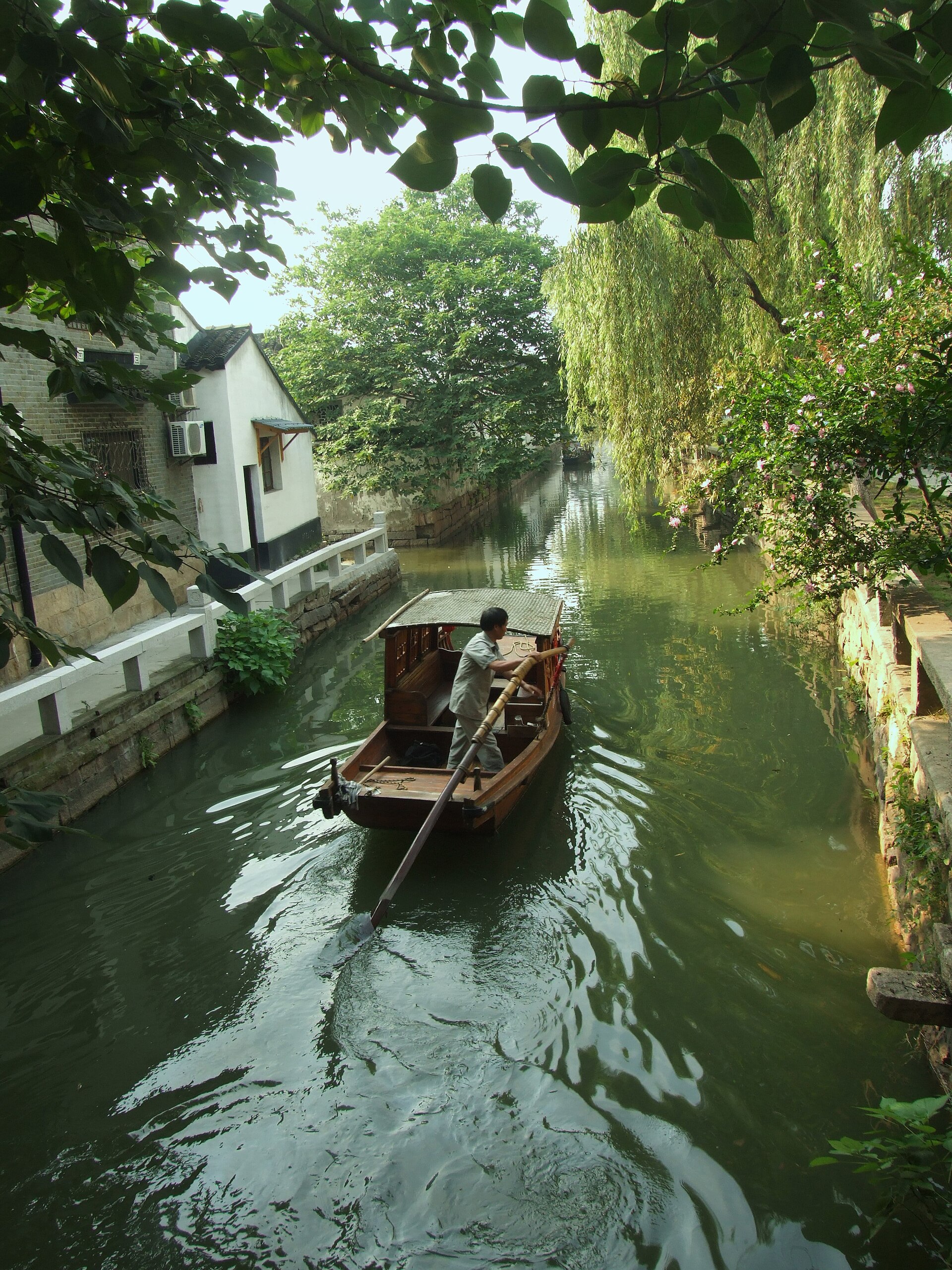
A wooden canal boat in Suzhou's old town — a boatman rowing past whitewashed waterside houses and a green willow A classic experience
Canal Boats
摇橹船 · ¥80–150 · the Suzhou ride to try

Suzhou earned the nickname "Venice of the East" for the network of canals threading the old town. A ride on a hand-rowed wooden boat (摇橹船) along the water is the most classic way to see the city. You can board at Pingjiang Road, Shantang Street, and in the outlying water towns like Tongli.

Expect to pay around ¥80–150 per ride (~฿400–750), depending on the spot and the route length. Some evening boats are lantern-lit, with a boatwoman singing local songs — read the canal-side food walk in Pingjiang & Shantang Street food.

Cost: ~¥80–150 per ride · pay via Alipay/WeChat
Board at: Pingjiang Road · Shantang Street · Tongli water town
Best: lantern-lit evening boats along the canal
🚌
Public Buses
公交车 · ¥1–2 · fills the gaps the metro misses

Suzhou's buses cover the whole city and are very cheap, at just ¥1–2 (~฿5–10) a ride. They're a useful backstop for the spots the metro doesn't reach directly — corners of the old town, or the links between gardens.

Pay by scanning Alipay/WeChat, with a Suzhou Tong card, or with exact-change cash. Use Amap to plan bus routes precisely — it tells you which stop to get off at and how far to walk after.

Cost: ~¥1–2 per ride · pay Alipay/WeChat/Suzhou Tong
Plan with: Amap or Apple Maps for routes and stops
Cash: exact change only, no change given
🚕
Metered Taxis & DiDi
出租车 / 滴滴出行 · English app, Alipay pay

Suzhou taxis are metered, with a flag-fall of around ¥10–14 for the first 3 km, then roughly ¥1.8–2.4 per km. DiDi — China's ride-hail app — shows you the fare before you confirm. Its interface is in English, you can type destinations in English, and payment links straight to Alipay.

Tip: street-hailed taxi drivers rarely speak English, so keep your destination in Chinese characters on your phone — or just use DiDi, which removes the need to speak at all. It's the right call when you have luggage, when it's raining, or for the outlying water towns the metro doesn't reach.
Taxi: flag-fall ~¥10–14 · night surcharge
DiDi: download & link Alipay before you fly · shows fare upfront
Payment: Alipay · WeChat Pay · cash
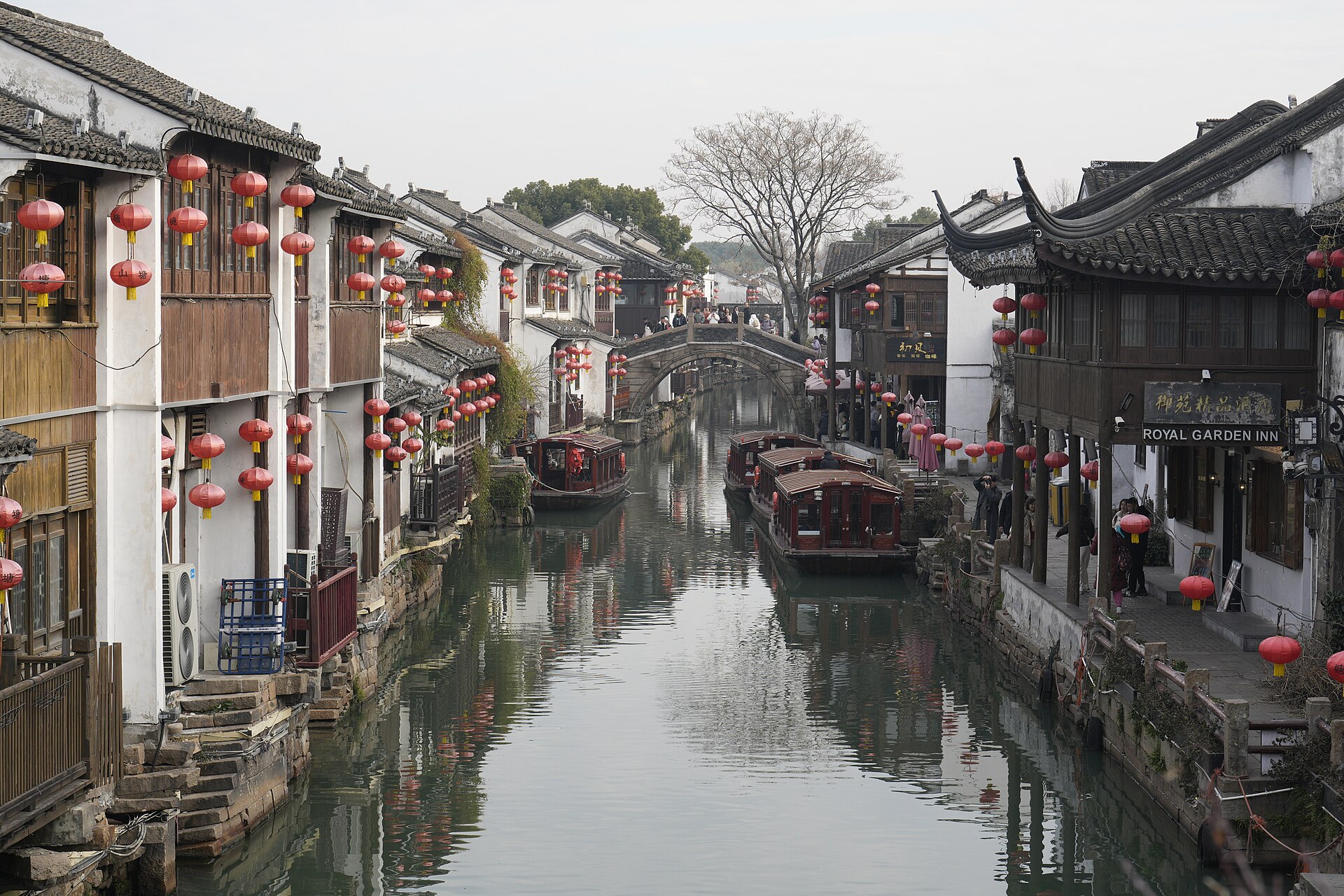
Shantang Street, Suzhou — an old-town canal lane lined with antique timber houses, red lanterns and a humpbacked stone bridge On foot
Walking the Canal Old Town
步行 · the best way to see Suzhou · free

An honest truth: the heart of Suzhou is best seen on foot. The old town is full of canal-side lanes, ancient stone bridges and connected gardens. Pingjiang Road and Shantang Street are the two prettiest waterside walks — you can stroll along the canals past historic houses for half a day with ease.

Tip: start early when it's quiet, then use a shared bike for the stretches when you tire. The flat terrain makes switching between walking and cycling effortless — see everything to do in the Suzhou attractions guide.
Popular walks: Pingjiang Road · Shantang Street
Best: early morning or sunset — fewer people, better light
Flat city: easy to alternate walking and cycling
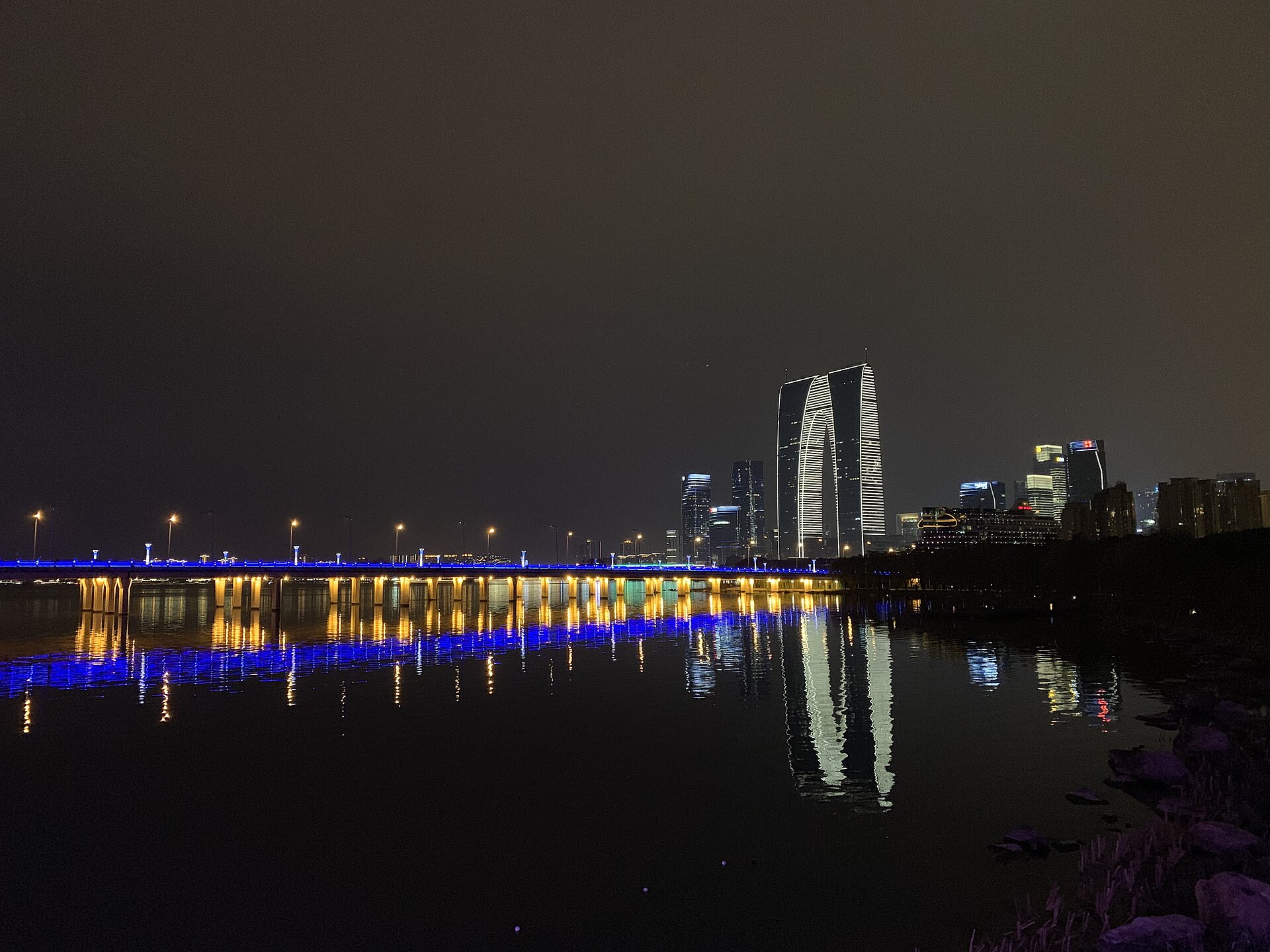
Jinji Lake, Suzhou at night — the lit Gate of the Orient tower and a blue-lit bridge reflected in the water in the SIP district The modern side
SIP / Jinji Lake
金鸡湖 / SIP · Line 1 · towers by the lake

Suzhou's other face is the Suzhou Industrial Park (SIP) on the shore of Jinji Lake — modern towers, big malls and the Gate of the Orient (东方之门), a landmark after dark. Line 1 runs straight to this side: get off near Jinji Lake and walk the waterfront.

Wide walking and cycling paths ring the lake, and at night the lights reflect off the water — a favourite for photos, and a complete contrast to the old town. Yet a single Line 1 ride flips between the two worlds in one day.
How: Line 1 to the Jinji Lake area (Dongfangzhimen)
Best: lakeside walk/cycle paths · night lighting
Pairs with: the old town at the far end of Line 1
Navigation

Which map app actually works in Suzhou

This matters more than people expect. Google Maps' public transit data for mainland China is unreliable — even with a VPN, route guidance for the metro and buses is frequently wrong or simply absent. Two apps give accurate, real-time transit directions without any workaround:

🗺️
Amap (Gaode / 高德地图)
The app most Chinese residents use

Amap has accurate, live data for every metro line, bus route, and intercity train in China. You can search destinations in English, and the transit planner gives step-by-step directions down to which exit to use. Download it from the App Store or Play Store before you arrive — no VPN required to use it.

Tip: Download before departure — some app stores in China require a VPN to access.
🍎
Apple Maps
iPhone users already have this

Apple Maps in China uses Amap's data as its backend, which means its transit directions for the Suzhou metro are accurate. On an iPhone this is the path of least resistance — no extra app, no VPN, and it fits your existing Maps workflow.

Android note: Google Maps transit doesn't work well in China — install Amap instead.

If you want LINE, Instagram, Gmail or full Google Maps while in China, you'll need a VPN installed and tested before you fly — most VPN websites are blocked once you're inside the country. See the full breakdown in the China internet, VPN and eSIM guide.

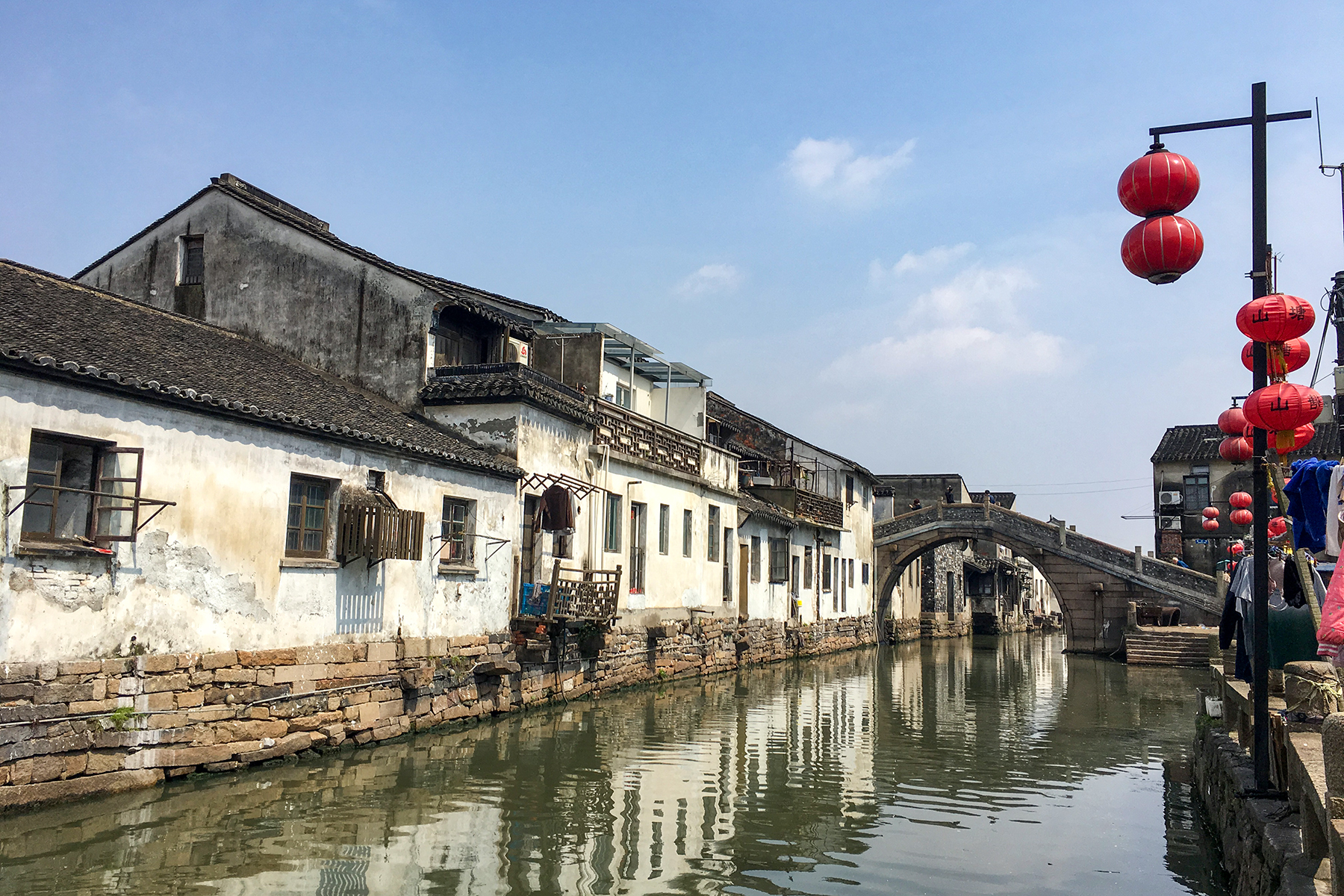
A canal in Suzhou's old town — whitewashed tiled houses, an arched stone bridge and red lanterns lining the water
Suzhou's old town is a canal quarter you explore mainly on foot and by bike — planning a late evening out? Check the last metro time first, and keep DiDi handy for the gap.
Two things to do first

Sort these out before you board your flight

Two preparations make the biggest difference. First, open Alipay, link your Visa or Mastercard through the international mode, and find the Metro and Hellobike features in the app before you leave home. Once you land in Suzhou you won't be hunting for anything — one app scans you through the metro gate, unlocks a bike, hails a DiDi and pays for dinner.

Second, book your train from Shanghai in advance through Trip.com or 12306, because weekend and holiday departures sell out fast. Pick the right station — for the old town, alight at Suzhou Railway Station (苏州站). The old town itself, by contrast, you can walk and cycle freely without leaning on transport much at all.

For first-time visitors: staying in the old town near Pingjiang Road gives you the easiest walk to the gardens and canals, while the SIP side by Jinji Lake suits anyone who prefers the modern, with quick Line 1 access. Browse stays and real prices in the 10 best hotels in Suzhou, and plan the whole trip from the Suzhou first-timer guide.
Common questions

FAQ · Getting around Suzhou

How long is the train from Shanghai to Suzhou?
The high-speed train from Shanghai Hongqiao to Suzhou takes just 23–30 minutes, and a second-class ticket is around ¥35–40 (~฿175–200). Trains run extremely often, roughly every 10–15 minutes. You can alight at Suzhou Railway Station (苏州站) on the edge of the old town, with Lines 2 and 4 straight to the gardens, or at Suzhou North (苏州北站) on the SIP / Jinji Lake side, served by Line 2. Buy tickets in advance through Trip.com or 12306 — see the full plan in Suzhou as a day trip from Shanghai.
How many metro lines does Suzhou have, and what do they cost?
Suzhou Rail Transit has five main lines (Lines 1–5). Fares are distance-based, starting at ¥2 and topping out around ¥8 (~฿10–40). Line 1 runs east–west through the old town out to SIP and Jinji Lake; Line 2 runs north–south past the railway station and the Tiger Hill area; Line 4 runs north–south through the old town to its southern terminus at Tongli; Lines 3 and 5 are cross-town routes. Pay with the Suzhou Metro QR, Alipay or WeChat, scanning straight through the gate.
What's the best way to get around Suzhou's old town?
Suzhou's old town is a maze of canals and narrow lanes, and it's best explored on foot and by bike because the whole city is flat. Only Lines 1 and 4 skirt the old town — no line threads every lane — so you walk or grab a shared Hellobike/Meituan bike (¥1.5–2 a ride) from the station to reach the gardens and Pingjiang and Shantang streets. For the classic experience, take a canal boat past the waterside houses — see everything to do in the Suzhou attractions guide.
Does Suzhou have an airport, and how do I arrive if I'm flying?
Suzhou has no major airport of its own. Most visitors fly into Shanghai first — landing at Pudong (PVG) or Hongqiao (SHA) — and connect by high-speed train. The smoothest route is to board the HSR at Shanghai Hongqiao, which sits right beside Hongqiao Airport and is linked to Pudong by Metro Line 2. From there it's a ~23–30 minute ride to Suzhou.
How do I pay for the metro and buses in Suzhou?
Several options: (1) Alipay QR — open the app, tap Metro or Transport, scan at the gate; easiest for tourists, and you can link a Visa or Mastercard via international mode. (2) WeChat Pay — same idea via City Service. (3) The official Suzhou Metro QR app. (4) A single-journey token from station machines, with English menus. Buses take Alipay/WeChat or exact-change cash (no change given). Full setup in the Alipay & WeChat Pay guide.
Can I use Google Maps in Suzhou?
Google Maps can show a basic map (with a VPN) but its transit data for mainland China is unreliable or absent. Use Amap (Gaode / 高德地图) or Apple Maps instead — both use accurate, real-time data for the metro and buses, neither requires a VPN, and they'll even point you to the nearest canal-boat dock or shared bike.