10 sights worth your time
Ordered outward from the heart of the park — not just photo stops, but places that genuinely tell Sukhothai's story.
 1
1
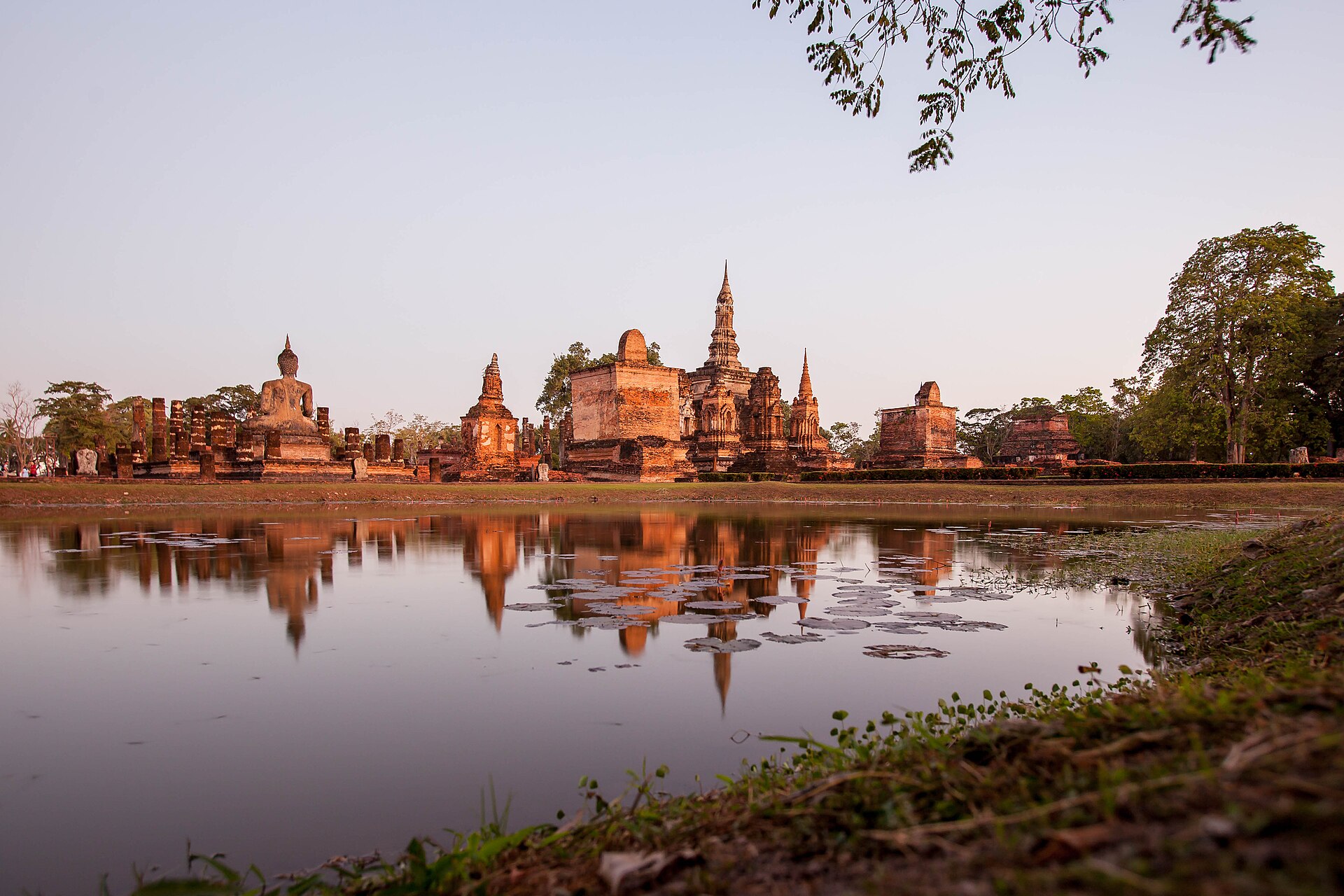
Picture it: you cycle into the park and your eye catches a cluster of chedis rising from the lawn — the main lotus-bud chedi, its slender finial a form unique to Sukhothai art, ringed by smaller chedis and rows of seated Buddhas. Wat Mahathat was the royal temple at the centre of old Sukhothai, the religious and ceremonial heart of the kingdom. Around it stand the bases of assembly halls, laterite columns and a large seated Buddha that still convey how grand the city once was. It sits in the middle of the central zone, so you can pair it with Wat Sa Si and Wat Si Sawai in one loop.
 2
2
If you only pick one temple, make it this one. Wat Si Chum sits outside the city wall in the north zone, and its highlight is Phra Achana, a colossal seated Buddha in the subduing-Mara pose housed in a thick-walled mondop. The front is open as a tall, narrow slot lined up exactly with the face — walk in, look up, and the head and serene features fill the gap, one of the most arresting images in all of Sukhothai. The hands, once lacquered and gilded, still carry visible traces of gold leaf. A local legend tells of someone hidden in the wall to make the image seem to "speak" and rally the troops.
 3
3
Where Wat Mahathat is about grandeur, Wat Sa Si is about quiet beauty. Its bell-shaped (Sri Lankan-style) chedi and assembly hall sit on a small island in a pond called Traphang Trakuan, reached by a little footbridge. When the water is still, the chedi's reflection on the surface is lovely, especially in the soft light of morning and late afternoon — one of the most popular photo spots in the park. It's in the central zone near Wat Mahathat, an easy stop on the bike route, and the trees around the pond make it a shady place to pause for a few minutes out of the sun.
In the central zone, not far from Wat Mahathat, is a temple that looks clearly different from the rest — Wat Si Sawai, with three laterite prangs in a row, Khmer in form. They're a reminder that this site absorbed Hindu religion and Khmer culture before Sukhothai rose as a Buddhist city; the temple was later adapted for Buddhist use. Traces of stucco decoration still show on the prangs in places. You can see it together with Wat Mahathat and Wat Sa Si in the same zone. It's the spot that shows Sukhothai didn't appear from nothing, but built on an older culture that came before it.
Near the temple cluster in the central zone stands the King Ramkhamhaeng Monument, the king seated on his stone throne — the most remembered ruler of the Sukhothai era, credited with creating the Thai script and a paternal style of rule. His story appears on the famous Ramkhamhaeng Inscription, which describes a prosperous Sukhothai — "in the water there are fish, in the fields there is rice." It's a spot where Thai visitors often pay their respects before touring the temples, and a good place to start if you want to understand why this city matters so much to the nation's history.
To understand why these ruins were once so grand, stop at the Ramkhamhaeng National Museum, near the central-zone entrance. It displays Sukhothai Buddha images, Sangkhalok ceramics, inscriptions and artefacts found in the old city — the real objects that show the craftsmanship of the Sukhothai artisans and the roots of the art you're about to see in the park. It's air-conditioned, which makes it a good place to escape the midday heat and add some context before or after you tour the temples. A short visit is enough to get the overall picture of the city.
In the west zone is a temple that takes a little effort but rewards it — Wat Saphan Hin, set on a low hill reached by a long path paved with slate slabs (which gives it its name, "stone bridge"). Climb to the top and you find Phra Attharot, a large standing Buddha with one hand raised in the gesture of giving protection, facing the city. It's a spot with a wide view over the park and the plain around it, quiet and far less busy than the central zone. It suits anyone who wants a high vantage point and doesn't mind a short uphill walk — go in the morning or late afternoon to avoid the heat.
Beyond the headline temples, cycling the park takes you past smaller ones with a charm of their own — Wat Trapang Thong sits on an island in a lotus pond by the Old Town entrance, with a chedi and a Buddha footprint, reached by a wooden footbridge; it's a working temple where monks and locals still come to make merit. Around the city moat and across the zones, you'll keep passing assembly-hall bases, small chedis and scattered Buddha images worth a stop. The real charm of Sukhothai is cycling slowly and stumbling on a quiet temple that isn't in the guidebook — open the park map and let yourself wander a little.
When you've finished the temples, the heat has eased and you want genuine local food, head into New Town Sukhothai, about 12 km east of the park on the Yom River. This is where locals actually eat. The thing to seek out is Sukhothai noodles (kuaitiao Sukhothai) — thin rice noodles with pork, long beans, crushed peanuts and a touch of palm-sugar sweetness, a dish that tastes different from anywhere else. There's also an evening market and riverside spots for an easy, friendly-priced dinner — the feel of a local meal before you head back to your room. If you're staying in the Old Town instead, there are noodle shops and a small market over there too.
 10
10
Once you've done the Sukhothai park and still have a full day, head out to Si Satchanalai Historical Park, about 50–80 km north of town — Sukhothai's sister city, far less visited and a good deal shadier and quieter. The highlights are Wat Chang Lom, a chedi ringed at the base by rows of stucco elephant buttresses; Wat Phra Si Rattana Mahathat (Chaliang) by the river; and the Sangkhalok ceramic kilns, where the old export pottery that once shipped across the region was fired. It suits anyone staying overnight in Sukhothai with a full second day — make it a day trip out of town.