The kingdom that gave Thailand its first capital left lotus-bud chedis, lily ponds and Buddha images scattered across green lawns under shade trees — here is how to actually do it: the three zones, per-zone tickets, cycling routes, and the heat you need to plan around.
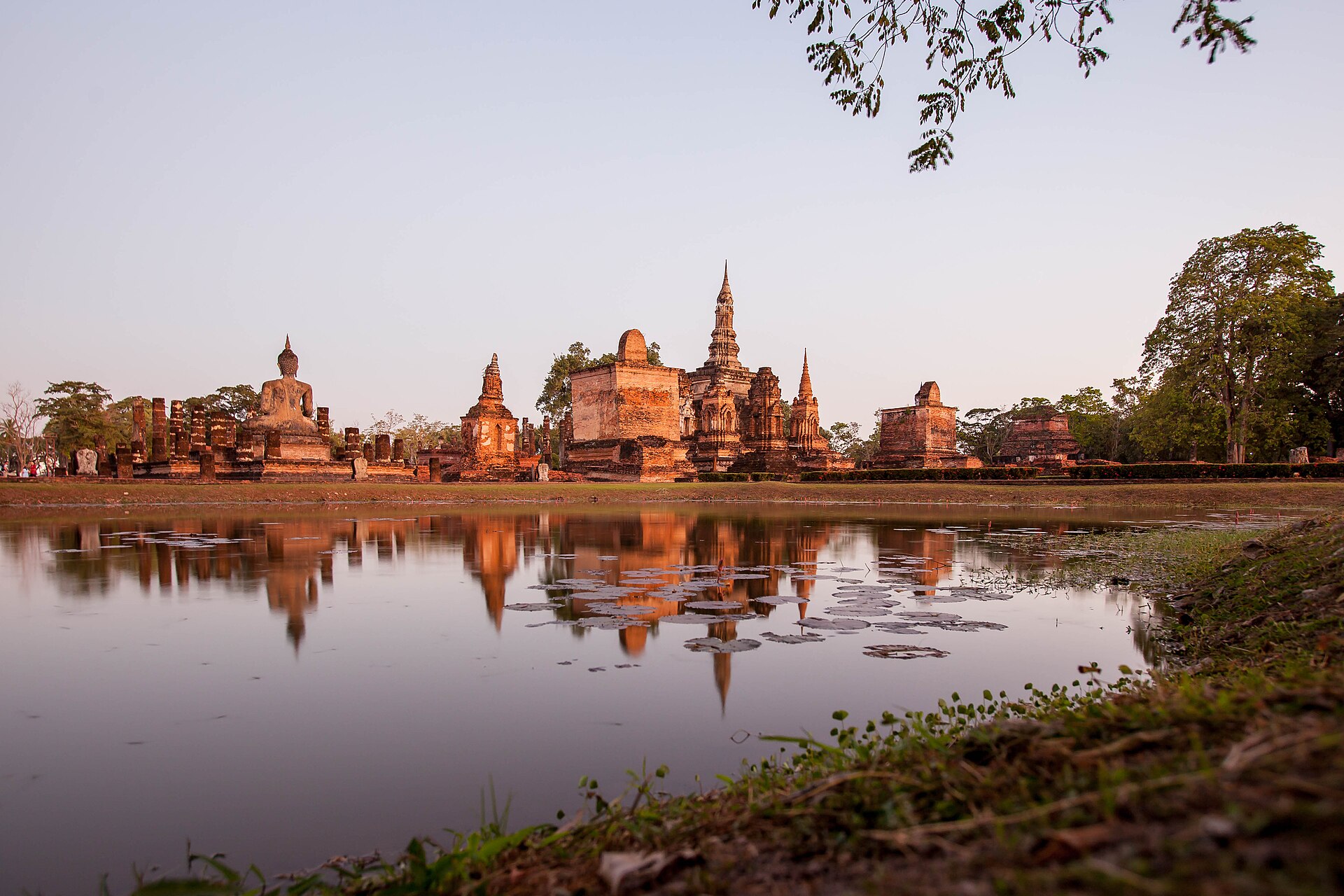
There is a moment, usually early on a rented bicycle, when you ride in through the park gate past green lawns and lily ponds, turn into Wat Mahathat, and see it: a lotus-bud chedi mirrored in still water, ringed by rows of Buddha images and countless smaller ruined chedis. The morning light is soft, the pond is glassy, the crowds are thin — this is Sukhothai at its best, and it is the reason to start at dawn.
Sukhothai Historical Park is the heart of Sukhothai (the name means "dawn of happiness"), Thailand's first capital in the 13th–14th centuries, before power moved south. Today its ruined chedis, assembly halls and seated, standing and walking Buddha images are spread across a beautifully restored site that was inscribed as a UNESCO World Heritage Site in 1991 (listed together with its sister cities Si Satchanalai and Kamphaeng Phet).
What sets it apart from other ancient cities is that it is quieter, greener and less crowded: wide lawns, big shade trees and ponds at intervals, ideal for a slow day on a bike. The town comes in two halves — the Old Town around the park, and the New Town about 12 km east on the Yom River, which has the bus terminal, more restaurants and an evening market. The honest catch is the heat: much of the open ground is exposed, so the middle of the day is to be avoided.
Sukhothai's park is not one enclosure but several zones with separate tickets — knowing the layout helps you plan the ride and pay only for the zones you actually want.
The most visited and the best value, inside the old city walls, gathering the major temples within an easy ride of each other: Wat Mahathat, the city's principal temple; Wat Si Sawai, with its Khmer-style prang; and Wat Sa Si, set on an island in a pond — plus the King Ramkhamhaeng Monument and the Ramkhamhaeng National Museum. If you are short on time, this one zone covers most of the highlights.
A ride north of the Central zone, reachable by bike. The destination is Wat Si Chum, home to Phra Achana, a giant seated Buddha in the subduing-Mara pose that fills a tall-walled square mondop and is glimpsed through a narrow slot in the front wall — the most striking and memorable image in Sukhothai. Ticketed separately from the Central zone.
The farthest and quietest zone. Its highlight is Wat Saphan Hin, reached by walking up a stone path onto a low hill to a large standing Buddha at the top, with a wide view over the plain and the ruins below — a peaceful place to watch the sun go down. Ticketed separately again, so save some energy and water for the climb.
All inside the old city walls, only a few minutes' cycling apart — this is the loop to start with if you have half a day.
The image that defines the whole city — the principal lotus-bud (bud-shaped) chedi that is the signature of Sukhothai art, ringed by subsidiary chedis and long rows of Buddha images in various poses, including large seated figures still holding their grace. It sits among moats and lily ponds that mirror it beautifully at dawn and dusk, and it is where you should begin the loop.
A short ride from Wat Mahathat. Its draw is three prang in a row in the Khmer style, thought to have begun as a Hindu shrine before becoming a Buddhist temple. The prang form, so different from the lotus-bud chedi nearby, shows how several eras of art layer together in one city.
Set on an island in a pond (Traphang Trakuan) that you reach by a footbridge. Its Sri Lankan–style bell-shaped chedi and assembly hall reflect in the water for one of the most serene and photogenic scenes in the park, with big trees along the bank for a shady rest stop mid-ride.
A bronze statue of King Ramkhamhaeng the Great, the ruler credited with creating the Thai script and bringing Sukhothai to its height, seated on the Manangkhasila throne. It is a stop people pause to pay respect at while cycling the Central zone, and it sits close to the museum so you can continue straight on to see the real artefacts.
If you want to understand what you have just cycled past, stop here — it holds Sukhothai Buddha images, Sangkhalok ceramics and inscriptions that bring the art and life of the era into focus, the real objects that make the chedis and halls come alive. Separate admission, office hours (often closed on certain days — check before you go).
The key thing to grasp first is that Sukhothai's park charges per zone — there is no single ticket for everything. Thai nationals pay around ฿20–30 per zone and foreigners around ฿100 per zone (prices can change, check at the booth at each zone). If you bring a bicycle or vehicle in, there is a small extra vehicle fee per zone.
A simple way to think about it: if you are short on time or watching the budget, the Central zone alone covers most of the highlights. If you mean to see it all, then pay extra for the North zone (Wat Si Chum) and the West zone (Wat Saphan Hin) — buying each ticket at the entrance of that zone when you get there.
The option most people choose is renting a bicycle for around ฿30–50 a day from shops near the park entrance in the Old Town, because the ground is flat, there is shade in places, and the Central-zone temples are an easy ride apart — you can stop anywhere and wait for no one. The further North and West zones are still reachable by bike if you are up for it.
If you would rather not pedal, especially in the hot season, there are alternatives: a tram tour within the park, motorbike rental for the longer hops between zones, or songthaew shared trucks that run between the New Town and the Old Town (about 12 km apart). Walking the whole site is genuinely tiring because the temples are spread out and the sun is strong, and Grab is limited in Sukhothai, harder to hail than in a big city.
If you have time and want to understand what you are looking at, stop by the Ramkhamhaeng National Museum in the Central zone, which holds the Sukhothai Buddha images, Sangkhalok ceramics, stone inscriptions and antiquities excavated from the city — the real objects that make the chedis and halls you just cycled past come alive, and that help you picture how far this kingdom once reached. It charges separate admission and keeps office hours (often closed on certain days — check before you go).
Etiquette: many ruins are still sacred ground — dress respectfully with shoulders and knees covered (carry a shawl), and do not climb on the chedis, hall platforms or Buddha images, which are fragile ancient monuments. When photographing the Buddha images, and Phra Achana at Wat Si Chum especially, be respectful — no mocking poses and never stand over or point at the head.
Heat and shade: although the park is greener than many ancient cities, most lawns and temple courts are still open to the sky. In the hot season (March–May) the sun makes a midday walk hard going. The trick is to start at opening time (~6.30 am) or come in the late afternoon, avoiding roughly 11 am to 3 pm. Bring water, a wide-brim hat, sunscreen, and shoes you can slip off easily (a few spots require removing them).
Sukhothai is regarded as the birthplace of Loy Krathong, and every November the park hosts the Loy Krathong & Candle Festival, with a light-and-sound show among the floodlit chedis and halls — an atmosphere completely unlike the daytime, the old brick and the lotus-bud chedi glowing warm under the lights. It is the peak time of year and the busiest, so book accommodation well ahead and allow extra time for transport and parking → see the Sukhothai season and Loy Krathong guide
These sit off the Central-zone loop, but they are worth cycling or riding out to reach.
Stay in the Old Town near the park to wake up and cycle into the ruins before the heat, or stay in the New Town for more restaurants and the evening market.