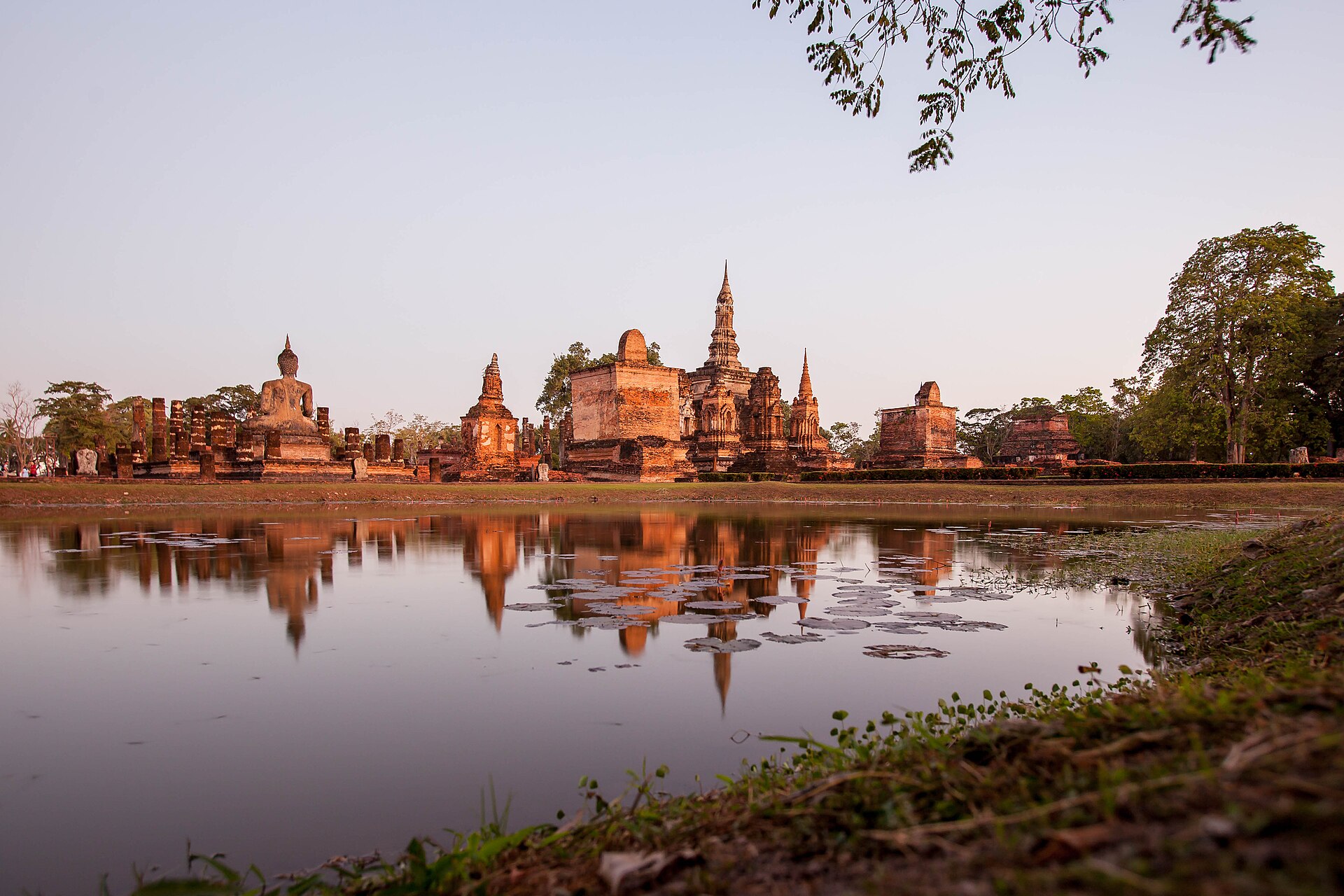
Sukhothai in every season
Sukhothai in every light
Whatever month you arrive, this World Heritage city has something worth seeing.
Sukhothai sits in Thailand's lower north, with three clear seasons — a cool, dry stretch made for cycling the ruins, a hot season that pushes toward 40°C on open, shadeless park grounds, and a green, quiet rainy season. Add the famous Loy Krathong festival each November, held at the very park where the tradition is said to have begun, and timing your trip matters. This guide tells you straight.
If you only want the best weather, pick December or January. Daytime temperatures sit around 24–32°C, mornings and evenings are cool, the rain has gone, and you can cycle between Wat Mahathat, Wat Sa Si and Wat Si Chum all day without wilting on the open ground — and the floodlit monuments look their best because the sky is clear. But if you want the festival Sukhothai is most famous for, aim for November, when the park holds the Loy Krathong and Candle Festival. Sukhothai is regarded as the birthplace of Loy Krathong, and floating krathong against the lit chedis is a sight you won't get anywhere else. The catch: November during the festival is the peak of the year — the busiest, with rooms filling fast and prices high, so book months ahead.
If the cool season doesn't fit, go in knowing two things. March to May is hot — some days hit 38–40°C, and the ruins are open lawns and ponds with almost no shade. And June to October is the rainy season, with showers that usually come in short afternoon-to-evening bursts. Both seasons are still easy to enjoy if you time your hours — visit at dawn when the park opens or in the late afternoon — and you'll get thinner crowds and cheaper rooms for it. The full month-by-month breakdown is below; to compare across the country first, read best time to visit Thailand.
The weather, what it delivers, and what you are trading for it — told straight.
This is the answer if you're asking when Sukhothai is at its finest. The rain has gone, the sky is clear, daytime sits around 28–32°C, and mornings and evenings drop to a comfortable 24–26°C. You can walk or cycle between Wat Mahathat, Wat Sa Si on its island and Wat Si Sawai all day without the sun grinding you down. Visibility is good, and the lotus-bud chedis mirror sharply in the ponds.
December and January are the best weather of the year. November brings the Loy Krathong and Candle Festival at the park — lovely, but it draws big crowds and rooms fill fast. For good weather with thinner crowds, choose an ordinary weekday in early December or February that doesn't fall on a long-weekend holiday, and avoid the New Year period when rooms are priciest.
The hot season is genuinely hot. Daytime highs usually top 35°C, and from late March into April some days reach 38–40°C. Here's the honest part: the Sukhothai ruins are open lawns and ponds with barely a large tree for shade. A few minutes in the midday sun and you'll feel it.
The way to handle it is to go right when the park opens at dawn, or from the late afternoon into the evening — and rent a bicycle rather than walking, so you catch a breeze and cover ground faster. Always carry water, a wide-brimmed hat and sunscreen. The trade-off works in your favour: far fewer people than the cool season and lower room prices. Songkran in April is a fun way to beat the heat with water, but it's also the hottest week of the year.
Sukhothai is in the lower north, where the rain isn't as heavy as in the south. From June to August it usually comes in short afternoon or evening bursts — heavy but brief — and the rest of the day stays fine for cycling. The greenery around the ruins is lush, the park ponds are full and mirror the chedis beautifully, crowds thin out and rooms get cheaper. Keep a folding umbrella or a packable rain jacket on you.
The thing to know: September is the wettest month, when the rain can come more often and last longer, so allow extra time and have an indoor backup. Sukhothai isn't a low-lying riverside city that routinely floods its park, so this is about timing your day rather than avoiding the month. On the whole, the rainy season is when the ruins look greenest and feel quietest — ideal if you want the place without the crush.
The biggest highlight is the Loy Krathong and Candle Festival (Loy Krathong Phao Thian Len Fai), held at the Historical Park each November around the full moon of the twelfth lunar month. Sukhothai is regarded as the birthplace of Loy Krathong, which makes this festival special: the monuments are floodlit and a light-and-sound show plays out among the old ruins, with floating krathong set against the silhouettes of the lit chedis.
Beyond Loy Krathong, Songkran in April is a fun way to cool off in the heat (though it's the hottest week), and the year-end into New Year brings the year's coolest, clearest air for seeing the ruins. On some evenings the park lights Wat Mahathat after dark — the chedis under the lights are striking, and the air is cooler. The clearest evenings are in the cool, dry season.
Temperature, rainfall and crowd levels — in one table for easy comparison.
| Month | Temperature | Rain | Crowds | Notes |
|---|---|---|---|---|
| January | 24–32°C | Very low | High (New Year) | Cool and clear · peak cycling |
| February | 24–34°C | Very low | Moderate | Still pleasant · warming late in the month |
| March | 25–37°C | Low | Moderate | Heating up · stronger sun |
| April | 27–40°C | Low | Moderate (Songkran) | Hottest, up to 38–40°C · Songkran |
| May | 26–38°C | Moderate | Low | Still hot · rains begin late in the month |
| June | 25–35°C | Moderate | Low | Afternoon-evening rain · rooms cheaper |
| July | 25–34°C | Moderate | Low | Intermittent rain · lush, few crowds |
| August | 25–33°C | Heavy | Low | Rain getting more frequent · pack an umbrella |
| September | 25–33°C | Heaviest | Low | Wettest · full ponds, very quiet |
| October | 25–32°C | Heavy | Low | Rain easing · lush, cooling late in the month |
| November | 24–32°C | Low | High (Loy Krathong) | Turning cool, skies clearing · Loy Krathong festival |
| December | 23–31°C | Very low | High (year-end) | Coolest and clearest · ideal for cycling |
Two questions that can decide your whole Sukhothai trip — answered straight, both of them.
The cool season is the answer. The park is flat and the main temples in the central zone sit close together, so renting a bicycle (around ฿30–50/day at the gate) lets you loop Wat Mahathat, Wat Sa Si and Wat Si Sawai in comfort once the air is cool — no sweating it out like the hot months. Skies are clear and the chedis are sharp. Wat Si Chum, with its giant seated Buddha (Phra Achana), and the hilltop Wat Saphan Hin sit outside the central zone, where a bike or motorbike really helps.
The park is split into zones (central, north and west) with separate tickets, so allow a half to a full day. For a full how-to on the ruins, read our Sukhothai Historical Park guide, and see everything worth visiting in things to do in Sukhothai.
Sukhothai is regarded as the birthplace of Loy Krathong, and the Loy Krathong and Candle Festival at the Historical Park is the year's headline event — floodlit monuments and a light-and-sound show among the old ruins. It draws visitors from across the country and abroad, so the rooms near the park fill fast and prices climb to their highest of the year.
If you're set on the festival, book your room months ahead and brace for crowds, traffic and entry queues. Some travellers stay in the New Town (Mueang Mai), about 12 km east, which has more hotels and restaurants, and travel in for the event. See your options in where to stay in Sukhothai, and read more on the tradition in our Loy Krathong & Yi Peng guide.
These are reasons to time your visit, not reasons to avoid it.
The biggest highlight of the year. Sukhothai is regarded as the birthplace of Loy Krathong, and this festival is held right at the Historical Park, with the monuments floodlit and a light-and-sound show among the old ruins. Floating krathong against the silhouettes of the lit chedis is a sight you won't get elsewhere. Worth knowing: it's the peak of the year — the busiest time, with rooms filling fast and prices at their highest — so book months ahead and allow time to get to and from the event. More in our Loy Krathong & Yi Peng guide.
Songkran is a water-splashing festival that lands right in the hottest week of the year. Sukhothai has a small-town feel to it — water-pouring blessings at the temples alongside relaxed street water-play in the neighbourhoods, gentler than the big cities. It's a hot but joyful time. Worth knowing: if you'd rather see the ruins in peace, skip the main splashing days and go to the park at dawn, and keep your gear waterproofed. More in our Songkran guide.
The turn of the year brings Sukhothai's coolest, clearest weather — ideal for cycling the ruins all day and photographing the chedis mirrored in the ponds. On some evenings the park lights Wat Mahathat after dark, and the monuments under the lights are a fine sight in the cool air. Worth knowing: it's a long-weekend holiday, so crowds are heavier and rooms book out and cost more. Outside the festival and holiday dates, an ordinary cool-season weekday is quieter and easier to book.
Not exhaustive — just the things that actually matter for Sukhothai.
Whatever month you arrive, this World Heritage city has something worth seeing.