Home Xiamen China Xiamen hotels About
Home  ›  Asia  ›  China  ›  Xiamen  ›  Jimei School Village
🇨🇳 Xiamen · Attractions

Jimei School Village (集美学村)
the seaside campus town a self-made tycoon built for his hometown — and its "Western buildings in Chinese hats"

Ride Metro Line 1 out over the sea from Xiamen Island, about 30 minutes, and you reach the school town that Tan Kah Kee (Chen Jiageng) built more than a century ago — Chinese roofs on Western bodies, a seaside Turtle Garden with 600-odd stone carvings, and a Dragon Boat Pool that mirrors a whole row of old buildings.

Get to know it

Why Jimei School Village feels unlike anywhere else in Xiamen

Picture this: you board the metro in the centre of Xiamen Island, and after a while the track lifts up and runs straight out over the sea, the windows filling with open water and a long bridge. Then you step off at a station with a curious name — Jimei School Village (集美学村) — and a few minutes' walk away stands a row of old school buildings, their roofs distinctly Chinese with upturned ends, yet the bodies below them all stone columns and arched windows in a European style. This whole place is not an ordinary old quarter; it is a school town that one man built for his own hometown with money he earned far overseas.

Jimei School Village means, literally, "Jimei school town" — a cluster of educational institutions that Tan Kah Kee, known in Mandarin as Chen Jiageng (陈嘉庚), an overseas Chinese who grew rich on rubber in Malaya, began building in 1913. From one small school it grew into primary and secondary schools, a teachers' college, a maritime school, and eventually a university. Today it is still home to Jimei University and other institutions, with real students walking around — not a museum that has died.

Three things bring people here: the "Jiageng" architecture itself, which is hard to see anywhere else; the seaside Turtle Garden (鳌园), which gathers the stone carvings, the monument and Tan Kah Kee's own tomb; and the calm air around the Dragon Boat Pool (龙舟池), where old buildings mirror in the water. It all sits far from the bustle of the island's tourist quarters, which makes it ideal for a slow half-day with a story behind every building.
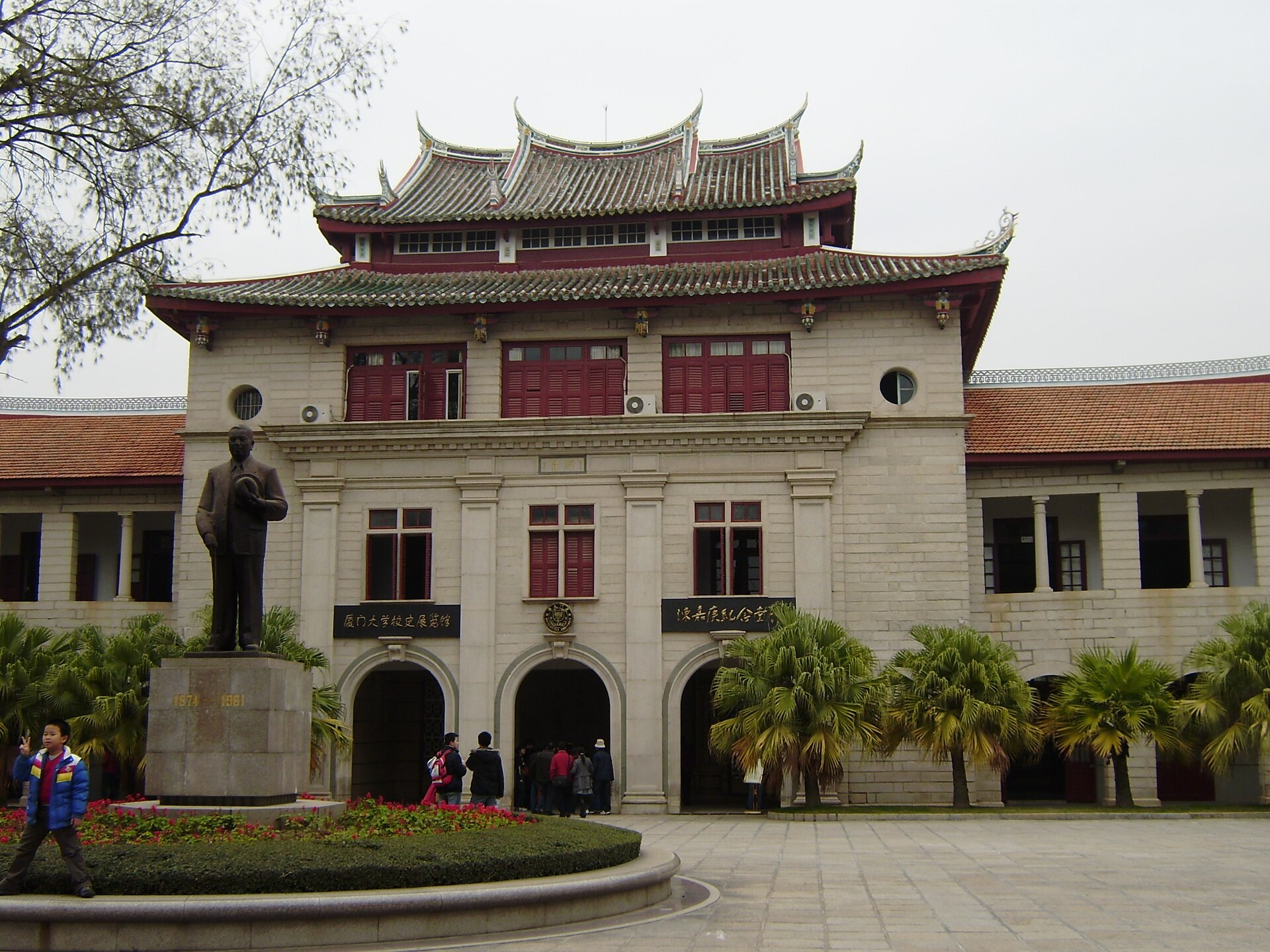
Jimei School Village, Xiamen — a Jiageng-architecture school building with a Chinese tiled roof on a Western-style body and a statue of Tan Kah Kee out front
A school building in Jimei — "Jiageng" architecture, a Chinese roof set on a Western-style body, the signature style Tan Kah Kee devised himself
🎫
Admission
Village free · Turtle Garden ~¥20
~¥20 (~฿100) ticket covers Turtle Garden + memorial
🚇
Getting there
Metro Line 1
Jimei School Village station · over-sea stretch
⏱️
From downtown
About 30 minutes
Metro runs ~06:00–22:30
🏛️
Highlight
Turtle Garden (鳌园)
600+ stone carvings + monument + Tan Kah Kee's tomb
🕐
Time needed
Wander the town anytime
Turtle Garden / memorial have set hours — check first
📸
Best for
A relaxed half-day
Lovers of architecture, history and sea views
What to see

5 highlights in Jimei School Village

From the "Western buildings in Chinese hats" to the seaside Turtle Garden and the Dragon Boat Pool — know these before you go so you don't miss the key spots.

How to see it all in a half-day: get off the metro at Jimei School Village station, then walk into the town past the Jiageng buildings on your way to the Turtle Garden. Buy the combined ticket (~¥20 / ~฿100) and do the Turtle Garden, monument, tomb and memorial hall one after another. Finish with a stroll around the Dragon Boat Pool in the evening light. The whole thing takes about half a day, leaving you time to head back into the city for dinner.
The story behind it

Tan Kah Kee and a town built on rubber money

🌏 From a seaside village boy to a rubber king in Malaya

Tan Kah Kee (Chen Jiageng) was born in Jimei in 1874 and left home as a teenager to work with family in Singapore, gradually building his own business until he became one of the biggest rubber and pineapple magnates in Malaya. But what kept his name alive is that he did not hoard the wealth — he believed that "education is the foundation for saving the nation", and poured enormous sums back into building schools in his hometown.

Starting with a small school in 1913, he kept expanding it into a whole school town, and in 1921 he founded Xiamen University with his own money. It is said that in years when the business lost money he still sold off assets to keep the schools running. That level of commitment is exactly why he is so revered in China to this day.

🏯 Why the buildings are "half Chinese, half Western"

Tan Kah Kee spent much of his life overseas and saw plenty of Western architecture, but his heart stayed Chinese. So he devised a style that took the strength and practicality of Western buildings — stone columns, arched verandahs, airy halls — and combined it with Chinese-style roofs that spoke of his roots. The result is the Jiageng architecture that became a signature of both Jimei and Xiamen University.

If you have already walked Xiamen University on the island, you will notice many buildings there speak the same language. Coming to Jimei is like seeing the "original" of a style that spread across the city, which is why people who love architecture often pair the two in a single trip.

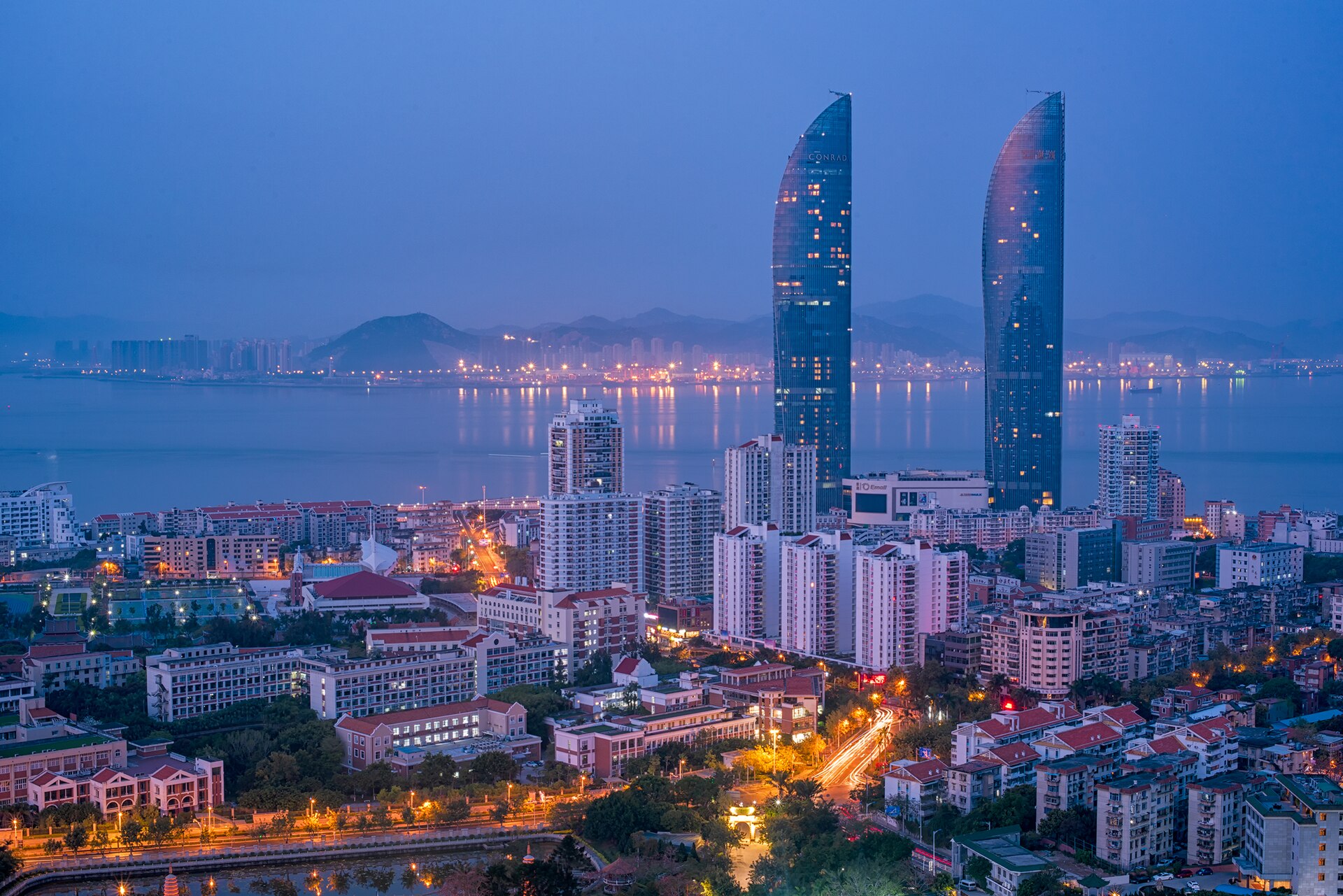
Xiamen skyline at dusk with the twin towers and the sea — the starting point for the over-sea Metro Line 1 ride to Jimei
Xiamen's skyline at dusk (a general city view, not Jimei) — Jimei sits on the mainland side; Metro Line 1 runs out over the sea from the island in about 30 minutes

🚆 The over-sea metro ride — a bonus on the way

The thing that makes a trip to Jimei more fun than you'd expect is the journey itself. Xiamen's Metro Line 1 has a stretch where the track lifts up and runs out over the sea between the island and the Jimei mainland, about 2.8 km long. Take a window seat and you get wide sea views and a sea-crossing bridge, free with your ride. Some people go to Jimei partly just to ride this stretch — it is one of the few city metro lines in China that gives you this feeling.

A small tip: sit on one side on the way out and switch to the other side on the way back, so you catch the sea on both sides. And if you can choose your timing, late afternoon into evening gives softer, prettier light than the harsh midday sun.

Getting there

How to reach Jimei School Village

The good news is that Xiamen has a metro, and Jimei is one of the easiest attractions to reach by it. The way to go is Metro Line 1, getting off at Jimei School Village station (集美学村站), which is named directly after the attraction. It is a few minutes' walk from the station into the school town. Pay your fare by scanning Alipay/WeChat, or buy a single-journey ticket from the machine.

🚇
Metro Line 1
Jimei School Village stop
~30 min from downtown · with the over-sea stretch
🚄
From the HSR north station
Direct on Line 1
Xiamen North Station (HSR) is also on Line 1
🚕
Taxi / DiDi
Easy but pricier
Over the bridge from the island, ~30–40 min by traffic
Pair it to make the trip worthwhile: Jimei is on the mainland side, opposite the island's headline sights like Gulangyu and Xiamen University, so most people treat it as a separate half-day, or pair it with the botanical garden or other Jimei-side spots in the same day. Carry your passport and Alipay/WeChat to scan for tickets and payments, since many places in China don't take cash.
More nearby

Pair Jimei with other Xiamen sights

Seen the original Jiageng architecture at Jimei? Cross over to the seaside version on the island, plus other stops for the same trip.

Frequently asked

FAQ · Jimei School Village before you go

Is Jimei School Village free, and how much is the ticket?
Wandering the campus town — looking at the Jiageng-architecture buildings along the streets and around the Dragon Boat Pool — is free; there are no walls or gates charging admission. What you pay for is the Turtle Garden (鳌园), which includes Tan Kah Kee's tomb and the Liberation Monument, plus the Tan Kah Kee Memorial Hall. The combined ticket is around ¥20 (~฿100) and covers both. Children, seniors and students usually get a discount or free entry under the rules. Bring your passport in case you need to scan to register or buy a ticket. Prices can change, so check the latest before you go.
Who was Tan Kah Kee (Chen Jiageng 陈嘉庚), and why does Jimei matter?
Tan Kah Kee, known in Mandarin as Chen Jiageng (陈嘉庚), was an overseas Chinese who built a fortune in the rubber business in Malaya (today's Malaysia and Singapore), then poured the money back into building schools in his hometown of Jimei, starting in 1913. He expanded them into a whole campus town and also founded Xiamen University. He is revered in China as a major educator and philanthropist, which is why the entire town of Jimei feels like a living memorial to his belief in "education to save the nation".
What is 'Jiageng' architecture (嘉庚建筑)?
Jiageng architecture is the style Tan Kah Kee devised himself: Minnan-style Chinese tiled roofs, with the ridge ends curving up like swallowtails, set on top of Western-style buildings of granite and red brick with arched windows. People in China affectionately call them "Western buildings wearing Chinese hats", because the top half looks Chinese while the lower half looks Western — a reflection of Tan Kah Kee's own identity as an overseas Chinese. Many of the school buildings in Jimei, and at Xiamen University, are built in this style, and it has become a signature of the city.
What is there to see in the Turtle Garden (鳌园)?
The Turtle Garden, or Ao Yuan (鳌园), is a seaside garden that Tan Kah Kee designed and supervised himself, built from 1950 until it was completed around 1961. It has three main parts: a corridor whose walls are carved with more than 600 stone reliefs of Chinese history, legend and daily life; the Jimei Liberation Monument (集美解放纪念碑), a stone column about 28 metres high in the central plaza; and Tan Kah Kee's tomb, set within the garden itself. The garden is named for the turtle-shell shape of the headland it sits on. It is a lovely place to walk slowly among the fine carvings with the sea right beside you.
How do you get to Jimei School Village — can you take the metro?
Yes — Xiamen has a metro, and the easiest and most fun way is to take Metro Line 1 to Jimei School Village station (集美学村站), named directly after the attraction; it is a few minutes' walk from the station to the town. The special part is that Line 1 has an elevated stretch of about 2.8 km that runs out over the sea between Xiamen Island and the Jimei mainland, so a window seat gives you free sea and bridge views. From the city centre it takes about 30 minutes. The metro runs roughly 06:00–22:30, and you pay by scanning Alipay/WeChat or buying a single-journey ticket from the machine.
Klook · Xiamen tickets & activities

Xiamen tours, the Gulangyu ferry and activities — book ahead for peace of mind

Jimei is easy to reach by metro, but the island's busier sights — like the ferry to Gulangyu or a city tour — have limited quotas and sell out fast in high season. Booking on Klook ahead locks in a clear price so you're not gambling at the gate.

See Xiamen tickets & activities on Klook →
Wherebest is a Klook affiliate partner — we may earn a commission when you book through our link, at no extra cost to you.