Home Guangzhou China Guangzhou Hotels About
Home  ›  China  ›  Guangzhou  ›  Roast Meats (烧腊)
Cantonese Food Guide · 2026

Cantonese roast meats (烧腊)
the crackle Guangzhou is proud of

Crisp-skinned roast goose over sour-sweet plum sauce, honey-glazed char siu with caramelised edges, pork belly blistered into golden crackling, glossy soy-sauce chicken — siu laap is the everyday heart of Cantonese cooking, and Guangzhou queues for it daily.

The tradition

Siu laap (烧腊) — the meats hanging in every Guangzhou window

Walk Guangzhou for a while and you start seeing the same scene on repeat: a glass-fronted counter with glossy mahogany roast geese hanging in a row, long strips of honey-lacquered char siu, golden-skinned roast pork chopped into squares, and whole dark-glazed chickens. That is siu laap (烧腊, Mandarin shāo là) — the family of Cantonese roasted and cured meats that people here eat as routine, not as a festival treat.

There is an old saying, "食在广州" — "for eating, go to Guangzhou" — and nothing proves it more quietly than the small roast-meat counters tucked into every lane. Cantonese diners treat good roast meat as the measure of a cook: the skin has to crackle, the meat has to stay juicy, the sauce has to be judged just right. And the headline act here is not Peking duck — it is roast goose (烧鹅). This is its home.

Every Cantonese roast follows the same principle: the skin is the hero. Goose and crispy pork go through a process of separating the skin from the flesh with air, brushing it with a maltose-and-vinegar wash, and drying it completely before it ever meets the fire — so that the heat puffs the skin into thin, brittle scales. Char siu and soy-sauce chicken, meanwhile, are all about the marinade and the glaze soaking deep into the meat. Simple plates that hide more technique than they let on.

The essential four

Roast meats worth knowing by name

Ordered by how often you will see them on a Guangzhou roast-meat counter — the four that tell you something true about this kitchen.
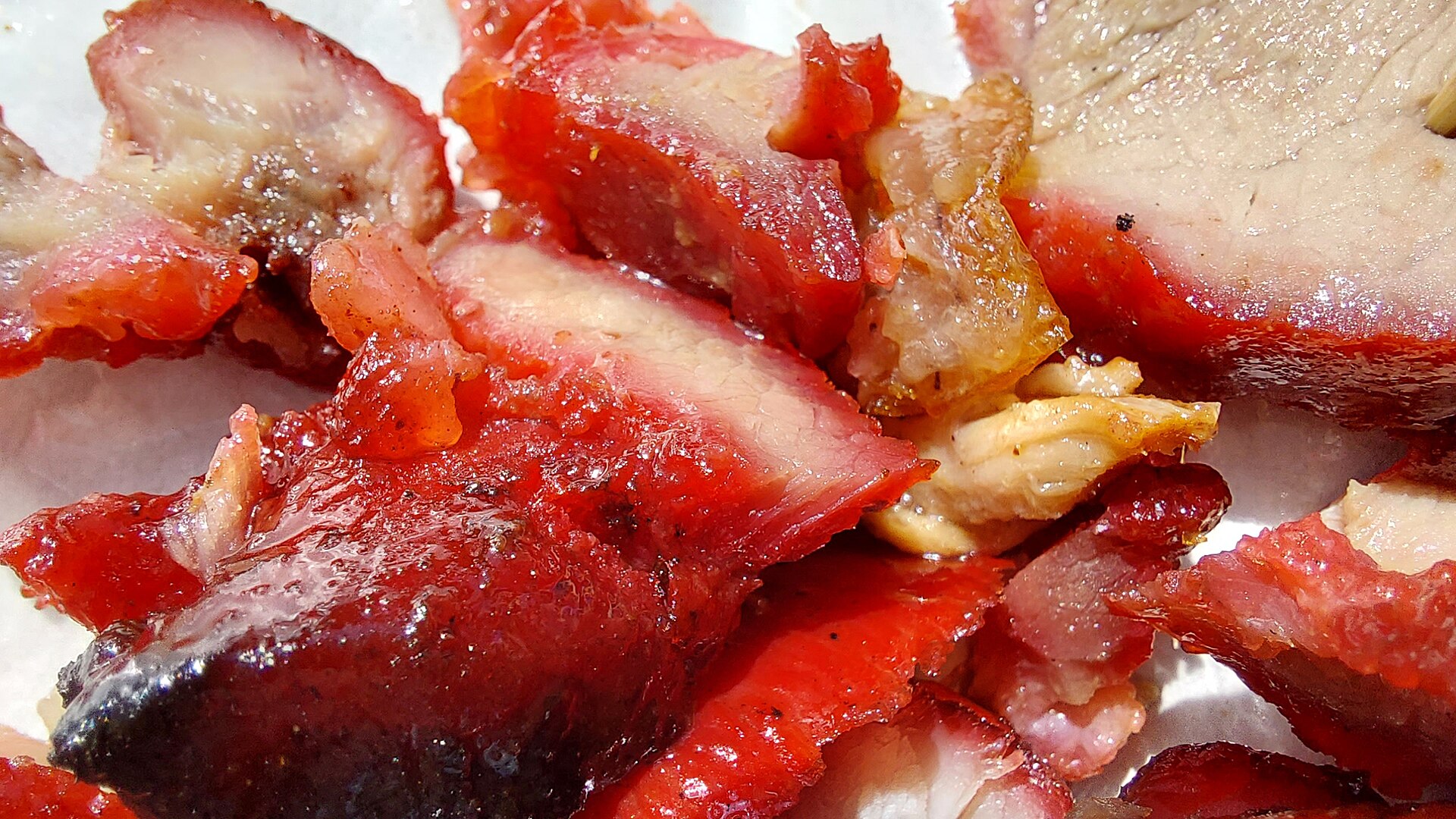
Char siu — Cantonese honey-glazed barbecued pork, deep red and glossy with charred caramelised edges, sliced into pieces 1
Char Siu (叉烧)
Honey-Glazed Barbecued Pork · the dish that measures a roast-meat shop

Pork shoulder or collar — often cut to the 3-fat-to-7-lean "golden ratio" that the trade swears by — marinated in honey, soy sauce, rice wine and five-spice, then skewered and roasted until the edges caramelise to a sweet char and a final honey glaze leaves it glossy. The name means "fork-roast", from the way it is hung on a fork over the heat. Good char siu has those slightly burnt edges, stays moist inside, and lands sweet first, savory second. Bingsheng (炳胜) in Tianhe is famous for its char siu, especially a signature "black char siu" that draws a steady queue.
Where: Bingsheng Pinwei (炳胜品味 · 168 Tianhe East Rd, Tianhe) · roast-meat counters citywide
Price: ¥28–58 a plate (~฿140–290) · char siu rice ¥18–32 (~฿90–160)
Tip: Ask for 肥叉 (fattier char siu) if you like it juicy · spoon the sweet soy over the rice
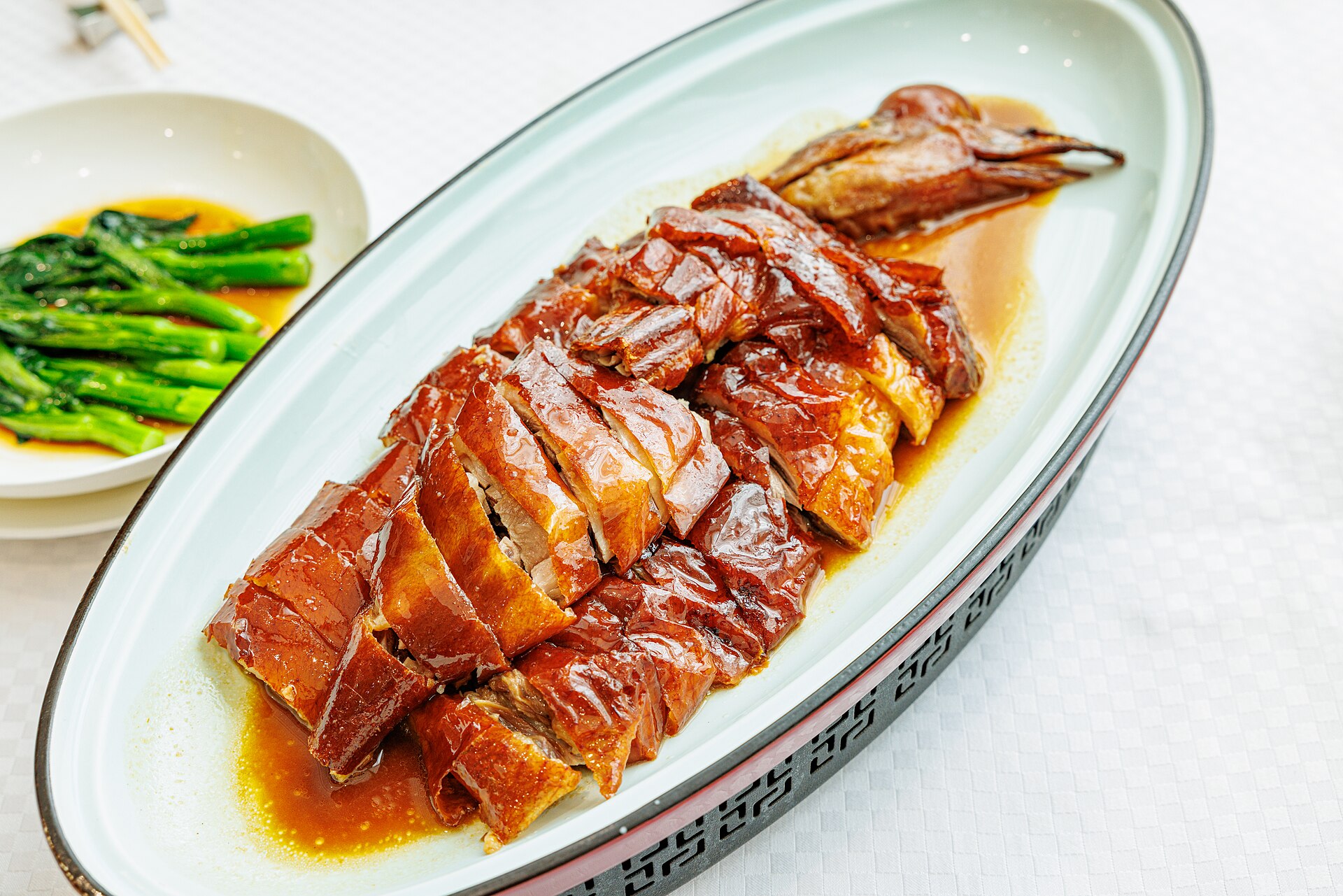
Cantonese roast goose — crisp lacquered mahogany skin, chopped into pieces on an oval platter with sauce and choy sum 2
Roast Goose (烧鹅)
Crisp-Skinned Roast Goose over Plum Sauce · the Cantonese star

This is the dish Guangzhou is proudest of, and the real thing lives here, not in Beijing. A large goose has air blown between its skin and flesh, is brushed with maltose, dried, then roasted in a clay pit over lychee-wood charcoal — the 深井烧鹅 style that began in Shenjing village, Huangpu district — until the skin puffs into thin crackling scented with lychee smoke. The flesh stays juicy, the fat under the skin melts to silk, and it is chopped and served with sour-sweet plum sauce (酸梅酱) to cut the richness. The crack of the skin on the first bite tells you the shop did it right.
Where: Wang Ji (旺记 · 169 Fengyuan Rd, Liwan · sells out fast) · Bingsheng (灌汤烧鹅, soup-filled roast goose)
Price: half goose ¥98–168 (~฿490–840) · roast goose rice ¥28–45 (~฿140–225)
Tip: Order 上庄 (thigh-and-leg section) for more meat and skin · go before noon while the goose is fresh
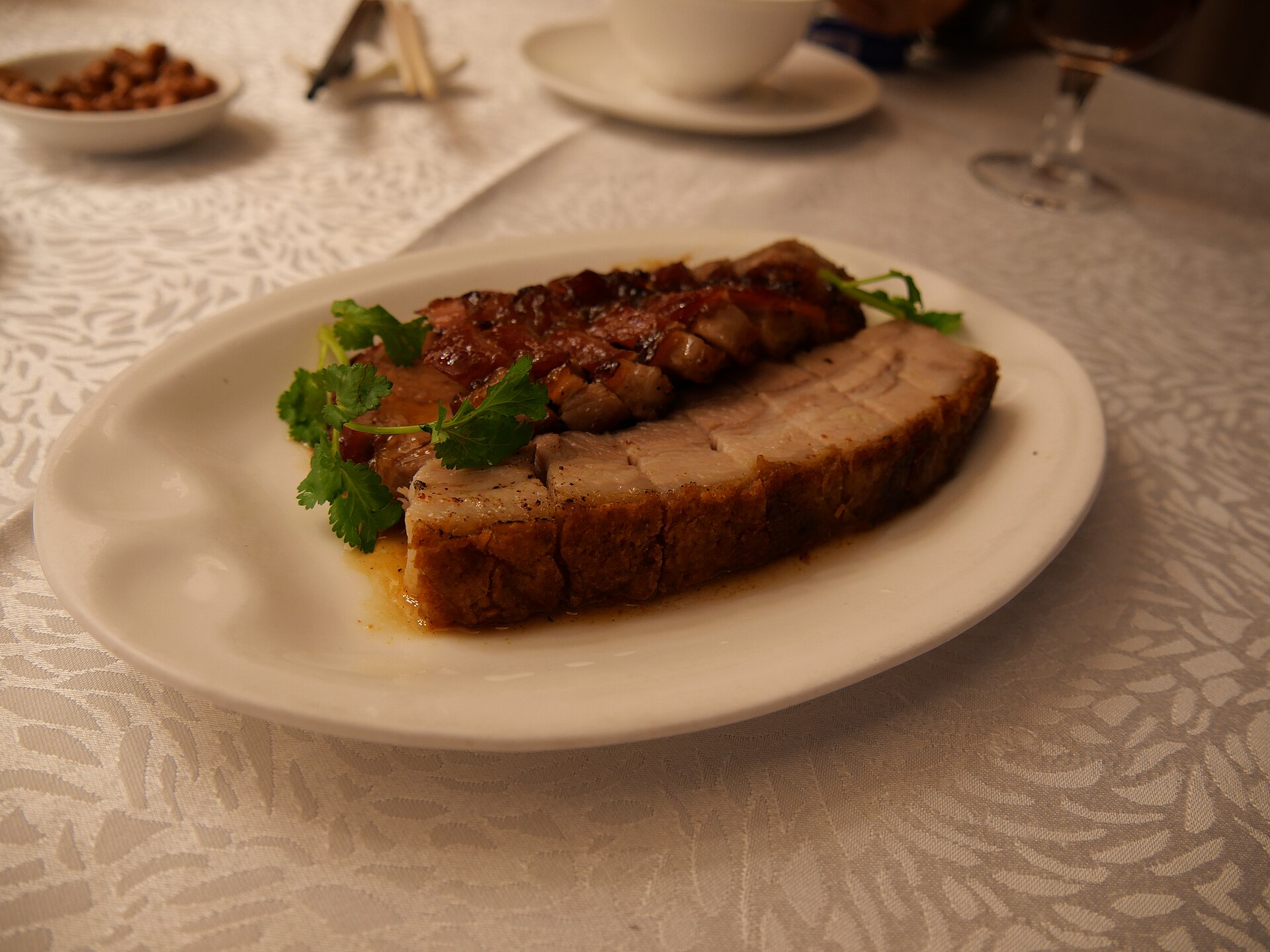
Crispy roast pork belly — golden blistered crackling skin, sliced and plated beside char siu on a white plate 3
Crispy Roast Pork (烧肉)
脆皮烧肉 · Pork Belly with Skin Blistered into Golden Crackling

Pork belly whose skin puffs into tiny golden blisters — like crisp sandpaper. That texture comes from pricking the skin with hundreds of tiny holes, rubbing it with salt, drying it out, then roasting it hot until the skin explodes into crackling that snaps like popcorn when you bite. Below the skin sits a thin layer of fat and tender meat; you dip it in yellow mustard or, the Cantonese way, in plain sugar. It is a fixture at celebration tables, where the red-gold skin is read as a symbol of prosperity.

Where: roast-meat shops around Liwan (Xiguan) · Sen Cheng (森成 · Haizhu · known for crackling)
Price: ¥32–58 a plate (~฿160–290)
Tip: Pair it with char siu as a 双拼 (two-meat plate) · dip in sugar to cut the fat
🍗4
Soy-Sauce Chicken (豉油鸡)
Poached in Master Soy Stock · glossy dark skin, silky flesh

A whole chicken is dipped and poached in a master stock of soy sauce, rock sugar, rice wine and spices — star anise, cinnamon, ginger — in a repeated dip-rest-dip rhythm until the skin turns a deep, glossy brown and the meat soaks up the savory-sweet flavour right to the bone. Served warm or cool, chopped into bite-size pieces. Locals often order half a soy-sauce chicken alongside a roast goose or char siu on a shared platter. Don't confuse it with white-cut chicken (白切鸡), which highlights the clean taste of the bird — soy-sauce chicken is the roast-counter version, deeper and darker.

Where: Jiu Ye Ji (九爷鸡 · near Beijing Rd · known for its chicken) · roast-meat counters citywide
Price: half chicken ¥38–68 (~฿190–340) · soy-sauce chicken rice ¥20–32 (~฿100–160)
Tip: Ask for the thigh-and-leg if you like it juicy · spoon the braising stock over the rice
About that skin: why do goose and crispy-pork skin stay crisp so long? Because of the "air-and-dry" step before roasting, which separates the skin from the flesh and removes all moisture. When the heat hits, the fat beneath pushes the dry skin up into scales — and the drier the skin, the longer the crackle lasts. It is also why roast meat taken back to the hotel rarely crackles the way it does at the shop.
How locals eat it

Rice plate vs shared platter — which to order

烧味饭 — the single-plate rice meal (solo / quick lunch)

Eating alone or in a hurry? Order siu mei faan (烧味饭) — hot steamed rice topped with one or two roast meats and a drizzle of sweet soy, usually with a side of blanched greens (choy sum) and a clear soup. The favourites are 叉烧饭 (char siu rice) · 烧鹅饭 (roast goose rice) · 烧肉饭 (crispy pork rice) · 豉油鸡饭 (soy-sauce chicken rice).

Want two meats on one plate? Order 双拼饭 (a two-meat rice) — char siu plus crispy pork, say, or roast goose plus soy-sauce chicken. Good value, and you get to taste more. Expect ¥18–45 a plate (~฿90–225).

拼盘 — the shared platter (with a group)

With three or four people, a shared platter (拼盘, pīn pán) works out better — half a roast goose (¥98–168), a big plate of char siu, half a soy-sauce chicken, all set in the middle of the table. Add plain rice and a stir-fried vegetable and share everything.

Group size: two people — a quarter goose plus two bowls of rice · four people — half a goose plus char siu, a vegetable and rice. Per person: a regular roast-meat shop runs ¥40–90 (~฿200–450); a larger restaurant like Bingsheng ¥120–180 (~฿600–900).

Paying — sort it out first

Small roast-meat counters (烧腊档) mostly take WeChat Pay and Alipay; some accept Chinese yuan cash, but almost none take foreign credit cards. Link a Visa/Mastercard to Alipay or WeChat before you leave home — it saves a lot of awkwardness at the counter.

Old-school shops in the Xiguan (Liwan) lanes usually have no English menu — and that is fine. Point at the meats hanging in the window, or say a simple dish name like 叉烧饭 / 烧鹅饭. A little effort goes a long way and the welcome is usually warm.

Cantonese roast-meat shops

Where to go — every budget

Places Guangzhou locals actually queue for, from a back-lane counter in Xiguan to a citywide name.

1
Bingsheng Pinwei (炳胜品味)
Citywide Cantonese restaurant · Tianhe · famous for char siu

If you want roast meat at restaurant-level skill in a comfortable sit-down setting, Bingsheng is the first name Guangzhou locals reach for — a group with branches across the city. The char siu here is celebrated, especially a signature "black char siu", and the soup-filled roast goose (灌汤烧鹅) is a house highlight. Dinner brings a queue; arrive before 6pm or after 8.30pm to be seated faster. Picture menu, staff happy to help.

Address: 168 Tianhe East Rd, Tianhe (several branches, incl. Zhujiang New Town) · Metro Line 1/3, Tiyu West Rd
Hours: 11.00–14.30 / 17.00–22.00 · Price: ¥120–180/person (~฿600–900)
2
Wang Ji (旺记烧腊)
40-year-old roast-goose shop · Liwan · near Lychee Bay

A traditional Cantonese roast-meat shop near Lychee Bay (荔枝湾) that has been going for over 40 years. The crisp-skinned roast goose is made fresh every day — glossy golden skin, fragrant tender meat that never feels greasy — and it has long been a favourite of the Xiguan neighbourhood. The goose tends to sell out within a few hours of opening, so go early if you want it. A humble, well-priced place, but its quality is taken as a given by locals.

Address: 169 Fengyuan Rd, Liwan · near Lychee Bay (荔枝湾景区)
Hours: from ~10.00 (goose sells out fast) · Price: ¥30–70/person (~฿150–350)
3
Miao Zhan (妙栈烧腊)
Heritage roast-meat shop in Dongshan · since 1928

One of Guangzhou's oldest roast-meat shops, around since 1928 in the Dongshan (东山) neighbourhood, and officially recognised as a "Guangzhou Time-Honoured Brand" (老字号). The roast goose and roast duck here are tender and deeply flavoured, and it has been a fixture for older Dongshan residents for generations. The room is plain and old-fashioned, nothing fancy — but the flavour is the real thing, the kind that survives nearly a century.

Address: Dongshankou (东山口) area, Yuexiu · Metro Line 1, Dongshankou
Hours: ~10.00–20.00 · Price: ¥30–80/person (~฿150–400)
4
Jiu Ye Ji (九爷鸡)
Chicken & roast-meat fast counter · Beijing Rd · city centre

For soy-sauce chicken and a roast-meat rice plate in a hurry, right in the centre, Jiu Ye Ji is easy to find and cheap. It is known as one of Guangzhou's first quick-service roast-meat shops — tender soy-poached chicken with glossy skin, rice plates that come piled and well-sauced. It sits near the Beijing Road pedestrian street, handy for a stop mid-sightseeing. No booking — order at the counter and grab a seat.

Address: near Beijing Rd pedestrian street, Yuexiu (several branches) · Metro Line 6, Beijing Rd
Hours: ~10.30–21.00 · Price: ¥20–50/person (~฿100–250)
Frequently asked

FAQ · what to know before you eat Cantonese roast meats

What is siu laap (烧腊), and how is it different from Peking duck?
Siu laap (烧腊, Mandarin shāo là) is the family of Cantonese roasted and cured meats: char siu 叉烧, roast goose 烧鹅, crispy roast pork 烧肉 and soy-sauce chicken 豉油鸡. Its biggest star is roast goose. Unlike Peking duck — which uses duck and is served wrapped in pancakes with sweet bean sauce — Cantonese roasting uses a larger, meatier goose, roasts it over lychee-wood charcoal until the skin blisters into crackling, then chops it and serves it with sour-sweet plum sauce. This is a Cantonese specialty, not a Beijing one.
What is shenjing (deep-well) roast goose and why is the skin so crisp?
Shenjing roast goose (深井烧鹅) is named after Shenjing village (深井村) in Guangzhou's Huangpu district, the birthplace of Cantonese roast goose. The technique uses a pit dug into the ground (深井 means "deep well") with lychee-wood charcoal at the bottom and iron bars across the mouth from which the goose hangs, so heat circulates evenly around the whole bird. Before roasting, air is blown between the skin and the meat, the skin is brushed with a maltose-and-vinegar wash and air-dried until completely dry — which is why it puffs into thin, brittle crackling and carries a faint lychee-wood aroma.
How do you order a roast-meat rice plate (烧味饭)?
Siu mei faan (烧味饭) is steamed rice topped with one or two roast meats and a drizzle of sweet soy — the single-plate meal Guangzhou locals eat every day. Popular choices: 叉烧饭 (char siu rice) · 烧鹅饭 (roast goose rice) · 双拼饭 (a two-meat plate, e.g. char siu plus crispy pork). Expect ¥18–45 a plate (~฿90–225). In a group, order a shared platter (拼盘) instead — half a goose or a large plate of char siu in the middle of the table with plain rice and a clear soup.
What is the difference between roast goose and roast duck in Guangzhou?
In Guangzhou roast goose (烧鹅) is the original and the prize: a larger bird, meatier, with thicker fat and a deeper flavour. Roast duck (烧鸭) is the cheaper, more widely available alternative, a touch more tender. Hong Kong and elsewhere often serve duck because goose is harder to source — but in Guangzhou, the home of roast goose, good shops still roast the real thing. If a menu lists 烧鹅 (goose) it will always cost more than 烧鸭 (duck), and it is worth the difference.
How is soy-sauce chicken (豉油鸡) different from white-cut chicken (白切鸡)?
They are two different Cantonese chicken dishes. Soy-sauce chicken (豉油鸡) is poached whole in a master stock of soy sauce, rock sugar and spices until the skin turns glossy dark brown and the meat is soaked through with savory-sweet flavour; it belongs to the siu laap family. White-cut chicken (白切鸡) is gently poached in barely-simmering water, plunged into cold water, and served with a scallion-ginger oil dip to highlight the clean taste of the bird. Different categories — but many roast-meat shops sell soy-sauce chicken alongside their goose and pork.
Do Guangzhou roast-meat shops take cash, and is there English?
Small roast-meat counters (烧腊档) mostly take WeChat Pay and Alipay; some accept Chinese yuan cash, but almost none take foreign credit cards. Link a Visa/Mastercard to Alipay or WeChat before you travel. Old-school shops in the Xiguan (Liwan) lanes usually have no English menu — just point at the meats hanging in the window, or say 叉烧饭 (char siu rice) or 烧鹅饭 (roast goose rice). Larger restaurants like Bingsheng have picture menus and staff who can help.
Klook · Food Tour

Guangzhou Food Tour — eat the right shops with someone who knows

A Guangzhou food tour with a local guide: walk the Xiguan lanes, taste roast goose, char siu, dim sum and street snacks — eat the good stuff, skip the language barrier.

See Guangzhou food tours on Klook →
Wherebest is a Klook affiliate partner — we may earn a commission when you book through our links, at no extra cost to you.