Home Guangzhou China Guangzhou Hotels About
Home  ›  China  ›  Guangzhou  ›  Congee & Noodles
Guangzhou Food Guide · 2026

Congee & noodles (粥粉面)
what Guangzhou eats every morning

Silky sampan congee, springy bamboo-pressed wonton noodles, soft soy-glossed rice rolls and beef ho fun straight off a roaring wok — the everyday trio that Cantonese kitchens are built on, and that locals eat from cradle to old age.

Shangxiajiu (上下九) food street in Liwan — the district where these dishes were born
The everyday trio

What 粥粉面 means — and why it matters

Ask anyone in Guangzhou what they had for breakfast and the answer almost always falls into three categories: 粥 (congee), 粉 (rice noodles), 面 (egg noodles) — together, 粥粉面 (zhōu fěn miàn). This is not banquet food that needs a reservation. It is everyday eating, woven into the rhythm of the city: a few yuan a bowl, served at small corner shops that open before dawn and close late.

The pleasure of Cantonese cooking lies in being fresh, light and precise — it lets the ingredient speak rather than burying it under heavy sauce. That sets it apart from the numbing heat of Sichuan or the dark, sugary braises of Shanghai. There's a saying locals repeat with quiet pride: "食在广州" — to eat is to eat in Guangzhou. The logic is simple: when the produce is good and the hand is skilled, you don't need to mask anything. Sampan congee, wonton noodles, cheung fun and dry-fried beef ho fun are the proof of that philosophy.

These dishes are rooted in Liwan (荔湾) on the western side of the city, and especially the old Xiguan (西关) quarter, once home to wealthy merchants. Sampan congee was born on the boats of Lychee Bay; bamboo-pressed noodles were perfected in old family shops; and the wide rice noodle takes its name from Shahe (沙河), a village on the city's edge that was its original source. All of it began as the food of ordinary people — and became a city's signature flavour that is genuinely hard to imitate.

The essential four

Dishes worth knowing in the 粥粉面 family

Four dishes that, between them, tell the whole story of the Cantonese kitchen — from silky porridge to a wok-seared plate of noodles.

🥣1
Sampan Congee (Tingzai Zhou)
艇仔粥 · silky porridge with fish, peanuts and dried squid — born in Liwan

Picture congee simmered until the rice has dissolved entirely into a smooth, grain-free cream. The base is cooked from rice and pork bones until it turns naturally sweet and velvety, then the fresh toppings go in at the moment of serving — thin slivers of raw fish, dried squid, fried peanuts, crisp pork skin, spring onion and crunchy fried bamboo strips. The word "sampan" (boat) comes from the Tanka people who lived on sampans in Lychee Bay (now Liwan Lake) during the Qing dynasty. They cooked and rowed their congee out to people along the waterfront, and the name has stuck ever since.

Where: Old congee shops across Liwan, around Liwan Lake and along Xihua Road (西华路)
Price: ¥12–30 / bowl (about ฿60–150)
Tip: Eat it hot and stir the toppings through first. A classic Guangzhou breakfast.
🍜2
Wonton Noodle (Yun Tun Mian)
云吞面 · shrimp wonton with thin egg noodle in a clear soup

Real Guangzhou wonton noodle is set apart by the noodle itself — a bamboo-pressed noodle (竹升面) made by a cook sitting on a thick bamboo pole and bouncing it over the dough again and again, rather than kneading by hand. The dough is high-gluten flour and duck eggs only, not a drop of water, which gives a thin yellow strand that is springy and snaps with a clean bite. The wontons are wrapped around whole, bouncy shrimp and served in a clear broth simmered from dried shrimp, pork bones and flatfish. A shop that knows its craft lays the noodles at the bottom of the bowl and sits the wontons on top, so the noodles never go soggy — a small detail that tells you everything.
Where: Wu Cai Ji (吴财记 · 212 Wenchang North Rd · Michelin Bib Gourmand) · Baohua Noodle (宝华面店 · Xiguan)
Price: ¥15–35 / bowl (about ฿75–175)
Tip: Ask for the noodles served separately if you want them at their springiest
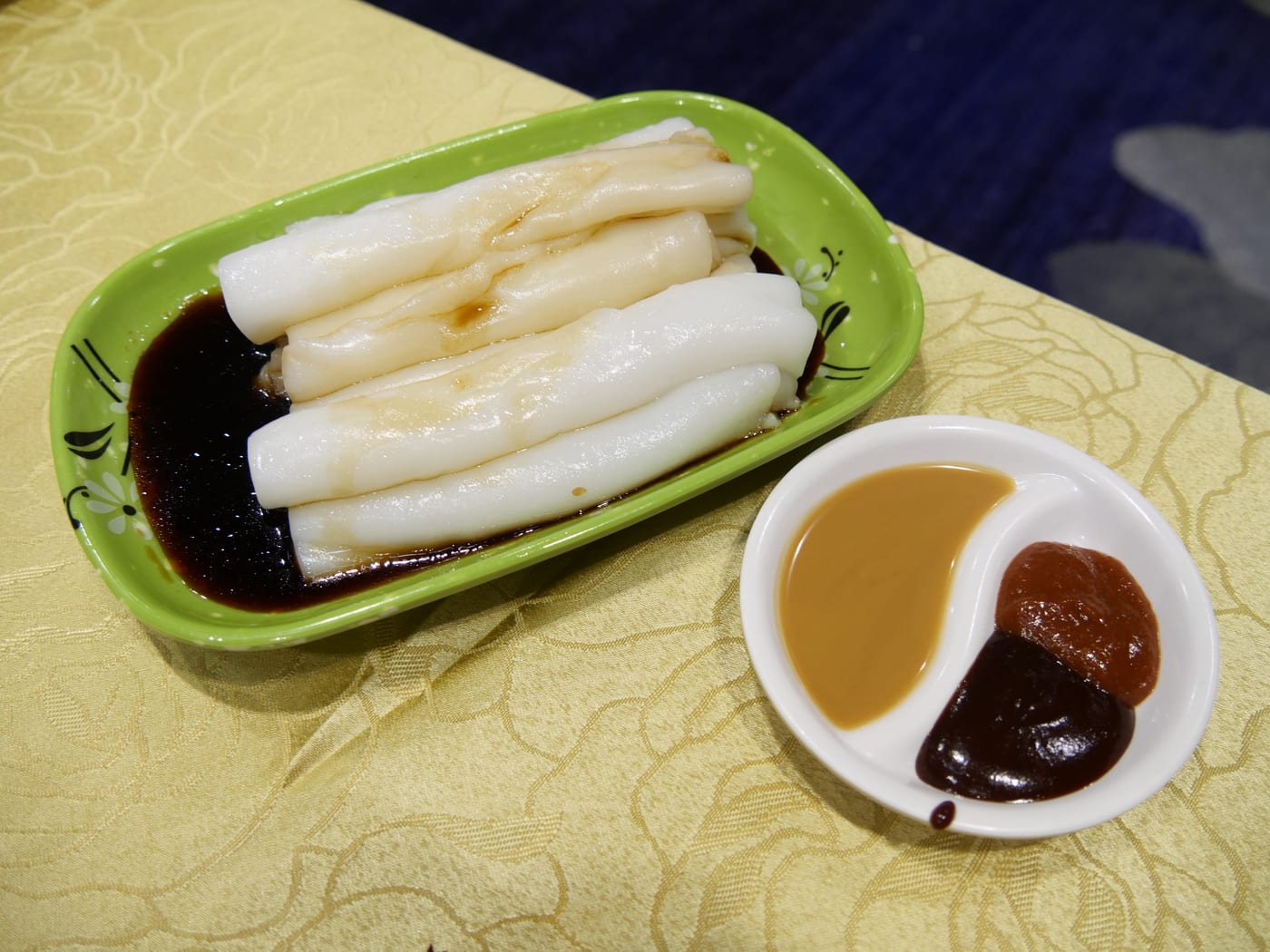
Cheung fun — silky white steamed rice-noodle rolls in dark sweet soy sauce, served with sesame and hoisin dipping sauces 3
Cheung Fun (Chang Fen)
肠粉 · silky steamed rice-noodle rolls, soy-drizzled

A thin rice-flour batter is spread on cloth or a tray, steamed for mere seconds into a translucent sheet, then rolled around a filling — fresh shrimp, beef or char siu, sometimes with an egg cracked in — cut into lengths and finished with a lightly sweet soy. The whole point is the texture of the sheet: silky, slippery and so soft it almost melts. Guangzhou's old-school shops make it cloth-pulled (布拉肠), steaming the batter on fine cloth and scraping it off for the thinnest possible sheet, while the drawer style (抽屉肠) is steamed in a metal tray and comes out a touch thicker thanks to a little glutinous rice flour. It is the breakfast Guangzhou eats alongside congee almost every morning.
Where: Yin Ji (银记肠粉 · open since 1958 · 345 Wenchang North Rd near the Chen Clan Academy) · Fang Ji Snack (芳记小食店)
Price: ¥8–25 / plate (about ฿40–125)
Tip: Shrimp cheung fun (鲜虾肠) is the classic order · eat it the moment it leaves the steamer
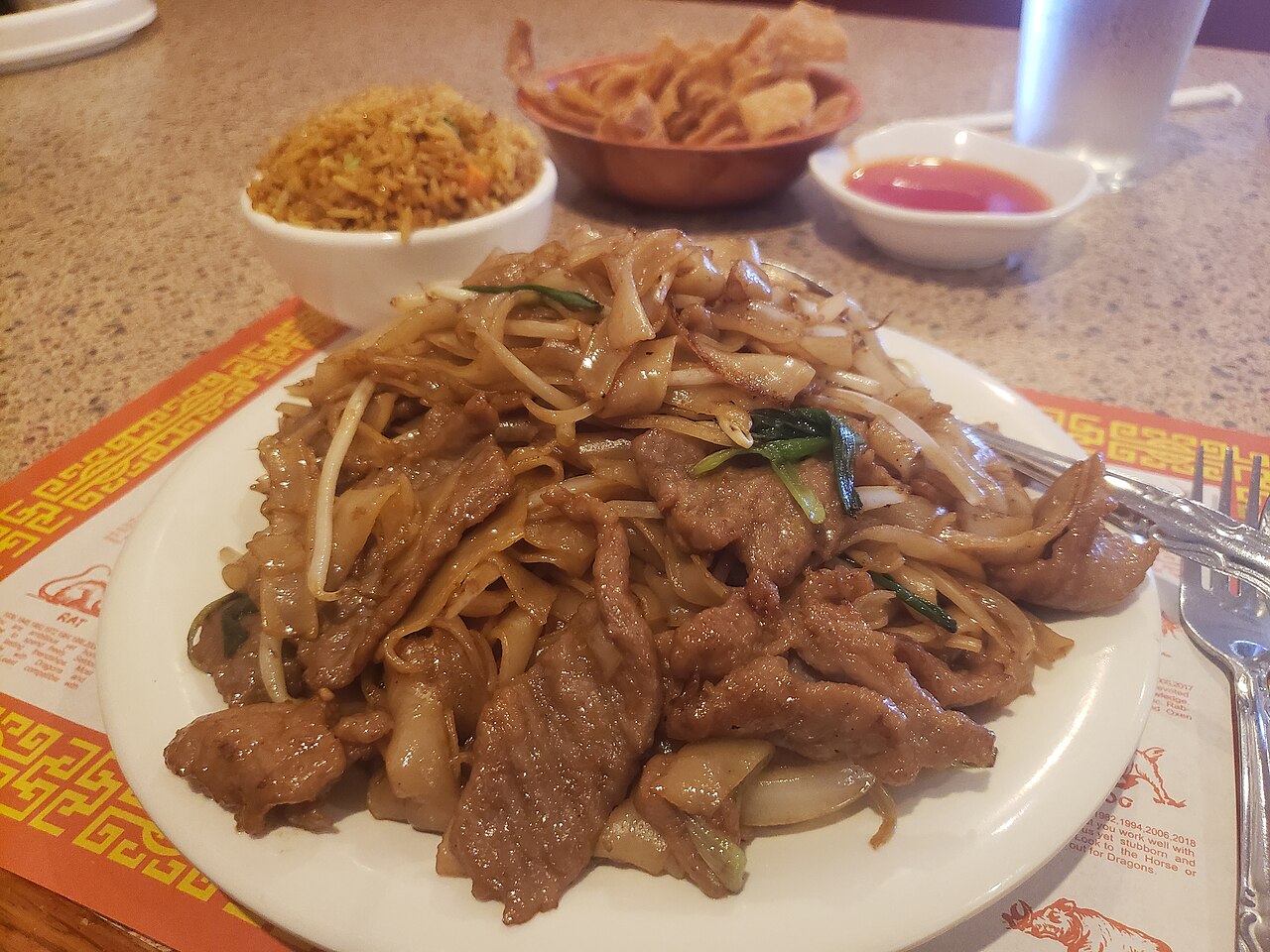
Dry-fried beef ho fun — wide flat rice noodles seared with beef strips and bean sprouts on a blue-and-white plate, with a light char from the wok 4
Dry-Fried Beef Ho Fun (Gan Chao Niu He)
干炒牛河 · wide rice noodles seared with beef — the wok-hei test

Wide, flat rice noodles (河粉, named after Shahe village) are dry-fried with tender marinated beef, bean sprouts, spring onion and just a whisper of soy. The heart of the dish is wok hei (鑊氣) — "the breath of the wok," that smoky aroma that only comes off a screaming-hot iron wok over maximum flame. The cook has to toss fast and continuously so the noodles cook dry with a faint char at the edges, yet never break, clump or turn greasy. It sounds simple; it is anything but. If the noodles come out mushy or wet, the heat wasn't high enough — which is exactly why Cantonese cooks use this plate to measure a kitchen. Order it and you'll know straight away whether the wok is the real thing.

Where: Cantonese restaurants (粤菜) and yum cha houses citywide · old kitchens across Liwan
Price: ¥25–48 / plate (about ฿125–240)
Tip: Eat it the instant it arrives, while the wok aroma is still on the noodles — it fades fast
Eating like a local

How to eat 粥粉面 the way Guangzhou does

When to eat what

This food works at any hour, but locals lean on it most for breakfast and the late-afternoon gap. Sampan congee and cheung fun are the classic morning pairing — one bowl of porridge, one plate of rolls, just enough before work. Wonton noodle suits both a light lunch and an easy dinner, while dry-fried beef ho fun usually arrives as a main, alongside rice or a spread of dim sum.

These are small, plain shops — tables close together, busy, fast-turning, no dress code and no booking. Some take your order at a counter and leave you to find a seat; others have staff working the room. If you see a line of locals out the door in the morning, that's your signal that the food is good.

Eating solo: one bowl of congee or noodles plus a plate of cheung fun — ¥20–50 (about ฿100–250) and you're full. In a group: order a spread and share, and make sure you cover all three — congee, rice noodle and egg noodle.

A word on payment

These small shops run primarily on WeChat Pay and Alipay. Many still take cash in yuan, but almost none accept foreign credit cards. Download Alipay or WeChat before you arrive and link a Visa or Mastercard through international mode — scanning to pay is the smoothest option, and the shops are thoroughly used to it.

Plenty of older Xiguan shops have no English menu. Pointing at a picture works; showing the Chinese name of the dish works better — "肠粉" (cheung fun), "云吞面" (wonton noodle), "艇仔粥" (sampan congee). A little effort with the language is usually met with real warmth, even if it isn't fluent.

Where to go

Old shops — where locals queue

Places Guangzhou has been eating at for decades, confirmed open, with prices checked for 2026.

1
Wu Cai Ji Noodle (吴财记面家)
Bamboo-pressed wonton noodle · Michelin Bib Gourmand · Xiguan

A long-running family noodle shop in Xiguan that presses its own bamboo noodles, folds its own wontons and simmers its own broth — and holds a Michelin Bib Gourmand for the sheer consistency of it. The noodles are thin, yellow and springy, the wontons wrapped around whole shrimp, the broth clear but deeply savoury. If you want to see the traditional bamboo-pole noodle-making, the Xihua Road (西华路) branch sometimes has it on display. It's small and busy; go a little early to skip the wait.

Address: 212 Wenchang North Rd (near Changshou Lu station) · also 44 Diyijin St, Xihua Rd
Hours: ~7 am–8 pm · Price: ¥15–40/person (about ฿75–200) · Cash / WeChat / Alipay
2
Yin Ji Chang Fen (银记肠粉店)
Cloth-pulled cheung fun · open since 1958 · near the Chen Clan Academy

A legendary Guangzhou cheung fun house, open since 1958 and known above all for its cloth-pulled rolls (布拉肠) — steamed on fine cloth and scraped off into sheets so thin and slippery they barely hold together before they melt on the tongue. The Wenchang North Road branch near the Chen Clan Academy is the old location locals point newcomers to. Shrimp and beef cheung fun are the favourites, and a plate alongside a bowl of congee makes a complete morning. There are now branches across the city, including the Shangxiajiu tourist strip.

Address: 345 Wenchang North Rd, Liwan (near the Chen Clan Academy) · multiple branches
Hours: ~7 am–9 pm · Price: ¥10–30/person (about ฿50–150) · WeChat / Alipay
3
Baohua Noodle (宝华面店)
Wonton & pig-trotter noodle · local favourite in Xiguan

A small Xiguan noodle shop that locals are genuinely fond of. The draws are springy wonton noodle and a pig-trotter noodle (猪手面) where the trotter is braised until it's soft enough to fall off the bone, in a broth made sweet and round by long bone-simmering, with bouncy shrimp wontons alongside. Prices are gentle, this isn't a tourist spot, and the atmosphere is genuinely no-frills — a good place to try Cantonese noodles the way Guangzhou actually eats them day to day.

Address: Xiguan (西关), Liwan District · near Baohua Road (宝华路)
Hours: ~8 am–9 pm · Price: ¥20–40/person (about ฿100–200) · Cash / WeChat / Alipay
4
Xihua Road & Liwan Lake (西华路 / 荔湾湖)
The local morning-food district for congee and rice rolls

If you want sampan congee in a genuinely local setting, take a morning walk down Xihua Road (西华路) in Liwan — an old food street lined with congee shops, cheung fun stalls and cheap breakfast spots. This isn't the tourist scene of Shangxiajiu; it's where Guangzhou actually eats. Around Liwan Lake (荔湾湖), the birthplace of sampan congee, you'll find old congee shops scattered through the lanes. Wandering the side streets is exactly how you turn up the good stuff no guidebook lists.

Address: Xihua Road (西华路) and around Liwan Lake Park (荔湾湖公园), Liwan District
Hours: Most shops open early, ~6:30 am–2 pm · Price: ¥10–35/plate (about ฿50–175)
Frequently asked

FAQ · before you eat 粥粉面

What does 粥粉面 (congee, noodle, noodle) mean?
粥粉面 (zhōu fěn miàn) is the umbrella term for three everyday Cantonese food groups: is congee (rice porridge, such as sampan congee 艇仔粥), covers rice-flour noodles (cheung fun 肠粉 and wide ho fun 河粉), and is egg noodle (such as wonton noodle 云吞面). These are inexpensive breakfast and casual-meal staples found at small shops all over Guangzhou, open from early morning to late at night.
What makes sampan congee (艇仔粥) different from ordinary congee?
Sampan congee is simmered from rice and pork bones until the grains break down completely into a silky, almost grain-free porridge, then finished with fresh toppings: thin slivers of fish, dried squid, fried peanuts, crisp pork skin, spring onion and bamboo strips. The name "sampan" (boat) comes from the Tanka boat-dwellers of Lychee Bay (荔枝湾, now Liwan Lake) who, during the Qing dynasty, cooked and sold this congee from their sampans to people along the water.
What are bamboo-pressed noodles (竹升面) in Guangzhou wonton noodle?
竹升面 (zhúshēng miàn), or jook-sing noodles, are made the traditional way: a cook sits on one end of a thick bamboo pole and bounces it repeatedly over the dough instead of kneading by hand. The dough is high-gluten flour and duck eggs only, with no added water, producing a thin yellow noodle that is springy and snaps cleanly. Authentic Guangzhou wonton noodle serves whole-shrimp wontons in a clear broth, with the noodles placed at the bottom of the bowl so they don't go soggy.
What is the difference between cloth-pulled and drawer-style cheung fun (肠粉)?
Cheung fun is a thin sheet of steamed rice noodle rolled around a filling and drizzled with sweet soy. There are two methods: cloth-pulled (布拉肠), where the batter is steamed on a fine cloth and scraped off to give the thinnest, silkiest sheet — the method used by Guangzhou's old-school shops — and drawer-style (抽屉肠), steamed in a metal tray, slightly thicker because it includes some glutinous rice flour. Popular fillings are shrimp, beef, char siu and egg.
Why is 干炒牛河 used to judge a Cantonese kitchen?
干炒牛河 (gānchǎo niúhé) is wide rice noodles dry-fried with marinated beef and bean sprouts. Its whole identity rests on wok hei (鑊氣) — the smoky aroma produced by a screaming-hot wok over maximum flame. The cook must toss continuously and fast so the noodles cook dry with a slight char at the edges but never break, clump or turn greasy. If the noodles are mushy or wet, the heat wasn't high enough. That is why Cantonese cooks treat this dish as a true test of skill.
Where do I go for real congee and noodles in Guangzhou?
The Xiguan (西关) neighbourhood in Liwan District is where this food originated. Locals point to Wu Cai Ji for bamboo-pressed wonton noodles (吴财记 · 212 Wenchang North Rd · Michelin Bib Gourmand), Yin Ji for cheung fun (银记肠粉 · open since 1958 · 345 Wenchang North Rd near the Chen Clan Academy), and the small shops along Xihua Road (西华路) and Baohua Road (宝华路). Expect to pay around ¥8–40 (about ฿40–200) per plate.
Klook · Food Tour

Guangzhou Food Tour — the right shops, with someone who knows

A Guangzhou food tour with a local guide who takes you through the sampan congee spots, bamboo-noodle shops, cheung fun stalls and dim sum houses of Xiguan and Liwan — taste it all, no language barrier.

See Guangzhou Food Tours on Klook →
Wherebest is a Klook affiliate partner — we may earn a commission when you book through this link, at no extra cost to you.