A clear bone broth with no chilli in sight, beef so fresh it's still sliced to order, a whole goose lacquered in the window, and tea poured into thimble-sized cups. This is a cuisine all its own — and Guangzhou eats it every day.
Let's be clear from the start: Chaoshan (潮汕) food is not Cantonese food, even though both belong to Guangdong province. Chaoshan comes from the cities of Chaozhou and Shantou (Chao + Shan) in the northeast, a region with its own language — the Teochew dialect, the same one many overseas Chinese families speak — and its own culture and culinary identity. Chaoshan people take real pride in being Chaoshan, and they don't much like being lumped in with the Cantonese.
So why does it belong in a Guangzhou food guide? Because Chaoshan people have moved into the city to work and trade for generations, and they brought their kitchens with them. Fresh-beef hotpot restaurants, braised-goose shops and gongfu teahouses have sprung up in every district. When someone in Guangzhou suggests hotpot today, more often than not they mean Chaoshan fresh-beef hotpot. It has quietly become part of how this city eats.
The heart of Chaoshan cooking is two ideas: fresh and true. The flavour of the ingredient matters more than the sauce. The broth runs clear. The beef is so fresh it is sliced minutes before it reaches you. The seafood comes off the boat. Where Cantonese cooking masters dim sum and roast meats, and Sichuan brings fire and numbing spice, Chaoshan is a kind of restraint that runs deep — the sort that wins people over without raising its voice. It has long been counted among the most refined cooking traditions in China.
In order, from the star of the show — fresh-beef hotpot — to the tea ritual that closes every meal.
1
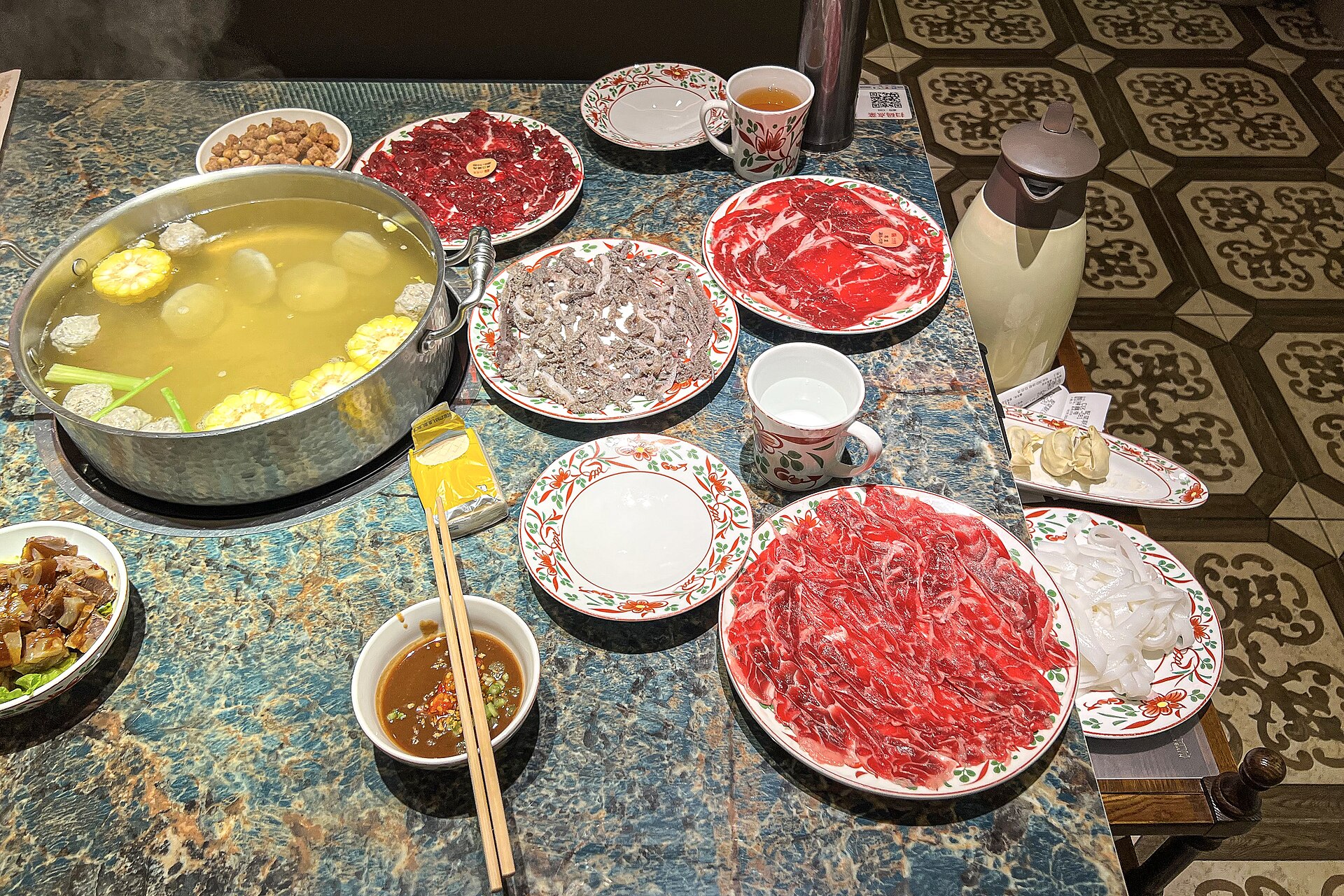
Picture a pot of clear broth with not a single chilli floating in it — beef bones simmered with daikon radish, corn and celery until they turn naturally sweet. Not spicy, not greasy. And the beef? That is the whole point. It is sliced to order behind the counter, and at the best places it's so fresh it still quivers on the plate. You blanch it in the broth for a handful of seconds, and the moment it turns pale brown you lift it out, dip it in shacha satay sauce and eat it straight away. This is the most modest and most quietly delicious hotpot Guangzhou has to offer.
This is what separates Chaoshan hotpot from every other kind. The beef menu isn't just "beef" — it's split into as many as ten different parts of the cow, each sliced to a specific thickness with its own cooking time. Diaolong (吊龙) is the prized upper-back loin, the most tender, blanched for about 8–10 seconds. Shibing (匙柄) is a tendon-edged cut with beautiful marbling, around 7–8 seconds. Wuhua zhi (五花趾) is a shank cut with a springy tendon that's fun to chew. Menus often print a little table of blanching times for each cut — a built-in instruction manual, right there on the table.
Real Teochew beef balls aren't run through a machine — the beef is pounded by hand with a pair of iron bats for an hour or more until it turns springy. The legend says a proper one will bounce when you drop it, and it's basically true. The trick is to pound the meat into a paste while keeping the fibres intact, so the ball stays bouncy and bursts with a little beef juice when you bite. Drop them into your hotpot, or order a bowl of them in a plain clear broth. Chaoshan kids grow up on these, and several of the famous old beef-ball makers have branches in Guangzhou.
If you walk past a Chaoshan shop and see a whole, deep-brown goose hanging in the window — that's lou e (卤鹅), Teochew braised goose. It uses the large lion-head goose (狮头鹅), braised in a master stock (卤水) that has been simmered, kept and topped up over time — the longer it's used, the deeper and more fragrant it gets. It comes sliced with the braising liquid spooned over, served with a garlic-and-vinegar dip that cuts the richness and lifts the meat's natural sweetness. The neck and the goose liver are the parts Chaoshan diners fight over; if you're feeling brave, the goose blood and intestine braised in the same stock are there too.
Visitors from Thailand will recognise this one — the Thai oyster omelette traces its roots straight back to Teochew. But the Chaoshan version, hao lao (蚝烙), leans on small fresh oysters tossed in tapioca starch and fried in a hot pan with egg, so the starch sets into a chewy, almost gluey layer that wraps each oyster as it gives up its umami into the pancake. Crisp at the edges, soft in the middle, scattered with spring onion, and eaten with a fish-sauce-and-chilli dip or a Chaoshan chilli sauce. Order it alongside hotpot or on its own — the freshness of the oysters tells you whether the kitchen is using good ingredients.
A Chaoshan meal doesn't end with the food — it ends with tea. Gongfu cha (工夫茶) is the Chaoshan tea ritual, taken very seriously: a small clay pot, cups the size of a thimble, and strong, dark Phoenix Dan Cong oolong (凤凰单丛) from Phoenix Mountain in Chaozhou. The pot is poured in a continuous circle so every cup comes out the same colour and strength. The cups are tiny on purpose — you sip a little at a time, slowly, while you talk. The tea is bitter first and then sweet at the back of the throat, and it does a brilliant job of cleansing the palate after a rich meal. Most Chaoshan restaurants pour it for you free, before and after.
Start by drinking a cup of the plain broth to taste the sweetness of the beef bones, radish and corn — a good broth is clear and rounded before you've cooked anything in it. Then start blanching the beef. Chaoshan diners follow a rule: lean cuts first, then the fattier cuts and offal, because fat and heavier ingredients cloud the broth and change its flavour.
Blanch a little at a time, dropping the beef in and counting the seconds for each cut. The moment it turns pale brown, lift it out and dip it in the shacha sauce. Never leave beef sitting in the pot — a few seconds too long and it turns tough. Drop the hand-pounded beef balls in to simmer alongside, and finish the meal with noodles or vegetables cooked in the broth, which by now has grown sweeter from all the beef.
Group size: two people order 3–4 plates of beef plus balls and greens · four people manage 6–8 plates easily · Per person: around ¥90–130 (~฿450–650) for a full meal.
Most fresh-beef hotpot and Chaoshan restaurants in Guangzhou take WeChat Pay and Alipay as standard. Some accept cash in yuan, but foreign credit cards are rarely taken. The easiest move is to download Alipay before you travel and link a Visa or Mastercard through its international mode.
Popular chains like Bahe Li Hai Ji get very busy on Friday and Saturday evenings, with long queues. Arrive before 6pm, or use the restaurant's electronic queue (usually a WeChat mini-program). The big chains tend to have photo menus, so you can point and order without any language worry — and some branches stay open until 3am for a late-night craving.
Where Guangzhou goes for fresh-beef hotpot and Chaoshan food — always check the address and hours in a maps app before you set out.
If you're having your first Chaoshan fresh-beef hotpot in Guangzhou, this is the name people mention first — the original chain out of Shantou, now all over Guangdong. Beef sliced to order, a clearly divided cut menu complete with blanching-time tables, a clear bone broth that's sweet on its own, and a house shacha sauce. The atmosphere is the buzz of a genuine local restaurant. There are branches in both the Tianhe and Haizhu districts, so just pick whichever is closest to where you're staying.
Another fresh-beef hotpot chain Guangzhou turns to in numbers, with two things going for it: approachable prices and late hours. Diaolong loin, fattier cuts and hand-pounded beef balls, all in the same clear broth, at a spot that's an easy stroll from the Beijing Road shopping street — handy for dinner after a wander. It gets busy in the evening, so go before the rush or be ready for a short wait in the queue.
Teochew braised-goose shops in Guangzhou tend to be small specialists, and they're easy to spot — a whole deep-brown goose hanging in a glass case at the front. Order a plate of sliced braised goose, the neck, the liver, with the garlic-vinegar dip and a bowl of hot congee, and you have a light, satisfying meal. Many also sell other Chaoshan snacks braised in the same master stock: blanched squid, braised eggs, braised tofu. Look for the shop with people queuing for takeaway — that's the sign the cooking is the real thing.
If you want a full Chaoshan meal at the table rather than just hotpot, sit-down Chaoshan restaurants (潮汕菜馆) are plentiful in the Tianhe and Haizhu districts. Order the oyster omelette, Chaoshan-style steamed fish, blanched greens with garlic oil, fish-sauce-cured raw shrimp, and finish with gongfu tea poured at your table. The atmosphere suits a group sharing several dishes. A good one will have local Chaoshan diners eating there regularly — listen for the Teochew dialect at the tables around you.