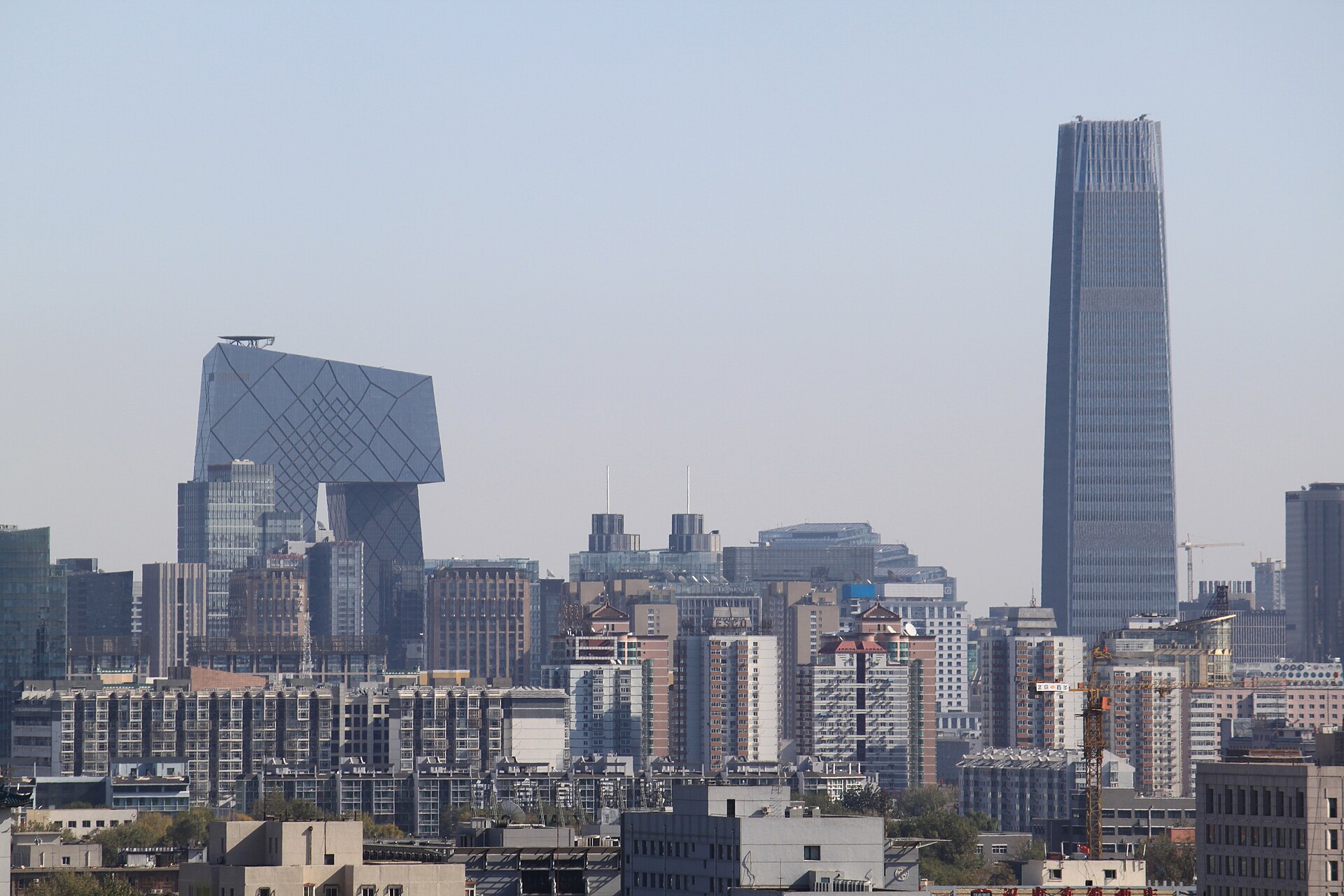
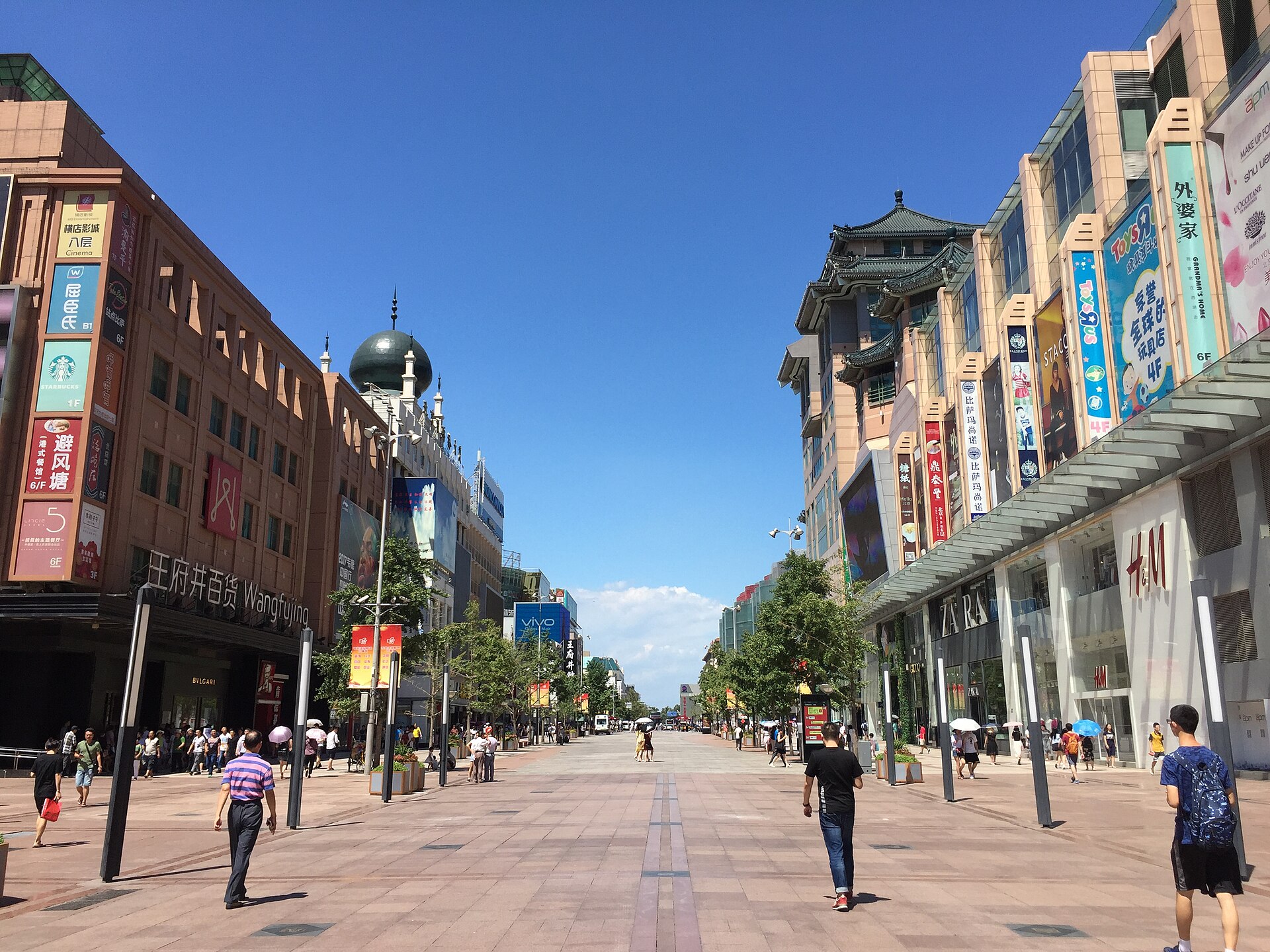
The other Beijing — no city walls, no palace roofs. This is the eastern skyscraper district, home to China Zun (the city's tallest building), Rem Koolhaas's looped CCTV Headquarters and SKP, the highest-grossing department store on earth.
Picture this: you have just walked out of the Forbidden City — gold roofs, red walls, centuries of imperial history. You take Metro Line 1 a few stops east, get off at Guomao (国贸), and surface into what feels like a different city entirely. Glass towers on every side, wide roads full of traffic, and straight ahead, China Zun (officially CITIC Tower), Beijing's tallest building at 528 metres, its profile shaped like an ancient Chinese wine vessel.
This is the CBD (中央商务区) — Beijing's central business district, in the Chaoyang District (朝阳区) on the eastern side of the old city's axis, with Guomao at its heart. The China World Trade Center (国贸) complex opened in the late 1980s and grew steadily into a cluster of office towers, hotels and luxury malls, becoming the city's hub for international finance and business.
Most visitors come to Beijing for the old things — the Great Wall, the palaces, the temples, the hutongs. Few make a point of coming here. But if you are a business traveller with meetings, a brand-shopping enthusiast, or simply curious what "modern Beijing" actually looks like, the CBD is the answer — and it sits just a short metro ride from the old city.
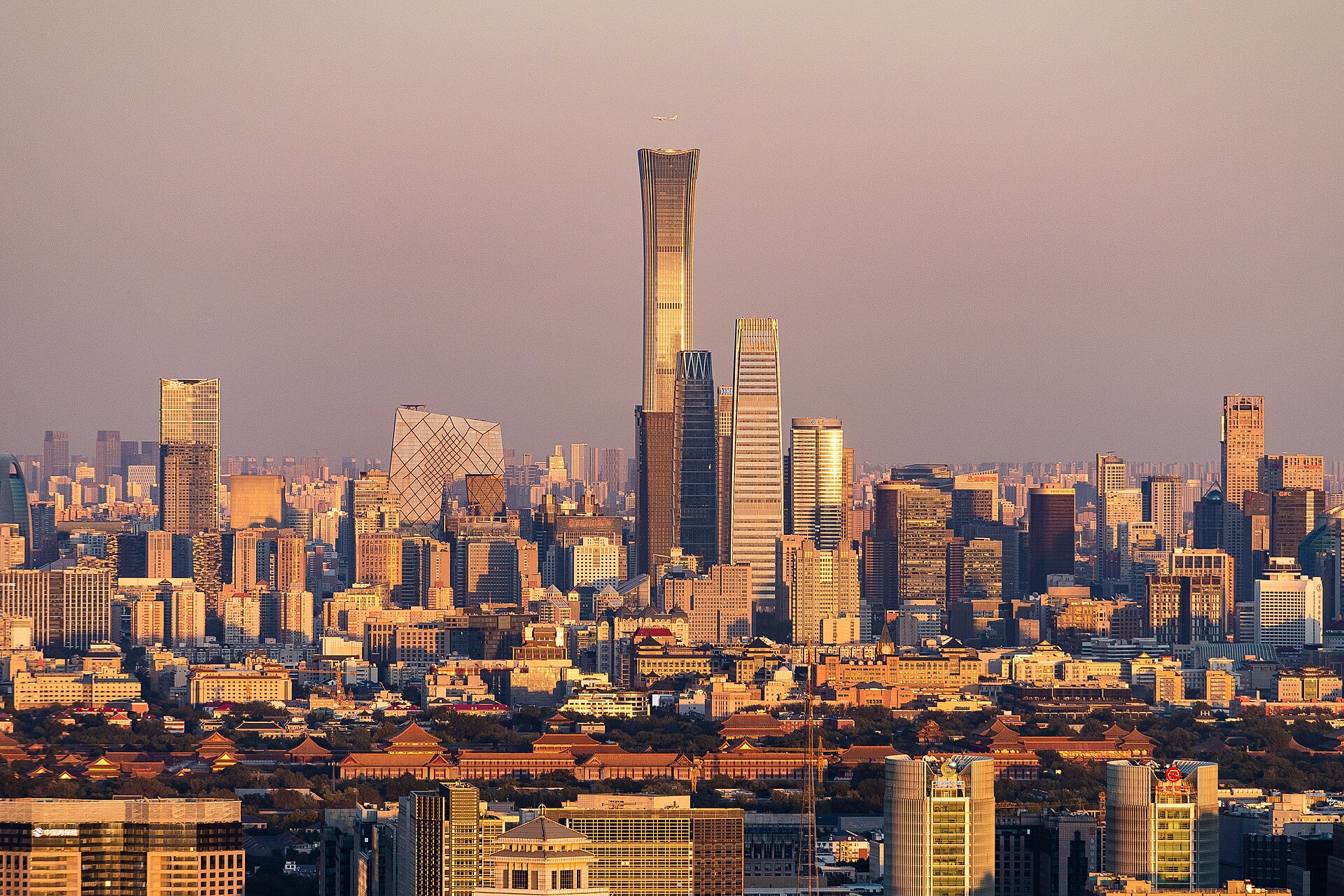
Offices and meetings by day. A lit-up skyline and high-floor bars after dark.
The difference between the CBD and old Beijing is one of scale and pace. Where the hutongs slow you down and reward attention to small details, this district makes you look up and move at the speed of the people heading to work. The roads are wide, the towers are tall, and the whole place is designed to say that Beijing has become an international financial city. Here is who tends to like it.
This district is an open-air museum of architecture. China Zun (CITIC Tower) was designed by Kohn Pedersen Fox in the shape of a "zun" — an ancient Chinese bronze wine vessel, wide at the top and base and narrow in the middle, which gives the tower its giant-vase silhouette. The CCTV Headquarters, designed by Rem Koolhaas and OMA, is a continuous loop on two leaning legs that meet overhead, seeming to defy gravity. Both stand in the same district and can be photographed from many angles.
If "shopping" to you means luxury brands, this is the destination. SKP (新光天地) is the highest-grossing department store in the world and carries every top-tier name; across the road, SKP-S is an art-retail concept space. The China World Mall, inside the Guomao complex, mixes luxury brands with a wide range of restaurants and connects directly to the metro station, so you never have to step outside.
The CBD does not run ticketed observation decks the way Shanghai does, but it has bars and restaurants on high hotel floors with views over the whole district — for example Atmosphere on floor 80 of the China World Summit Wing, where the price of a single drink buys a panorama of Beijing at night. This is something the lower-rise old city simply cannot offer.
This is the main reason the district exists. Multinational offices, banks and many embassies sit in Chaoyang. If you have CBD meetings, staying here means a short walk or a few minutes by car. The hotels are built for working travellers — meeting rooms, fast internet and a location that links Line 1 and Line 10 at Guomao.
Beijing's tallest building — 528 metres, 109 floors, completed in 2018, designed by Kohn Pedersen Fox. The name "China Zun" comes from the zun, a ceremonial bronze wine vessel from ancient China; the tower flares at the top and base and narrows in the middle, giving it the look of a giant vase. Inside are offices, apartments and a hotel. There is no general public observation deck in the way Shanghai's towers have, so the best way to appreciate it is from outside — walking around the base for photographs, or from a high-floor bar in a nearby hotel. (If a tour or viewpoint is running, check the current status before you go.)
The headquarters of China's state broadcaster, designed by Rem Koolhaas and OMA — a continuous looped structure that reads like an angular figure folded back on itself. Locals nickname it "da kucha" (大裤衩 / "big underpants") for the way its two leaning legs meet at the top. It is one of the most-discussed pieces of contemporary architecture in China. The interior is not open to the public, but the exterior photo angles are the highlight — walk around to find the spot where the two legs overlap into a frame, and you get the shot that instantly says Beijing.
The original complex that gave Guomao its name — office towers, hotels and the China World Mall (国贸商城), which connects directly to Guomao metro station. Inside are luxury brands, restaurants, food courts and an indoor ice rink. The tallest part of the complex is the China World Tower (国贸三期), at around 330 metres, whose upper floors house the China World Summit Wing hotel and the Atmosphere bar. The whole thing is walkable indoors, which is a real advantage on a bad-air or freezing-cold day.
The luxury department store with the highest sales in the world, on Jianguo Road in the CBD, carrying every top-tier name — Hermès, Chanel, Louis Vuitton and dozens more. Across the road, SKP-S is built as an art-retail concept space (its sheep-and-robot installation has become a popular photo spot). Even if you have no intention of buying anything, walking the interior architecture and the displays is worth it. The most convenient access is Dawanglu (大望路) station on Lines 1 and 14.
The highlight many visitors miss here is the night view. The CBD towers are fully lit after dark, and the best way to take it in is from a bar or restaurant high up in a hotel — Atmosphere on floor 80 of the China World Summit Wing is one of the highest bars in Beijing, where one drink buys a panorama of the whole district. Check drink prices and opening hours before you go. The best time to arrive is shortly before sunset, so you watch the daylight sky turn into the night lights.
A few stops on Line 1 reaches the old city, and the area runs from fine dining to reasonably priced food courts.
The biggest advantage of this district for visitors is Line 1. Ride west from Guomao through Wangfujing (王府井) — the famous pedestrian shopping street — and on to Tiananmen and the Forbidden City, all without changing lines. The loop Line 10 takes you to Sanlitun (三里屯) for nightlife and shopping, and onward towards the 798 Art District in the north-east.
Read more: all Beijing attractions · the 798 Art District guide
The district has a broad range of dining, from fine dining on the high floors of the luxury hotels to the food courts inside the China World Mall and SKP, which serve regional Chinese and international food at reasonable prices. If you want Peking duck, several of the famous names have branches in the malls and hotels here. Prices in the CBD malls run higher than the street stalls of the old quarters; for cheaper, simpler food, walk the streets just outside the towers or look for the canteens inside the office buildings where staff eat.
Read more: the full Beijing city guide — where to eat, see and stay
Best for business travellers, luxury shoppers and anyone who wants a skyline view from the room.
The case for basing yourself in the CBD / Guomao is straightforward: step out of the door and you are in the skyscraper district, next to SKP and the China World Mall, with a major metro interchange (Lines 1 and 10) at Guomao that gets you into the old city fast. Most hotels here are international five-stars and serviced apartments, with some of the best skyline rooms in Beijing.
The honest limitations: this is a business district — it is east of the imperial sights such as the Forbidden City and the hutongs, so you take the metro in, and it is quieter at the weekend when office workers head home. If your itinerary is mainly old palaces and lane-house neighbourhoods, staying near Wangfujing may be more convenient. But if your goals are business, luxury shopping and city views, this area is hard to beat.
Or read individual hotel reviews for the CBD / Chaoyang area:
The district is very easy to reach by metro, and it is a key interchange. Choose your route based on where you are coming from.
Also in Chaoyang, north of Guomao, Sanlitun is Beijing's liveliest area for bars, cafes and shopping on the modern side of the city. Taikoo Li is an attractive open-plan mall gathering fashion brands and international restaurants, and the area is far busier and more animated at night than the CBD. If you are staying in the CBD and want somewhere to eat and drink in the evening, it is just a few minutes away.
An arts zone converted from a complex of old socialist-era factories, in the north-east of Chaoyang, gathering galleries, artist studios, cafes and street art among red-brick industrial buildings. It is unlike anything else in Beijing — neither imperial palace nor glass tower, but the city's creative side. Half a day is ideal for wandering the galleries and taking photographs.
Read more: the full 798 Art District guide