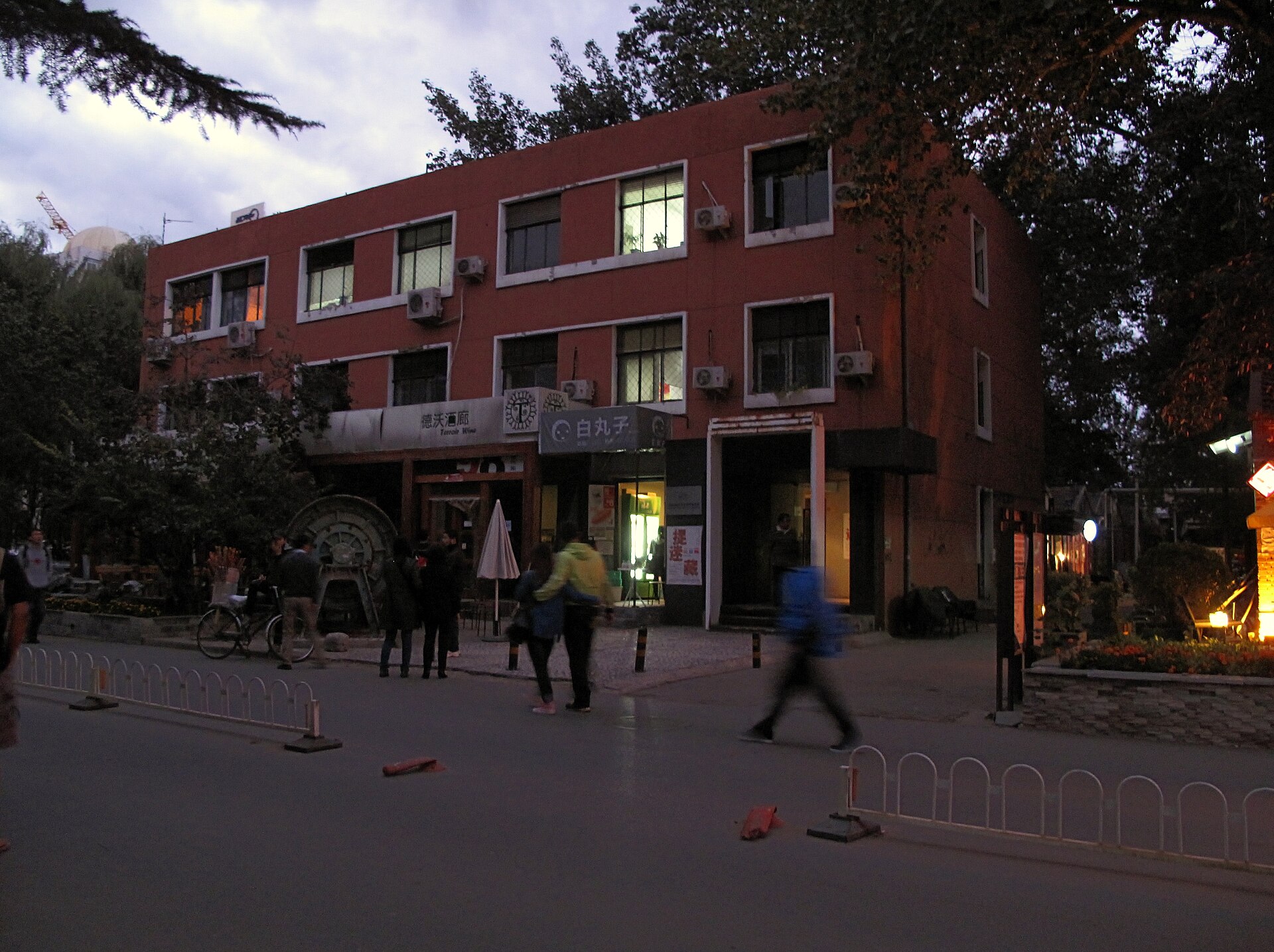
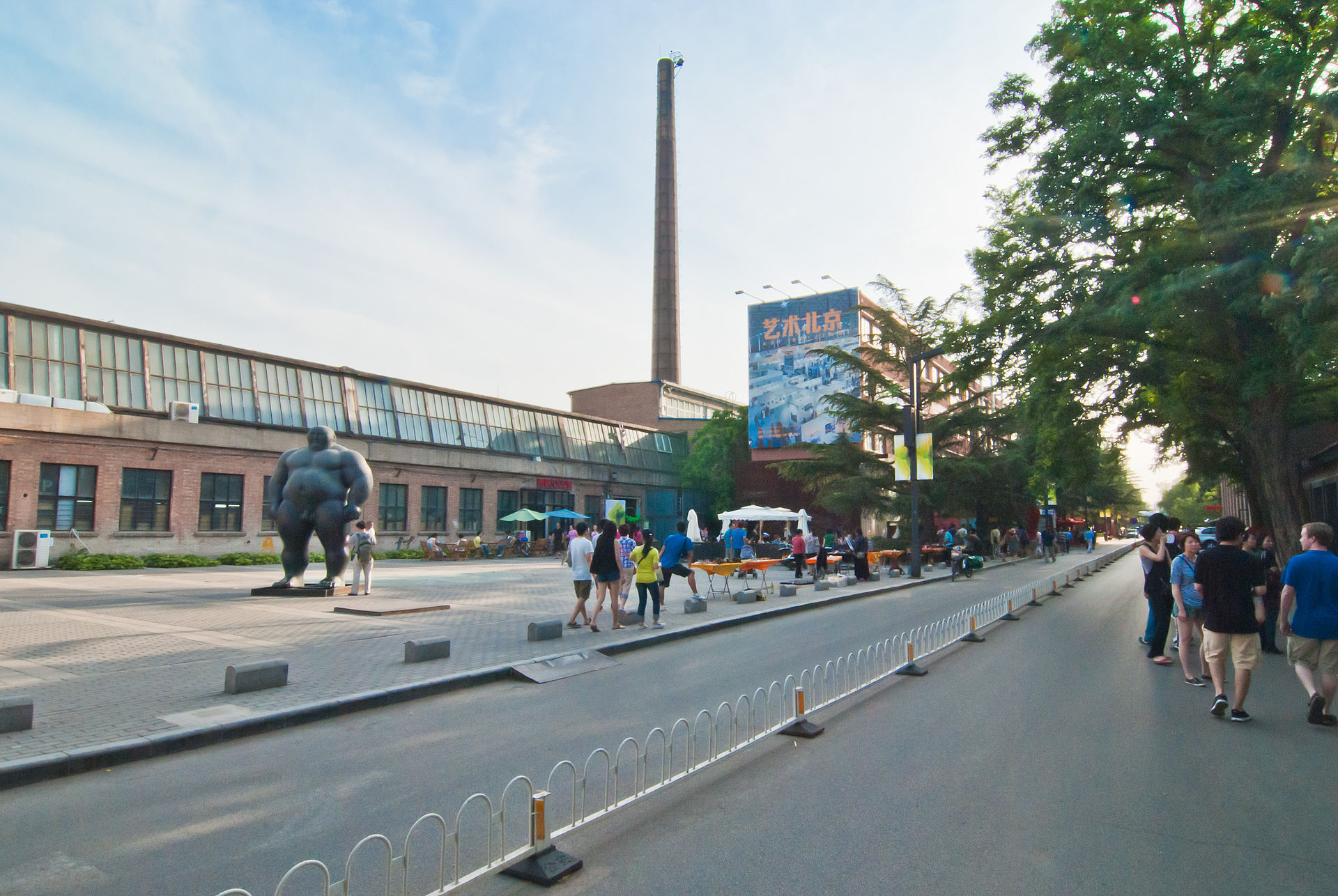
Red-brick lanes between abandoned 1950s workshops that artists made their own — dozens of galleries, outdoor sculptures, a tall factory chimney and cafés, out in Chaoyang District. The open-air area is free to wander.
Picture this: you walk into a lane flanked by red-brick buildings with saw-tooth roofs and tall factory windows. On some walls, big red Maoist-era slogans are still painted, untouched. Old steel pipes run overhead, a steam locomotive sits parked as if it were an exhibit, and a large contemporary sculpture stands in the middle of a courtyard. All of this was once Factory 718, a 1950s state electronics complex built in East-German Bauhaus industrial style — practical, light-filled and, decades later, accidentally perfect for showing art.
This is 798 Art District, known to locals as Dashanzi (大山子), in the Jiuxianqiao area of Chaoyang District, in Beijing's northeast. Artists began renting the cheap, high-ceilinged workshops around 2002, and bit by bit the place became the largest and most important contemporary-art district in Beijing.
Today it holds dozens of galleries, artist studios, design shops, independent bookstores, cafés and restaurants, all tucked among the original industrial relics. The anchor institution is UCCA (Ullens Center for Contemporary Art). What sets 798 apart from every other Beijing sight is simple: the open-air lanes are free to wander, there is no ticket queue, and the mix of old factory and new art is something you will not find anywhere else in the city.
Wander the lanes — each of these has something behind it.
The institution that anchors 798, with a rolling programme of international-level exhibitions, both Chinese and foreign artists, throughout the year. The space is a converted factory hall, light and airy. Admission runs around ¥60–150 (~฿300–750) depending on the show. Check what is on before you come — this is the single best reason the trip out pays off.
The buildings themselves are half the appeal. The saw-tooth roofs were designed to draw even north light into the workshops; the windows are tall; and on some walls, revolutionary-era slogans are still painted in red characters. These details are why almost every corner of 798 photographs with a story attached.
Walk far enough and you find oversized contemporary sculptures, a red dinosaur installation, strange figurative statues, long runs of factory piping, and an old steam locomotive kept as art in its own right. All of it is free to see and photograph — the most fun part of the visit if you would rather not pay gallery admission.
798 is not only art on walls. It is full of independent design shops, art bookstores, ceramic studios and good-looking cafés inside the old workshops — ideal for a coffee break between galleries. If you like café-hopping, this is the right field for it.
Continue east from 798 a little further and you reach 751 D·Park, a former gasworks converted into a design park. Giant spherical gas tanks, tall steel pipework and event spaces used for fashion shows. It draws fewer people than 798 and feels rawer — good for photos, and easy to fold both into one trip.
The best way to do 798 is to let yourself get a little lost in the lanes rather than over-plan. Walk from the main courtyard into the side alleys, step into whichever galleries look interesting (many are free; some charge), read the signboards to see what is showing, and pick only the ones you genuinely want to see.
If time is tight, start with UCCA, then circle the outdoor sculptures and street-art walls around it, and finish by walking into 751 D·Park next door. That adds up to a comfortable half-day.
798 is one of the more enjoyable café districts in Beijing. Most of the coffee shops sit inside converted factory units with high, open ceilings, and some have outdoor seating facing the sculptures. They make good leg-rest stops between galleries — or somewhere to settle in and read for a couple of hours on a rainy or too-hot afternoon.
798's signature angles are the spots where the tall factory chimney cuts against the sky and the red-brick walls carrying old Maoist slogans, plus the big contemporary sculptures in the courtyards. On a clear day you get a strong contrast between old industry and new art.
Honestly, 798 is heavily used for social-media photos, and some spots have a small queue of people waiting their turn, especially on weekends. For fewer people in the frame, come on a weekday morning right as the galleries open around 10am — the light is still soft and the crowds have not built up.
798 sits in the northeast, a little outside the centre, so getting there is not as direct as the inner-city sights — choose between metro-plus-a-walk or a DiDi straight to the gate.
798 is in Chaoyang District, the same area as Sanlitun and the CBD — stay around here and the DiDi to 798 is short.