China's first national wetland park — winding canals, quiet ponds, reed beds and persimmon groves across 11.5 km² west of the city. Take an electric boat or walk the boardwalks, and let the pace slow down for half a day.
Most people come to Hangzhou for West Lake and forget that, only a few kilometres to the west, there is another world entirely — one with no towers, no main roads, just water. Picture yourself on the bow of a small electric boat as it slides into a narrow canal lined with willows and reeds, the only sounds the lap of water and birdsong somewhere out of sight. This is Xixi (西溪), and it feels nothing like the lake.
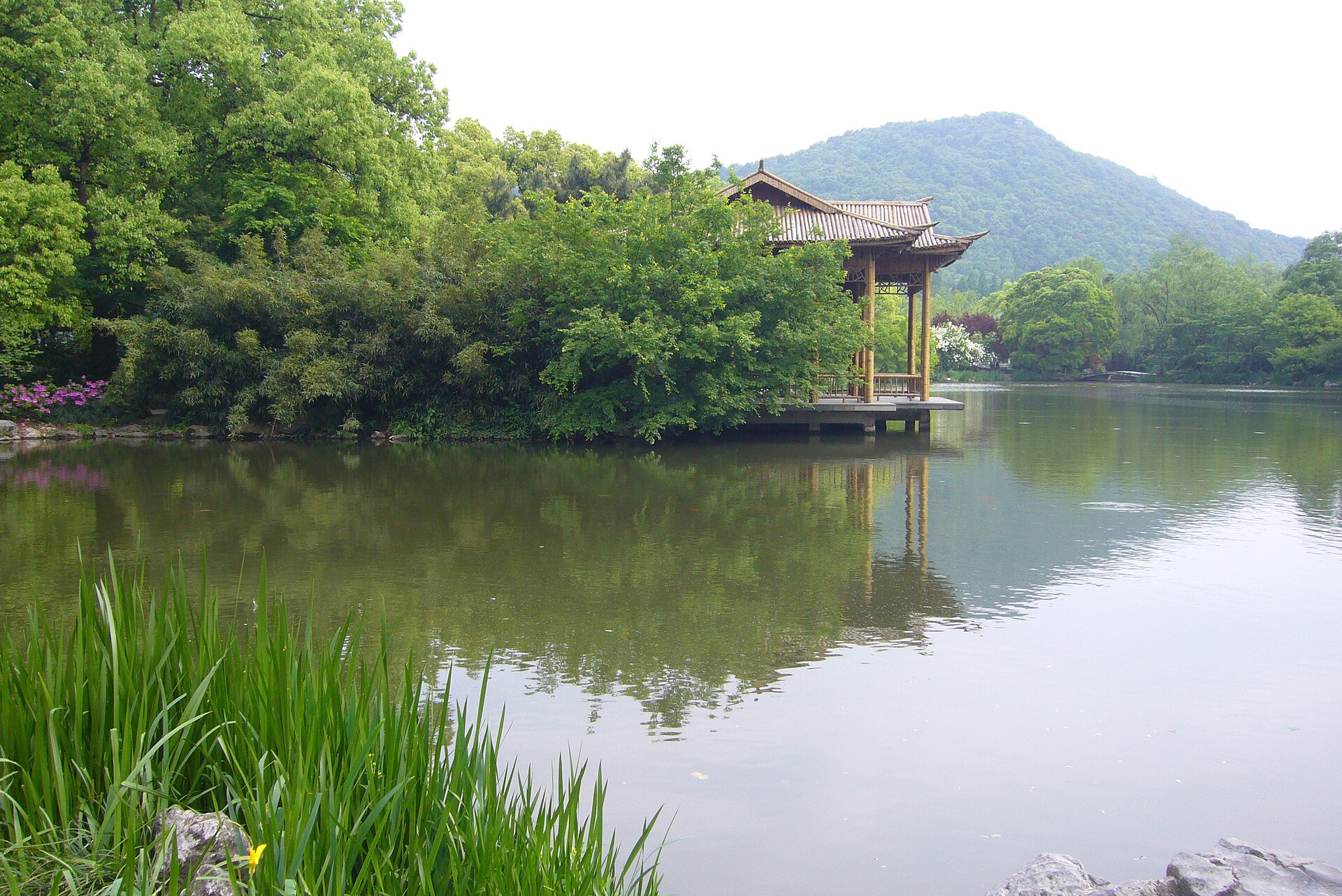
Xixi National Wetland Park opened in 2005 as China's first national wetland park, covering roughly 11.5 km². Most of it is water: six long rivers braid together into a network of canals, separated by small islands, fish ponds and reed beds. Locals call it "the kidney of Hangzhou" for the way it filters water and holds moisture across the western districts. What makes Xixi special is that it was never designed simply to look pretty — it is a landscape where people and water have lived together for centuries, scattered with old fishing villages, persimmon orchards and waterside pavilions.
If you have seen the 2008 Chinese film If You Are the One (非诚勿扰) by director Feng Xiaogang, you have already seen this place — seven of its scenic spots appear in the film, including a night boat-cruise scene people remember. Xixi became a popular pilgrimage for domestic travellers afterwards, but the good news is the park is so large that the crowds spread thin; walk a little deeper in and it feels like you have the wetland to yourself.
Each has its own rhythm — take it slowly and you will understand why people in Hangzhou love this place.
1
This is what you come to Xixi to do. Walking alone won't show you the place — the real magic is in canals the paths never reach. Electric boats leave from a dock near the Zhoujiacun entrance and run fixed routes through reed channels, under old stone bridges, past pavilions and timber houses on the water, taking roughly 30–60 minutes depending on the route. For something quieter and more traditional, some zones offer hand-rowed boats you can hire by the boat, slipping into narrow side-canals the electric boats can't enter.
Deeper inside the park sits Gaozhuang, a private garden that was once the home of an imperial official. Inside, it is laid out in classical Chinese garden style — ponds, covered walkways, small pavilions and timber halls — more refined and shaded than the plain village houses elsewhere in Xixi. It makes a good place to rest your legs mid-explore. Look for an angle where a timber doorway frames the water beyond it; from there the view composes itself like a Chinese landscape painting.
Come between mid-November and mid-December and you'll find Xixi at its most beautiful. Hundreds of mu of reeds flower white all at once, and when the wind moves through them they ripple like drifting snow. There is a Chinese phrase for the scene — "autumn reeds flying like snow". The best place to see it is from a boat threading directly through the reed channels, the white plumes at eye level on either side. It's the season people in Hangzhou wait all year for.
Xixi is one of Hangzhou's oldest plum-blossom viewing spots. From mid-February to mid-March, the plum trees along the water bloom in turn — white, pink and deep red. There is an old tradition here called "seeking plum blossoms by boat", drifting slowly along the canals in search of the trees in finest flower. If you visit Hangzhou early in the year and want an atmosphere most tourists don't know about, this is the golden window: the air is still cool and pleasant, and it's far less crowded than peak spring.
From mid-September, the persimmon orchards across Xixi begin to ripen, bright orange fruit hanging heavy against the green water. Xixi's square persimmons are well enough known to be counted among China's finest, and some areas open for visitors to pick their own. Throughout the park you'll also find traces of the old water way of life — weathered timber houses, small boat landings and canalside shrines. Walk on a while and you start to understand that Xixi isn't only nature; it's a way of living where people still use the water as their road.
Everything you actually need, in one place — holiday prices can differ, so check before you go.
Xixi sits west of the city, about 8–10 km from West Lake, and is easy to reach by Metro Line 3 or by taxi:
The quickest option is a taxi or DiDi straight from the West Lake shore to the Zhoujiacun entrance, about 25–30 minutes depending on traffic. This works well if you plan to see West Lake in the morning and Xixi in the afternoon, or the reverse.
Line 3 runs past Xixi with several stations for different gates — Xixi Wetland South (西溪湿地南) for the Zhoujiacun main entrance, Huawu for the Gaozhuang entrance, and Hongyuan for the Longshezui (West District) gate. Pick the one that matches the zone you want to start in.
The East District is the main zone with electric boats, Gaozhuang, the persimmon groves and the most scenic canal routes — admission ¥80. Parts of the West District are free but require an online reservation in advance and focus on walking trails and hand-rowed boats. For a first visit, go for the East District via the Zhoujiacun entrance.
Give the morning to Xixi (8.30 am–noon) for the boat and a walk through Gaozhuang, then taxi back to West Lake for the afternoon — stroll the Broken Bridge and the Su Causeway as the light softens. It's a day that gives you both the calm and the classic side of Hangzhou.
Xixi is on the western edge of the city, so most visitors base themselves near West Lake or in the centre and take Xixi as a half-day trip. Here are the Hangzhou hotels we have reviewed: