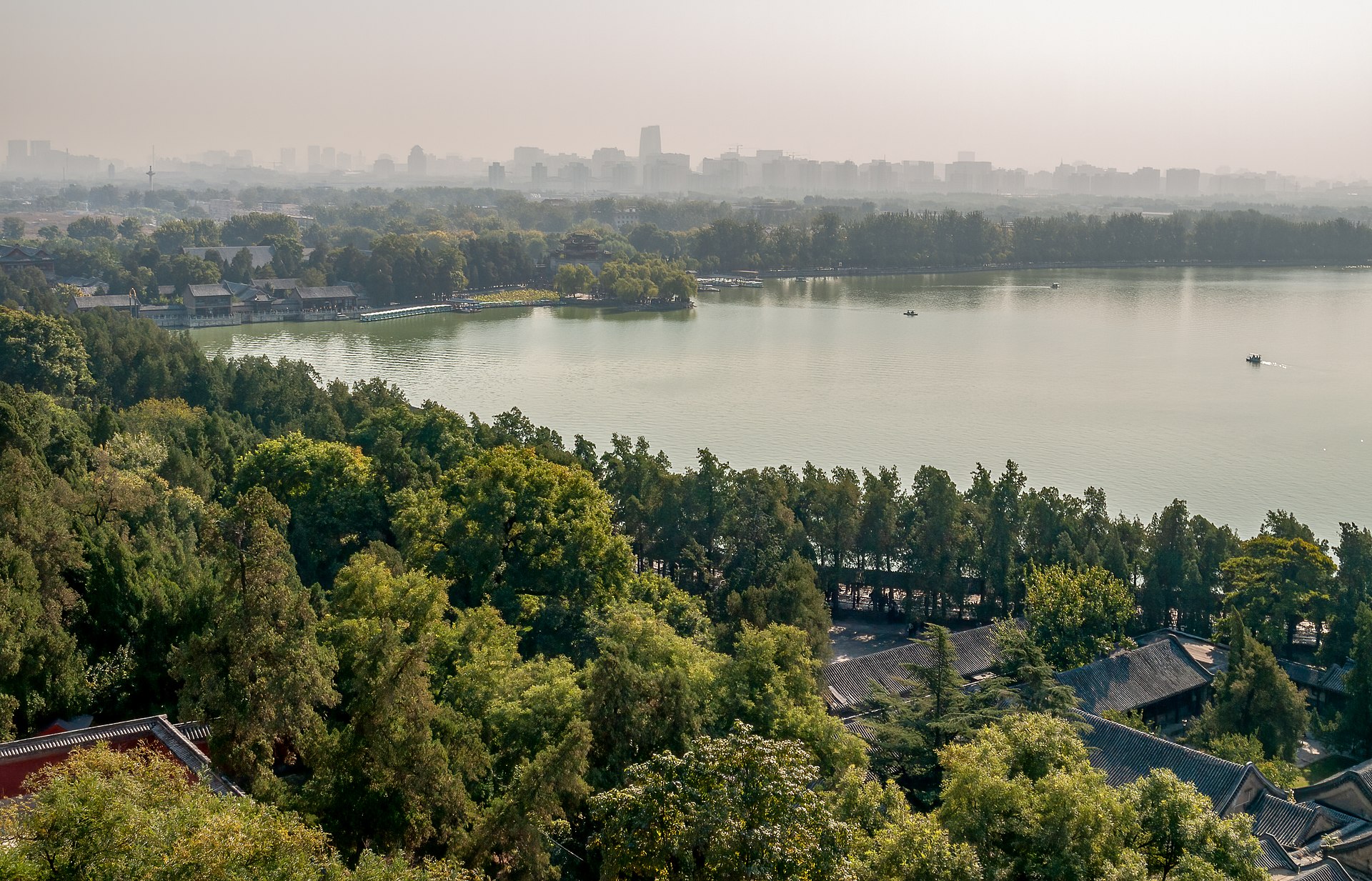
Stand at the top of Longevity Hill and Kunming Lake opens out below you — dragon boats drifting, the Seventeen-Arch Bridge reaching across to an island. This was where emperors escaped the summer heat of the city. Today you can walk it for a whole day.
Picture a garden so large you could walk all day and still not see all of it — and then realise three-quarters of it is not land but lake. That is the Summer Palace (颐和园 Yiheyuan), the largest and best-preserved imperial garden in China, covering roughly 290 hectares in the northwest suburbs of Beijing. It has been a UNESCO World Heritage Site since 1998, recognised as an outstanding example of Chinese imperial garden design.
The garden is built around two halves that always belong together: Longevity Hill (万寿山 Wanshoushan), terraced with halls and pavilions rising to a temple at the summit, and Kunming Lake (昆明湖), a man-made lake dug by hand and modelled on West Lake in Hangzhou. Walk the shoreline and you understand why the imperial court chose this place to escape the heat and the noise of the capital.
The story most often told here is that of Empress Dowager Cixi. The Summer Palace was rebuilt on a grand scale in 1888 after being destroyed in war, and it is widely said that she diverted funds intended for the imperial navy to pay for the restoration. Historians still argue over how literally true that is, but the lakeside Marble Boat — built in the shape of a paddle-steamer that can never sail — stands as a fitting symbol of the era either way.
The grounds are vast — knowing what to see and in what order means you cover the best of it without wearing yourself out.
1
This is the feature that tends to stop people in their tracks. A roofed wooden walkway runs 728 metres along Kunming Lake at the foot of Longevity Hill, and every beam and crossbeam carries one of around 14,000 hand-painted scenes — landscapes, flowers and episodes from classic Chinese novels such as Romance of the Three Kingdoms and Dream of the Red Chamber. Walking its length lets you take in the paintings, stay shaded from the sun and catch the lake through the columns the whole way along.
The three-tiered octagonal tower at the summit of Longevity Hill is the visual anchor of the entire Summer Palace. Wherever you stand on the lake, it tends to be there in the background. Reaching it means a fair climb up the stairs, but at the top the whole sheet of Kunming Lake spreads out in front of you, with the Seventeen-Arch Bridge and the island laid out below. It is the view that most repays tired legs.
At the western end of the Long Corridor sits a lakeside pavilion built in the shape of a paddle-steamer, carved entirely from stone — hence the name. It began as a wooden pavilion under the Qianlong Emperor before being rebuilt during Cixi's time in a hybrid Western-and-Chinese style. The boat cannot sail anywhere, being made of stone, but it has become one of the most talked-about spots in the garden, not least because of that century-old story about the navy's money.
A long, low stone bridge with seventeen arches crosses Kunming Lake from the eastern shore to South Lake Island (Nanhu Island). Its balustrades are topped with more than 500 carved stone lions, no two of them alike. On clear winter mornings the rising sun lines up to shine through all the arches at once — a shot photographers wait for, especially around the winter solstice in late December when the golden light pours straight through every opening.
5
Behind the north side of Longevity Hill, near the North Palace Gate, a canal-side shopping street recreates the watertown atmosphere of Suzhou in the Jiangnan region. The shops lining both banks were built so the imperial court could play at being ordinary townspeople out shopping on an easy afternoon. It draws far fewer people than the lakeside, which makes it ideal if you enter through the North Palace Gate (Beigongmen station): you can start here before climbing over the hill and coming out on the lake side.
Everything you actually need, in one place — prices and hours shift with the season, so check before you go.
The Summer Palace is in the northwest suburbs of Beijing, in the Haidian district. Allow roughly 40–50 minutes' travel from the city centre — Subway Line 4 is the easiest way in.
Get off at Beigongmen (北宫门), exit D, and walk a few minutes to the North Palace Gate. This entrance sits right beside Suzhou Street behind the hill — good if you want to start with the quieter Suzhou Street and then climb over to the lake side.
Get off at Xiyuan (西苑) and walk to the East Palace Gate, the grand, formal main entrance. Good if you want to start in the imperial courtyards, then move on to the lake, the Long Corridor and the climb up the hill later.
Ferries cross Kunming Lake between the Longevity Hill shore, South Lake Island and other jetties. There is a separate fare, but it cuts out a long walk around the water and gives you the view of the Tower of Buddhist Incense from mid-lake that you cannot get on foot.
The Summer Palace shares the northwest district with Peking and Tsinghua universities, and it is not far from the Old Summer Palace (Yuanmingyuan). If you start early and have the energy, the two palaces make a natural full-day pairing in this corner of the city.
The Summer Palace is out in the suburbs, so most visitors stay in the city and ride Subway Line 4 out to it. A central base with good access to Line 4 makes for the easiest day. Here are the hotels we have reviewed: