Golden salt-baked chicken scented with sand ginger, tofu stuffed with minced pork, pork belly steamed over preserved greens — long before Shenzhen became a forest of skyscrapers, these were Hakka villages, and this is the kitchen the original locals grew up with.
Say "Shenzhen" and most people picture skyscrapers, electronics markets and a city where young people from across China come to chase a future — so it is easy to believe Shenzhen "has no food of its own". That is not quite true. Before 1979, when Shenzhen was designated a Special Economic Zone, this place was Bao'an County (宝安县) — fishing hamlets and hillside villages where the Hakka (客家) had lived for centuries. And Hakka cooking is exactly the original taste of the real Shenzhen.
The Hakka settled the Longgang (龙岗) and Bao'an (宝安) districts during the Qing dynasty and built fortified communal homes called weiwu (围屋) — walled compounds where a whole extended family lived together like a village in miniature. Many still stand in Longgang, and at Gankeng Hakka Town (甘坑古镇) a restored old Hakka village lets you wander stone lanes and eat the local food. Picture it: under the 600-metre Ping An tower, a Hakka cooking tradition several centuries old is still quietly going.
Hakka food grew out of frugal mountain village life, where everything had to stretch and keep — so the flavours run deep and salty, leaning on fatty pork, slow-braised offal and preserved vegetables like mei cai (梅菜). It is not refined or showy, but it is filling and warm in the way home cooking is. If you have eaten plenty of clean, light Cantonese food and want to try the other side of Guangdong, Hakka is the one old Shenzhen holds closest.
The first three are the "客家三件宝 — three treasures of Hakka cooking" you cannot skip, plus one legendary village feast.
1
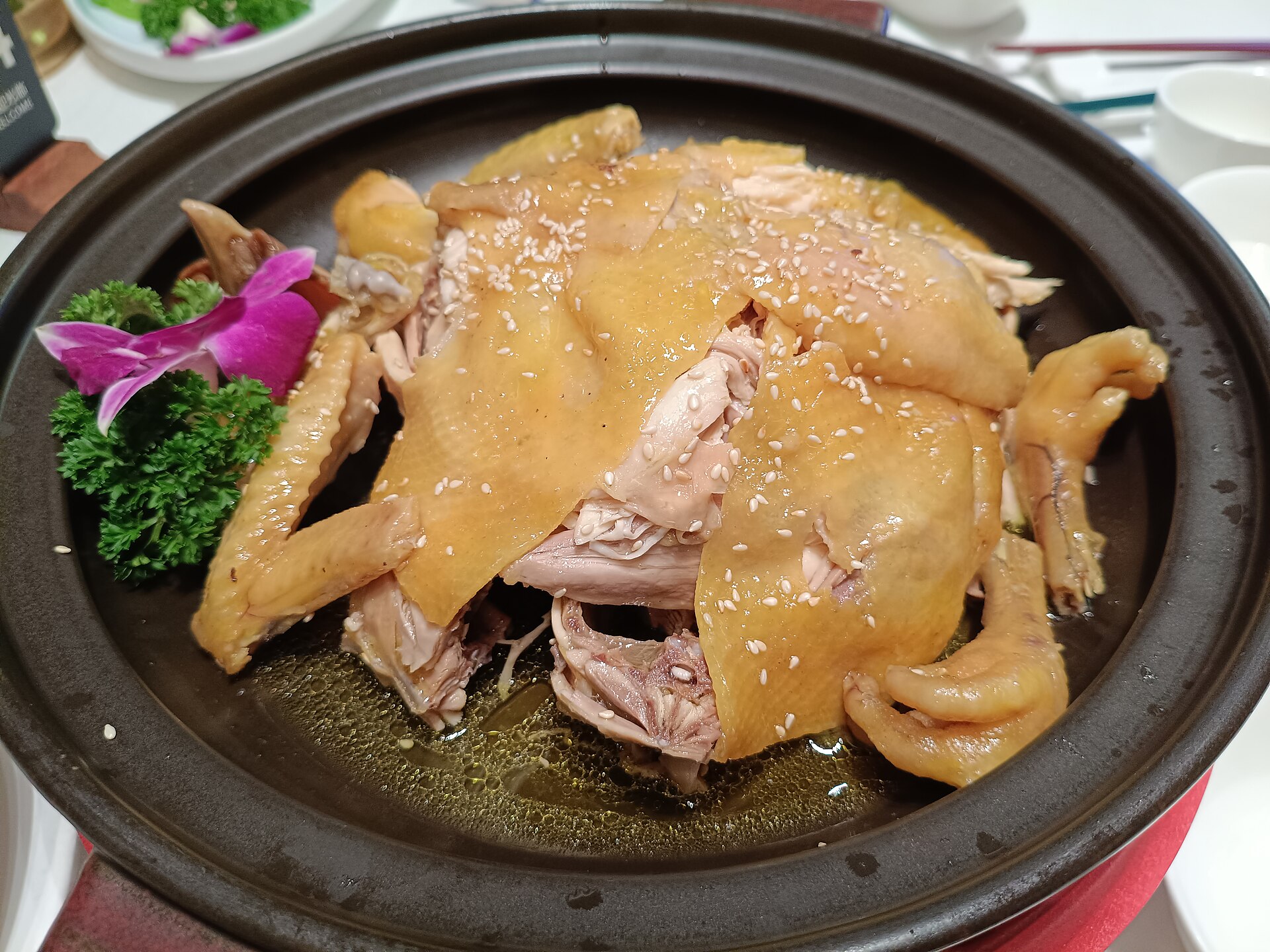
The flagship of the Hakka kitchen — a whole free-range chicken rubbed with sand ginger (沙姜) and salt, wrapped in paper, then buried and baked in coarse rock salt dry-roasted until it is searingly hot. The heat cooks the bird slowly from the outside in, with no water to dilute it, so it cooks in its own juices: the skin comes out a glossy gold, the meat stays firm and gently savory, and it carries that unmistakable sand-ginger aroma. Many modern Hakka restaurants serve it hand-torn (手撕盐焗鸡), shredded and tossed in sand-ginger oil so the flavour reaches every piece. A good one is never dry — there is still juice in the meat when you bite.
2
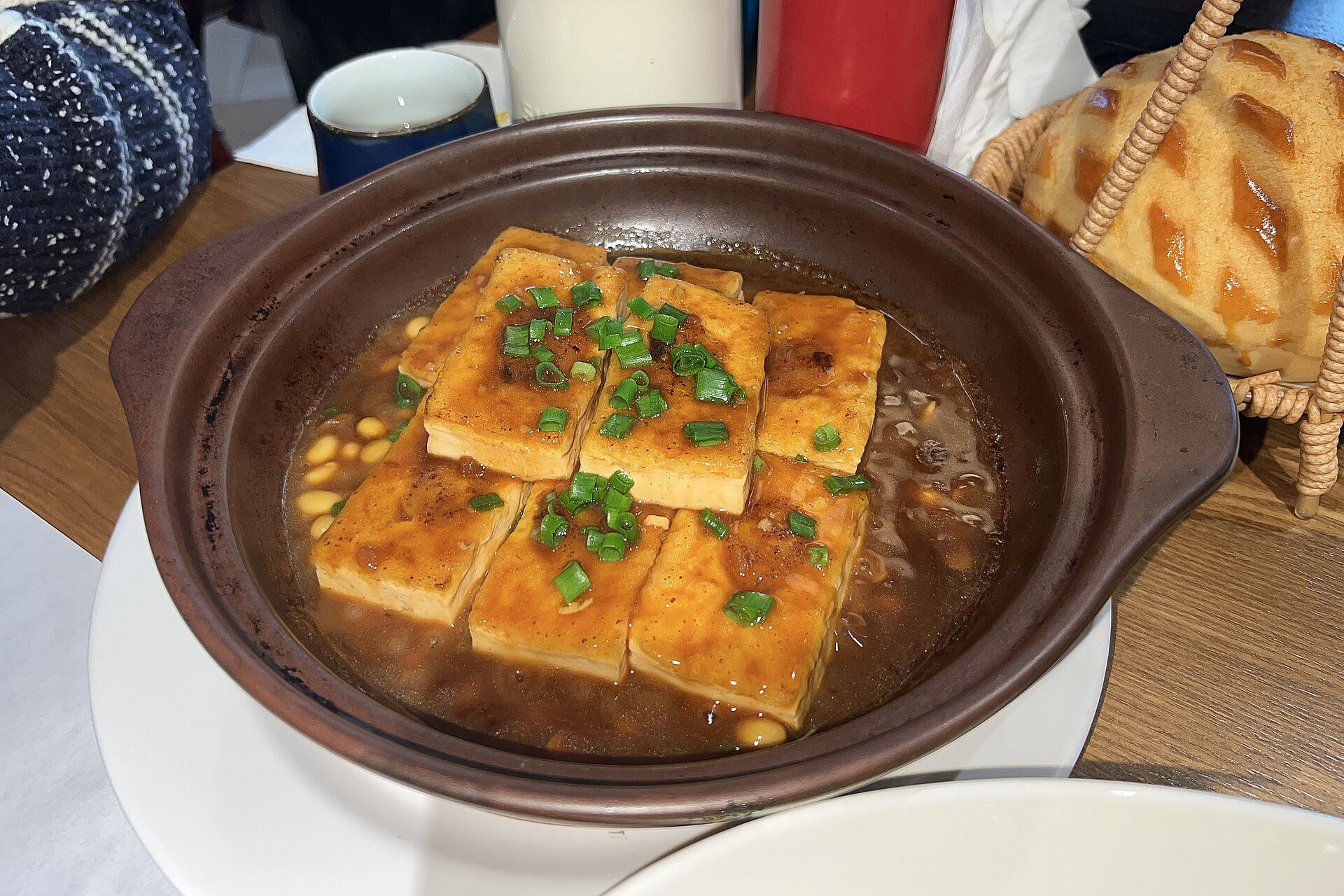
Blocks of tofu, hollowed out and stuffed with seasoned minced pork (some versions add fish or shrimp), pan-fried on the stuffed side until golden, then braised in sauce until the tofu turns soft and drinks up the flavour. The character 酿 means "to stuff" — and the story goes that the Hakka missed the dumplings of their northern homeland but could not grow wheat in the south, so they filled tofu instead of dough wrappers. It is a humble dish that sits on the Hakka table at nearly every meal, and Shenzhen diners call it yong tau foo, just like Hong Kong and Singapore do.
One of the "three treasures", and an old recipe said to go back well over a thousand years — pork belly is boiled, then fried so the skin blisters, sliced and laid face-down in a bowl, topped with mei cai (梅菜) preserved mustard greens that bring a salty-sweet, fermented note, then steamed long and slow until the pork is meltingly soft. It is flipped onto a plate to serve, pork on top, greens beneath, the richness of the belly cut just right by the tangy-salty preserved vegetable. This is a legendary rice dish — so rich it almost demands a bowl of hot steamed rice.
No dish tells the old-Shenzhen story better — a big basin layered with ingredients: pork belly, chicken, duck, meatballs, taro, fried pork skin, shiitake and vegetables, all over a rich broth that seeps down through the layers, so the bottom only gets tastier as the flavours sink in. Poon choi is the banquet dish of the Hakka villages, dating back to the late Southern Song dynasty, served at weddings, festivals, ancestor worship and other celebrations. To this day, villages in Bao'an still hold poon choi feasts, keeping the tradition alive.
Walk into a Hakka restaurant for the first time and unsure what to order? Start with the three treasures of Hakka cooking — 盐焗鸡 (salt-baked chicken) · 酿豆腐 (stuffed tofu) · 梅菜扣肉 (pork belly with preserved greens). Chicken, vegetable and pork all covered, and you see the whole cuisine in one meal.
Two people: those three plus rice and a soup is just right. Four or more: add 土猪汤 (free-range pork soup simmered with white pepper) or a stir-fried green.
客家三宝 / 酿三宝 (the stuffed trio) — tofu, sweet pepper and bitter melon all stuffed with the same minced pork, so you get several textures in one plate · 梅菜扣肉 is sometimes made with taro instead (芋头扣肉), which is even richer and more fragrant.
酿苦瓜 · 算盘子 (stir-fried taro-dough "abacus beads") · 盐焗鸡爪/鸡翅 (salt-baked chicken feet / wings) make great snacks with a beer · Hakka restaurants often pour 娘酒 (Hakka fermented rice wine), softly sweet and worth a taste.
Most Hakka restaurants in Shenzhen take WeChat Pay and Alipay as the main payment. Mall chains (such as Keyu 客语 or Hakka Ben Se 客家本色) may have a card terminal but still lean on QR-code payment. Link a Visa/Mastercard to Alipay or WeChat before you travel.
Mall branches usually have picture menus and can manage some English. Older shops in Longgang and Bao'an may have no English menu — no problem: point at the photos or say the short dish names like 盐焗鸡 / 酿豆腐, and the locals are usually glad to help.
From easy mall chains with picture menus to the heritage Hakka village in Longgang where you get the original atmosphere.
If you want to try Hakka food for the first time without gambling on the language barrier, Keyu is the safest name — the chain grew out of an old Hakka restaurant in Guangzhou, shrank its plates and lowered prices (many dishes ¥20–30) so you can sample a lot in one meal. The signature is old-style hand-torn salt-baked chicken (古法手撕盐焗鸡), made with whiskered free-range birds, glossy gold skin, firm meat. Branches sit in big malls across the city (such as Coastal City in Nanshan), with picture menus, comfortable seating and the air-con cranked up.
Another chain Shenzhen locals reach for when they miss home cooking — the Nanlian branch (南联店) sits in Longgang near Metro Line 3. The draws are hand-torn salt-baked chicken, with crisp golden skin and tender meat, and stone-ground stuffed tofu (石磨酿豆腐), made with house tofu that's soft inside, pan-seared then braised to soak up the sauce, plus a free-range pork soup (客家土猪汤) simmered for hours with white pepper and mineral water until it runs clear and sweet. Generous portions and fresh ingredients make it good value, and it's a comfortable spot to come as a family.
Hakka cooking from the city of Heyuan (河源, in northern Guangdong) is known for bolder, more traditional flavour than the mall chains — the Dazhonghua branch (大中华店) sits in central Futian and is the pick if you want Hakka that hasn't been softened for city palates. The mei cai kou rou here is rich and fragrant with preserved greens, and the freshwater fish and braised offal are done with real depth. The room is homey rather than fancy, but the flavour is the real Hakka thing that Heyuan natives in Shenzhen come to for a taste of home.
If you want Hakka food with a genuine taste of "old Shenzhen", Gankeng is the answer — an ancient Hakka village in Longgang restored into a visitor town, with old houses, stone lanes and Hakka restaurants set in traditional three-storey timber buildings. Order salt-baked chicken, pork soup and local snacks, then wander and take photos. It's the clearest picture you'll get of what Hakka life in Shenzhen looked like before the skyscrapers, and it makes a good half-day trip out of the city centre — easy to reach by metro.