Dayspring Inn Matsu — 303 Reviews, #1 in Nangan All Rooms Sea View, Free Transfers
In the Matsu Archipelago (馬祖) — Taiwan's remote Cold War frontier, where granite cliffs once held military tunnels and Fujianese stone villages cling to hillsides above a sea that glows blue on bioluminescent nights — one name keeps coming up when experienced travellers plan their stay: Dayspring Inn (日光春和). With 303 reviews on Booking.com, a score of 8.9, and a sustained TripAdvisor #1 ranking for Nangan, this 12-room design guesthouse holds a distinction no other property in Matsu can claim: it is the most reviewed hotel in the entire archipelago. What guests cite most consistently are sea-view rooms in every category and complimentary airport-and-ferry transfers that make arriving on this remote island far less daunting than it might otherwise be.
The Matsu Islands sit just a few kilometres off Fujian Province in mainland China, close enough that on a clear day you can see the other shore. For much of the twentieth century, this proximity made Matsu a strategic military frontier rather than a travel destination — tunnels were blasted through sea cliffs, garrisons occupied stone villages, and the name Matsu carried the weight of geopolitical tension. Today, those same tunnels draw visitors seeking history, and the quiet coves where sentries once patrolled are now famous for the "藍眼淚" (Blue Tears): a seasonal bioluminescence phenomenon in which the sea glows an electric blue at night, caused by blooms of dinoflagellates that ignite with every wave. Dayspring Inn sits in Ren'ai Village, Nangan, at the heart of this quietly extraordinary destination. It has been here longer than almost any other guesthouse on the islands, and its 303 reviews represent the accumulated testimony of travellers who chose it as their base for everything Matsu offers.
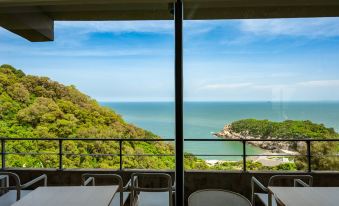
"Every room has a sea view — guests describe waking to blue water and stone hills out the window. The owner picks guests up from the airport, gives a thorough introduction to the island, and the vegan breakfast comes in as genuinely one of the best meals of the trip. Many say they did not expect a guesthouse this considered in such a remote place."
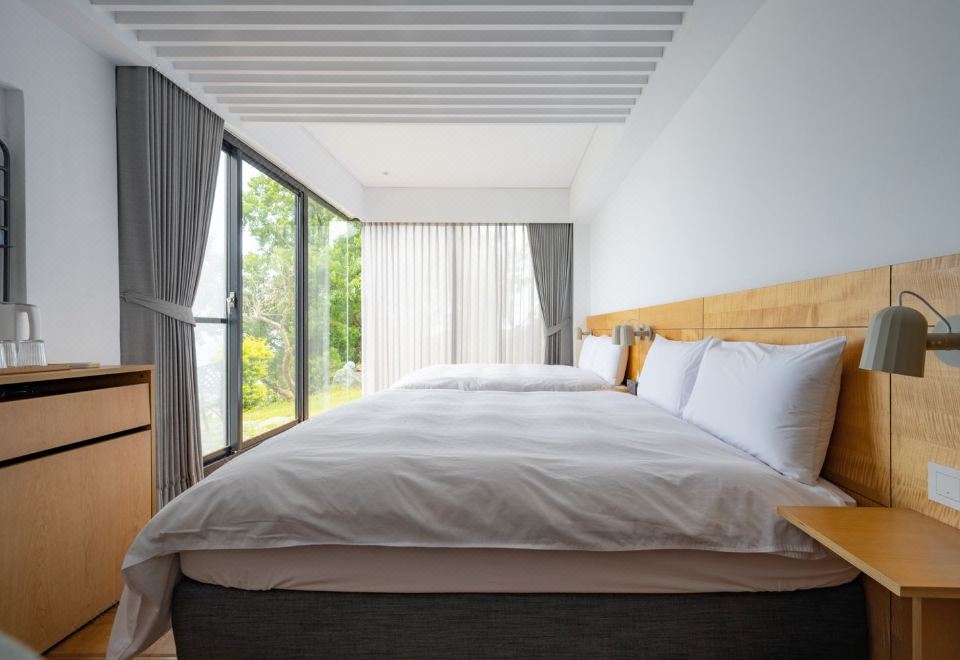
The most immediately striking feature of Dayspring Inn is its guarantee: every one of the 12 rooms has a sea view. On an archipelago where the horizon is always water, this sounds achievable — but ensuring that not a single room faces a wall or a rooftop requires deliberate architectural planning. The building was originally designed by architect Cheng Chihjen using fair-faced concrete as its primary material — a choice that weathers beautifully in the island's salt air and aligns with the understated character of traditional Fujianese stone construction nearby. In 2018, the design collective Biaugust Creation undertook a renovation that introduced a reading room, a specialty shop, and an afternoon tea space, giving the inn a cultural dimension that few guesthouses anywhere in Taiwan match.
Free transfers from Matsu Nangan Airport and the Fuao Ferry Terminal are standard at Dayspring Inn — and on an island with no on-demand taxi service, this detail matters more than it might sound. Arriving in Matsu for the first time can feel disorienting: a small prop plane, a narrow runway between hillside and sea, and the sudden realisation that you are genuinely far from the main island. Having the guesthouse owner or staff waiting in a vehicle, ready to explain the island's layout and point out the key military sites, ferry routes to the other Matsu islands, and the best spots to watch for Blue Tears that evening — this transforms a logistically complex arrival into something welcoming.
Breakfast at Dayspring Inn is entirely vegan, prepared using local Matsu ingredients, and it is one of the things guests mention unprompted even when their review is primarily about the views. The menu centres on Fujianese regional specialities — Golden Dumplings, Mi Shi rice parcels wrapped in leaves — dishes that sit at the intersection of traditional coastal Fujian cooking and Taiwan's island heritage. The inn maintains strict eco-conscious practices throughout: no disposable plastic products, no bottled water, and a commitment to low environmental impact that feels appropriate for a place as fragile and remote as Matsu. Guests who are not vegans routinely express surprise at how much they enjoy the food.
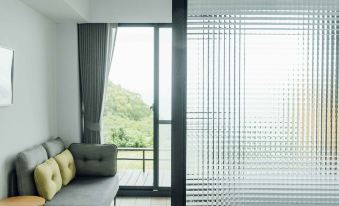
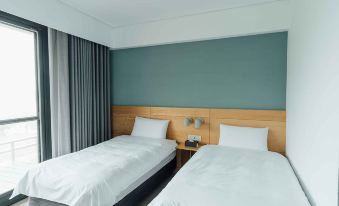
The 12 rooms range from Standard Doubles (27 m²) to Family Quad rooms (43 m²), all finished with the same fair-faced concrete and natural wood palette that defines the building's exterior. Most rooms have a private balcony. Bathrooms include a bathtub or shower, slippers, and a hairdryer. Free Wi-Fi covers all areas. Private parking is available for guests renting scooters or vehicles locally — which is the primary way to get around Nangan, and the inn can help arrange rentals. The Trip.com service score of 10.0 out of 10 is not a rounding artefact; it reflects a property where every review element connects back to the same human quality: attentive, informed, genuine hospitality.
Rates run from NT$5,400 to NT$6,500 per night, which is the highest in Matsu. The honest framing is this: Matsu is a remote island where the cost of operating a 12-room property — logistics, ingredients, staffing — is substantially higher than anywhere on the Taiwan mainland. The price includes a quality vegan breakfast, free transfers both ways, and a level of guidance that functions almost like a private Matsu concierge. For first-time visitors who want the least friction and the most context, the effective value is considerably better than the headline rate suggests. For travellers on tighter budgets, Matsu does have simpler homestay options at lower price points — but none with this track record.
Getting to Matsu is the most significant consideration before booking. Nangan is served by propeller aircraft from Taipei Songshan or Taoyuan (roughly 50 minutes), but flights cancel frequently due to the island's unpredictable wind conditions — especially between October and March. The alternative is a ferry from Fuzhou in mainland China (for travellers who can cross), or the less frequent domestic sea routes from Keelung. None of this is insurmountable, and the logistics are part of what makes Matsu feel genuinely remote — but it is worth planning with flexible return tickets. The 303 reviews on Dayspring Inn represent travellers who made it to Matsu and found exactly what they came for. Whatever your reason for being there — Cold War history, Fujianese stone villages, the silence of a hillside sea, or a night beside water that glows blue — this is where most of them stayed.
Dayspring Inn is not glamorous in a five-star sense. It is considered, carefully run, and shaped by a genuine understanding of what this island offers and what a thoughtful traveller needs to access it well. In an archipelago this remote, that clarity of purpose is its own form of luxury — and it explains why, after all these years of reviewers coming and going, the name at the top of the list remains the same.
Summary from Booking & Agoda
- ✓ Every room has a sea view — the feature mentioned most consistently across all 303 reviews
- ✓ Free airport and ferry transfers — an essential practical advantage on a car-sparse island
- ✓ Vegan breakfast using local Matsu ingredients — praised even by non-vegan guests for quality and flavour
- ✓ Knowledgeable, warm staff who genuinely help guests understand and enjoy Matsu
- ! Highest room rates in Matsu — NT$5,400+ per night
- ! Ren'ai Village location requires a scooter or vehicle to reach most island attractions
- ! Only 12 rooms — books out early during Blue Tears season (April–September)
- ✓ Sea view from every room is genuinely beautiful — opening the window and seeing ocean is the right start to a Matsu morning
- ✓ Staff picked us up from the airport and gave us a full briefing on the island — couldn't have navigated Matsu so comfortably without that
- ✓ The vegan breakfast was a surprise highlight — the Golden Dumplings and local rice dishes are unlike anything on the main island
- ✓ Modern concrete design feels calm and considered — perfectly matched to the pace of Matsu
- ! Rates are on the high side for Matsu, though the breakfast and transfers offset some of the cost
- ! The all-vegan breakfast may not suit everyone who prefers a more conventional morning meal
- ! Matsu itself is very quiet after dark — if you're expecting nightlife or a lively street scene, this is not the island for that
- 💡Highest price point in Matsu at NT$5,400+ per night — if budget is a primary concern, simpler homestays exist at lower price points. Factor in that breakfast and both-way transfers are included before judging the headline rate as expensive.
- 💡Guesthouse scale and style, not luxury-hotel amenities — rooms are 27–43 m², thoughtfully designed but without a pool, spa, or resort-style facilities. The value is in the experience and service, not in floor area or facility count.
- 💡Reduced or adjusted service in winter months — Matsu's November–February period brings strong winds, heavy fog, and irregular flight schedules. Some services may be adjusted seasonally → confirm current operations directly with the inn before booking a winter visit.