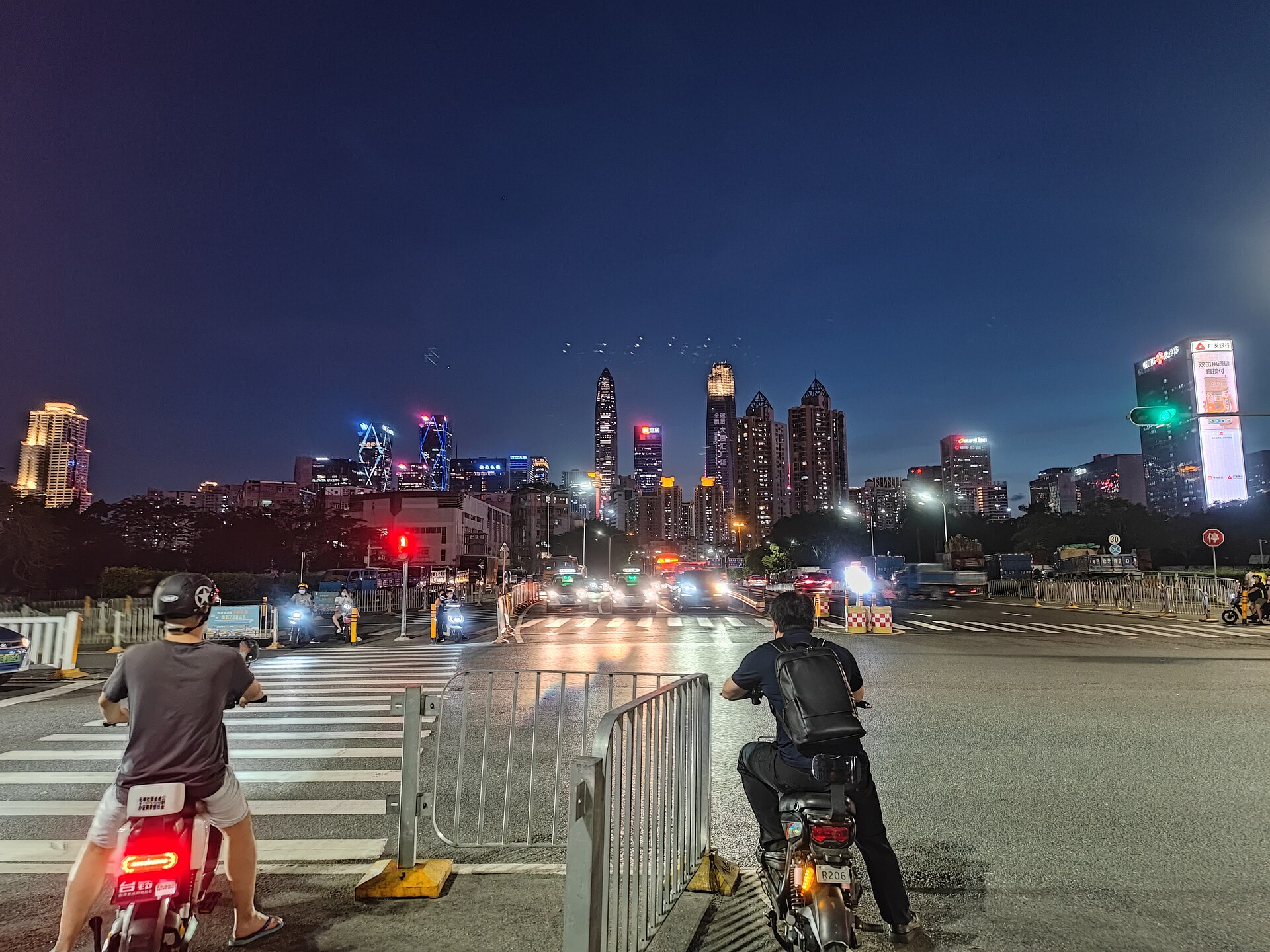
Shenzhen's tallest tower and China's second-tallest — a high-speed lift carries you to a glass floor at 547 m, where the Futian CBD spreads out below and Hong Kong appears on the southern horizon on a clear day.
Picture this: the lift doors close, the floor counter starts climbing — 20… 50… 90… — and about a minute later the doors open on floor 116, some 547 m above Shenzhen. You step out into glass on every side, a full 360°. Below you, the Futian CBD stacks up in a forest of towers. Off to one side, the green of Lianhuashan Park. And on a clear day, that line on the southern horizon isn't cloud — it's Hong Kong.
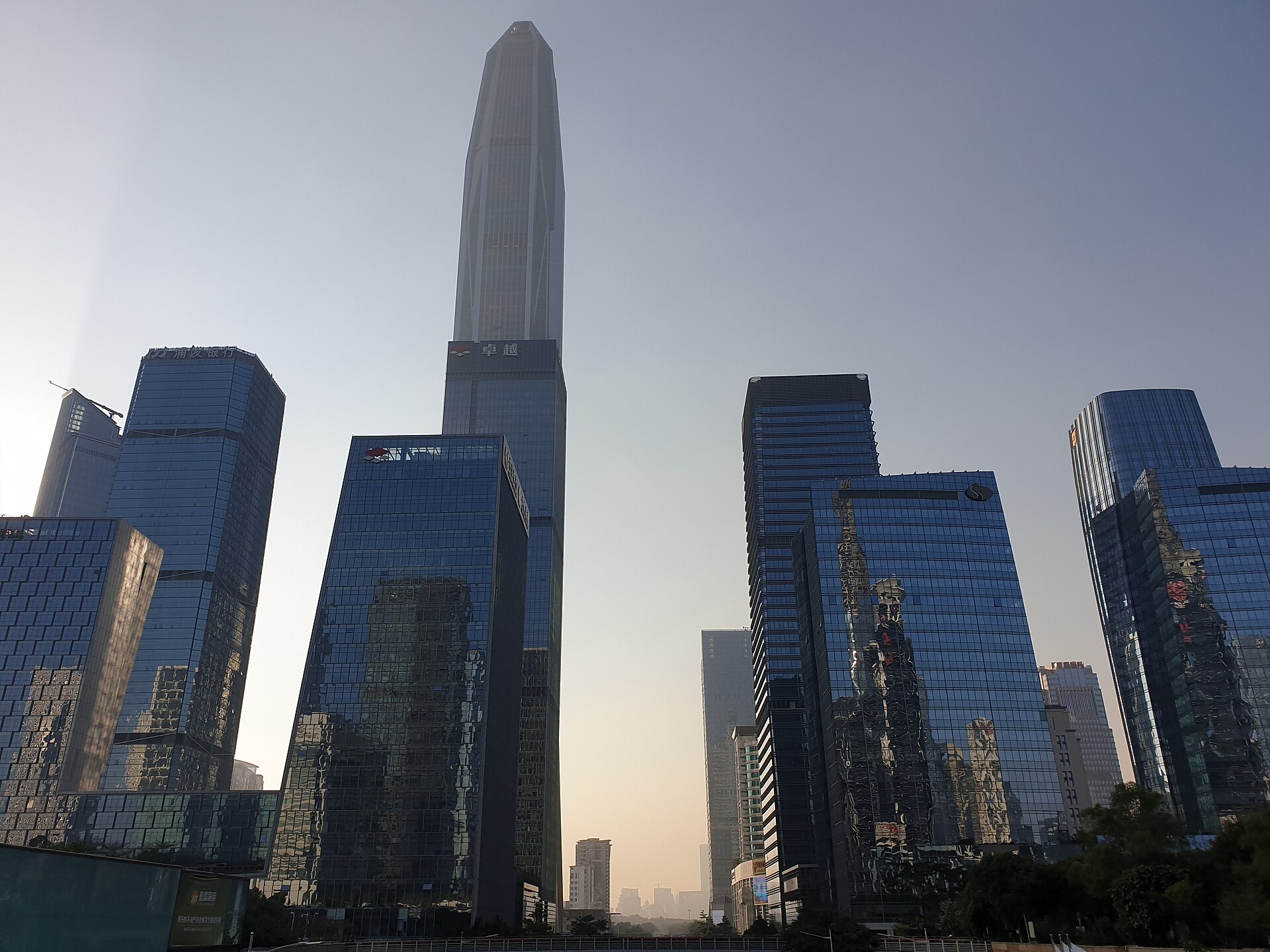
That is the Free Sky deck (云际观光层), near the top of Ping An Finance Centre — a 599 m, 118-floor supertall finished in 2017 that instantly became the city's new landmark. It is the tallest building in Shenzhen, the second-tallest in China after Shanghai Tower, and one of the tallest in the world. Architects Kohn Pedersen Fox designed it, and the stainless-steel facade catches the light differently all day long.
Here's the honest pitch: Shenzhen went from a cluster of fishing villages to a tech megacity on the Hong Kong border in under 45 years — and nothing tells that story like standing above the whole thing. This is the highest, most dramatic viewpoint in town.
Free Sky is more than a viewing balcony — there are a few zones to wander before you head back down
Ping An runs double-deck lifts that travel up to 10 metres a second, carrying you from the lobby to floor 116 in roughly a minute. The screens inside often play a light effect so it feels like you're punching up through cloud — the experience starts before you even reach the deck.
Floor-to-ceiling glass wraps the whole level. You can pick out the full Futian CBD, Lianhuashan Park and the Civic Center to the north, Shenzhen Bay to the west, and on a clear day the hills and towers of Hong Kong to the south — visibility runs to tens of kilometres. It's the view that really shows you how huge and dense this city is.
In places the deck has a transparent glass floor you can stand on and look straight down, hundreds of metres. Some people walk across without a thought, some freeze on the spot. It's a popular photo stop with a queue at busy times — wear comfortable shoes, and if heights aren't your thing, take it one step at a time.
Beyond the views there's a VR area, a mirrored walkway and an LED light tunnel that all make for fun photos. They're a good fit if you're visiting with kids, or if you want a few quirky shots rather than skyline panoramas alone.
A small display tells how Shenzhen went from fishing villages to a tech megacity in under half a century, with before-and-after photos of the skyline. See it and the view outside makes even more sense.
First, the honest bit: Shenzhen gets hazy and humid in spells, which can turn a high view into a grey blur. If the sky isn't open, a near-¥200 ticket might buy you little more than fog. The clearest seasons are autumn (October–December) and spring (March–April) — those are your best odds of picking out Hong Kong to the south.
The simplest move is to check the weather and air-quality forecast for the day and only buy once it looks clear. Tickets usually let you pick an entry window rather than booking weeks ahead.
If you only get one slot, going up around 5–6 pm is the best value: you see the city in daylight first, then stay as the sun drops and the lights flick on one by one — three moods on a single ticket. Full daylight gives the longest sightlines and the clearest look at Hong Kong; full night gives you the sea of lights but less distance.
Sunset draws the biggest crowds, especially on weekends. For more elbow room at the windows, try a late weekday afternoon instead.
The standard adult walk-up fare is ¥200 (~฿1,000); booking online in advance usually drops it to about ¥180 (~฿900). There are discounts for seniors, students and children (kids under 1.2 m enter free). The ticket covers the Free Sky deck only, not the offices or hotel inside the tower.
If you don't have a WeChat or Alipay account, the Chinese booking channels are awkward to use. Klook is the easier route — you can pay with an overseas card and get a QR-code ticket you scan at the entrance.
Shenzhen has one of the world's biggest, most modern metro networks, and the tower sits right on a station — the metro is by far the easiest way to arrive.
The Futian CBD is easy to keep exploring on foot — including a couple of free viewpoints and nearby sights