Home Chiang Mai Thailand Chiang Mai Hotels About
Home  ›  Asia  ›  Thailand  ›  Chiang Mai  ›  Food Guide
Chiang Mai Food Guide · 2026

What to eat in Chiang Mai
11 dishes, from khao soi to market food

The coconut-curry noodles topped with a crackle of crisp noodles. The herb sausage smoking over charcoal. The roasted-chili dip you scoop with sticky rice and pork rinds. And the evening market stalls where Chiang Mai locals actually queue. Here's where to start.

Why eat here

The taste of old Lanna

Chiang Mai was the capital of the Lanna kingdom for more than 700 years, and its kitchen still tells that story. Northern Thai food isn't the searing chili-heat of Isan or the south — it leans savoury and salty, built on herbs and roasted spice, the kind of cooking you can eat every day. On one side is the dish that became the city's emblem — khao soi, a coconut-curry noodle soup that carries clear traces of Burmese and Yunnanese cooking. On the other is a deep bench of home-style market food and Lanna tray meals that northerners have eaten for generations, from charcoal-grilled sai ua to roasted-chili dips and big pots of gaeng hung lay.

Chiang Mai is also ringed by high mountains and stays cool and easy most of the year, so its food culture is tied to the morning and evening markets — and to the sticky rice that's steamed in a bamboo basket and eaten with nearly every meal. We picked 11 dishes and snacks that tell both halves of the story, from the khao soi shops down the side lanes to the Doi-coffee cafés of Nimman — and we'll tell you plainly which dishes are easy, which take an open mind, and where to go for the real thing.

The essential dishes

11 things to eat before you leave Chiang Mai

Ordered from the dishes everyone can enjoy to the local classics that take a little nerve — and we'll flag which is which.
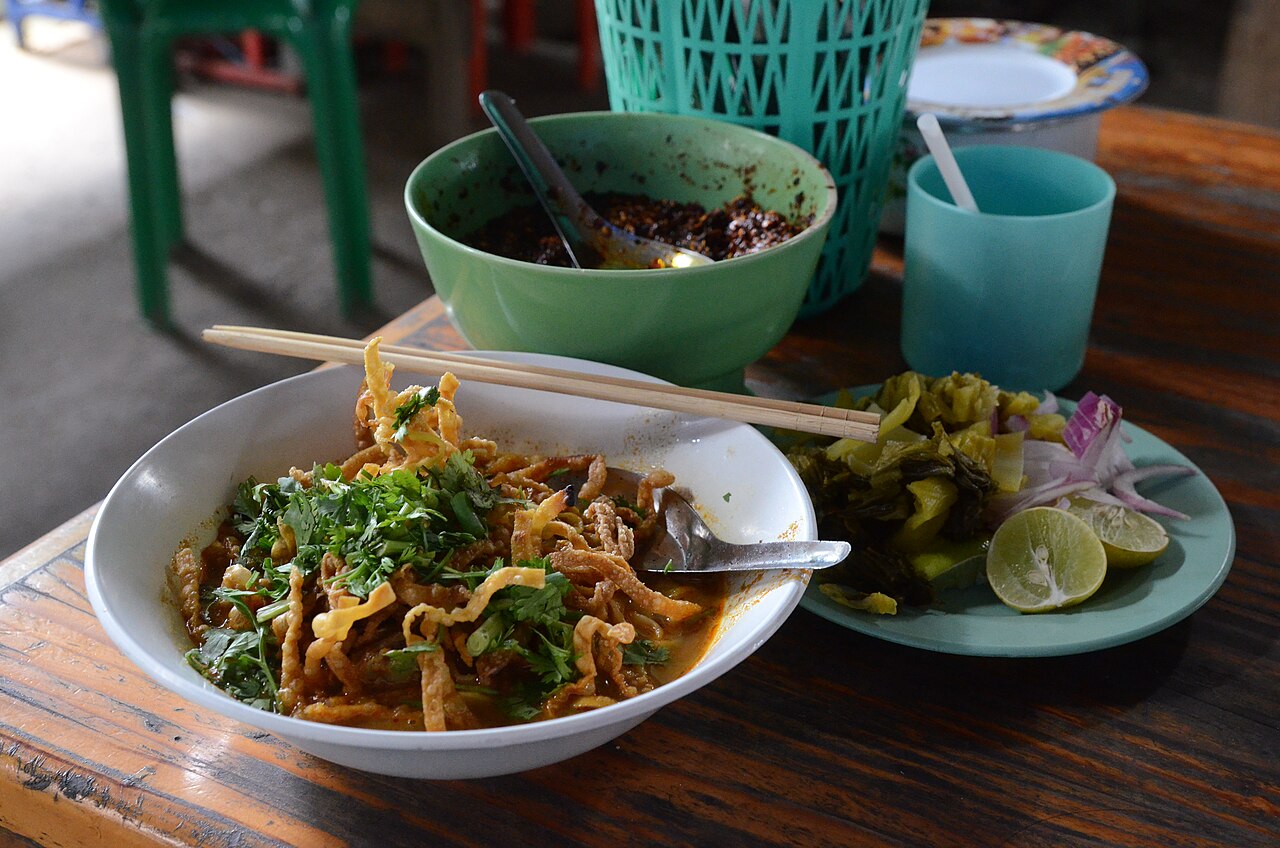
A bowl of chicken khao soi in orange coconut-curry broth topped with crisp fried noodles and coriander, served with pickled mustard greens, shallots and lime 1
Khao soi
ข้าวซอย · the dish the city owns

This is what Chiang Mai is known for. Egg noodles sit in a golden coconut-curry broth fragrant with curry paste and a hint of mild curry powder, carrying echoes of Burma and Yunnan. The noodles in the bowl are soft, then a tangle of crisp fried noodles goes on top for a second texture, with slow-cooked chicken or beef. The local way to eat it: squeeze in lime, add the pickled mustard greens and sliced shallots, stir it through and eat it hot — sour, salty, rich and fragrant, all in one bowl. It's easy to love and wins almost everyone over.
Where: Khao Soi Khun Yai (near Wat Lok Molee · tiny, sells out fast) · Khao Soi Mae Sai · Khao Soi Lam Duan Fah Ham (Fah Ham district · long-running)
Price: ~฿40–80/bowl (chicken/beef/pork)
Tip: Add lime and pickled greens before the first bite · many famous shops only open morning to afternoon
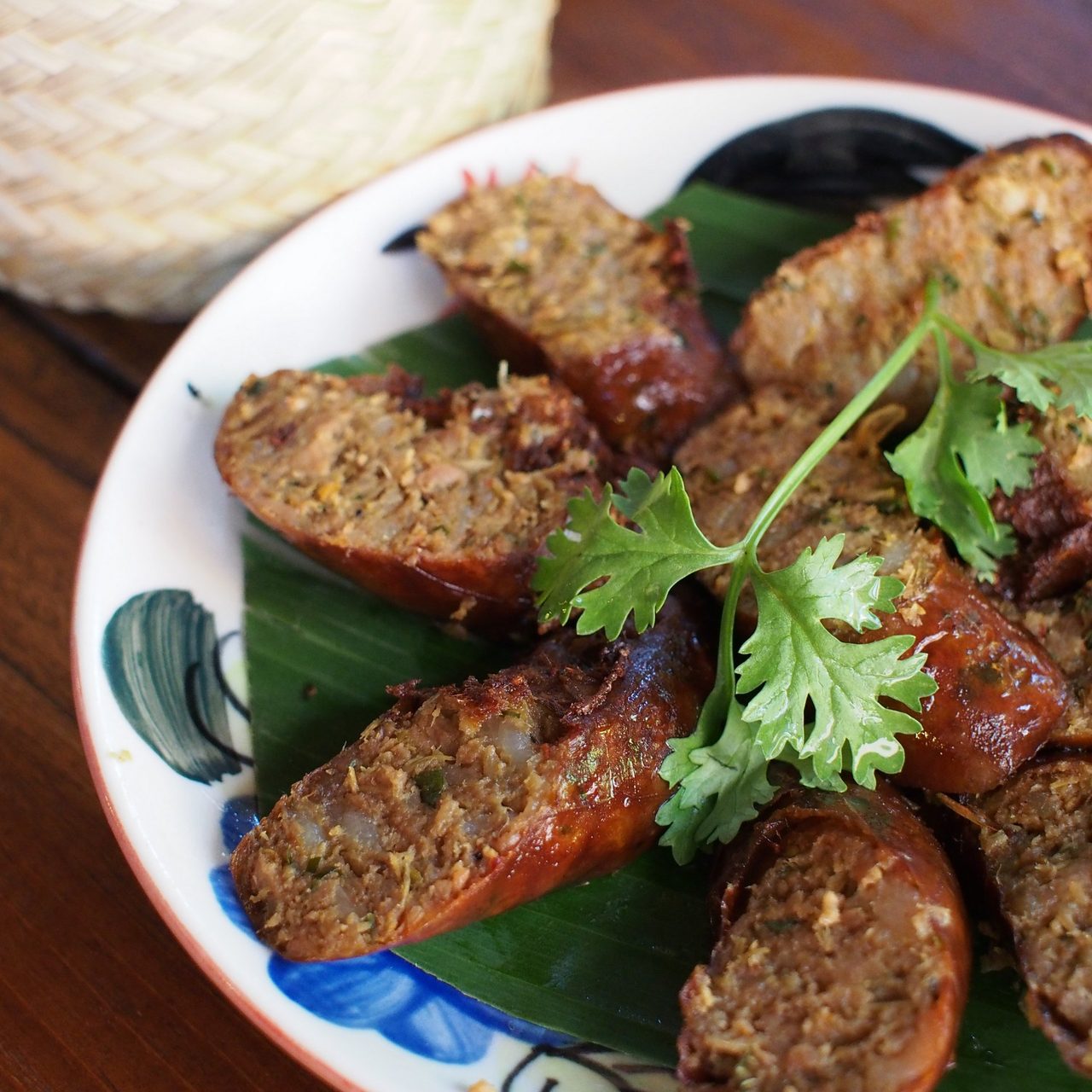
Grilled sai ua northern Thai sausage sliced into coins on a banana leaf, showing the orange herb-flecked interior, served with coriander and crackers 2
Sai ua
ไส้อั่ว · the herb sausage to eat hot

If khao soi is the main event, sai ua is the sausage no Chiang Mai kitchen is without. Minced pork is packed with curry paste and herbs — lemongrass, kaffir lime leaf, chili paste, turmeric — then coiled into a ring and grilled over charcoal until the skin tightens and just chars at the edges. The first bite is all fragrant herb and juicy pork, nicely salty and gently spicy. Eat it on its own or with sticky rice. You'll find it across Chiang Mai's markets — buy it hot off the grill, when it's at its most fragrant.
Where: Warorot Market (Kad Luang) · Chang Phueak Gate in the evening · northern-deli shops citywide
Price: ~฿40–80 per 100g or stick, depending on the shop
Tip: Pick a stall grilling fresh out front and eat it while it's hot
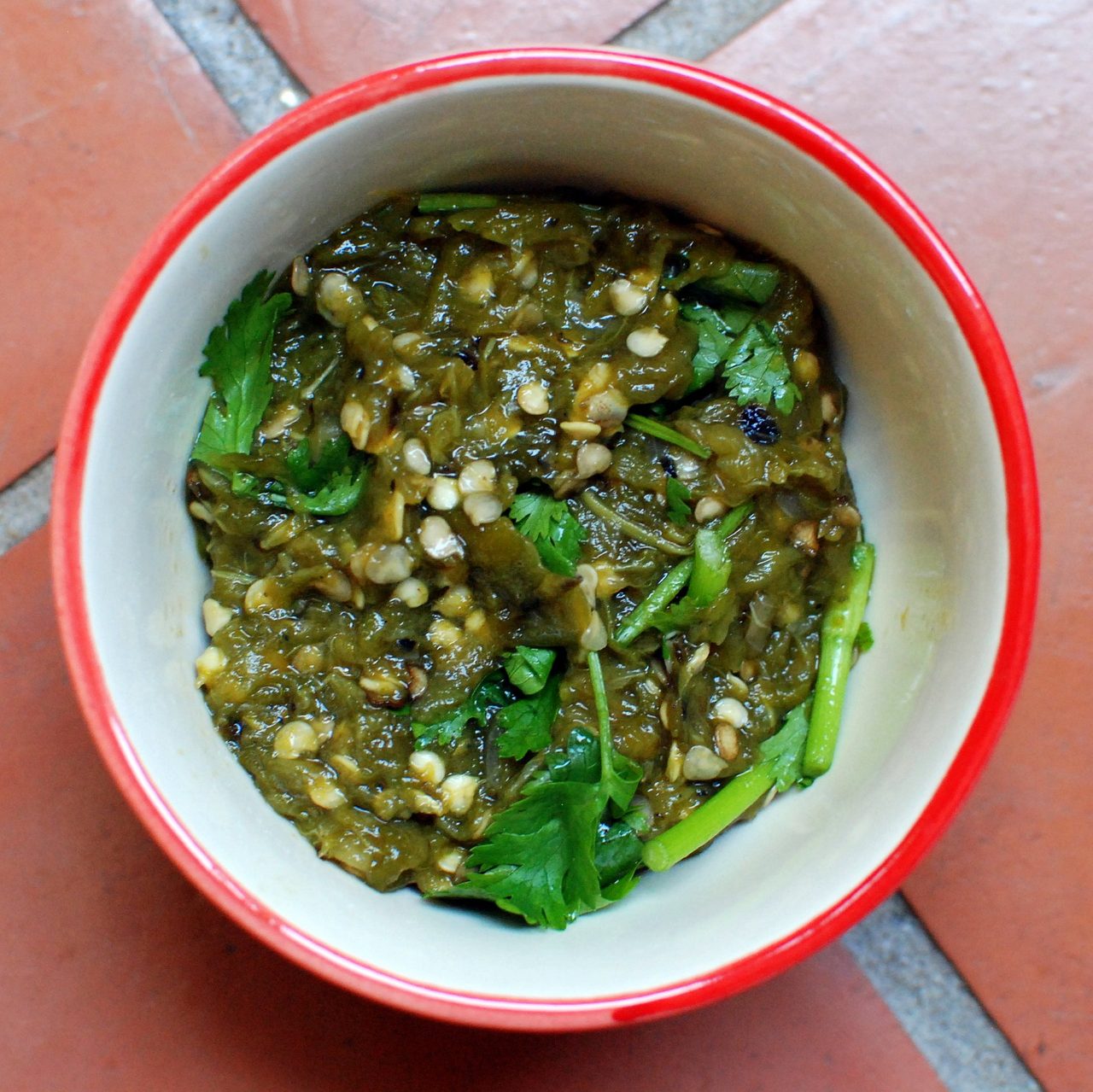
A bowl of green nam prik num roasted-chili dip with coriander on top, smooth from pounded roasted green chilies and garlic, in a red-rimmed ceramic bowl 3
Nam prik num + kaeb moo
น้ำพริกหนุ่ม · the relish every northern table has

Nam prik num is the heart of a northern Thai spread. Long green chilies are roasted until soft and smoky, then pounded with garlic, shallot and salt into a smooth green dip with a gentle heat and a lovely charred aroma. You eat it with kaeb moo (crisp pork rinds) and steamed vegetables — long beans, pumpkin, eggplant — scooping it all up with sticky rice for a simple meal that's quietly addictive. This is the everyday home flavour of Chiang Mai, the kind of thing locals eat all the time. The heat is moderate and varies by shop.
Where: Northern restaurants citywide · Warorot Market (bagged, with pork rinds) · local sticky-rice-and-fried-chicken shops
Price: ~฿30–60/bowl + pork rinds ฿20–50/bag
Tip: Eat it with pork rinds, steamed veg and sticky rice for the full spread
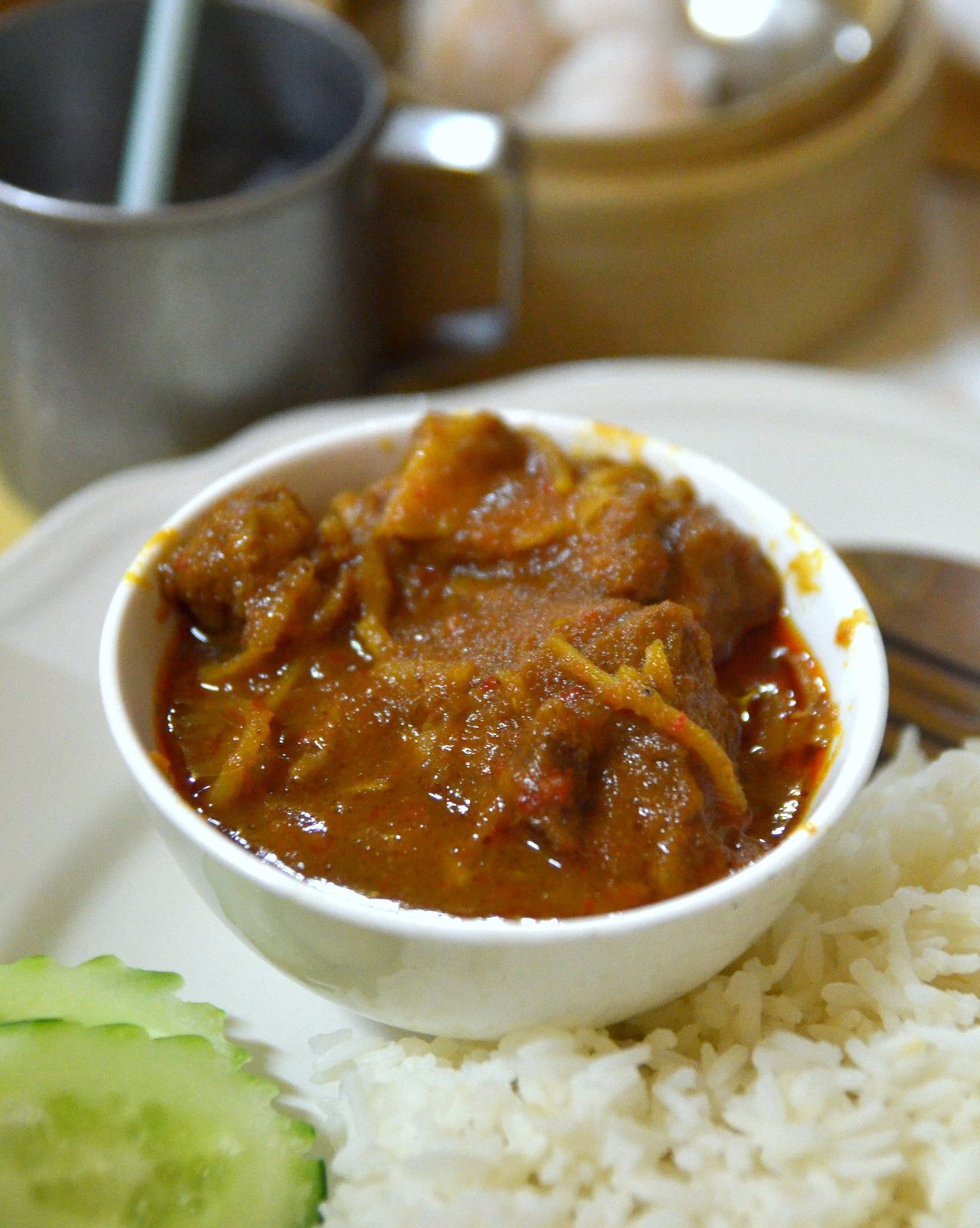
A white bowl of gaeng hung lay pork curry, large chunks of pork in a thick reddish-brown sauce with shredded ginger, served beside rice and cucumber 4
Gaeng hung lay
แกงฮังเล · Burmese-style pork curry, sweet and sour

A curry that came in from Burma and became fully Lanna. Big pieces of pork belly and fatty pork are simmered in a thick sauce with hung lay curry paste, shredded ginger, pickled garlic and tamarind until the flavour turns sweet, sour and savoury all at once. The pork goes meltingly tender, the heat is low, and the whole thing smells warm with spice. It's a dish northerners cook for merit-making and celebrations, eaten with steamed rice or sticky rice. Another one that's easy for just about everyone.
Where: Sit-down northern restaurants such as Huen Phen · khantoke halls · Lanna tray meals in the markets
Price: ~฿60–150/plate, depending on the shop
Tip: Order it with sticky rice and nam prik num for a proper northern spread
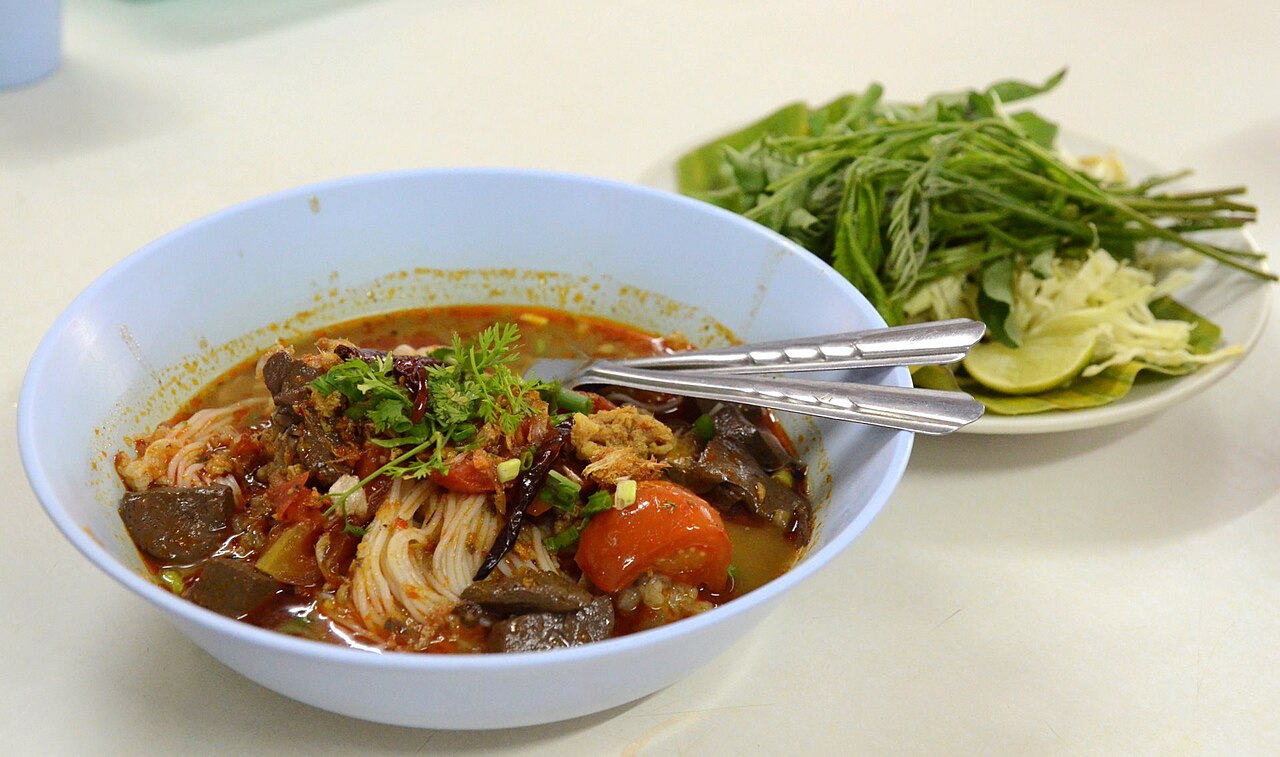
A bowl of khanom jeen nam ngiao, rice noodles in a red-orange tomato broth with pork blood and cherry tomatoes, served with a side plate of fresh greens and cabbage 5
Khanom jeen nam ngiao
ขนมจีนน้ำเงี้ยว · tomato broth with cotton-tree flowers

A regional noodle dish you'll find easily at morning markets. Fermented rice noodles (khanom jeen) are doused in a red-orange broth simmered from tomatoes, chili paste and pork bones, with dried cotton-tree flowers (which give it a distinctive taste and colour), little tomatoes, and soft cubes of pork blood. The flavour is tangy, mildly spicy and well rounded, eaten with a side plate of fresh greens, bean sprouts, cabbage and lime. To be honest, the traditional recipe leans on the pork blood — you can ask the shop to leave it out — but with an open mind it's a hearty, genuinely northern flavour.
Where: Morning markets citywide · in-town nam ngiao noodle shops · Ton Phayom market
Price: ~฿35–60/bowl
Good for: Anyone wanting a real northern flavour · ask to skip the blood if you prefer
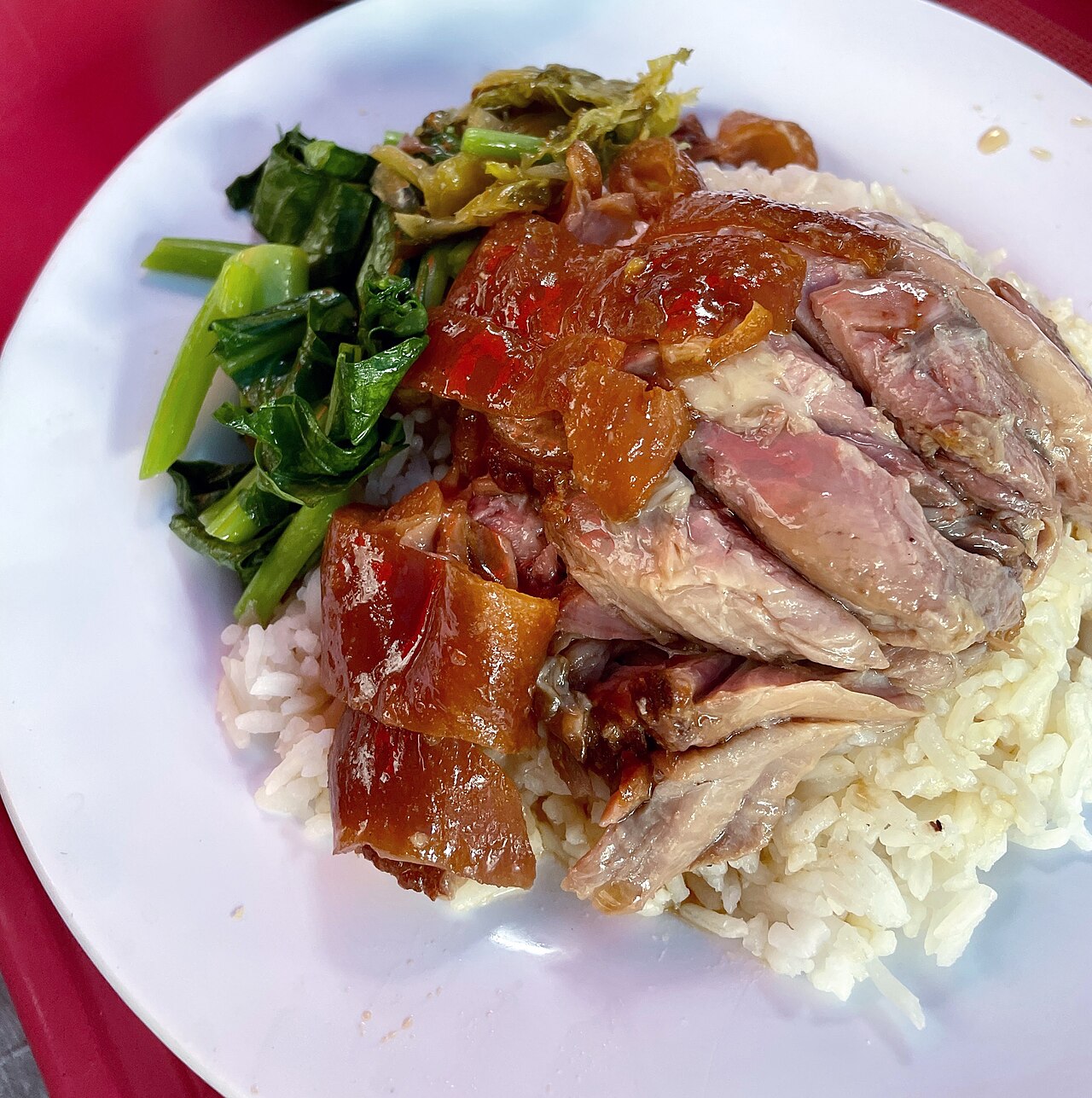
A plate of khao kha moo, tender stewed pork leg with glistening skin over rice in dark gravy, served with pickled greens and blanched kale 6
Khao kha moo
ข้าวขาหมู · stewed pork leg over rice, the everyday favourite

The one-plate meal Chiang Mai eats all day. Pork leg is braised in a five-spice gravy until the meat falls apart and the skin turns to soft jelly, then spooned over hot rice and ladled with the fragrant gravy. It comes with sour pickled greens, blanched kale, a braised egg, and a sharp chili-vinegar that cuts the richness. The most famous version is the Chang Phueak Gate stall locals call "the lady in the cowboy hat," who sells from evening into the night with a queue almost every day. An easy, filling, cheap meal — a Chiang Mai late-night staple.

Where: Khao Kha Moo Pratu Chang Phueak (the cowboy-hat lady · evening to late) · pork-leg rice stalls in markets citywide
Price: ~฿40–70/plate (extra for egg/pork)
Tip: Spoon on the chili-vinegar and eat with the pickled greens to cut the fat
🍚7
Sticky rice
ข้าวเหนียว · the staple with every northern meal

Northern food is eaten mainly with sticky rice, not the steamed jasmine rice of central Thailand. Glutinous rice is steamed in a clay pot or a woven bamboo basket until it's fragrant and tender, then pinched into a ball by hand and dipped into nam prik num, scooped through nam prik ong, or eaten alongside sai ua and pork rinds. Half the fun of a northern meal is rolling little balls of sticky rice and dipping them into the various dishes on the tray. Eat one meal this way and you'll instantly understand how the north eats — the basket of sticky rice is the warm, casual centre of any Lanna spread.
Where: Comes with every northern restaurant · sticky-rice-and-fried-chicken/pork stalls in markets
Price: ~฿10–20/bag or small basket
Tip: Pinch it into a ball and dip — that's how the northern spread is meant to be eaten
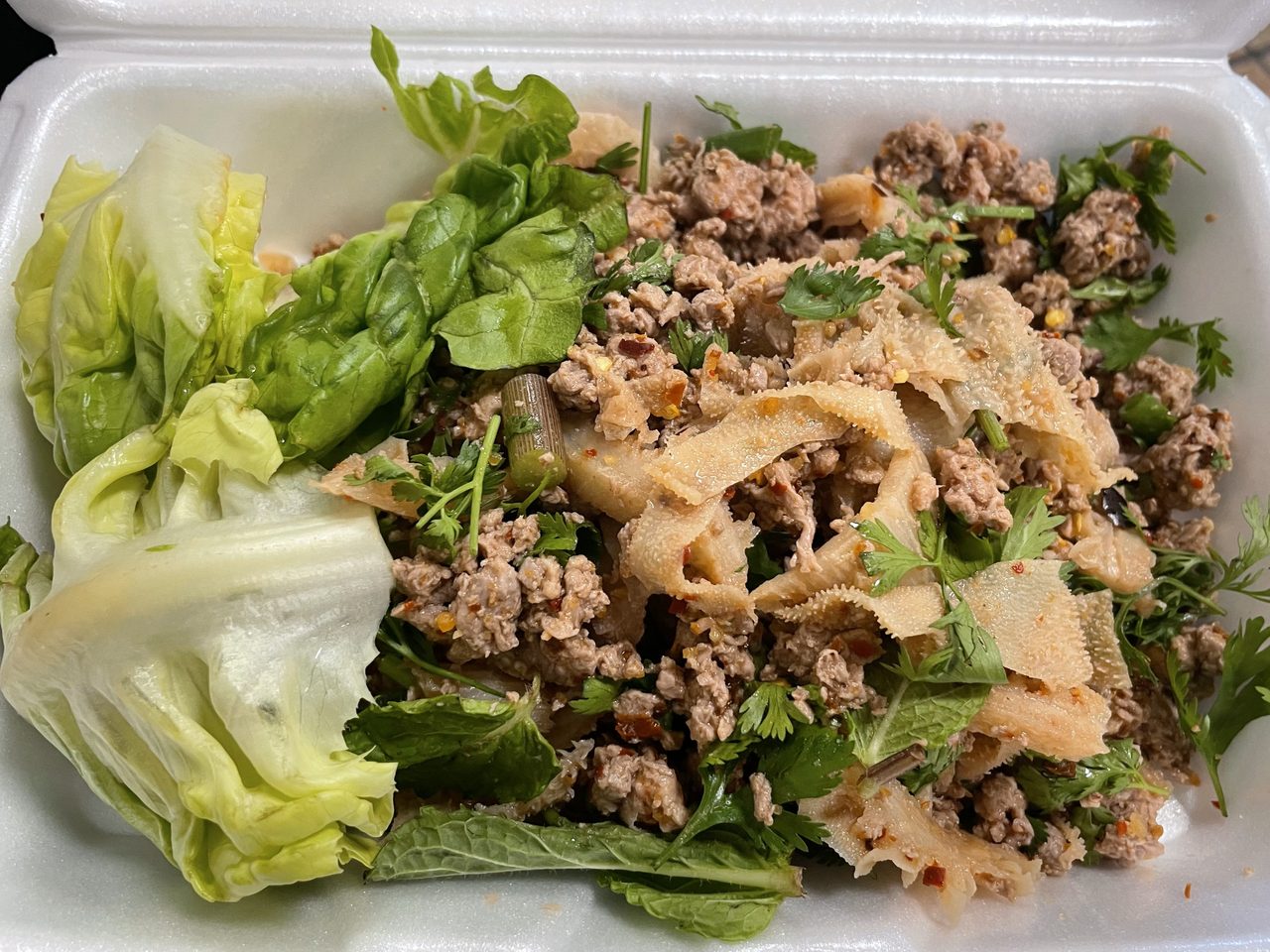
A plate of larb mueang, minced pork tossed with roasted northern spices, scattered with coriander and mint, served with lettuce and pork rinds 8
Larb mueang / larb khua
ลาบเมือง · northern larb with roasted spice

Northern larb is nothing like the Isan version — no toasted rice powder or fish sauce dressing here. Instead it's built on phrik larb, a blend of dozens of roasted, ground spices tossed through minced pork or beef for a deep, complex, warmly spiced flavour that's savoury rather than sour. It's eaten with fresh herbs, mint and pork rinds. There's a cooked version (larb khua, stir-fried) and a raw version for locals. To be honest, some traditional recipes mix in offal — if you're not used to that, the cooked pork larb khua is the easier pick. It's one of the best windows into true Lanna flavour.

Where: Northern restaurants such as Huen Phen and local larb mueang shops · khantoke trays
Price: ~฿60–120/plate
Good for: Anyone who likes deep, spiced flavour · choose cooked larb khua if you'd rather skip raw
🥗9
Gaeng khanun & nam prik ong
แกงขนุน · น้ำพริกอ่อง · home-style Lanna, gentle on the heat

Two home-style dishes you'll meet often on a northern tray. Gaeng khanun is young jackfruit, cut into pieces and simmered with pork ribs, tomato and northern curry paste into a mild, rounded curry fragrant with holy basil — northerners consider it an auspicious dish, since the word "khanun" sounds like "support." Nam prik ong is a relish of minced pork and tomatoes cooked down to a glossy orange, mildly sweet-sour-savoury, a bit like a northern take on Bolognese, eaten with fresh vegetables and sticky rice. Both are easy on the heat — fine for kids, satisfying for adults — and a gentle way into northern food.
Where: Sit-down northern restaurants · khantoke trays · market stalls selling home-style dishes
Price: ~฿40–100/plate
Tip: Nam prik ong is one of the easiest northern dishes for a first-timer
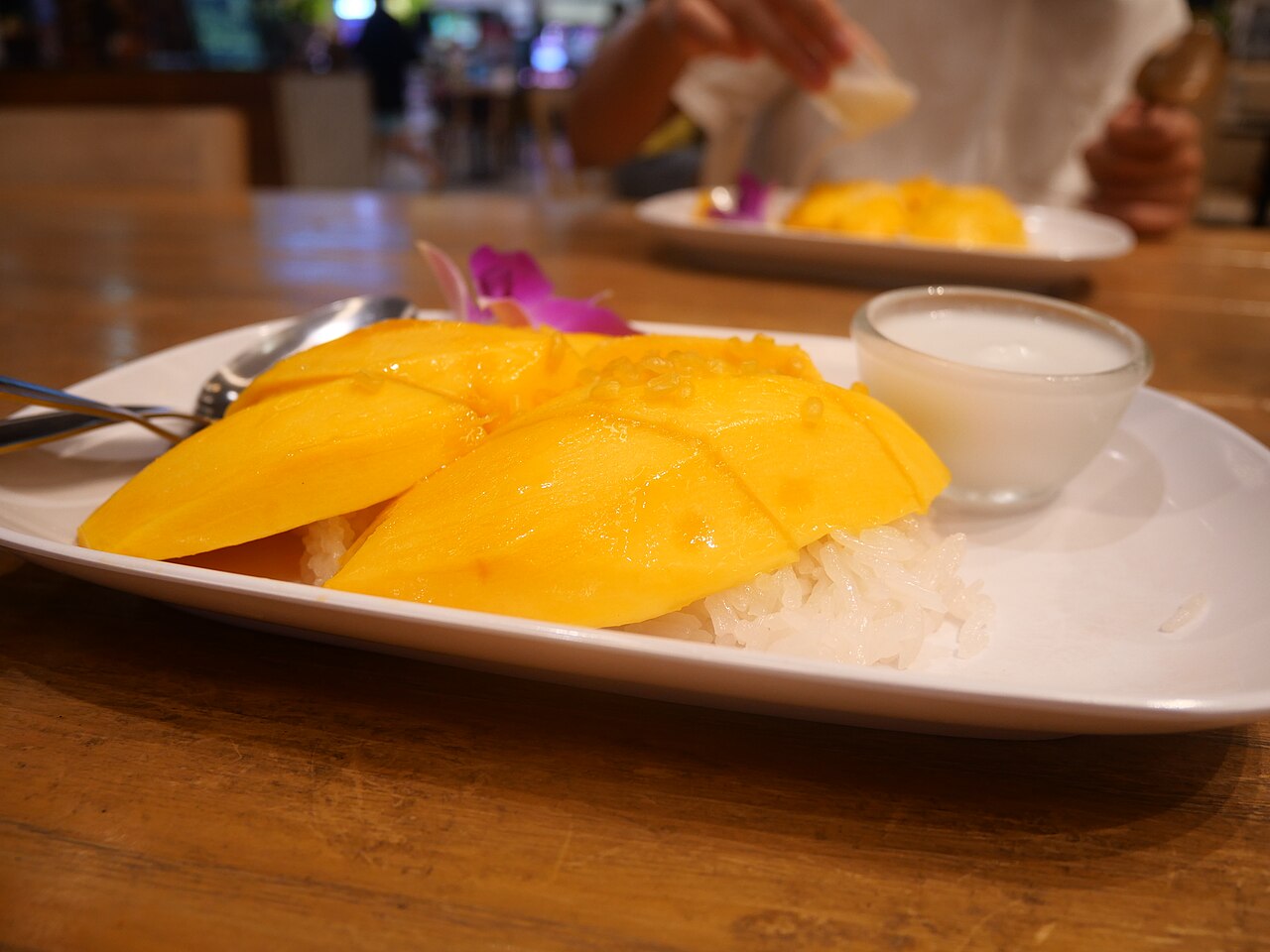
Mango sticky rice on a white plate, slices of ripe yellow mango beside coconut sticky rice with a cup of coconut cream and an orchid garnish 10
Mango sticky rice
ข้าวเหนียวมะม่วง · the hot-season dessert

The Thai dessert visitors fall for, easy to find across Chiang Mai. Sticky rice is steeped in sweetened coconut milk until soft and rich, set beside slices of ripe mango (the fragrant nam dok mai or ok rong varieties), drizzled with thick coconut cream and scattered with a few toasted mung beans. Each bite balances warm sticky rice, cool sweet mango and salty-rich coconut. It's at its best in the hot season (March–May), when mangoes are everywhere and at their sweetest. Look for it in markets, on the Walking Streets and at dessert shops around town — a finish to a meal you shouldn't skip.
Where: Warorot Market · Sunday Walking Street · dessert shops and carts citywide
Price: ~฿40–80/plate, depending on the mango and season
Season: Best in the hot season (Mar–May) when mango is sweetest and cheapest
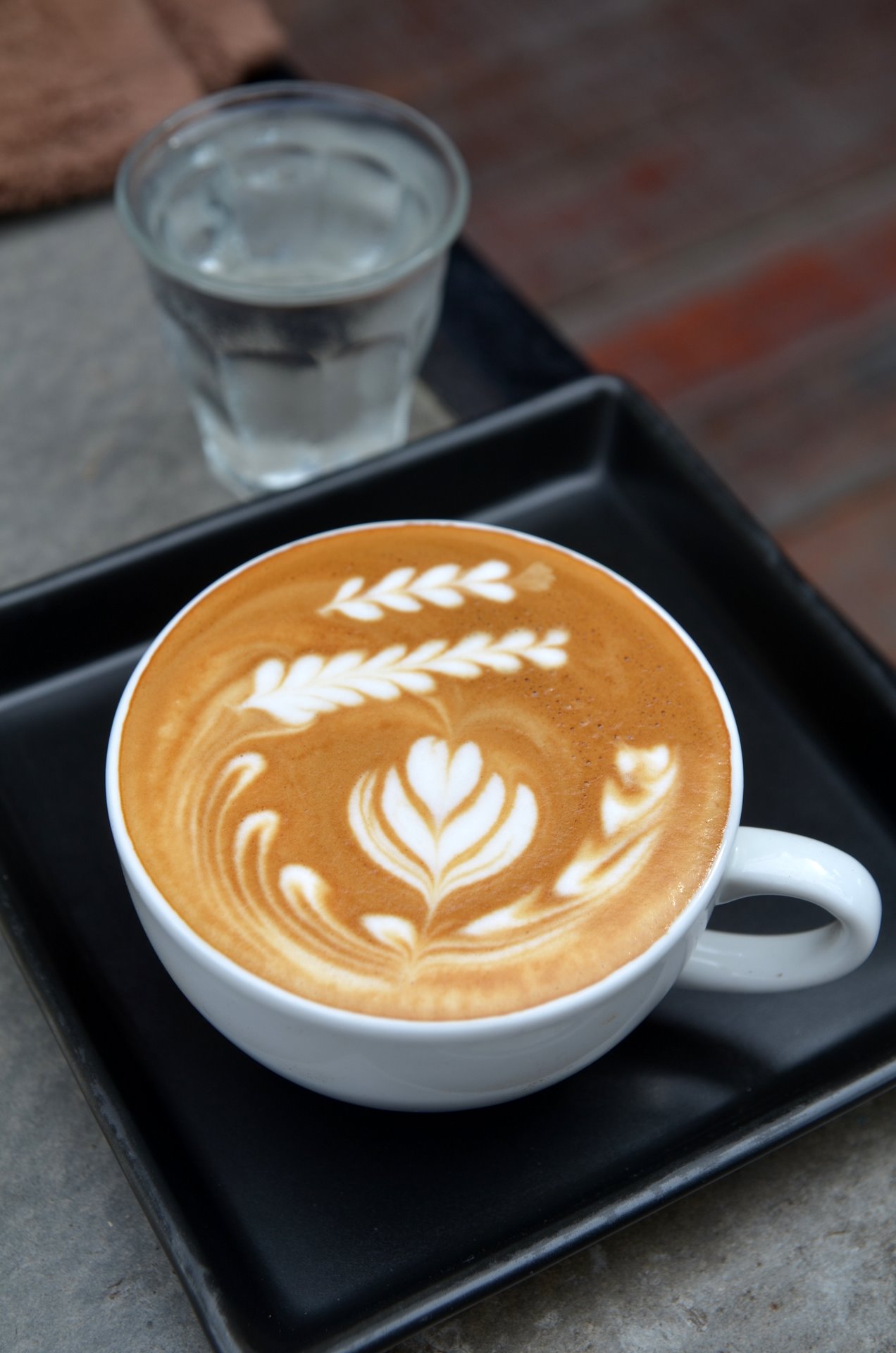
A latte with rosetta latte art on a black tray beside a glass of water, milk foam patterned over golden-brown coffee 11
Chiang Mai Doi coffee
กาแฟดอย · highland arabica and the cafés of Nimman

Chiang Mai isn't only about food — it's Thailand's real coffee city. Arabica beans are grown on the northern highlands like Doi Chang, Doi Saket and Doi Pu Muen, then roasted and brewed in independent cafés all over town, above all in the Nimmanhaemin area, which is full of specialty coffee shops, skilled baristas and pretty latte art. The names that come up again and again are Ristr8to (home to a world latte-art champion), Graph Café, and Akha Ama Coffee, which sources its beans from an Akha hill-tribe community. Sitting with a cup of Doi coffee in a Chiang Mai café is something not to miss, around ฿60–120 a cup.

Where: Ristr8to · Graph Café · Akha Ama Coffee (Nimman and in town)
Price: ~฿60–120/cup
Tip: Try a black filter coffee from Thai Doi beans to taste the local terroir
Go deeper

The Chiang Mai food guides, by topic

Want to dig into a single dish or a particular way of eating? We've split each one into its own guide.

Where to eat

Which market or area to head for

Know what each market and neighbourhood does well before you set off.

Chang Phueak Gate
North of the old-city moat · evening to late-night food plaza

Chiang Mai's liveliest evening street-food plaza, just north of the old city. It's famous for the cowboy-hat khao kha moo vendor with the daily queue, plus fried snacks, khao soi, noodles and plenty of casual eats. The vibe is easygoing and friendly — a natural place to start an evening, where locals and visitors end up side by side.

Best for: Khao kha moo · fried snacks · dinner · Hours: ~17:00–late
Warorot Market (Kad Luang)
Kad Luang · the old downtown market by the Ping

The historic downtown market where Chiang Mai locals come for regional food and edible souvenirs — sai ua, pork rinds, nam prik num, nam prik ong, mu yo sausage and dried goods, all in one place. Graze as you shop and take some home. It's a proper working market, busy all day, where you get the real regional products at local prices, right next to the Night Bazaar and the Ping riverside.

Best for: Sai ua · northern food souvenirs · Hours: ~06:00–18:00
Sunday Walking Street
Ratchadamnoen Rd, old city · Sunday evenings

The biggest and busiest of the walking streets, open Sunday evenings down the spine of the old city. It's packed with food to graze on — khao soi, sai ua, local sweets, fresh juice, and temple-courtyard food courts — woven in with craft stalls and souvenirs. It makes for an easy dinner you eat as you wander, all evening long. There's more in our Sunday Walking Street guide.

Best for: Grazing · local snacks · Hours: Sunday ~16:00–22:00
Nimmanhaemin
Nimman · the café and lifestyle district

Chiang Mai's most happening district, full of specialty Doi-coffee cafés, modern restaurants and dessert spots — made for café-hopping and relaxed meals. Ristr8to, Graph and Akha Ama are all around here. It's the kind of area where you can sit and work or linger for hours, blending the city's coffee scene with a younger lifestyle crowd.

Best for: Doi coffee · cafés · easy meals · Hours: ~08:00–22:00
The places people recommend

The spots not to miss

Places Chiang Mai locals and serious eaters have recommended for years — put them in the plan.

1
Khao Soi Khun Yai
The tiny legendary khao soi shop · near Wat Lok Molee

A small, unfussy khao soi shop near Wat Lok Molee that locals and serious eaters pass along by word of mouth. It opens late morning and tends to sell out fast because of the queue. The khao soi comes with chicken or beef in a rich, deeply fragrant broth with crisp noodles on top, eaten with pickled greens and shallots. The setting is plain, with seats under the trees. Honestly, go before noon — it runs out quickly — and prices are gentle, the local-shop kind.

Address: Near Wat Lok Molee, old city, Chiang Mai
Hours: From late morning, sells out fast (morning–afternoon) · Signature: chicken/beef khao soi ~฿40–60 · cash
2
Khao Soi Lam Duan Fah Ham
A long-running khao soi institution · Fah Ham district

A veteran khao soi shop in the Fah Ham district that's been part of Chiang Mai for a long time — one of the areas known for the halal khao soi tied to its Chinese-Muslim Yunnanese roots. The broth is rich and full of spice, the meat slow-cooked and tender, with chicken or beef to choose from. The setting is traditional and easy, and it keeps longer hours than many of the tiny shops. A good pick if you want a khao soi place with real history behind it.

Address: Fah Ham district, by the Ping River, Chiang Mai
Hours: Morning–afternoon (check before you go) · Signature: chicken/beef khao soi ~฿50–80
3
Huen Phen
A legendary northern restaurant · old city

A long-established northern restaurant in the old city that's among the first names people mention for a full Lanna spread. It does nam prik ong, nam prik num, gaeng hung lay, larb khua, sai ua and pork rinds. At lunch it runs as a simple rice-and-dishes shop; in the evening it becomes a sit-down restaurant in an old wooden house decorated with Lanna antiques. It's ideal if you want to try several northern dishes in one meal. It's popular, so arrive early or be ready to wait for a table.

Address: Ratchamanka Rd, old city, Chiang Mai
Hours: Lunch and dinner (check times) · Signature: full northern spread · old-Lanna setting
4
Khao Kha Moo Pratu Chang Phueak (the cowboy-hat lady)
The famous pork-leg-rice stall · Chang Phueak Gate plaza

The most famous khao kha moo in Chiang Mai, known to everyone as "the lady in the cowboy hat" after the hat the vendor wears every day. The pork leg is braised until meltingly soft, the skin like jelly, spooned over hot rice with pickled greens and egg. It sells from evening into the night at the Chang Phueak Gate plaza, with a long queue almost every night. To be honest, you'll wait a bit — but it's an easy, tasty, cheap meal and a fixture of a Chiang Mai late night.

Address: Chang Phueak Gate plaza, Chiang Mai
Hours: Evening–late · Signature: khao kha moo ~฿40–70 · cash · expect a queue
5
Akha Ama Coffee
Doi coffee from an Akha community · in town and Nimman

A Doi-coffee café with a story, using arabica beans from an Akha hill-tribe community's farm in the northern highlands, roasted and brewed with real care. It's one of the cafés that helped put Thai coffee on the map. The coffee is clean and full of character, the room warm and welcoming, with several branches in the old city and around Nimman. A great choice if you want to try genuine Thai Doi coffee while supporting the growers at the source, around ฿60–120 a cup.

Address: Several branches · old city and Nimman, Chiang Mai
Hours: ~08:00–18:00 · Signature: Akha Doi coffee ฿60–120 · QR / cash
Frequently asked

FAQ · what people ask before they go eating

How much does a meal in Chiang Mai cost?
Chiang Mai works on any budget and is noticeably cheaper than Bangkok. A bowl of khao soi or noodles is about ฿40–80. Market eats like sai ua, khao kha moo or mango sticky rice run ฿40–70 a plate. A sit-down northern restaurant is around ฿100–250 per person. A specialty coffee in the Nimman area is ฿60–120 a cup. A khantoke dinner with a dance show is roughly ฿300–600 per person. Honestly, if you stick to markets and local shops, a few hundred baht a day will keep you well fed.
Where should I eat khao soi in Chiang Mai?
The names people recommend most are Khao Soi Khun Yai (a tiny shop near Wat Lok Molee that opens late morning and sells out fast), Khao Soi Mae Sai, and Khao Soi Lam Duan Fah Ham (a long-running shop in the Fah Ham district). All serve chicken or beef khao soi in a rich, fragrant coconut-curry broth topped with crisp fried noodles, eaten with pickled mustard greens, shallots and lime, around ฿40–80 a bowl. If you're staying around Nimman, there's also Khao Soi Nimman, which is easy to find and comfortable to sit at. There's a full breakdown in our khao soi guide.
Is northern Thai food very spicy, or hard to eat?
Most northern food isn't as fiery as Isan or southern Thai cooking. It leans savoury and salty, more about herbs and roasted spice than raw chili heat. Dishes like khao soi, gaeng hung lay and sai ua are easy for almost anyone, while nam prik num and nam prik ong are pleasantly spicy and adjustable. To be honest, the ones that take an open mind are the offal- or blood-based dishes — some versions of khanom jeen nam ngiao, and traditional larb khua. If you're unsure, order small portions to try first.
Do Chiang Mai restaurants take cards, or do I need cash?
Market and street stalls mostly run on cash, but many now have a Thai PromptPay QR code you can scan, which is very handy if you have a Thai banking app. Cafés and sit-down restaurants around Nimman and in town generally accept QR transfers, and some take credit cards. It's worth carrying small notes for markets and food carts, since some little shops still have no card machine.
Where do I find Chiang Mai market food?
Chang Phueak Gate in the evening is a lively street-food plaza, famous for the well-known khao kha moo vendor (the lady in the cowboy hat), fried snacks and casual eats. Warorot Market (Kad Luang) is the old downtown market for sai ua, pork rinds, nam prik num and edible souvenirs. The Sunday and Saturday Walking Streets are packed with food to graze on, and there are also the Chiang Mai Gate market and Ton Phayom market where locals actually shop. Honestly, eating where Chiang Mai locals queue gets you the real regional flavour at better prices than the purely touristy zones.
How do I take a cooking class or eat a khantoke dinner?
Chiang Mai is one of the most popular places in Thailand for Thai cooking classes. A typical class starts with a market tour to pick ingredients, then teaches you 4–5 dishes such as khao soi, a curry, pad thai and mango sticky rice; half- and full-day options exist, usually ฿800–1,500. A khantoke dinner is a Lanna tray-set meal eaten with a traditional dance show, with nam prik ong, sai ua, gaeng hung lay and pork rinds on the tray. Both are easy to book ahead through a tour platform. See our cooking-class and khantoke guides for the details.
Klook · cooking class

Learn to cook Thai food in Chiang Mai — market tour, then hands-on

A Thai cooking class with a local chef who walks you through the market to pick ingredients, then teaches you to make khao soi, a curry and mango sticky rice with your own hands — you go home with the skill and the memory.

See Chiang Mai cooking classes on Klook →
Wherebest is a Klook affiliate partner — we may earn a commission when you book through our link, at no extra cost to you.