A white Sri Lankan-style stupa with a gold-clad spire rising over the old town, built by legend to enshrine a relic of the Buddha in the days of the Tambralinga kingdom — here is how to actually visit: what to see inside, the cloth-raising ritual, the dress code, opening hours, and how to combine it with the old town.
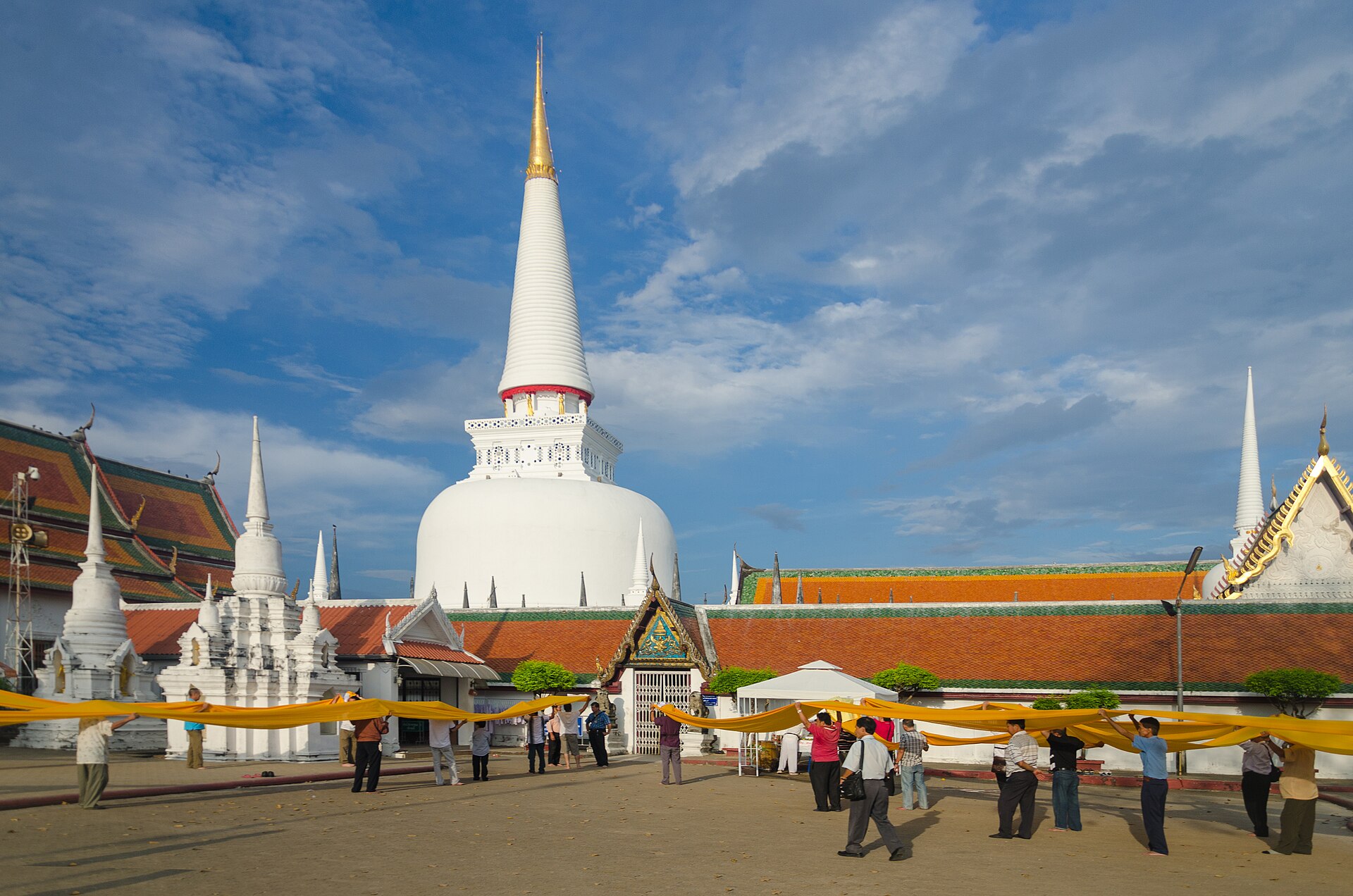
There is a moment, usually as you walk in from Ratchadamnoen Road in the morning and look up, when you see it: a tall white chedi with a gold-clad spire rising into the sky, ringed by small white subsidiary chedis and the tiled roofs of the surrounding halls, with people walking quietly around it to pay their respects and some carrying a long cloth up to drape over the stupa. This is the image that has lived in the hearts of Nakhon Si Thammarat's people for generations, and it is the reason to come here before anything else.
Wat Phra Mahathat Woramahawihan is one of the holiest temples in southern Thailand and the symbol of Nakhon Si Thammarat (locals call it "Nakhon" or "Khon"), one of the oldest cities in the country and once the seat of the Tambralinga kingdom, known to foreign traders as "Ligor". Its heart is the Phra Borommathat chedi, a large Sri Lankan-style stupa about 78 m tall with a gold-clad spire, which by legend was built to enshrine a relic of the Buddha (held to be a tooth relic) brought here and laid to rest.
What sets this temple apart from a typical tourist sight is that it is a living, active place of worship, not just a monument to look at. Southerners and pilgrims from across the country come to pay their respects to the relic here every day, so the atmosphere is one of devotion rather than sightseeing. The temple also sits on Thailand's UNESCO World Heritage Tentative List, recognised as important evidence of Buddhism and cultural exchange across the southern peninsula — a good reason to visit it with respect for the place.
Knowing a little of the story behind it makes the chedi in front of you mean a great deal more — this is not just an old stupa but the centre of faith that has sustained this city for a thousand years.
As the story is told, a relic of the Buddha (held to be a tooth relic) was brought and enshrined on the sandy shore, and a chedi was raised over it that became the seed of the city. The tale is bound up with Prince Thanakuman and Princess Hemchala, who are said to have carried the relic across the sea to safety. Whatever the details in each version, the core is the same: this relic made Nakhon Si Thammarat the Buddhist centre of the southern peninsula.
The chedi you see today is a bell-shaped (Sri Lankan-style) stupa on a square base, its white dome rising into a slender tapering spire that is clad in gold at the top. The form reflects the Sinhalese (Sri Lankan) strand of Buddhism that spread in through the southern peninsula — evidence that Nakhon Si Thammarat was once a port and a meeting point for religious and cultural exchange between Sri Lanka, India and Southeast Asia.
For its historical and architectural value, Wat Phra Mahathat Woramahawihan has been placed on Thailand's UNESCO World Heritage Tentative List, the step towards a possible future inscription. The status reflects that the chedi matters not only to southerners but as a piece of Buddhist heritage with meaning beyond the region — and it is a reminder to visit thoughtfully and with respect for the site.
It is all within the one temple complex, easily walkable — start at the chedi itself, then take in the rest slowly and quietly.
The image that defines the whole city — the large white bell-shaped chedi with its gold-clad spire, standing in the centre of the courtyard, ringed by many small subsidiary chedis. People walk clockwise around it (circumambulation) to pay their respects, apply gold leaf and make a wish. The most heartfelt moment for many is to take part in raising a cloth around it and to feel the sacred atmosphere at the base. It is where you should begin and where you should give the most time.
The heart of devotion here is the Hae Pha Khuen That cloth-raising ritual — people together carry a pha phra bot, a long cloth often painted with scenes from the life of the Buddha, in procession into the temple, then take it up to drape around the chedi as an offering. It is held on a large scale twice a year, on Makha Bucha and Visakha Bucha days. If you come at these times you will see the most beautiful and sacred atmosphere of all, but it is extremely crowded, so allow extra time and be ready for the heat and the crowds.
Around the chedi courtyard runs the Phra Rabiang cloister, a long covered gallery lined with many Buddha images in a continuous row to walk past and pay respects to. It is shaded and calm, a place where people pause to sit and meditate between circuits of the chedi — and one of the scenes that best captures what a living, working temple feels like.
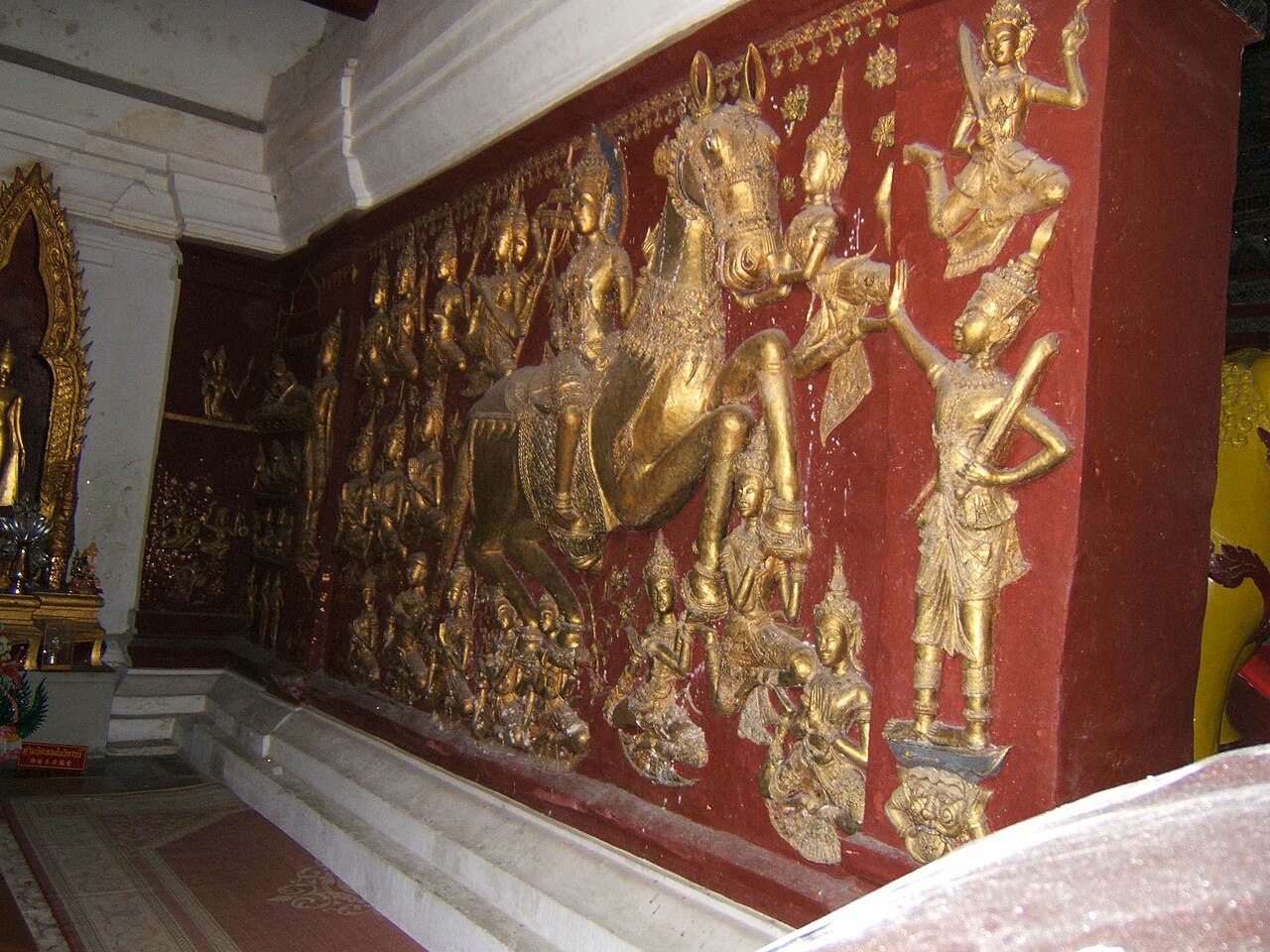
The hall beside the chedi base takes its name from the "Phra Song Ma" theme, the episode of Prince Siddhartha's Great Departure riding the horse Kanthaka. Inside are detailed stucco reliefs and ornamentation, and it forms the route up to the circumambulation terrace around the chedi base. It is one of the temple's finest displays of craftsmanship, well worth taking slowly.
Within the grounds, a hall displays offerings, gold items and treasures donated to the relic by the faithful over a very long time, both ancient pieces and valuables that reflect the devotion of many eras. It helps you grasp just how much this relic means to people. There is usually a donation box or small upkeep contribution by goodwill, and it may keep set hours, so check on site.
Wat Phra Mahathat is an active sacred site, not just a photo stop. The thing to prepare for is dressing modestly — cover your shoulders and knees, and avoid vests, sleeveless tops, short shorts or skirts and anything see-through. Carrying a shawl just in case is the safest move.
Once you are in the chedi courtyard and the cloister, which are sacred ground, keep your voice down, remove your hat and sunglasses in front of the Buddha images, and at some spots take off your shoes. Do not climb on the chedi base or the Buddha images, do not pose mockingly, and never stand over or point at a Buddha's head when taking photos. If you walk around the chedi, follow others quietly and respectfully.
The temple grounds are open daily from morning to late afternoon, roughly 8 am to 5 pm as a guide (times may vary slightly between parts of the complex, check on site). Early morning and late afternoon are cooler and quieter than the middle of the day. Entering to pay your respects at the chedi and walking the grounds has no official entrance fee.
The temple museum displaying the treasures may ask for a small donation or upkeep contribution by goodwill, and keeps set hours. If you are coming for a festival, especially the Hae Pha Khuen That cloth-raising on Makha Bucha and Visakha Bucha days, it is far busier than usual, so come early and allow extra time for parking and crowds.
The temple is in the old town of Nakhon Si Thammarat, on Ratchadamnoen Road. If you are staying in town it is easy to reach by songthaew, motorbike taxi, tuk-tuk or Grab (less common here than in a big city). From Nakhon Si Thammarat Airport it is about 20 km by shuttle or taxi. Coming from further afield, there are flights from Bangkok, the southern railway, and buses or minivans.
The bonus is that the temple sits close to several of the old town's other sights, a short walk or ride away — the City Pillar Shrine, the old city wall and moat, the National Museum (home to the revered Phra Buddha Sihing image), the Ho Phra Isuan and Ho Phra Narai Brahmin shrines, and the Suchart Subsin shadow-puppet (nang talung) house. It makes an easy day of exploring the old town on foot → read how to get around Nakhon Si Thammarat (the city has no skytrain or metro — songthaews, motorbikes and rental cars do the work).
What makes Wat Phra Mahathat different from elsewhere is the feeling of a living pilgrimage. On any day you will see southerners and pilgrims from across the country coming to pay their respects to the relic, lighting incense and candles, applying gold leaf, offering flowers and walking around the chedi. The chanting, the scent of incense and the gold catching the morning light on the spire give the place a calm and sacred feeling far removed from an ordinary tourist site.
To feel this fully, come early in the morning when the light is soft and the crowds are thin, and take your time, watching the people who have come to make merit rather than rushing for a photo and leaving — a way to visit that gives you both a lovely scene and respect for what is a sacred temple to the people of the south.
Once you leave Wat Phra Mahathat, these sit nearby in the old town, a short walk or ride away — well worth carrying on to in the same day.
Stay in town near the temple and the old quarter, so you can wake up and pay your respects at the chedi before the heat, then walk on to the old town and the markets.