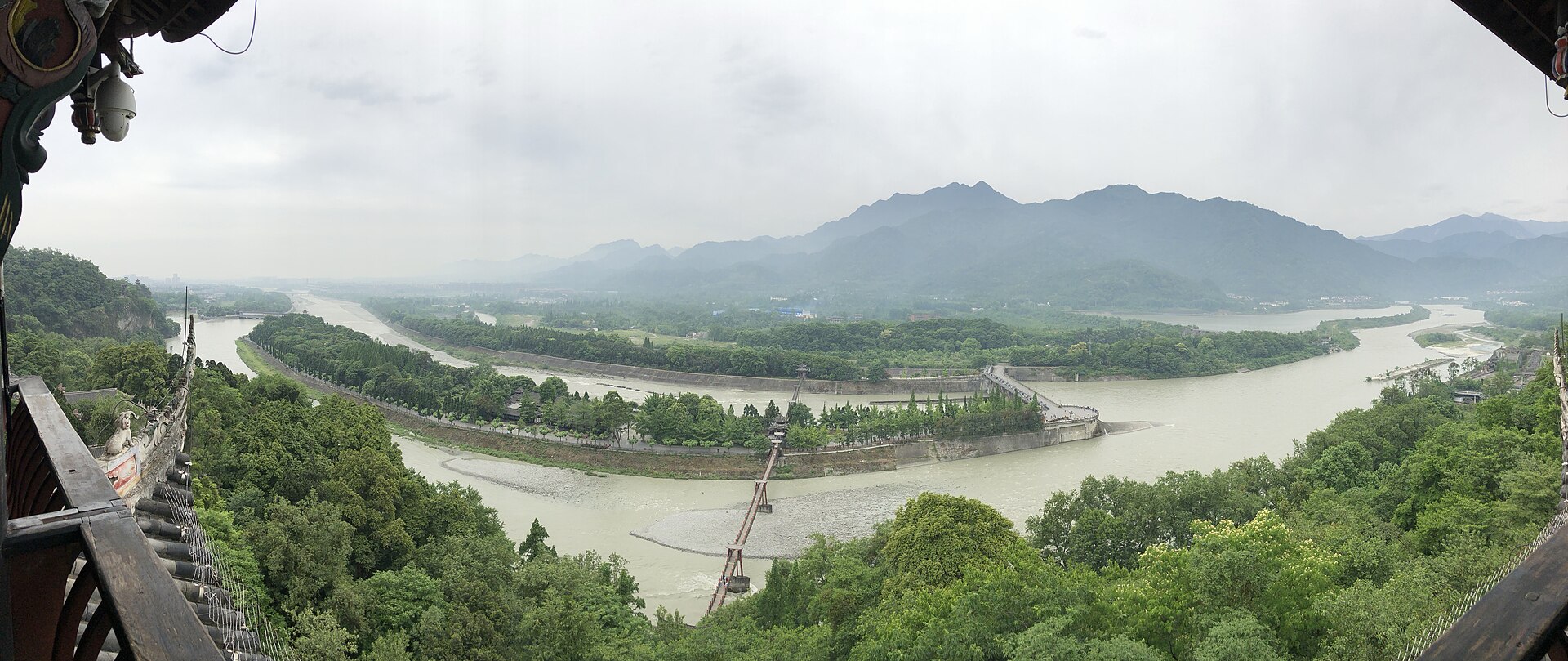
Two UNESCO World Heritage Sites just 30 minutes from Chengdu by bullet train — a cool, green mountain where Taoism took shape, and an ancient waterworks that has fed the Sichuan plain for over two millennia.
Picture this: you finish breakfast in Chengdu, and by mid-morning you are standing at the Fish Mouth (鱼嘴), watching the Min River split into two channels along a levee that Li Bing designed 2,200 years ago. By the same afternoon you are walking under the dense green canopy of Mount Qingcheng, one of the holiest mountains in Taoism. All of it fits into a single day, because the high-speed rail gets you from the city to the foot of the mountain in about half an hour.
These are two UNESCO World Heritage Sites, inscribed together in 2000, both in Dujiangyan City and only about 20–30 minutes apart by road. Mount Qingcheng (青城山) is regarded as the birthplace of organised Taoism — Zhang Daoling, founder of the Way of the Celestial Masters, is said to have practised here in the 2nd century. The Dujiangyan Irrigation System (都江堰) is the oldest waterworks still in operation anywhere in the world: built around 256 BC, it continues to channel water across the Chengdu plain to this day.
What makes this trip special is that it gives you two completely different moods in one day: engineering that leaves you genuinely impressed, and a mountain that leaves you calm — and both are far easier to reach than most people expect.
Follow the standard route down from the Two Kings Temple to the riverbank — each feature shows how Li Bing tamed the Min River without ever building a dam across it.
A fish-head-shaped levee that juts out into the Min River and divides it into two channels — the inner river feeds irrigation to the Chengdu plain, while the outer river carries off surplus water and sediment. The genius is that it adjusts the proportion of water automatically with the seasons: more into the fields during the dry season, more flushed away during floods, with nobody operating it.
An ancient suspension bridge spanning the Min River right at the Fish Mouth — one of the best-preserved old cable bridges on the upper Min (the current structure was rebuilt in 1974). It sways gently as you cross, and from the middle you look straight down at the two channels of water dividing below. It is the most photographed spot in the whole Dujiangyan complex.
An old temple on the hillside on the right bank, built to honour Li Bing (李冰), who created the system, and his son — both granted the title of "king" after the Song dynasty, hence the name. From the temple terrace you look down over the entire waterworks and the Min River, which is the clearest way to understand how the whole of Dujiangyan fits together.
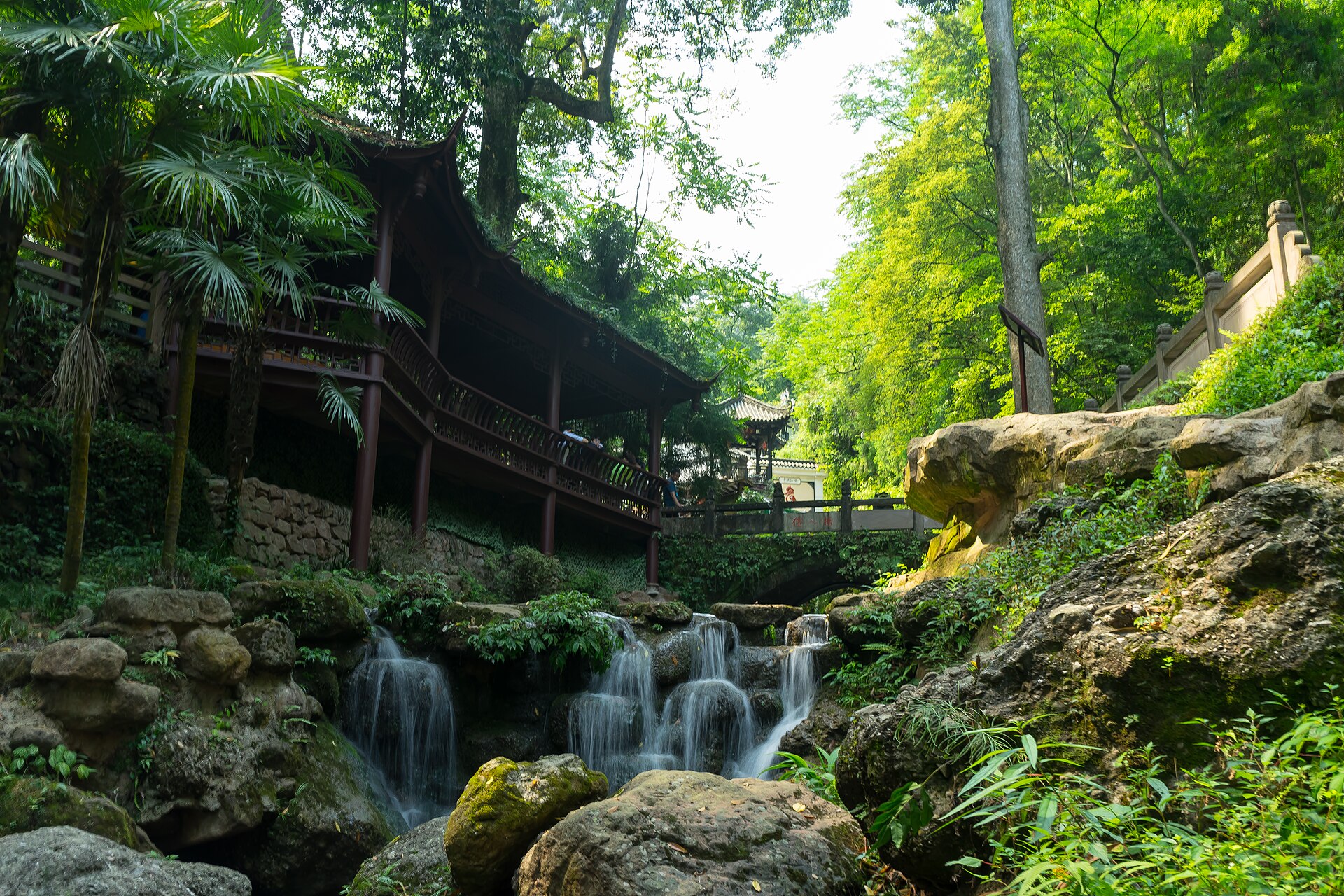
The front mountain is what people usually mean by "Mount Qingcheng," because it holds the densest concentration of Taoist temples, shrines and relics — from Jianfu Palace (建福宫) at the base, up to Tianshi Cave (天师洞), where Zhang Daoling is said to have practised, and the Laojun Pavilion (老君阁) on the highest peak. The trails are shaded by bamboo and old trees, which earned the mountain the epithet "Qingcheng, the most secluded mountain under heaven" (青城天下幽).
There is a cable car and a boat across Yuecheng Lake (月城湖) to ease the middle section. Walking the whole way to the top takes around 3–4 hours, but with the cable car it becomes a comfortable half-day — which is exactly what you want if you are combining it with Dujiangyan in a single day.
The rear mountain is a completely different experience — almost no temples, but plenty of waterfalls, streams, cliffs and trails that are far longer and steeper. Locals come to this side to escape the heat and hike all day. If you love walking and have a separate full day, the rear mountain gives you rawer, quieter nature. Note that it has a separate ticket (around ¥20) and a different entrance from the front mountain.
For anyone with a single day, the smoothest approach is Dujiangyan in the morning, Qingcheng front mountain in the afternoon. The irrigation system takes around 3–4 hours to walk; from there it is about a 30-minute ride to Mount Qingcheng, where the cable car gets you to the upper section before evening. Then take a late train back to Chengdu.
If you want to hike the rear mountain properly, or you are the kind of traveller who likes to sit with a pot of tea in a quiet temple and take your time, split it across two days — trains from Chengdu are frequent and cheap, so it costs almost nothing to do so.
The easiest and cheapest option is the high-speed rail, which takes you from central Chengdu to the foot of the mountain in half an hour.
If you enjoy trips like this out of the city, Chengdu has several more you can do by train and be back the same evening.