A 71-metre Buddha carved out of an entire cliff face, watching over the meeting of three rivers for more than 1,200 years — about an hour from Chengdu by high-speed train, then you are standing at its feet.
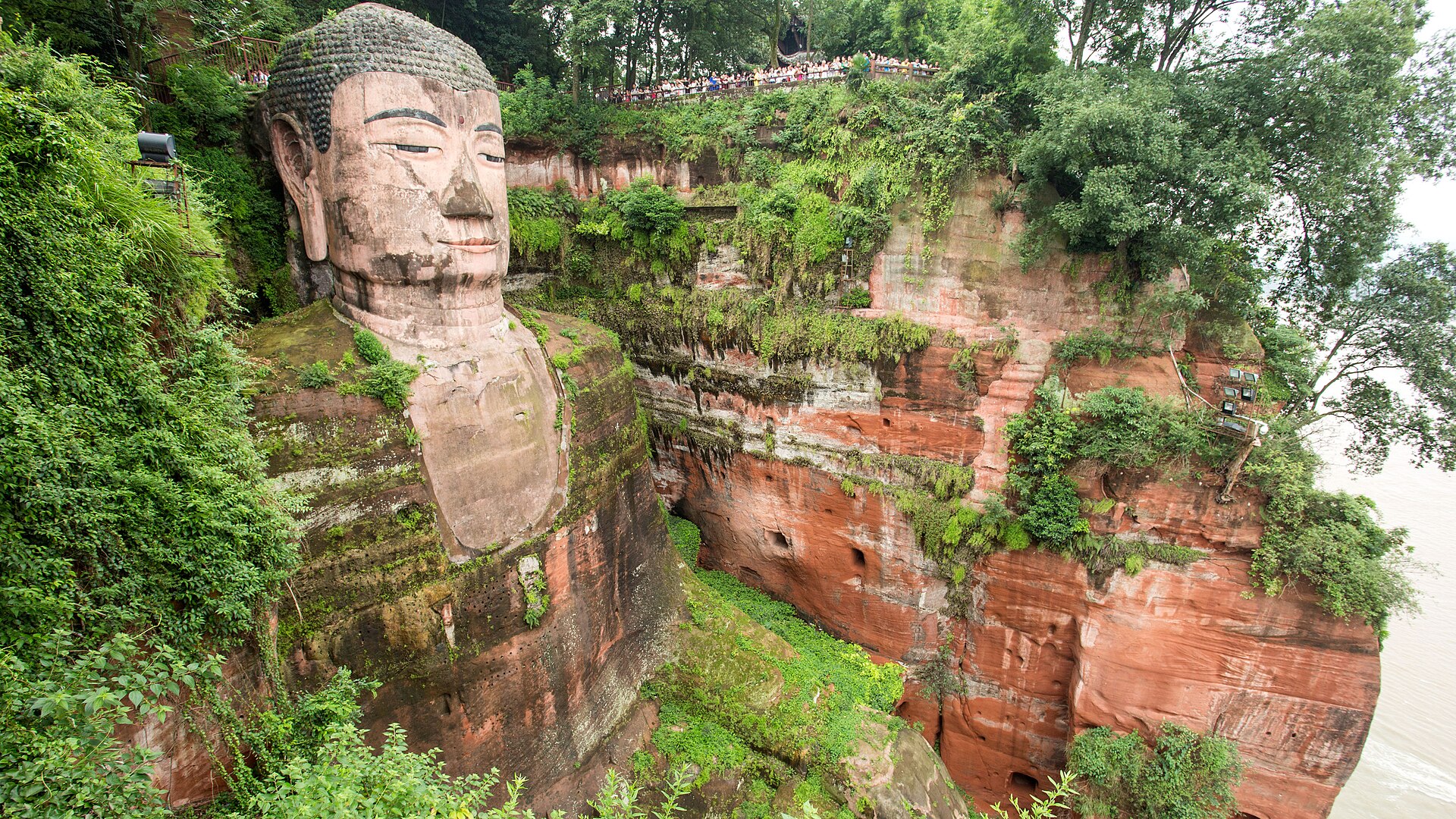
Picture it: you work your way down a switchback stone stairway pinned to the cliff, and suddenly you are standing at the Buddha's feet — a single toe longer than a grown adult. Look up and the calm face rises more than 70 metres above you, the 1,021 spiral curls of hair arranged in perfect rows, three rivers meeting behind your back. This is the part photographs never quite manage: the sheer scale only makes sense once you are actually standing there.
This is the Leshan Giant Buddha (乐山大佛) — a 71-metre Buddha carved into the cliff at the confluence of the Min, Dadu and Qingyi rivers, in the city of Leshan in Sichuan Province. It is the largest stone Buddha in the world, and a UNESCO World Heritage Site, listed together with the Mount Emei Scenic Area since 1996.
What makes it remarkable is not only the size, but the story behind it. Carving began in 713 AD under a monk named Haitong (海通), who wanted the Buddha to protect the boatmen who so often came to grief where three fast rivers collide. He spent decades raising funds and died before the work was done; his successors carried on and completed it in 803 AD — about 90 years from first chisel to finished figure.
You will look at the Buddha differently once you know these.
Tang-dynasty craftsmen built concealed drainage channels into the hair curls, the collar and behind the ears, carrying rainwater off the figure and slowing the erosion of the soft sandstone. More than a thousand years later, that system is a large part of the reason the Buddha is still standing at all.
There is an old saying that the mountain itself is a reclining Buddha — seen from the right distance on the river, the ridgeline reads as a figure lying on its back, with the Giant Buddha seated exactly at the chest. It is a detail most people miss unless they take the boat out onto the river to look.
The figures people like to repeat: a hundred people can sit comfortably on the top of one foot, and each toenail is large enough to stand on. Walk all the way down the cliff stairs, turn around and look up, and you will understand why none of that is an exaggeration.
The scenic area is more than the Buddha alone. It includes Lingyun Temple (凌云寺) on the hilltop above the Buddha's head, and the quieter Wuyou Temple (乌尤寺) on an island in the river. Both are free to walk through once you are inside. With time to do the full loop, you get old Chinese temple courtyards set among the forested hills.
The Leshan Giant Buddha and Mount Emei share a single UNESCO listing — which is exactly why so many travellers plan the two together. The same high-speed line passes through Leshan before reaching Emeishan, only about 15 minutes apart.
The Jiuqu stairway is a nine-bend stone walkway clinging to the cliff, dropping from the level of the Buddha's head down to its feet. This is the closest view you can get — photographing the toes, looking up at the face from directly below. The path is fairly steep and narrow; the descent is easy, but coming back up means climbing many flights of stairs again.
The single most important thing to know: the stairway queue is very long on weekends and in high season. On busy days you may wait over an hour just to start the descent. The best move is to arrive at the gate when it opens (~7.30 am in peak season) and head straight for the stairs before the late-morning tour buses arrive.
If you would rather not queue or do all that climbing, the river boat is an excellent alternative. Boats leave from a dock near the scenic area and take about 20–30 minutes, heading out into the river and turning to face the Buddha — and from here you see the whole figure in a single frame, along with the two carved guardian bodhisattvas flanking it that are invisible from above. The boat ticket is separate, around ¥70 (~฿350), bought at the dock.
Boats may not run in poor weather or when the river level shifts, so check the status at the dock first. If you have the time, plenty of people do both — the cliff stairs early while it is quiet, then the boat for the wider view.
The classic head-on shot of the face is taken from the upper viewing terrace at the level of the Buddha's head, before you start down the stairs. The shot that really shows the scale — tiny people against the giant figure — has to be taken from below at the feet, or from a boat out on the water.
The best time is early, right at opening: soft light, fewer people, and a shorter stair queue. Avoid the long Chinese public holidays (Chinese New Year, National Day on 1–7 October, Labour Day), which are the most crowded. Spring and autumn have the most comfortable weather; summer is hot and can be wet, so bring an umbrella and water.
The quickest and most comfortable option is the high-speed train, then a short onward ride into the scenic area.
Most people use Chengdu as a base and do Leshan as a there-and-back day trip — pick somewhere near a train station or central so an early start is easy.