A small island in the Gulf of Thailand that has taught countless people to dive, because it's one of the cheapest and most popular places in the world to learn. Clear water, reef close to shore, dive schools all over the island. Here's the honest version: the courses, real prices, the top dive sites, snorkelling for non-divers, and how to choose a school on safety — not just on price.
Koh Tao (เกาะเต่า, "Turtle Island") is a small island in the Gulf of Thailand, in Surat Thani province, about 1–1.5 hours by ferry north of Koh Phangan. Its name means "turtle island", and that name is how most of the world knows it — as Thailand's diving capital, one of the cheapest and most popular places anywhere to get scuba-certified. The reasons are simple: the dive sites sit close to shore, the water is fairly clear, the Gulf is calmer than the Andaman side for much of the year, and dozens of dive schools compete hard enough to push prices down to a level you rarely find elsewhere.
But Koh Tao isn't only about going deep. People who've never dived can give it a try, those who don't want to dive at all can snorkel over reef and fish with ease, and anyone after a challenge can take up freediving. We'll say it plainly from the start: this island's appeal is mostly underwater. If you don't dive or snorkel, Koh Tao is a small island of viewpoints, quiet beaches, good cafes and a laid-back pace — worth knowing before you come, so you set your expectations right.
From a first-ever try-dive to certified divers who just want to get in the water and look at fish — there's a course for every level. Prices are given as ranges because they shift with the year and season.
For anyone who has never dived and wants to find out if they like it before committing to a full course. It takes just half a day to a day: an instructor teaches the basics in shallow water, then takes you on a real, shallow sea dive under close supervision. You don't get a certification, but you get the genuine experience. It costs about ฿1,000–2,500, and if you enjoy it, many shops will credit that towards a full Open Water course.
2
The island's most popular course. Finish it and you hold an internationally recognised dive certification you can use anywhere in the world. It takes about 2–3.5 days, split between theory, skills in shallow water or a pool, and several dives in the open sea. It costs around ฿9,000–11,000, usually covering tuition, gear and the exam — many shops include cheap or free accommodation while you train. Ask clearly what is and isn't included.
Already have Open Water and want to go deeper and add skills? The Advanced course takes about 2 days and costs roughly ฿8,000–10,000, and it fully unlocks deeper sites like Chumphon Pinnacle. If you'd rather dive on a single breath without a tank, Koh Tao is also one of Asia's biggest freediving hubs, with beginner courses starting at around 2 days too. For both, choose a school that puts safety first above all.
If you're already certified you don't need to learn anything new — just book fun dives on a school's boat. These usually run as half-day, two-dive trips, costing around ฿800–1,200 per dive (cheaper in a multi-dive package, and usually discounted if you bring your own full set of gear). It's the easy way to dive several of the island's sites at a relaxed pace, out in the morning and back by evening. Bring your certification card and logbook.
There are dozens of dive sites around Koh Tao; these are the ones people talk about most — some suited to beginners, some you'll need an Advanced certification for first.
A rock rising from open sea that many rate as the best dive site in the Gulf of Thailand. Its signature feature is a vertical chimney you can swim up through, dense schools of fish, and a chance of larger species. It sits fairly far offshore, so it's usually a full-day boat trip. Best for certified divers with a bit of experience.
A submerged pinnacle west of the island, and the site with the best chance of a whale shark (a harmless, plankton-feeding fish) in patches, especially around March–May and September–October — but it's never guaranteed, purely down to luck. It's a relatively deep site, best for divers with an Advanced certification or solid experience.
Two of the most popular sites, around Koh Nang Yuan: shallow, calm, with colourful hard coral and lots of fish. They're where schools love to take Open Water students for their first dives, and they're snorkellable too, which makes them ideal for beginners. Visibility is usually good and the current gentle.
White Rock (Hin Khao) is one of the island's most-dived sites — a wide reef, plenty of fish, suited to both students and fun dives, and a popular spot for night dives. The current is gentle to moderate, and instructors like it for training because it's safe and there's a lot to see.
A bay on the island's south side where you'll often see small blacktip reef sharks in shallow water — shy, and harmless to people. It's a spot where you can see sharks while snorkelling, no deep dive required, with the occasional turtle too. Watch calmly from the surface and never chase or approach the wildlife.
Hin Wong bay, on the island's east side, is known for clear water and a quieter feel than the Sairee side. Big underwater boulders, coral, and varied fish make it good for both diving and snorkelling close to shore. On calm days the visibility here is often especially good.
No certification, no course — just a mask and snorkel and you can see Koh Tao's underwater world. These are the best snorkelling spots.
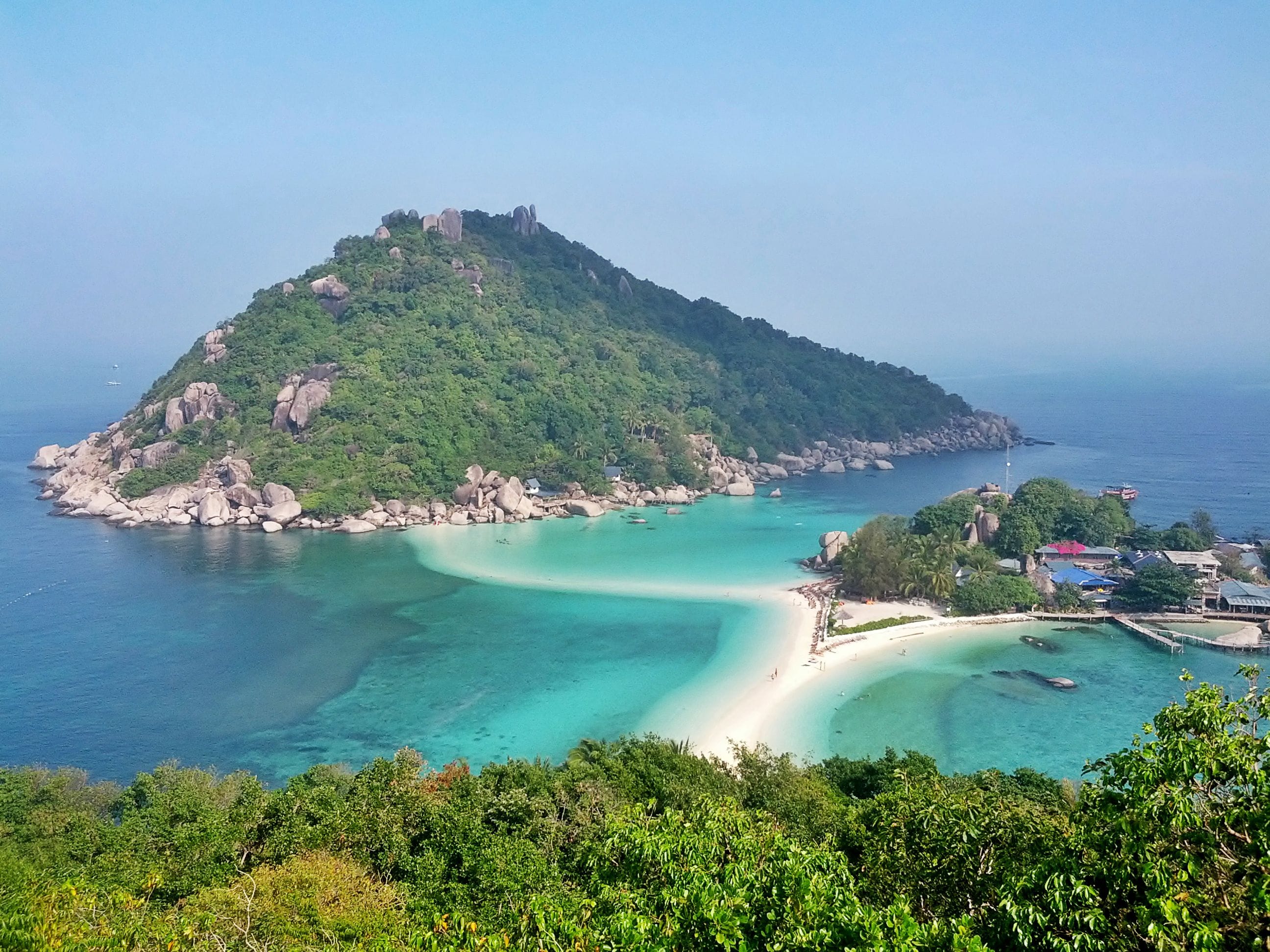
Koh Tao's most beautiful sight — three small islets linked by a white sandbar. As well as the hilltop viewpoint, the water around the sandbar lets you snorkel straight off the beach over coral and fish. It's a private island with a small entry fee, and plastic bottles aren't allowed. Go early for fewer people and clearer water.
A snorkelling spot where you've a good chance of seeing small blacktip reef sharks — shy and harmless to people. You can swim out from the beach or go by boat, and you may spot the odd turtle too. Mornings and a higher tide tend to make for easier sightings. Watch from a distance and never swim at, chase or touch the wildlife — for everyone's safety, theirs included.
Aow Leuk, on the southeast, is a curved bay with clear water, gentle current and coral close to shore — ideal for a first try at snorkelling. Tanote Bay (Aow Tanote), in the east, is also quiet and clear, with big boulders and lots of fish. You can get in straight off the beach at both, and they suit children or weaker swimmers (a life vest is fine to wear).
The easiest option for non-divers is a snorkelling boat tour around the island that stops at Koh Nang Yuan, Shark Bay and several pretty spots in a single day. Snorkel gear is provided and some trips include lunch. You can book on the island or on Klook. Choose a smaller-boat trip with fewer people and you'll get more time in the water.
Koh Tao has dozens of dive schools and plenty are good, but the very cheapest can mean big groups or worn gear. This is a safety decision — choosing well is worth more than saving a few hundred baht.
You can dive Koh Tao year-round, but some months are calmer and clearer than others — and whenever you go, reef etiquette is something everyone needs to know.
The Gulf around Koh Tao is generally calmest and clearest from around March to September — easy diving and good visibility. April and May are very hot. Whale sharks tend to be reported more often around March–May and September–October (still no guarantee).
October to December is the monsoon — wettest and roughest. Some ferry crossings can be cancelled when the sea is up, but diving often still runs on days the sea is workable. Visibility is more variable. If you come now, allow flexible days and check conditions with your school.
The first rule of every dive: don't touch, hold or stand on the coral. Coral is a living thing — slow-growing and fragile, and even a touch or a kick from a fin can damage it. Control your buoyancy, keep your gear from dangling and dragging, and don't take anything from the sea. Just look.
Choose a reef-safe sunscreen that avoids chemicals known to harm coral, or wear a long-sleeve rash top instead. Don't feed the fish, don't chase or crowd turtles and sharks for a photo, and take every piece of rubbish back out with you. Good diving leaves as little trace as possible, so the next generation sees the same sea you did.
If you want to learn to dive, get certified without spending a fortune, or you're already certified and want to do plenty of dives in clear water with reef close to shore — Koh Tao is one of the best and cheapest places in the world for exactly that. The mood is friendly, the diver-and-backpacker scene is warm, and everything revolves around the sea.
But here's the truth: this island's main appeal is underwater. If you don't dive or snorkel, Koh Tao is a small island with lovely viewpoints, quiet beaches, good cafes and easy strolls — charming, but small. Set your expectations there and you'll enjoy it more. And take particular care over scooter rental getting around (see the box below). Diving or chilling, choose whatever's actually you.