Home Kanchanaburi Thailand Kanchanaburi Hotels About
Home  ›  Asia  ›  Thailand  ›  Kanchanaburi  ›  Day Trip from Bangkok
🗓️ Kanchanaburi · 1 Day from Bangkok · 2026

One Day in Kanchanaburi

Just over two hours from Bangkok lies the river town on the Kwai — but one day forces a choice: the war-history circuit (the Bridge over the River Kwai, Don Rak cemetery, the Death-Railway train) or the seven emerald tiers of Erawan Waterfall. This plan lays out both routes, and tells you honestly why you cannot do them together.

Why you have to choose

One day in Kanchanaburi does one route well

Kanchanaburi is a popular day trip from Bangkok for one simple reason — it is close. An early start and an evening return work easily, ~2–2.5 hours each way, no flight and no overnight needed. It is well worth getting out of the city to meet the river and the western hills.

But here is the part to be clear about up front: one day does only one route well. Kanchanaburi has two worlds that sit in different directions — the war-history circuit (the Don Rak War Cemetery, the Thailand–Burma Railway Centre, the Bridge over the River Kwai, and the Death-Railway train to Tham Krasae), all clustered in and around town, and Erawan Waterfall, the seven emerald tiers that lie another ~65 km out, where the round trip alone eats close to three hours.

Try to cram both into one day and you get both in a rushed, half-finished way — racing through a cemetery and museums that deserve a slower pace, then reaching Erawan so late in the afternoon you barely make the upper tiers (which stop admitting climbers around 15:30–16:00). So this plan gives you two separate one-day routes to choose from. And if you genuinely want both, an overnight stay is far better value.

A word before you go: sites such as the Don Rak War Cemetery, the Bridge over the River Kwai, Hellfire Pass and the museums are tied to the Thailand–Burma 'Death Railway', built under the wartime Japanese occupation by Allied prisoners of war and conscripted Asian labourers, tens of thousands of whom died. These are memorials and graves, not fun attractions — visit them with respect, dress modestly, and keep your voice down.
How to get there from Bangkok

Pick how you travel before you pick your route

How you get there shapes which route you can do — if Erawan is the goal, a private car or a tour is the answer; for the in-town sites, the train or a minivan are fine.

🚆The Death Railway train (atmospheric + cheap)

It runs from Bangkok's Thonburi station (Bangkok Noi) through Kanchanaburi and the River Kwai bridge to Nam Tok, crossing the Tham Krasae wooden trestle along the cliff above the river — both transport and one of Thailand's finest rail rides. It is slower than the road with only a couple of services a day, so it suits the in-town / war-history route rather than Erawan. There are also weekend SRT excursion trains from Bangkok.

~2–3 hr · 3rd-class ~฿100 (tourist)
🚐Minivan (fastest and most frequent)

From Mo Chit 2 or Sai Tai Mai, with departures throughout the day, dropping you in Kanchanaburi town. Quicker and more flexible than the train, and a good fit if you plan to see the in-town sites and connect by songthaew or motorbike. For Erawan you would then need a second leg out to the park.

฿120–160/person · ~2–2.5 hr
🚗Private car / taxi / Grab (best for Erawan)

The most flexible option, reaching Erawan ~65 km out and the further sights without worrying about timetables. It pays off if you are a small group splitting the fuel — and it is the only way the one-day Erawan route really works, because you control your own timing up and down the falls.

~2–2.5 hr · best for Erawan + far sights
🎟️A day tour from Bangkok (no planning needed)

Day tours run from Bangkok with the route arranged for you — both the bridge + Death-Railway version and the Erawan version. Good if you would rather not drive or connect transport yourself; most include the vehicle, a guide and sometimes admission. Check which route the tour covers before you book.

Hotel pickup in Bangkok · route varies by programme
The one thing Kanchanaburi lacks: there is no BTS / MRT / skytrain / metro — it is a provincial river town. But there is the Death Railway, which you can ride as a sightseeing trip. Around town you get about by songthaew, rented motorbike, bicycle or river long-tail boat, and Grab is limited. Read the full breakdown in getting to Kanchanaburi and getting around Kanchanaburi.
Two routes to choose from

One day, choose one

Both routes are good in different ways — there is no right or wrong. Pick the one that matches whether you want the history and the story that day, or a swim in clear water in the forest.

Route A
War history — in town, easy to reach

The Don Rak War Cemetery, the Thailand–Burma Railway Centre and the Bridge over the River Kwai are all in town and close together, easy to reach by train or minivan, and you can add the Death-Railway train to Tham Krasae if time allows. These are places of remembrance — visit them quietly and with respect.

Choose this if: you are drawn to the story of WWII and the Death Railway, you have no private car, you want to ride the train, and you would rather not rush.
Route B
Erawan Waterfall — emerald pools in the forest

Erawan's seven emerald tiers in the national park, ~65 km from town, climbing from tier 1 up to 7 (the upper tiers steeper and rougher), swimming in clear pools where small fish nibble your skin. You can stop at the bridge on the way back. You need a private car or a tour, and you must time it to make the upper tiers before they close to climbers ~15:30–16:00.

Choose this if: you want to swim, you have a private car or a tour, and you are going in the rains (the falls run fullest and greenest) or the heat (the cool water is a relief).
Route A · stop by stop

The war-history route a day in town
A
One Day · Route A
Don Rak Cemetery · Railway Centre Museum · Bridge over the River Kwai · Tham Krasae Train
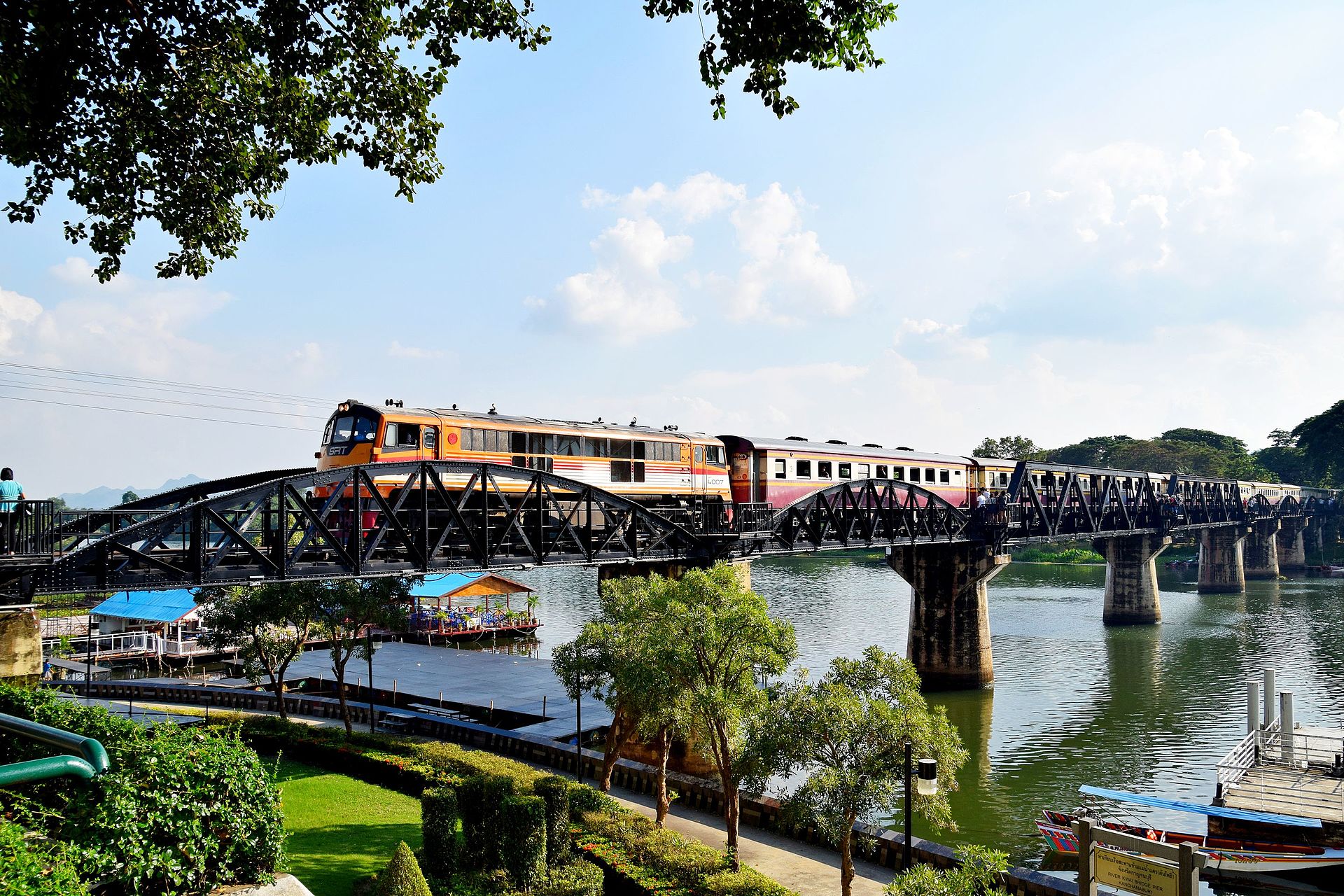
Bridge over the River Kwai, Kanchanaburi — the black iron railway bridge connected to the WWII Thailand–Burma Death Railway
06:00–08:30 · travel + arrival
Leave Bangkok early, arrive in Kanchanaburi town

Start as early as you can. For the in-town route, take the train from Thonburi station (atmospheric, with scenery before you arrive) or a minivan from Mo Chit 2 / Sai Tai Mai (quicker and more frequent, ~2–2.5 hours), dropping you near the cemetery and the museums. By train you watch the western countryside slowly give way to river and hills along the way.

Train: Thonburi station (Bangkok Noi) → Kanchanaburi · cheap · check the timetable, only a couple of services a day
Minivan: Mo Chit 2 / Sai Tai Mai · ฿120–160 · ~2–2.5 hr · frequent
Around town: songthaew, rented motorbike, bicycle, or on foot (the Route A sights are close together)
Tip: The Route A sights cluster in town — you can reach them all on foot, by bicycle or by songthaew, with no need to hire a car for the whole day. Start at Don Rak and the museum in the cooler morning, then head to the bridge mid-morning.
09:00–11:00 · ~2 hours
Don Rak War Cemetery + Thailand–Burma Railway Centre

Begin at the Don Rak War Cemetery in the town centre — the immaculately kept Commonwealth war cemetery with around 6,982 graves of Allied prisoners of war who died building the Death Railway. It is a place to walk quietly and with respect. Directly opposite is the Thailand–Burma Railway Centre, a thorough, serious museum that tells the story of the railway's construction, its background, and the lives of the prisoners — visit it before the bridge so the history makes sense.

The town also has the JEATH Museum by the river, which recreates a POW camp, and across the river the quieter Chong-Kai cemetery, both worth a stop if time allows. But for a single day, keep the focus on Don Rak and the Thailand–Burma Railway Centre.

Location: Town centre, reachable on foot or by bicycle · the cemetery and museum face each other
Entry: The cemetery is free · the museum has an admission fee (~฿150–320, check before you go)
Etiquette: Dress modestly, keep quiet, do not climb on or sit on the graves
With respect: this is a cemetery and a memorial to thousands of people who died — not a fun photo stop. Walk it quietly, take in the history, and honour the place. Read more context in the Kanchanaburi attractions guide.
11:00–12:30 · ~1–1.5 hours
The Bridge over the River Kwai (the black iron bridge)

Walk on to the Bridge over the River Kwai — the black iron railway bridge that has become the image of Kanchanaburi. It was built by prisoners of war and Asian labourers on the Death Railway, bombed and rebuilt; the curved spans are the original ones, the angular straight spans the post-war repairs. You can walk across it (there are refuge bays to step into when a train passes), and the local train still crosses it. Walking across is free.

From late November to early December there is the River Kwai Bridge Week, with a light-and-sound show that tells the history — if your trip lands in that window the atmosphere is especially busy. Whenever you go, keep the bridge's origins in mind and visit with respect.

Location: A little north of the town centre · there is a River Kwai Bridge station
Cost to walk: Free · mind the local train crossing at intervals — use the refuge bays
Special event: River Kwai Bridge Week, late Nov–early Dec (light-and-sound)
12:30–14:00 · lunch
A river-fish lunch at a floating raft restaurant

Take a break for a properly local Kanchanaburi lunch — freshwater river fish at a floating raft restaurant. Around the bridge and along the river there are several floating raft restaurants where you can eat yi-sok, snakehead or freshwater catfish, grilled, fried or in a tom yum, with a view of the river and hills. It is a flavour you rarely get in Bangkok. See more places and dishes in the Kanchanaburi food guide.

Zone: Riverside around the bridge · Mae Nam Khwae Road
What to order: River fish grilled / fried / in tom yum · choose by size, priced by the kilo
Mid-range: ฿200–400 per person depending on the fish and the place
14:00–16:30 · optional add-on
Ride the Death Railway to Tham Krasae (if the timing works)

If the train timetable lines up, this is the highlight worth doing — ride the Death Railway from the in-town / River Kwai Bridge station toward Tham Krasae. The train clings to the cliff on the Tham Krasae wooden trestle (the Wampo viaduct) above the river — a rail view that is beautiful and sobering at once, because this stretch was built at the cost of many prisoners' lives. There is a cave shrine (Tham Krasae) beside the track, and the photo spot for the wooden viaduct is right there.

One thing to know: train services are limited and the timetable can change. If you ride to Tham Krasae in the afternoon, check that there is a return service back to town in time to connect with your trip back to Bangkok — otherwise keep a minivan or private car as a backup. If the timing does not work in a single day, save the train for an overnight trip, which is more relaxed.

Route: Kanchanaburi / River Kwai Bridge → Tham Krasae → Nam Tok
Ticket: 3rd-class ~฿100 (tourist, on the special run) · very cheap on the local service
Check first: Only a couple of services a day · allow a return that connects with your Bangkok transport
16:30–19:00 · the journey back
Leave Kanchanaburi for Bangkok

If you came by minivan or private car, leave town around 16:00–17:00 to reach Bangkok before nightfall, allowing ~2–2.5 hours plus traffic on the way into the city. Evening minivans run frequently, while the return train services are limited and slower — so if you are banking on the train back, check the timetable in the morning and have a backup.

Leave town: ~16:00–17:00 (by road) to reach Bangkok before dark
Minivan: Frequent in the evening · ~2–2.5 hr
Train: Limited return services, slower · check ahead
Route B · stop by stop

The Erawan route a day in nature

B
One Day · Route B
Erawan's Seven Emerald Tiers · River-Fish Lunch · The Bridge on the Way Back
Kanchanaburi — the River Kwai and the western hills, near Erawan Waterfall in the national park
05:30–08:30 · a very early start
Leave Bangkok early and head straight for Erawan

The Erawan route needs an earlier start than Route A — because the falls sit another ~65 km past town (so it is more than three hours from Bangkok in total), and the upper tiers stop admitting climbers in the afternoon, around 15:30–16:00. The route that works best is a private car / taxi / Grab, or a tour, that takes you straight to Erawan with no time lost connecting in town. Without a private car, you can take a minivan to town and then a songthaew out to the park, but that adds time.

Recommended: Private car / taxi / Grab, or a tour straight to Erawan
Distance: Bangkok → Kanchanaburi town ~2–2.5 hr + town → Erawan ~65 km
Leave Bangkok: ~05:30–06:00 to reach the falls early and make the upper tiers
Why so early: the earlier you reach Erawan, the more of the upper tiers you get and the thinner the crowds, because tiers 6–7 stop admitting climbers around 15:30–16:00 and the climb up is steep and takes a while. Read the tier-by-tier detail and the rules in Erawan Waterfall.
09:00–13:00 · ~4 hours
Erawan Waterfall — climb tiers 1 to 7 and swim the emerald pools

Arrive at Erawan Waterfall — a seven-tiered waterfall in Erawan National Park, famous for the emerald-green water in its limestone pools. Climb from tier 1 upward, one level at a time; the lower tiers are an easy walk, the upper ones (5–7) steeper and rougher, so wear shoes with good grip. Several pools are swimmable, with small fish that nibble at your skin — bring swimwear and water shoes.

What to know: foreign admission is ~฿300 (cheaper for Thais, check before you go), and any plastic bottle you carry up requires a deposit (refunded when you bring the bottle back down) to keep the trails clean. The upper tiers stop admitting climbers around 15:30–16:00, so watch the clock. In the rainy season (Jun–Oct) the falls are fullest and greenest, but the climb to the upper tiers is slippery — take extra care.

Entry: Foreigners ~฿300 (cheaper for Thais · check before you go) + a plastic-bottle deposit
Bring: Swimwear, water shoes, drinking water · upper tiers close to climbers ~15:30–16:00
Season: Rains (Jun–Oct) fullest and greenest but slippery · hot (Mar–May) cool water is a relief
13:00–15:30 · lunch + the way back
A river-fish lunch, then a stop at the Bridge over the River Kwai

Come down from Erawan and find lunch — there are restaurants near the park, or head back into town for river fish at a floating raft restaurant. On the way back into town, stop at the Bridge over the River Kwai and spend 20–30 minutes walking across it to see the image of Kanchanaburi and reflect on the bridge's history with respect. Route B lets you stop at the bridge, but there is not enough time to do the museums and cemetery properly — which is exactly why a single day means choosing one route.

Lunch: Near the park, or back in town for river fish at a floating raft restaurant
Bridge stop: Walk across ~20–30 minutes · free · with respect for its origins
One route only: Route B fits the bridge, but not the full museums + cemetery
15:30–18:30 · the journey back
Leave Kanchanaburi for Bangkok

The Erawan route should set off back a little earlier than Route A, because it includes the stretch from the falls into town before the road home to Bangkok. Leaving around 15:30–16:30 works well, allowing ~2–2.5 hours plus traffic into the city. A tour will manage the return for you; if you are driving or in a Grab, setting off before dark makes the drive easier.

Leave town: ~15:30–16:30 (covering falls → town → Bangkok)
Total return: ~2–2.5 hr + traffic into the city
Self-driving: Set off before dark; the falls-to-town road is winding through hills, drive carefully
Don't want to drive? Book a day tour from Bangkok
Day tours run from Bangkok for both the bridge + Death-Railway route and the Erawan route — check which one the programme covers before you book.
See tours on Klook →
What to skip (or have to skip) on a one-day visit
  • Both routes in one day — choose one. Route A is the in-town circuit, Route B is Erawan; doing both means a rushed, half-finished version of each.
  • Hellfire Pass (Konyu Cutting) — it sits ~80 km northwest, too far to fit alongside the other sights in one day. Save it for an overnight trip.
  • Sangkhla Buri + the Mon Bridge — far out (~3 hours from town); it needs at least one overnight, not a day trip.
  • Huai Mae Khamin / Srinakarin Dam and Sai Yok — beautiful but distant and time-consuming; see the day trips around Kanchanaburi for trips longer than a single day.
  • The former "Tiger Temple" (Wat Pha Luang Ta Bua) — it closed in 2016 amid wildlife-trafficking findings; do not go. As for elephant camps, choose ones focused on observing, feeding or bathing rather than riding, for the animals' welfare.
Practical info

Timing · Where to Stay (if you change your mind) · Budget

⏱️
Travel time each way

Bangkok ↔ Kanchanaburi town is ~2–2.5 hours each way by road. Leave early ~06:00 and head back ~16:00–17:00 to allow for traffic into the city. The Erawan route adds another ~65 km, so start earlier and leave a bit sooner. The train is slower with fewer services — check the timetable ahead in getting to Kanchanaburi.

🏨
If you decide to stay over

If you arrive and find you want both routes, an overnight is well worth it — Kanchanaburi's signature stay is a floating raft house on the River Kwai (a gentle current, river views, cheap to comfortable). See the 2-day itinerary and accommodation options in the top 10 Kanchanaburi hotels.

🎫
Tickets and what to bring

Erawan is ~฿300 for foreigners plus a bottle deposit; museums ~฿150–320; check the train timetable ahead (few services). Carry water, sunscreen and a hat — the war sites and the bridge have little shade. Erawan's upper tiers close to climbers ~15:30–16:00. All prices are estimates — check before you go.

Budget breakdown

Estimated cost per person for a day trip from Bangkok

Category Budget (train/minivan) Mid-range (minivan + songthaew) Comfortable (private car/tour)
Return travel from Bangkok ฿200–320
(train/minivan, 2 legs)
฿240–320
(minivan, 2 legs)
฿1,500–3,000
(car/tour, split per person)
Admission / activities ฿100–320
(bridge free + 1 museum, or the train ฿100)
฿300–500
(Erawan ฿300, or museum + train)
฿300–650
(Erawan + museum)
Getting around town ฿50–150
(songthaew / bicycle)
฿150–400
(songthaew / charter / rented motorbike)
Included in the car fare
Food, 1–2 meals + river fish ฿120–300 ฿250–500
(incl. a floating raft restaurant)
฿400–800
(a full river-fish spread)
Total for the day (est.) ฿470–1,090 ฿940–1,720 ฿2,200–5,250
(per person if you split as a group)

Prices are estimates and may vary by season and group size — check before you go · A car or tour split among more people is cheaper per head · Hotel not included (a day trip means no overnight) · See the full budget in Kanchanaburi trip budget.

🛶
Want both routes?
The 2-day itinerary — sleep in a River Kwai raft house and get the war history and Erawan without the rush
See the 2-day itinerary →
Frequently asked questions

FAQ · One Day in Kanchanaburi

Can you do Kanchanaburi as a day trip from Bangkok?
Yes, if you pick one route. Kanchanaburi is ~2–2.5 hours from Bangkok each way, so an early start and an evening return work comfortably. But the honest truth is that the war-history circuit (the Bridge over the River Kwai, the cemetery, the museums, the Death-Railway train to Tham Krasae) and Erawan Waterfall cannot both be done well in a single day, because Erawan sits another ~65 km out of town and the round trip eats close to three hours. Choose one route for a day trip and do it properly. If you want both, an overnight stay is far better — see the 2-day itinerary.
For one day, should I choose the war-history sites or Erawan Waterfall?
Choose the war-history route if you are interested in the story of the Death Railway. The Don Rak War Cemetery, the Thailand–Burma Railway Centre and the Bridge over the River Kwai are all in town and close together, easy to reach by train or minivan, and you can add the Death-Railway train to Tham Krasae. These are memorials and graves, so visit them with respect. Choose Erawan Waterfall if you want to swim the seven emerald tiers in the forest — but you need a private car or a tour because it is ~65 km from town, and you must watch the clock because the upper tiers stop admitting climbers around 15:30–16:00. Both are good in different ways; pick the one that matches whether you want history or nature that day.
Is the train a good way to get to Kanchanaburi, and how do you ride it?
The Death Railway is one of Kanchanaburi's signature experiences and worth doing once. The line runs from Bangkok's Thonburi station (Bangkok Noi) through Kanchanaburi and the River Kwai bridge to Nam Tok, clinging to the cliff across the Tham Krasae wooden trestle above the river — it is both transport and one of Thailand's most scenic rail rides. It takes longer than the road (~2–3 hours) with only a couple of services a day; a 3rd-class tourist seat is around ฿100. It suits unhurried travellers who want the experience, and there are also weekend SRT excursion trains from Bangkok. Ride it with sober respect for the history of this railway line.
Can I reach Kanchanaburi by BTS or MRT?
Kanchanaburi is a provincial river town, so there is no BTS or MRT skytrain or metro — but there is the Death Railway, which you can actually ride as a sightseeing trip. From Bangkok you have several options: the train from Thonburi station (cheap and atmospheric), a minivan from Mo Chit 2 / Sai Tai Mai (฿120–160, ~2–2.5 hours), a bus (฿100–150), or a private car / taxi / Grab (~2–2.5 hours, best for Erawan). Around town you get about by songthaew, rented motorbike or river long-tail boat, and Grab is limited. See the full rundown in the getting-to-Kanchanaburi guide.
What time should I leave Kanchanaburi to get back to Bangkok?
If you came by road (minivan, private car or tour), leave Kanchanaburi around 16:00–17:00 to reach Bangkok before nightfall, allowing ~2–2.5 hours plus traffic on the way into the city. If you did the Erawan route, watch the time even more closely, because the upper tiers of the falls stop admitting climbers around 15:30–16:00 — so climb Erawan early. By train the return services are limited and slower, so check the train timetable in advance and keep an evening minivan as a backup plan.