A chicken wrapped in lotus leaf, sealed in clay and slow-baked for hours until the meat falls off the bone — then cracked open right in front of you. It is Hangzhou's most theatrical dish, born (so the legend goes) from a single beggar, and a West Lake institution for more than three hundred years.
A hard brown lump arrives at the table looking like anything but dinner. Then a server picks up a small mallet, cracks the clay shell open, and inside is a whole chicken wrapped in lotus leaves — steam and aroma rising into your face the moment the leaves are peeled back. This is beggar's chicken (叫化鸡, jiào huā jī), and few dishes tell the story of Hangzhou as well.
The name comes from a legend. As the story goes, a beggar came into possession of a chicken but had no pot and no stove, so he wrapped the bird in lotus leaves gathered from the lakeside, packed wet clay around it, and buried the whole thing in a fire pit he had dug. When he cracked the hardened clay open, the meat inside was astonishingly tender and fragrant — and the method passed into legend. The dish has a history of more than 300 years, and most food historians agree it began right here in Hangzhou.
Hangzhou sits on the shore of West Lake, and its food belongs to the Zhejiang (浙菜) tradition — or, more specifically, Hangzhou cuisine (杭帮菜): rounded, gently sweet, never spicy, drawn from the lakes and rivers that surround the city. Beggar's chicken fits the place perfectly. It doesn't lean on heat or heavy spice; instead it lets the scent of lotus leaf and the moisture of the meat do the talking. Eaten with a view of the lake, it makes complete sense.
From the lotus leaf at the centre to the clay shell on the outside — every layer has a job.
1
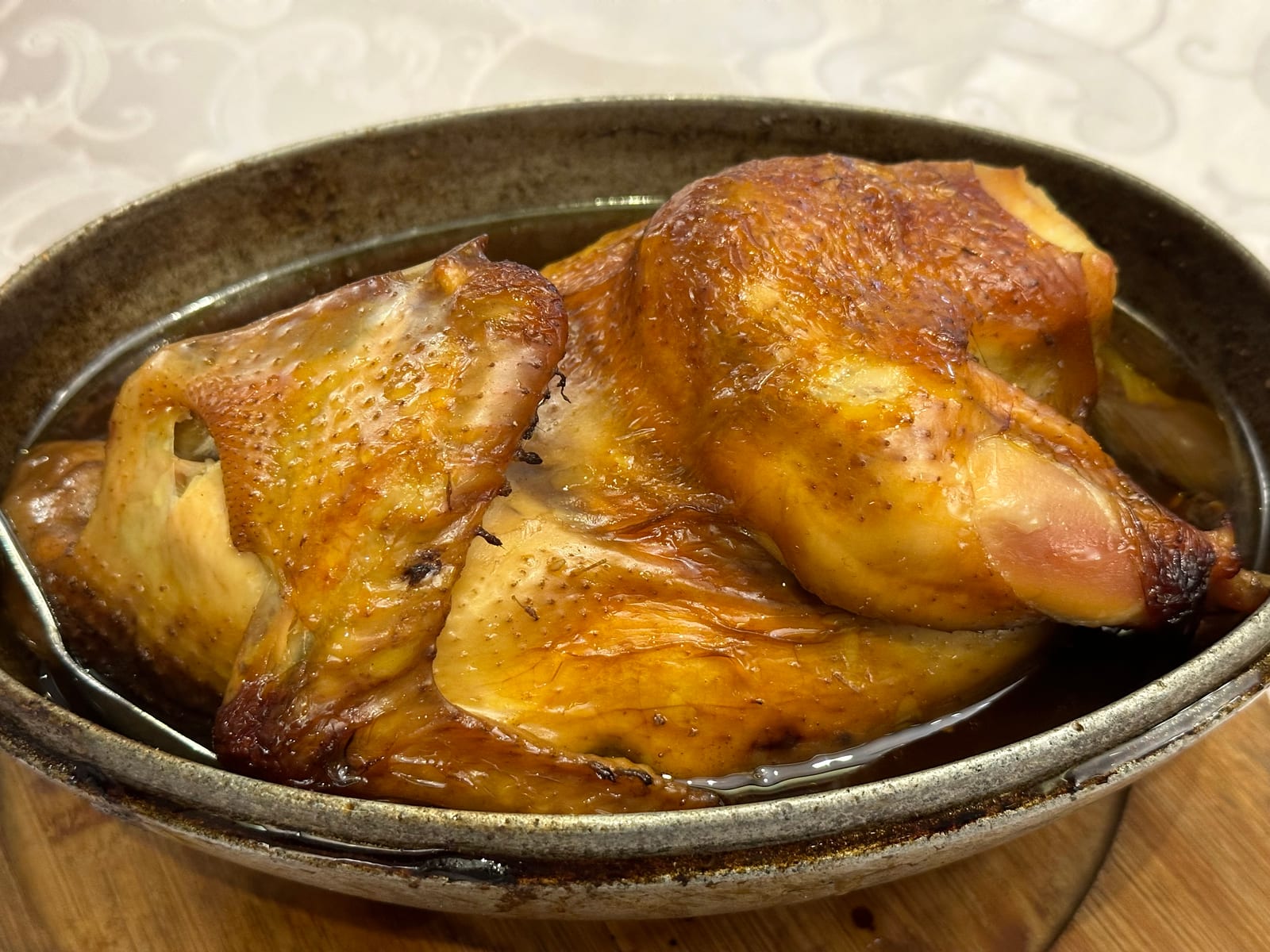
It starts with a whole chicken, marinated all over in soy sauce, rice wine and spices. The trick to the dish is baking it inside a fully sealed shell: every bit of moisture is trapped, so the chicken effectively steams in its own juices and never dries out the way a roast bird can. When the shell comes off, the meat is so tender it lifts from the bone with chopsticks alone. The skin isn't crisp like a roast — it's soft, and it has soaked up the marinade and the scent of lotus leaf right through to the flesh.
Before any clay goes on, the stuffed chicken is wrapped in several layers of lotus leaf — and this is exactly why beggar's chicken smells like nothing else. As it bakes, the heat draws a soft, green, tea-like fragrance out of the leaves and into the meat over the course of several hours. When the leaves are peeled back at the table, that scent is the first thing to hit you, and it's the part most people remember long after. Some kitchens use fresh lotus leaves in summer, others use dried leaves soaked in water; the two give slightly different aromas.
Open up the cavity and you find the stuffing that gives the dish its depth. Recipes vary by kitchen, but the base usually runs to ginger, spring onion, Chinese black mushrooms and pickled or preserved vegetables. Some places add minced pork or pork belly to make the bird richer and lend a sweetness from the fat. These aromatics slowly release their flavour as the chicken bakes, mingling with the bird's own juices to form a fragrant, savoury liquid pooled in the lotus leaf. When you eat, scoop some of that stuffing and liquid up alongside the meat.
The outermost layer is clay, mixed with wine and salt water and packed completely around the lotus-wrapped bird. In the oven it hardens into a sealed crust that works like a tiny oven of its own — trapping all the steam, heat and aroma inside, so the chicken cooks gently and evenly. Many modern restaurants now wrap the bird in dough instead of clay for cleanliness and convenience, or bake it in a ceramic pot, but the principle is identical: seal it tight and bake it slowly. A single bird can take several hours, and some recipes run as long as six.
Beggar's chicken arrives as a hard, rock-like lump that barely resembles food. A server brings it over and uses a small mallet to crack the clay shell open in front of you — at some places you do the honours yourself — revealing the dark green lotus leaves wrapped inside.
As the leaves are peeled back, a cloud of steam and aroma rises immediately — lotus leaf, the stuffing and the marinade all at once. The meat inside is so tender you hardly need a knife; chopsticks pull it straight off the bone. This is the moment that makes the dish more than a meal — it's a small piece of theatre, and the whole table stops to watch.
How many people: one bird comfortably feeds 3–4 as the centrepiece of a meal. Eat it with: plain rice and a stir-fried green vegetable to balance the richness of the meat and juices.
Because baking a whole chicken inside clay takes several hours, many traditional restaurants ask for at least a day's notice. If you're going specifically for this dish, call ahead or have your hotel phone the restaurant — it saves disappointment.
Larger establishments such as Lou Wai Lou often bake batches in advance and have it ready during the main meal services, but it can sell out when the city is busy (long holidays, peak summer). If you're already seated, tell the staff you want beggar's chicken straight away.
On payment: most restaurants take WeChat Pay and Alipay first and foremost. Larger places accept cash in yuan and some take foreign cards. Link a card to Alipay's international mode before you arrive in case a smaller place doesn't take cards — there's a walkthrough in our Hangzhou city guide.
The places locals and food-lovers have recommended for years — and a reminder to pre-order where you can.
If you want to eat beggar's chicken at the right place in Hangzhou, most people will point you to Lou Wai Lou first. This historic restaurant on Gushan Island (孤山) in the middle of West Lake has been open since 1848, is recognised as a Chinese "time-honoured brand", and is credited with making beggar's chicken — and several other classic Hangzhou dishes — famous. The lake views from the dining room are lovely; it's best for a long, unhurried lunch. Beggar's chicken runs ¥188 or ¥388 per bird depending on size. Order it alongside Dongpo pork and West Lake vinegar fish for the full classic spread.
Beyond Lou Wai Lou, a number of long-standing Hangzhou restaurants around West Lake and in the old town make beggar's chicken a feature of the menu. These places tend to serve the full Hangzhou repertoire — Dongpo pork, West Lake fish, Longjing shrimp — in a classic Chinese setting, and often at gentler prices than the lakeside tourist spots. The same advice applies: if your heart is set on beggar's chicken, call ahead or order a day in advance, since many don't keep it baking all day long.
For a more accessible take on beggar's chicken, modern Hangzhou chains such as Green Tea (绿茶) serve a version at a gentler price. The restaurants are designed in a pretty Chinese-garden style, and some branches sit between West Lake and the Longjing tea hills. They suit anyone who wants to taste several dishes in one sitting without committing to a whole pricey bird. The cooking may not have the depth of the original houses, but it's a fine starting point for a small group or a tighter budget.