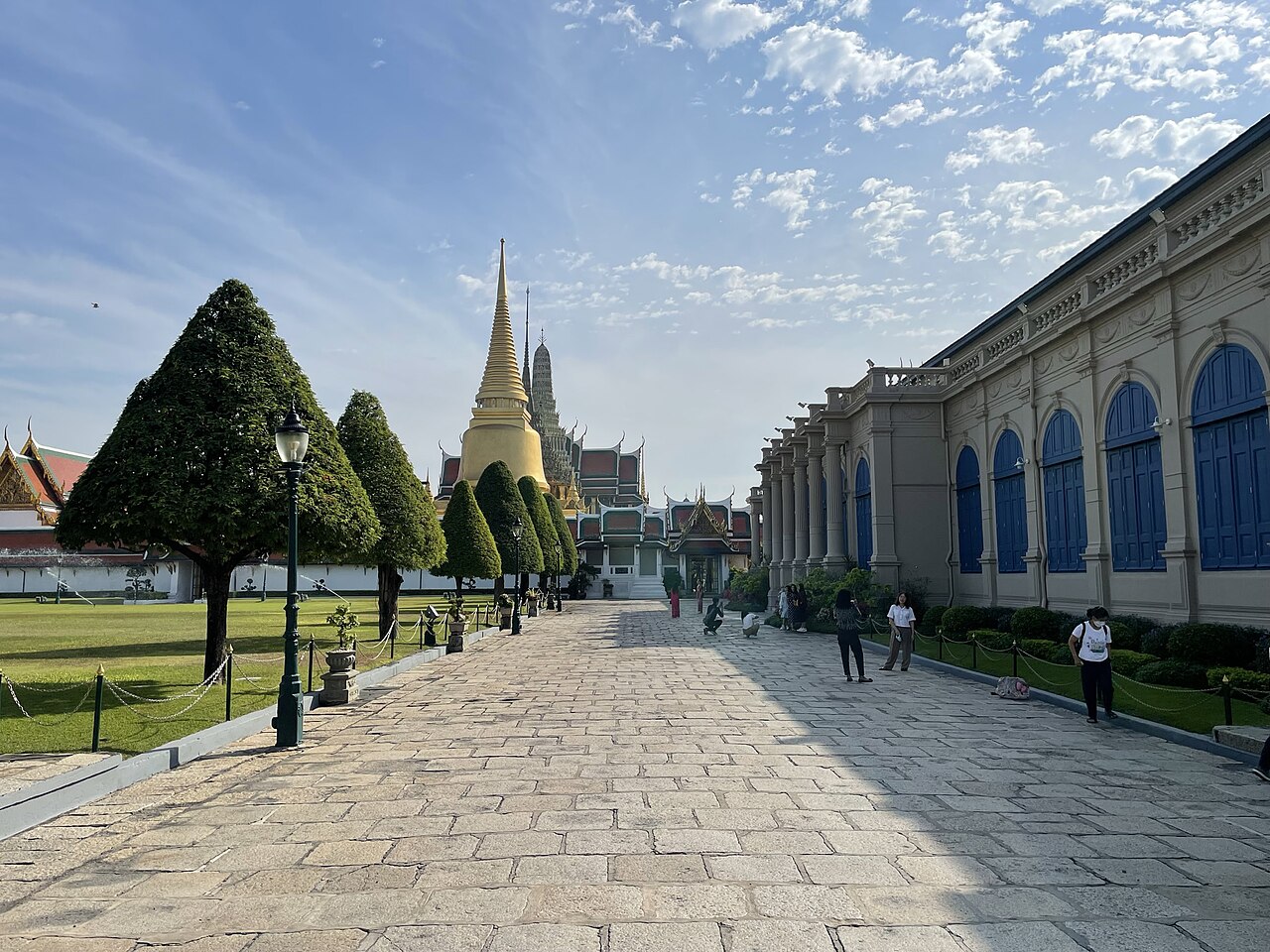
The royal palace King Rama I built in 1782, and the Emerald Buddha that crossed half of Asia to get here — this guide covers the ฿500 ticket, the strictest dress code in Thailand, how to arrive by MRT or river boat, and the one scam to see coming.
It is 8:30 on an ordinary weekday morning and you are standing at the Wiset Chaisri Gate. Through the white wall, dozens of golden spires cut against the sky. The early light catches the Phra Si Rattana Chedi until the whole stupa burns gold, and two five-metre giants lean on their clubs, guarding the temple gate ahead. The crowd around you goes quiet without anyone asking — a thing that rarely happens at a sight you have already seen in a hundred photos. The real thing simply beats the pictures, by a distance.
Rewind to 1782. King Rama I moved his capital across the river from Thonburi and built the Grand Palace as the heart of a new city: Rattanakosin, today's Bangkok. The intention was unmistakable — to raise a capital as splendid as Ayutthaya, the one lost to war. So this was never just a residence; it was a declaration that the kingdom stood again. Inside the walls, across more than 200,000 square metres, sit the royal quarters, the great throne halls, and Wat Phra Kaew — the Temple of the Emerald Buddha, a palace chapel with no resident monks, built for one purpose: to house the most sacred Buddha image in Thailand.
Today this is the single most visited sight in the country, and the one Thais themselves keep returning to — every lap of the compound reveals details you missed: the porcelain-flower mosaics, the mirrored glass that glitters along entire walls, gate giants whose faces are never repeated twice. This guide covers what genuinely deserves your time, plus the practical truths to know before you arrive, from the dress code to the street trick that still works on someone every single day.
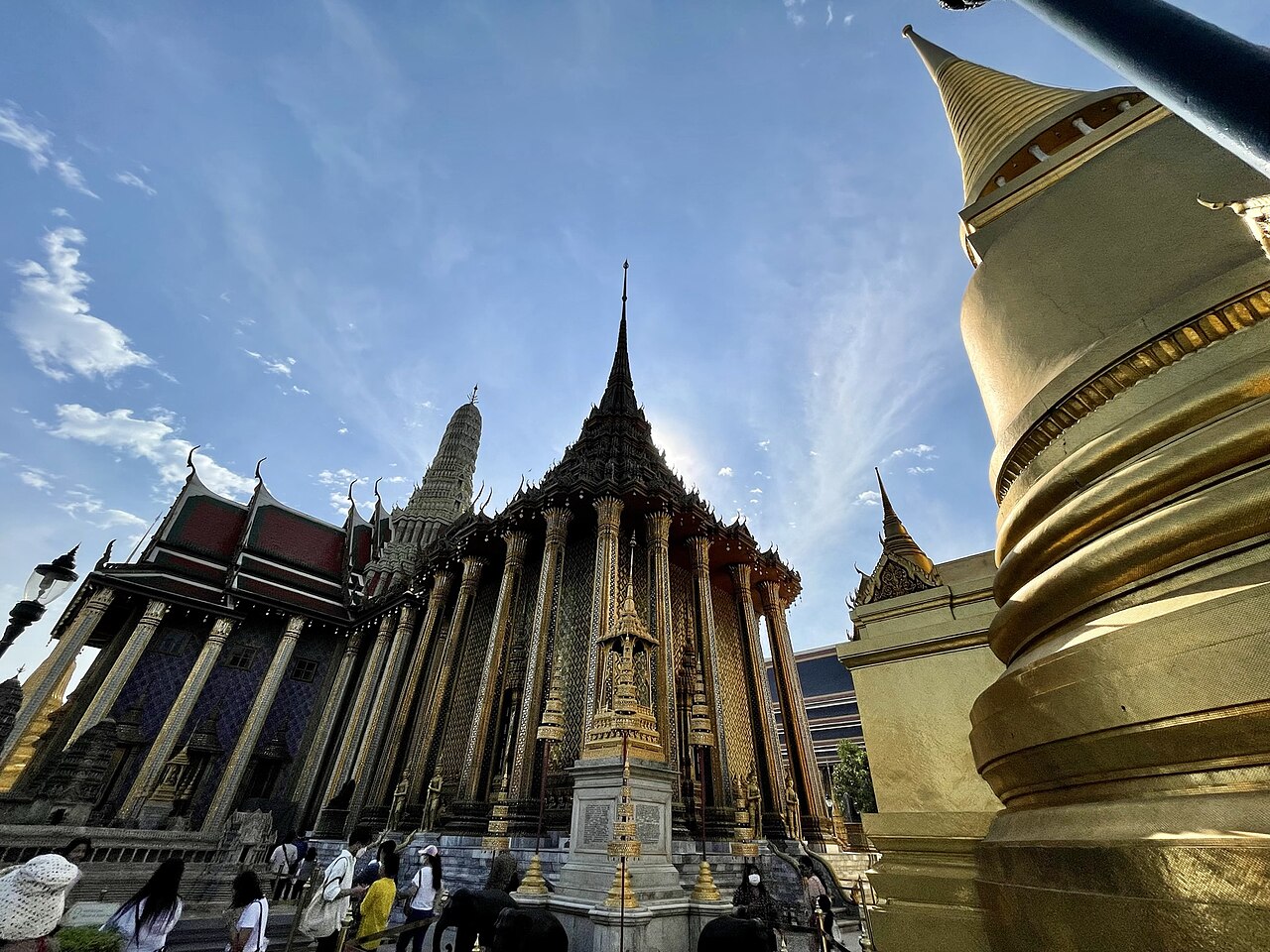
The visitor route leads through Wat Phra Kaew first, then out into the throne-hall quarter — these five are the ones not to drift past.
The Emerald Buddha is a deep-green jade figure about 48 centimetres across the lap, enthroned on a golden pedestal so high you crane your neck to meet it. What most visitors never learn: the image "changes clothes" three times a year — a summer, a rainy-season and a winter costume — and the King of Thailand performs the changing ceremony personally, as every king has before him. Photography inside is strictly forbidden. Sit low, keep your feet pointed away from the Buddha, and spend your minutes there on the murals that wrap the walls.
Three monuments line up on a raised terrace: the Phra Si Rattana Chedi, gilded head to toe and enshrining a relic of the Buddha; the Phra Mondop, a spired library holding the golden Tripitaka scriptures; and Prasat Phra Thep Bidon, the Royal Pantheon of past kings, opened only on select royal days. This is the postcard view of Wat Phra Kaew known worldwide — and do not miss the oddity on the same terrace, a detailed miniature of Angkor Wat commissioned by King Rama IV, complete enough to walk a full circle around.
The cloister that rings the whole temple is one continuous mural of the Ramakien — Thailand's telling of the Ramayana — across 178 panels from first scene to last, among the longest mural cycles in the world and continuously restored to keep its colours alive. Walk even one stretch and you will find monkey armies, demon hosts and details too small to believe. Each gate of the compound is flanked by mural-born giants standing guard in pairs — six pairs, twelve giants, no two faces alike. Find the green-skinned Thotsakan, the demon king himself.
Out in the royal quarter, the building that stops everyone is the Chakri Maha Prasat, built under King Rama V: a fully Victorian European palace — crowned with three tiered Thai prasat spires. Bangkok wits of the era nicknamed it "the farang wearing a chada", the Westerner in a Thai dancer's crown — a perfect snapshot of a Siam opening to the West while standing firmly on its own roots. Royal guardsmen stand post out front through the day.
The Dusit Maha Prasat is the classical Thai prasat in its purest form, raised in the first reign and used for major royal ceremonies ever since — many consider it the most perfectly proportioned Thai spired hall in existence. Before you leave, step into the Queen Sirikit Museum of Textiles near the entrance gate: royal garments and Thai silk craft, displayed in blissful air conditioning — the ideal last stop after two hours in the sun. Entry has generally been included with your palace ticket; confirm on the day.
The Emerald Buddha's biography reads like a road novel. Records say it surfaced in Chiang Rai around 1434, when lightning split an old chedi and revealed green stone beneath the stucco. From there it journeyed to Lampang, then Chiang Mai, then across the Mekong to Luang Prabang and Vientiane for over two centuries, before returning with the Thonburi-era army and finally settling here in 1784 — where it has presided over the kingdom ever since.
Chapel etiquette: shoes and hats off, cameras away completely, sit on the floor with your feet tucked away from the image, and keep voices low. Visit in early March, July or November and you may land on a costume-changing period — and meet the Buddha in a brand-new seasonal robe.
Walk anywhere near the palace and a well-dressed, friendly stranger may inform you the palace is closed this morning — a Buddhist holiday, a royal ceremony — and kindly offer a ฿20 tuk-tuk tour to "another famous temple" instead. Assume it ends at a gem shop or a tailor with very persistent salesmen, because it almost always does. The truth: the palace opens every day. Genuine closures are rare and announced officially at the gate, nowhere else.
The fix is simple: smile, decline, and walk on to the Wiset Chaisri Gate to see for yourself. Buy tickets only at the official counters inside the walls — never from anyone on the street — and treat any suspiciously cheap tuk-tuk around here as the most expensive ride in Bangkok.
The kindest light falls between 8:30 and 10:00 am, while the sun is still angled and the gilding glows without harshness. The classic frame is the upper terrace, catching chedi, mondop and pantheon in a single shot. The frames most people miss are the close-ups — mirrored mosaic on the column bases, the row of garuda figures gripping naga serpents around the chapel, and the golden kinnari statues posing motionless in the corners.
The limits, so you are not caught out: no photography at all inside the chapel of the Emerald Buddha, no drones over the palace grounds full stop, and between 10 am and 2 pm the crowds make clean shots nearly impossible. If photographs matter to you, arriving at opening time is the only real answer.
The palace sits on Rattanakosin Island, where the lanes are narrow and traffic crawls most of the day. The clever play is rail or river, then a short walk. The visitor entrance is the Wiset Chaisri Gate on Na Phra Lan Road.
All three are within a short walk or a single boat hop — easy to combine with the palace in one day.