Five highlights that repay attention
The garden is dense with detail — these are the things that stop you in your tracks.
This single upright stone, about three metres tall, is riddled with holes in every direction — the result of centuries of water erosion on Taihu limestone. The traditional test of a perfect scholar's rock was threefold: light a stick of incense at any one hole and smoke should emerge from all the others simultaneously; pour water over the top and it should flow out of every opening at once. The Exquisite Jade Rock has passed that test for hundreds of years and changed hands through several collections before arriving here. It is the garden's centrepiece and the most photographed single object in Yu Garden.
Constructing a convincing artificial mountain inside a 2-hectare garden requires both engineering and art. The Grand Rockery uses approximately 2,000 tonnes of Wuzen limestone, arranged by Zhang Nanyang, one of the most celebrated garden designers of the Ming period. A winding path leads up through the stone to a viewing terrace at the summit — not high by any absolute measure, but placed to give a full panorama of the garden's rooflines, walls and water below. In the Ming era this was the principal resting point: a place to sit, look down and feel the garden working around you.
 3
3
The Nine-Zigzag Bridge is a low wooden walkway that crosses the lake outside the garden walls in nine sharp turns — a design rooted in the belief that malevolent spirits can only travel in straight lines, so a sufficiently angular path keeps them from reaching the teahouse at the far end. Huxinting (湖心亭), the mid-lake pavilion at the bridge's end, is thought to date from around 1784. It still operates as a working teahouse where you can sit over the water drinking tea or eating xiaolongbao while the city noise stays on the far bank. This whole area is outside the garden walls and completely free to visit.
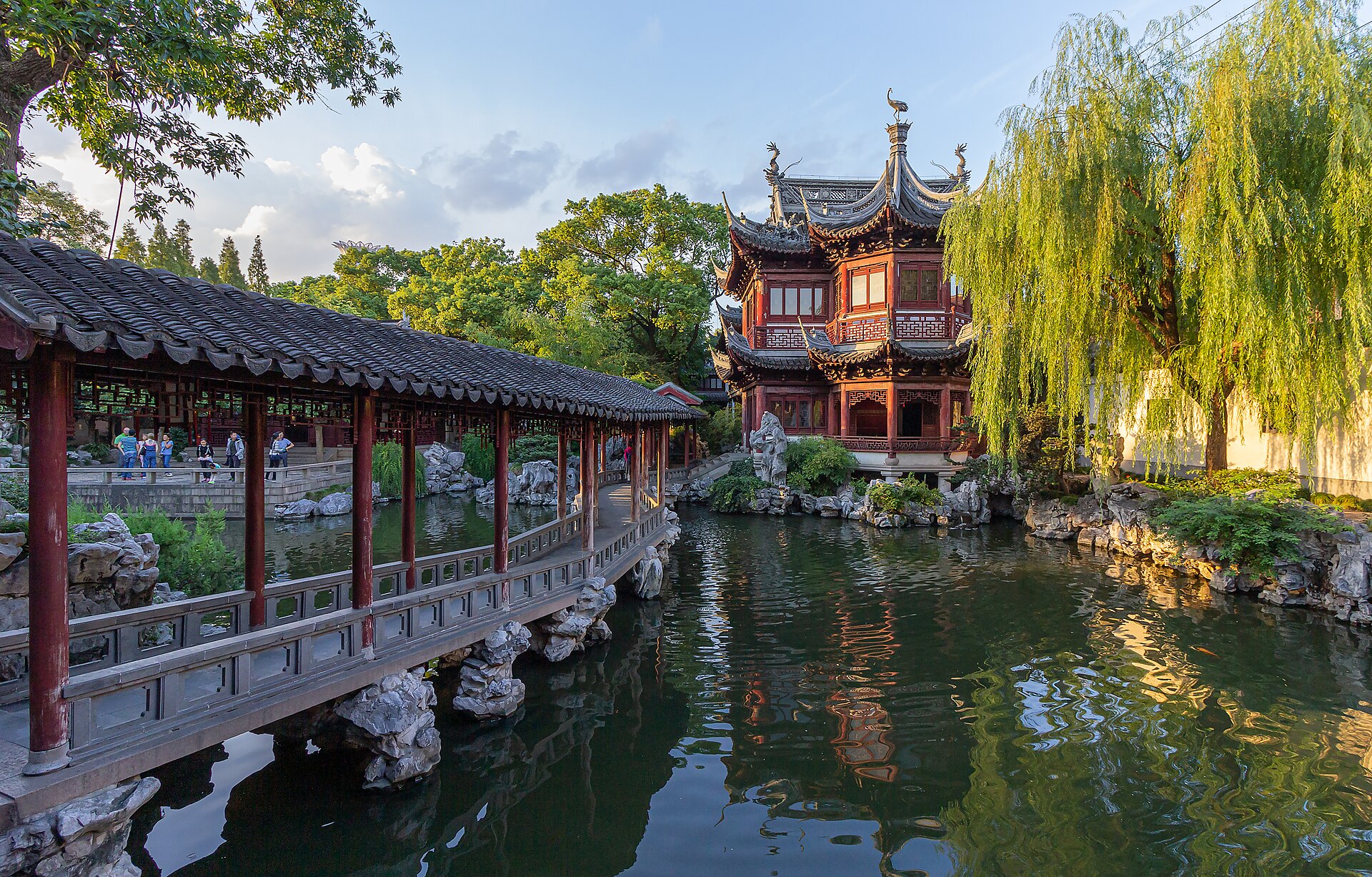
The white walls that divide Yu Garden into its sequence of linked courtyards are not merely partitions — they are dragons. Each section of wall is the body of a ceramic dragon, with a head at one end, a tail at the other, and the long curving spine of the wall running between them. The logic is functional as well as symbolic: a series of walls that undulate and turn prevents any single courtyard from being visible in full from outside it, making the garden feel far larger than its actual 2 hectares. As you move through the garden you keep meeting the same dragons from different angles, and the effect never quite wears off.
 5
5
The City God Temple (Chenghuang Miao) has stood here in various forms since the Ming dynasty — it remains an active Taoist place of worship, heavy with incense, with worshippers moving between halls at most hours. Admission is ¥10 if you want to enter the inner halls. All around it, the Yuyuan Bazaar spills across a pedestrianised area of restored Ming and Qing-era architecture: tea merchants, sesame cake stalls, fried tofu vendors, souvenir shops and the one place you genuinely should not miss — Nanxiang Mantou Dian, the xiaolongbao restaurant operating at this address since 1900. The soup dumplings are thin-skinned, broth-heavy and as good as their reputation. Expect a queue, especially at lunch.