Home Xiamen China Xiamen Hotels About
Home  ›  Asia  ›  China  ›  Xiamen  ›  Getting Around
🚇 Xiamen Transport Guide · 2026

Getting Around Xiamen
Metro Over the Sea, Ferries, BRT & More

An island city that's easier to navigate than you'd think — Line 1 runs a scenic stretch out over the sea, the ferry carries you to car-free Gulangyu, you can cycle the seaside Huandao Road, or hail a DiDi when you've got luggage. A little know-how takes you anywhere.

Before you go

An island city you can cross by metro, ferry and bike

Xiamen is a coastal city whose heart is Xiamen Island (the main island), linked to the mainland by bridges and tunnels, with the smaller, car-free island of Gulangyu just across the water. The good news is that the city is well-wired for getting around: a 3-line metro reaches almost every major sight, backed up by an elevated BRT system, city buses, the Gulangyu ferry, and shared bikes that make an easy ride along the coast.

One detail that gets people excited: Line 1 has a stretch that runs out over the sea as it leaves Xiamen Island for the Jimei side, with open water on both sides — so popular that visitors deliberately ride it for the view and the photos. Two things to know up front: stations have English signage, ticket machines have English menus, and Alipay QR gets you through the gate with no ticket at all. Every entrance also has a bag X-ray check, so budget a couple of extra minutes each time.

This guide covers every way to get around: the fast, cheap metro, the ferry to Gulangyu (which needs your passport and a timed ticket), the BRT, buses, metered taxis, DiDi for when you have luggage, shared bikes, and the map app that actually works in China. A little preparation, and the whole trip runs smoothly.

The main event

The Metro — fast, cheap, bilingual

Your first choice for journeys around the city. Clean trains, English signage, distance-based fares of ¥2–7 — and Line 1 throws in a free sea view.

Hours are roughly 06:30 to 23:00, varying slightly by line — last trains leave terminus stations before closing, so check the timetable in-station or in the Alipay app before a late night out. Fares run on distance: short hops cost ¥2, most rides ¥2–5, and a longer cross-water run to the mainland reaches ¥6–7. The system is new, clean, and easy to interchange, and because the city isn't as sprawling as the mega-metropolises, most journeys around the island don't take long.

Jimei district in Xiamen — a quarter of Chinese-Western hybrid roofline architecture, one terminus of metro Line 1, which runs elevated out over the sea from Xiamen Island
Jimei is one terminus of Line 1 — the stretch where the train runs elevated over the sea to reach this side is the highlight riders come for.
Key lines

Routes visitors use most

Line Route Key stops
Line 1 (the main spine · over-sea section) Xiamen Railway Station ↔ island centre ↔ Jimei / Xiamen North (北站) Zhongshan Road · Xiamen Railway Station · the over-sea stretch · Jimei
Line 2 Haicang (mainland) ↔ onto the island ↔ Wuyuan Bay (五缘湾) Cruise Terminal (Gulangyu ferry) · the island's business strip · Wuyuan Bay
Line 3 On the island ↔ Xiang'an (翔安) in the east Xiamen Railway Station · Huli district · Xiamen University Xiang'an campus
Line 1 (central section) Into the old-town heart of the island Zhongshan Road · Lundu pier (residents) · near Nanputuo Temple & Xiamen University
At rush hour: the lines into the island centre and across to the mainland get especially packed during 08:00–09:00 and 18:00–19:00. If you've just landed with luggage, or you're heading to the airport, shifting your journey outside these windows makes a real difference — see the Xiamen airport transfer guide for arrival options.

The island city's two signatures

The over-sea metro + the ferry to Gulangyu

Xiamen is an island city, which makes two of its journeys more special than in most places. The first is the over-sea stretch of Line 1 — as the train runs from Xiamen Island out toward Jimei and Xiamen North, the track climbs onto a viaduct across the water, with open sea on both sides and a genuinely lovely view on a clear day. Many people ride this part of Line 1 just for the photos; the trick is to take a window seat on the seaward side.

The second is the ferry to Gulangyu, the car-free UNESCO World Heritage island. The detail to get right: tourists must board at the Cruise Terminal (邮轮中心厦鼓码头) on the north of Xiamen Island, not the central Lundu pier (轮渡码头), which is reserved for residents. You book a timed ticket in advance (1–3 days ahead is wise, as slots fill quickly on holidays), and foreign visitors must use their passport to book and board. A return ticket is around ¥35 (¥50–80 for the air-conditioned cabin), and the crossing takes about 5–20 minutes.

Gulangyu island in Xiamen — a car-free island of European colonial-era villas by the sea, reached by ferry from the Cruise Terminal in about 5–20 minutes
Gulangyu is car-free — once you ferry across, you explore on foot. Bring your passport and book a timed ticket ahead.
To plan a smooth Gulangyu day: take Line 2 to a station near the Cruise Terminal, or hail a DiDi straight to the pier. Book an early-morning ferry slot to reach the island before the crowds, then head back in the afternoon or evening. For the full island walk-through, see the Gulangyu island guide.
Paying for the metro

Four ways to pay — pick what suits you

📱
Alipay QR

Easiest for visitors. Open Alipay, tap Transport, choose Xiamen, generate the Metro Pass, scan at the gate. No token, no card. Set this up at home.

💬
WeChat Pay

Same concept via a mini-program. Open WeChat, find the Xiamen Metro mini-program, scan at the gate. Works on all lines.

🎫
Single-journey token

Buy from machines inside every station. English menus, takes coins and notes. A good fallback if Alipay isn't set up yet.

💳
交通卡 (e-Tong)

A rechargeable transit card that works on the metro, the BRT and buses. Tap in and out — handy if you ride several times a day.

Honest summary: Alipay is worth setting up even if the metro is your only reason, because it also handles the BRT, taxis, DiDi, the ferry, shared bikes, local restaurants, and nearly every shop. As of 2026, some metro gates are also starting to accept contactless tap-to-pay with Visa and Mastercard, so even if Alipay isn't ready you can sometimes tap a card to ride. Full setup steps in the Alipay & WeChat Pay guide.

Other options

BRT, Buses, Taxis, DiDi and shared bikes

🚏
BRT — the elevated express bus
快速公交 · runs on viaducts, skips the lights

The BRT (快速公交) is a Xiamen signature — buses that run on dedicated elevated viaducts, separate from car traffic, so they skip the traffic lights and move far faster than ordinary buses. You board and alight at elevated stations, just like a train. Several routes (Kuai 1/2/3) link Xiamen Island with the mainland and the airport.

Fares are around ¥1–3, paid with a 交通卡 card or by scanning a QR code. Some station signage is in English; pair it with Amap to plan routes accurately. It's a handy option for spots the metro doesn't yet reach.

Fare: around ¥1–3 per trip
Payment: 交通卡 card · QR scan · cash on some routes
Why it's good: elevated, no traffic lights, faster than a normal bus
🚗
DiDi — China's ride-hail
滴滴出行 · English app, Alipay payment

DiDi is the dominant ride-hail app in China, with an English-language interface. Type your destination in English; the app locates it and shows a fare estimate before you confirm. Payment links directly to Alipay, and the base fare sits right around a taxi flag-fall.

DiDi is the right call when the metro has closed for the night, when you have luggage, when you're heading to the Cruise Terminal before dawn, or for anywhere the metro doesn't reach. You can hail one from the DiDi app, or from a mini-program inside Alipay or WeChat — no separate app needed if you'd rather not.

Hail from: the DiDi app · an Alipay mini-program · a WeChat mini-program
Payment: link Alipay in the app — it charges automatically at the end
When it beats the metro: late night · with luggage · a group of 3–4 splitting
🚕
Metered Taxis
出租车 · always on the meter

Xiamen's taxis are metered, with a flag-fall of around ¥10 for the first 3 km, then roughly ¥2 per km after that, with about a 20% surcharge late at night (23:00–05:00). Overall they're cheap, and because distances on the island aren't huge, most fares stay modest.

The one tip that makes taxis work: have your destination written in Chinese characters. Most drivers speak little or no English. A hotel business card, or a Google Translate screenshot of the address in Chinese, sorts it every time.

Sample fares: most island trips ~¥15–40 · higher crossing to the mainland by distance
Payment: Cash · Alipay · WeChat Pay (varies by car)
Note: No ride-hail surge — the meter is the meter
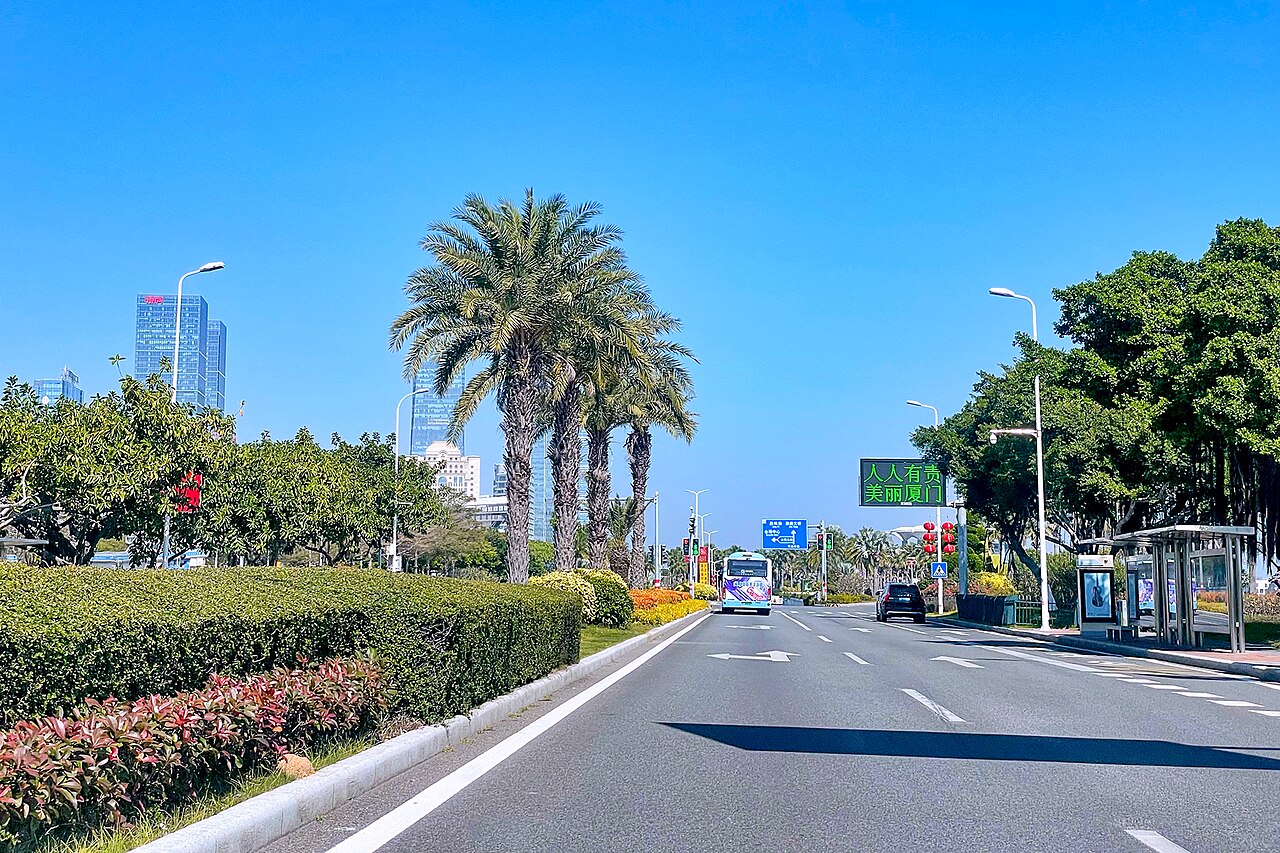
Huandao Road seaside boulevard in Xiamen — with a dedicated elevated seaside cycling lane, ideal for Hellobike/Meituan shared bikes at around ¥1.5 per 30 minutes Along the coast
Shared Bikes
共享单车 · Hellobike / Meituan

Xiamen is a superb cycling city, above all Huandao Road, which has a dedicated elevated seaside bike lane. Shared bikes come from brands like Hellobike and Meituan and cost around ¥1.5 per 30 minutes — scan a QR to unlock, park at designated spots.

Setting up the app means registering a phone number and linking Alipay or a foreign card; some riders use it via a mini-program inside Alipay. It's perfect for a morning or evening ride along the coast when the weather's at its best — one of the most enjoyable ways to see Xiamen.

Cost: around ¥1.5 per 30 minutes
Apps: Hellobike · Meituan Bike · Alipay mini-program
Best bit: the elevated seaside bike lane on Huandao Road
So which do you use when? Normal trips around the city or island → the metro first, every time — cheap and reliable · Somewhere the metro misses but the BRT reaches → the BRT · Luggage / late night / in a hurry / pre-dawn to the pier → DiDi or a taxi · A coastal ride on Huandao Road or around the island → shared bike · Crossing to Gulangyu → the ferry at the Cruise Terminal (bring your passport).
Navigation

Which map app actually works in Xiamen

This matters more than people expect. Google Maps' public transit data for mainland China is unreliable — even with a VPN, route guidance for the metro, BRT and ferry times is frequently wrong or simply absent. Two apps give accurate, real-time transit directions — including the metro, buses and which exit to use — without any workaround:

🗺️
Amap (Gaode / 高德地图)
The app most Chinese residents use

Amap has accurate, live data for every metro line, BRT route, bus and intercity train in China. You can search destinations in English; the transit planner gives step-by-step directions including which exit to use. Download it from the App Store or Play Store before you arrive — no VPN required to use it.

Tip: Download before departure. Some app stores in China require a VPN to access.
🍎
Apple Maps
iPhone users already have this

Apple Maps in China uses Amap's data as its backend, which means its transit directions for the Xiamen metro are accurate. If you have an iPhone, this is the path of least resistance — no extra app needed, no VPN, and it integrates with your existing Maps workflow.

Android note: Google Maps transit doesn't work well in China — install Amap instead.

If you want LINE, Instagram, Gmail or full Google Maps while in China, you'll need a VPN installed and tested before you fly — most VPN websites are blocked once you're inside the country. See the full breakdown at the China internet, VPN and eSIM guide.

Zhongshan Road in Xiamen — a pedestrianised old commercial street of arcaded shophouses, near a Line 1 metro station and the Gulangyu ferry area
Zhongshan Road is easy to reach — Line 1 has a station near the pedestrian zone, and the ferry area is a short walk on.
Two things to do first

Set up Alipay & book your ferry before you board your flight

If there's one preparation that makes a difference, it's this: open Alipay, link your Visa or Mastercard through the international mode, then tap Transport and select Xiamen before you leave home. When you land and walk up to the metro gate, you tap the phone and walk straight through — no queuing at a token machine while tired and jet-lagged. The same app then pays for the BRT, bikes, the ferry and DiDi too.

The other thing not to forget on this island city: if you plan to visit Gulangyu, book a timed ferry ticket in advance and carry your passport, since foreign visitors must use their passport to book and board at the Cruise Terminal, and popular slots sell out on holidays. Picking a hotel near a metro station, or in an area that matches your plan, also saves real time. See the 10 best Xiamen hotels.

A few quick etiquette notes: every station has a bag X-ray at the entrance — put your bag through each time (budget 1–3 minutes) · locals keep right on escalators so people in a hurry can pass on the left · at busy stations, let passengers off before you board · Gulangyu is car-free, so pack comfortable walking shoes.
Common questions

FAQ · Getting around Xiamen

How many metro lines does Xiamen have, and what are the hours?
Xiamen currently has three operating metro lines: Line 1 (the main spine, with a scenic elevated section that runs out over the sea between Xiamen Island and Jimei), Line 2 (Haicang ↔ the island ↔ Wuyuan Bay, passing the Cruise Terminal for the Gulangyu ferry), and Line 3 (the island ↔ Xiang'an, via Xiamen Railway Station). Trains run from around 06:30 to 23:00, with hours varying slightly by line; last trains leave terminus stations before closing, so check the timetable in the Alipay app or on station signage before a late night out.
How do I pay for the Xiamen metro?
Several options: (1) Alipay QR — open Alipay, tap Transport, choose Xiamen, generate the Metro Pass, scan at the gate; fastest for tourists. (2) WeChat Pay — open the Xiamen Metro mini-program and scan. (3) Single-journey token from a machine in each station, with an English menu. (4) A 交通卡 (Xiamen e-Tong) rechargeable card that also works on the BRT and buses. Metro fares are ¥2–7 by distance (¥1 ≈ ฿5). Full setup in the Alipay & WeChat Pay guide.
What is Xiamen's BRT (快速公交), and how is it different from a normal bus?
The BRT (快速公交, Bus Rapid Transit) runs on dedicated elevated viaducts separate from car traffic, so it skips the traffic lights and is much faster than an ordinary bus. You board and alight at elevated stations like a train. Several routes (Kuai 1/2/3) link Xiamen Island with the mainland and the airport. Fares are roughly ¥1–3, paid with a 交通卡 card or by scanning a QR code — a handy option where the metro doesn't yet reach.
Where do I catch the ferry to Gulangyu, and do I need my passport?
Tourists must board at the Cruise Terminal (邮轮中心厦鼓码头) on the north of Xiamen Island — not the central Lundu pier (轮渡码头), which is reserved for residents. You book a timed ticket in advance (1–3 days ahead is wise, as popular slots fill quickly on holidays), and foreign visitors must use their passport to book and board. A return ticket is around ¥35 (¥50–80 for the air-conditioned cabin), and the crossing takes about 5–20 minutes. Gulangyu is car-free, so you explore on foot. See the Gulangyu island guide.
Are taxis and DiDi in Xiamen expensive? Do I need to speak Chinese?
They're inexpensive. Flag-fall is around ¥10 for the first 3 km, then roughly ¥2 per km, with about a 20% surcharge late at night (23:00–05:00). DiDi — China's ride-hail app — has an English interface; you can type your destination in English and pay through Alipay in the app. You don't need to speak Chinese, though having your destination in Chinese characters helps if a driver calls. DiDi is ideal when the metro has closed, when you have luggage, or for spots the metro doesn't reach.
Can I use Google Maps in Xiamen?
Google Maps can display a basic map (with a VPN), but its transit data for mainland China is unreliable or absent. Use Amap (Gaode / 高德地图) or Apple Maps instead — both have accurate data for the metro, BRT, buses, ferry times and which exit to use, and neither requires a VPN. Download one before you fly, as some app stores in China require a VPN to access. See the China internet, VPN and eSIM guide for getting connected.
How do shared bikes work in Xiamen, and are they worth it?
Xiamen is a superb cycling city, especially Huandao Road, which has a dedicated elevated seaside bike lane. Shared bikes come from brands like Hellobike and Meituan and cost around ¥1.5 per 30 minutes — scan a QR to unlock, park at designated spots. Setting up the app means registering a phone number and linking Alipay or a foreign card. They're perfect for a morning or evening ride along the coast — one of the most enjoyable ways to see the city.