One of the largest public squares in the world: a vast stone expanse at the centre of the capital, ringed by Tiananmen Gate, the Monument to the People's Heroes, a memorial hall, the Great Hall of the People and the National Museum. Free to enter — but you'll need a passport and an advance reservation.
Come up from Subway Line 1, pass through the security checkpoint, and the ground opens out in every direction. Tiananmen Square (天安门广场) is a stone plaza at the centre of Beijing covering roughly 44 hectares, ranking among the largest public squares anywhere in the world. The sheer scale makes it obvious you are standing at the city's ceremonial core, with a major monument or building anchoring every side.
The square lies on Beijing's central north–south axis. To the north stands Tiananmen Gate, with its central portrait; just beyond the gate is the entrance to the Forbidden City. At the centre of the plaza is the Monument to the People's Heroes and the Chairman Mao Memorial Hall; flanking the square are the Great Hall of the People on the west side and the National Museum of China on the east. Because they all sit together, most visitors walk the square first and then continue straight into the Forbidden City in one trip.
The one thing to know before you plan anything: entering the square now requires an advance reservation, registered under your real name with your passport, through the official system — and everyone passes through airport-style security to get in. On busy days the screening queue can be long, so allow time. Full details on how to book and the rules are below.
Each side of the square has one major building — knowing what sits where makes the visit easy to plan.
1
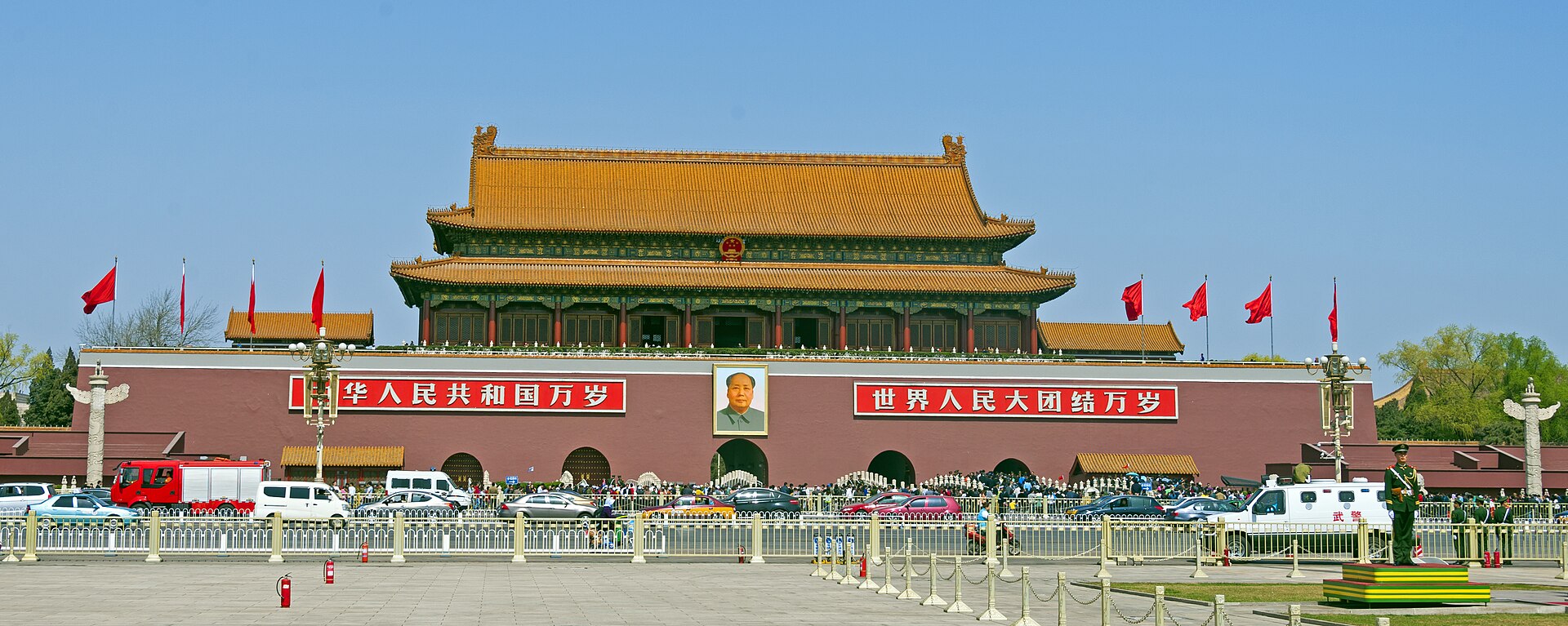
The vermilion gate tower with the yellow-tiled roof and the central portrait is the backdrop almost everyone photographs. It was once the formal gate of the Forbidden City under the Ming and Qing dynasties. Today you can climb up onto the gate tower for a view back across the full sweep of the square — but it is a separate ticket of around ¥15 (about ฿75) and must be booked in advance yourself.
2
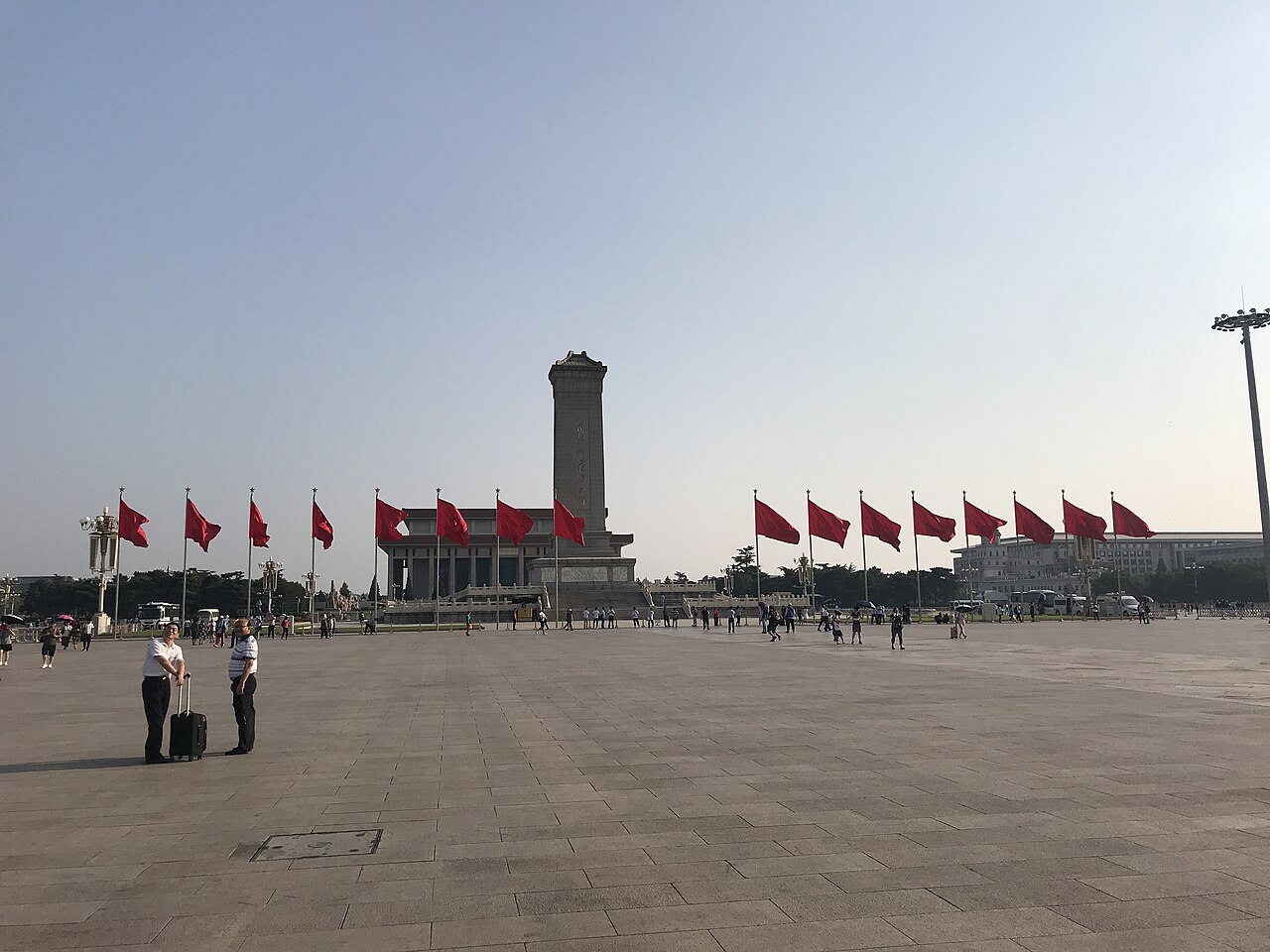
A granite obelisk roughly 38 metres tall stands at the exact centre of the plaza and serves as the reference point you can see from every corner. Its base is carved with relief panels depicting key events in modern Chinese history. The monument is fenced, so you view and photograph it from the surrounding pavement — it is the spot where visitors most often frame a photo with Tiananmen Gate behind it to the north.
The pale stone hall toward the south of the square is free to enter, but the rules are strict and the hours short. It typically opens in the morning, roughly 8 am to 12 noon, closed Mondays, and may close entirely if there is an event on the square. You must show your passport to enter, and bags, backpacks, cameras and drink bottles are not permitted inside — you store them in lockers first. Photography is not allowed inside; visitors dress respectfully and move through quietly in a single line. Hours change often, so confirm before you go.
The long, colonnaded stone building running the length of the square's western side is where national assemblies and major state functions are held. At certain times it opens to visitors to tour the interior halls when no session is taking place — you buy a ticket and check your bags — but the schedule is not fixed and depends on how the building is being used. If you want to go inside, check that day's status first. Most visitors simply admire its scale from the square itself.
The long building on the eastern side of the square is the National Museum of China, one of the largest museums in the world, with collections spanning Chinese history from antiquity onward. It is free, but you must book ahead — reservations open up to 7 days in advance through the official website, with timed entry slots to choose from. Tickets go quickly, you need the physical passport you booked with for ID at security, and bags are checked before you enter. Allow at least 1.5 to 2 hours.
The square's single most popular event — but it means a very early start and careful planning.
Every morning, Tiananmen Square holds a flag-raising ceremony timed to sunrise: an honour guard marches out and raises the flag to the top of the pole at the exact moment the horizon brightens. The ceremony itself lasts only about two minutes, but it draws large crowds, so you need to arrive in the dark to secure a viewing spot.
The ceremony starts at the day's actual sunrise, which moves through the year — roughly 4.40 am in midsummer to about 7.40 am in deep winter. Always check the sunrise time for your specific date before you go.
Arrive at least an hour before sunrise to clear security and find a good position. On long-weekend holidays or major dates the crowds are far bigger, and arriving 2–3 hours early is wise.
The square's reservation is split into time slots. If you want to be inside the square before sunrise, you must select the Flag-raising slot specifically — a regular morning ticket only admits you once the ceremony has already finished.
In the pre-dawn hours the subway is usually not yet open (it generally starts around 5–5.30 am). If the ceremony is earlier than that, you'll need a taxi or DiDi. Staying at a hotel near the square is by far the easiest option.
Everything you actually need, in one place — rules change often, so reconfirm before you travel.
Tiananmen Square sits in central Beijing on Chang'an Avenue and is easiest to reach by subway — each entrance has its own security checkpoint, so choose the one closest to where you'll head next:
Get off Line 2 at Qianmen and walk north into the square from the southern end. The checkpoint here usually has a shorter queue than the north side. It's a good approach if you want to start at the memorial hall end and walk up toward Tiananmen Gate.
Get off Line 1 at Tiananmen East or West; both sit right by Tiananmen Gate on the north side. This works best if you plan to walk the square first and then continue straight into the Forbidden City, since you come out right at the gate.
If you're coming for the dawn flag-raising before the subway opens, or you'd rather not change lines, a taxi or DiDi is simpler. Ask to be dropped near the entrance matching the slot you reserved. You can pay with Alipay or WeChat Pay.
The popular route: enter the square in the morning, walk the monument and photograph Tiananmen Gate, then continue into the Forbidden City to the north (book Palace Museum tickets separately in advance). Together the two take a half-day to a full day. Remember the square and the Forbidden City are booked through different systems.
Staying near Tiananmen Square makes the dawn flag-raising and the walk into the Forbidden City far easier. The areas around the square, the Forbidden City and Qianmen (前门) are within walking distance. Here are the hotels we've reviewed in the area: