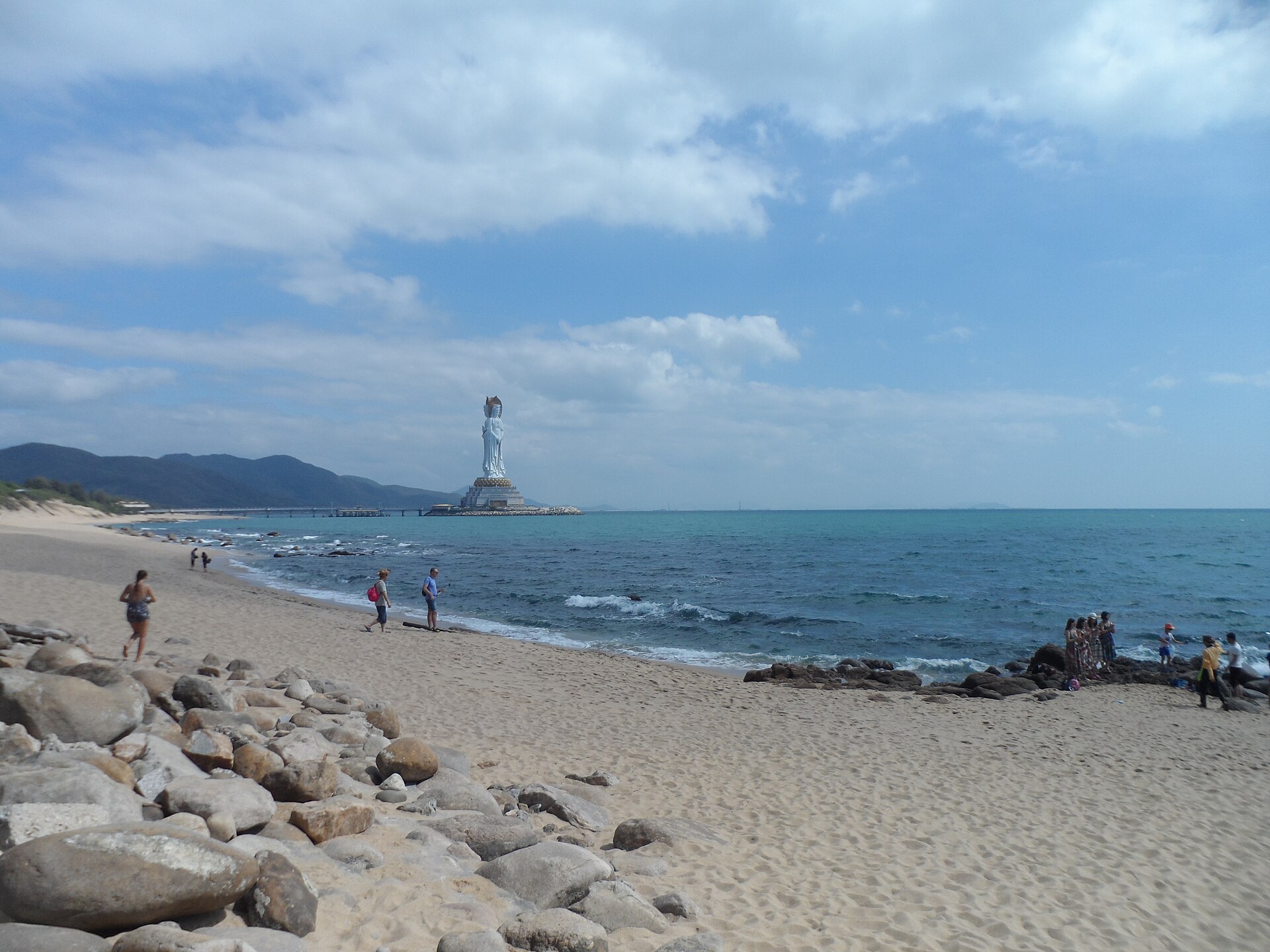
Hainan's largest seaside Buddhist park — a 108-metre, three-faced Guanyin standing on a platform out in the sea, visible from far down the coast road long before your car reaches the gate.
There is a moment on the coast road west of Sanya when an enormous white figure suddenly rises out of the blue sea ahead of you. That is the Guanyin of the South Sea (南山海上观音) — 108 metres tall, standing on a platform out in the water linked to the shore by a causeway. For scale: Rio de Janeiro's Christ the Redeemer is 30 metres. This is the tallest outdoor Guanyin statue in the world, and the comparison genuinely lands when you are standing beneath it.
The statue is only one part of the Nanshan Buddhism Cultural Tourism Zone (南山文化旅游区) — a sprawling seaside park that brings together the Tang-dynasty-style Nanshan Temple, the gold-and-jade Avalokitesvara hall, the Gate of Nonduality, a longevity valley and tropical seaside gardens. It is one of the most significant Buddhist centres in southern China, and a place mainland visitors come specifically to pray and make offerings.
What sets Nanshan apart from temples elsewhere in China is simple: it sits right on the sea. You walk between shrines in the sea breeze, under warm sun and coconut palms, rather than in a crowded city. The atmosphere is calm and open in a way ordinary temples rarely are. Set aside half a day and you will understand why this is the image most people carry away from Sanya.
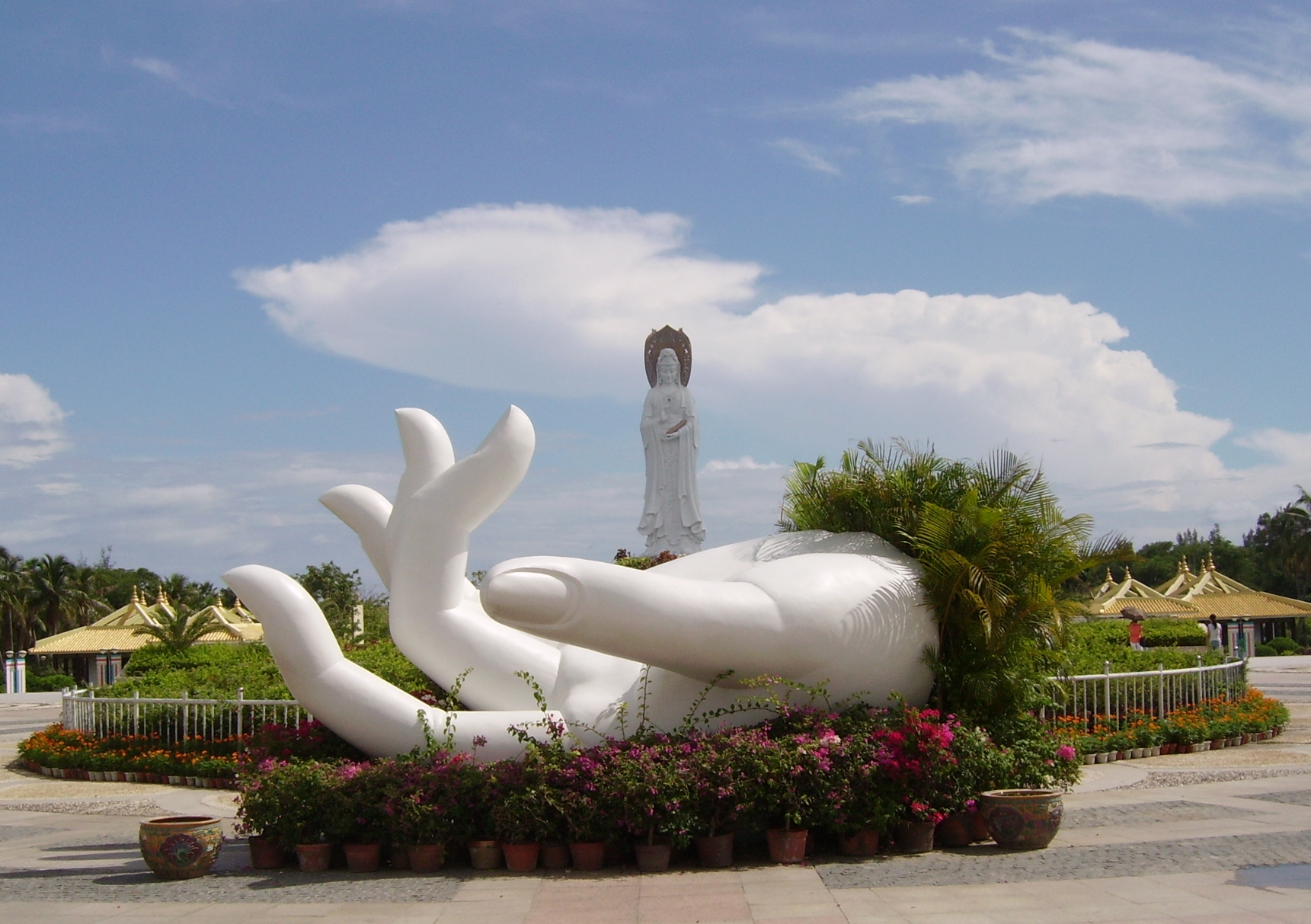
The park is large — walk it slowly, or take the shuttle between the main sites.
The headline act. The white Guanyin rises 108 metres from a platform out in the sea, with three faces looking in different directions — one holding prayer beads, one a lotus, one a sutra. A causeway leads out to the statue base, and a separate ticket (~¥25) lets you into the hall beneath it, where a smaller golden Guanyin is enshrined. It is both spectacular and genuinely revered.
The park's main temple, built in Tang-dynasty style on a rise facing the sea, with a large main hall, broad courtyards and stone steps that look down over the blue water. Chinese visitors come here to light incense and pray for long life and good fortune — fitting, since "Nanshan" means "Southern Mountain," a classical symbol of longevity.
Inside is a Guanyin figure made from gold, jade, diamonds and thousands of precious stones, standing roughly 3.8 metres tall — once recorded by Guinness as the most valuable gold-and-jade statue in the world. It requires a separate ticket, but if you appreciate fine craftsmanship it is worth the extra.
A large stone gate representing the Buddhist principle of "non-duality," set in the middle of the park as a striking backdrop for photos. Around it are lotus ponds, rock gardens and shaded paths that make for an easy stroll between the bigger sights.
Beyond the temple and the statue, the whole zone is laced with seaside walkways, tropical flower gardens, coconut palms and the "Longevity Valley," where the Chinese character for "shou" (long life) is carved in hundreds of different styles. It is a favourite spot to wander, take in the view and breathe the sea air. There is also a well-regarded vegetarian restaurant inside the park.
The Nanshan Buddhism Cultural Tourism Zone ticket (which includes Nanshan Temple) is ~¥129 per person (~฿645) — roughly ¥124 in peak season (1 Nov – 30 Apr) and ¥103 in low season (1 May – 31 Oct). From there, two extras are charged if you want the special sites: the base of the 108-metre Guanyin +¥25 and the gold-and-jade Avalokitesvara hall +¥20.
The park is far too big to cross comfortably on foot, so it is worth buying the internal shuttle (electric carts / minibuses) at ~¥15–25, which loops between the gate, the temple, the statue and the hall — especially helpful with children or older travellers. All prices can shift with the season, so check the latest on Trip.com or Klook before you go.
Allow at least half a day (3–4 hours) if you want to cover the temple, the gold-and-jade hall and walk all the way out to the seaside Guanyin. A good route: enter the gate → take the shuttle to Nanshan Temple first → stop at the gold-and-jade hall → finish at the 108-metre Guanyin on the sea (save the highlight for last).
There are vegetarian restaurants and cafés inside, though prices run high as you would expect at a major attraction — carry water and a snack. Wear comfortable walking shoes, a hat and sunscreen, since most of the route is open-air and right on the coast where the sun is strong.
Early morning (it opens at 8am) or late afternoon is best — the light is softer and kinder for photographing the seaside Guanyin, the heat is less brutal than midday, and crowds are thinner. Mornings also mean a shorter queue to climb to the statue base.
One thing to plan around: during major Chinese holidays — Lunar New Year (late Jan–Feb) or National Day Golden Week (1–7 Oct) — it gets extremely busy, because so many domestic visitors come to pray. Building in extra time for queues and buying tickets in advance both help a lot.
Nanshan is about 40 km west of central Sanya, roughly an hour away. There is no metro — the easiest option is a taxi or DiDi.
Visit Nanshan in the morning, then come back to a beachfront base in town or one of the luxury bays.