The "City of Three Mists" easing in on day one — Nong Jong Kham lake, the lakeside temples, the morning market and a town view from Doi Kong Mu at sunset; a full day northwest on day two for Pang Ung, Ban Rak Thai and the Su Tong Pae bamboo bridge; then Tham Lod Cave or the Bua Tong sunflowers before you fly out. This is the version for people who fly in from Chiang Mai rather than driving the whole loop.
Mae Hong Son is the "City of Three Mists", and what it does best is slowness, quiet and the layered Shan (Tai Yai), Karen and Yunnanese-Chinese culture woven through a small town in a mountain valley. This 3-day plan is built for travellers who fly from Chiang Mai into Mae Hong Son airport and base in town, rather than driving the full 600 km circuit. It splits the sights into three layers: the town and its culture, with Nong Jong Kham, Wat Chong Kham/Klang, the morning market and Doi Kong Mu; a full day to the northwest, driving out to Pang Ung, Ban Rak Thai, Su Tong Pae and Pha Sua Waterfall; and a cave-and-community day, taking in Tham Lod Cave or the Bua Tong sunflowers before you fly out.
It is made for anyone who wants an easy, unhurried Mae Hong Son without driving the whole route. Day one arrives and catches the town at dusk, day two is a full day in the hills, and day three picks up a cave or a field of flowers before the flight home. The main sights are out of town on mountain roads, so be clear up front: you need a car, motorbike or tour for days two and three, because public transport is very limited — the town itself is easy on foot. The simplest way in is to fly from Chiang Mai into Mae Hong Son airport (small planes, weather-dependent).
Want to drive the whole route yourself? That is the Mae Hong Son Loop — roughly 600 km by car or motorbike from Chiang Mai through Pai, Soppong, Mae Hong Son, Khun Yuam and Mae Sariang, with its famous ~1,864 curves, over 3–5 days. That is a different trip from this one. Want to time it right? The cool season (Nov–Feb) is comfortable and brings the mist at Pang Ung, while March–April is the burning season, when haze blankets the whole north — best avoided.
Fly in and check into town, walk around Nong Jong Kham with Wat Chong Kham and Wat Chong Klang, browse the morning market, then ride up Doi Kong Mu for the town view at sunset and a Shan (Tai Yai) dinner — the day you ease into the slow tempo of the City of Three Mists.
Day one begins with the journey — a short flight from Chiang Mai (CNX) into Mae Hong Son airport (MHS). It is quick, but the planes are small and the service is weather-dependent, with limited flights at some times of year, so check the schedule and book ahead. Anyone not flying can take a minivan or drive the mountain roads, but that is far longer and more winding. The airport is right by town, less than 10 minutes in, so once you have checked in you can head straight out in the afternoon.
Drop your bags and wander the small town first — Mae Hong Son is easy on foot, with cafés, Shan restaurants and rental shops around Nong Jong Kham. If you are heading out to Pang Ung or Ban Rak Thai tomorrow, sorting a car or motorbike rental, or arranging a chartered car or tour, today makes the morning easier. See the town in the Mae Hong Son guide.
The heart of town is Nong Jong Kham, a lake in the centre with Wat Chong Kham and Wat Chong Klang — two Burmese-Shan style temples with tiered roofs standing side by side on the shore — its signature view. Walk around the lake, then step inside to see the temples; Wat Chong Klang is known for its carved wooden figures and glass paintings of the Jataka tales, made by Burmese craftsmen. These are working temples, so dress respectfully, covering your shoulders and knees, and take your shoes off before going in.
Nearby is the Mae Hong Son morning market, busiest from pre-dawn into the morning — with Shan food such as tua nao (fermented soybean), khao soi served in a bowl, local sweets and highland vegetables to try. (If you arrive in the afternoon, save the market for early the next morning before you head out.) See every sight in the Mae Hong Son attractions guide and what to eat in the Mae Hong Son food guide.
Close the first day at the sight everyone comes for — Wat Phra That Doi Kong Mu, a pair of white chedis on a hilltop west of town and the best viewpoint over the whole of Mae Hong Son. Look down on the town in its valley, Nong Jong Kham and the airstrip all in one frame; it is at its best at sunset and when mist drifts over the town. You reach it by car or motorbike up the hill road. Entry is free, it is a sacred temple, so dress modestly.
Once it is dark, head back into town for a Shan (Tai Yai) dinner — local dishes such as khao soi in a bowl, tua nao, nam prik ong, gaeng hang lay or khanom jin nam ngiao. In the cool season there is often an evening walking street around Nong Jong Kham to graze along. See what to order in the Shan food guide.
A pre-dawn start up to Pang Ung for the mist at sunrise, then a full day through the hills to the northwest — the Yunnanese tea village of Ban Rak Thai, the Su Tong Pae bamboo bridge and Pha Sua Waterfall on the way back.
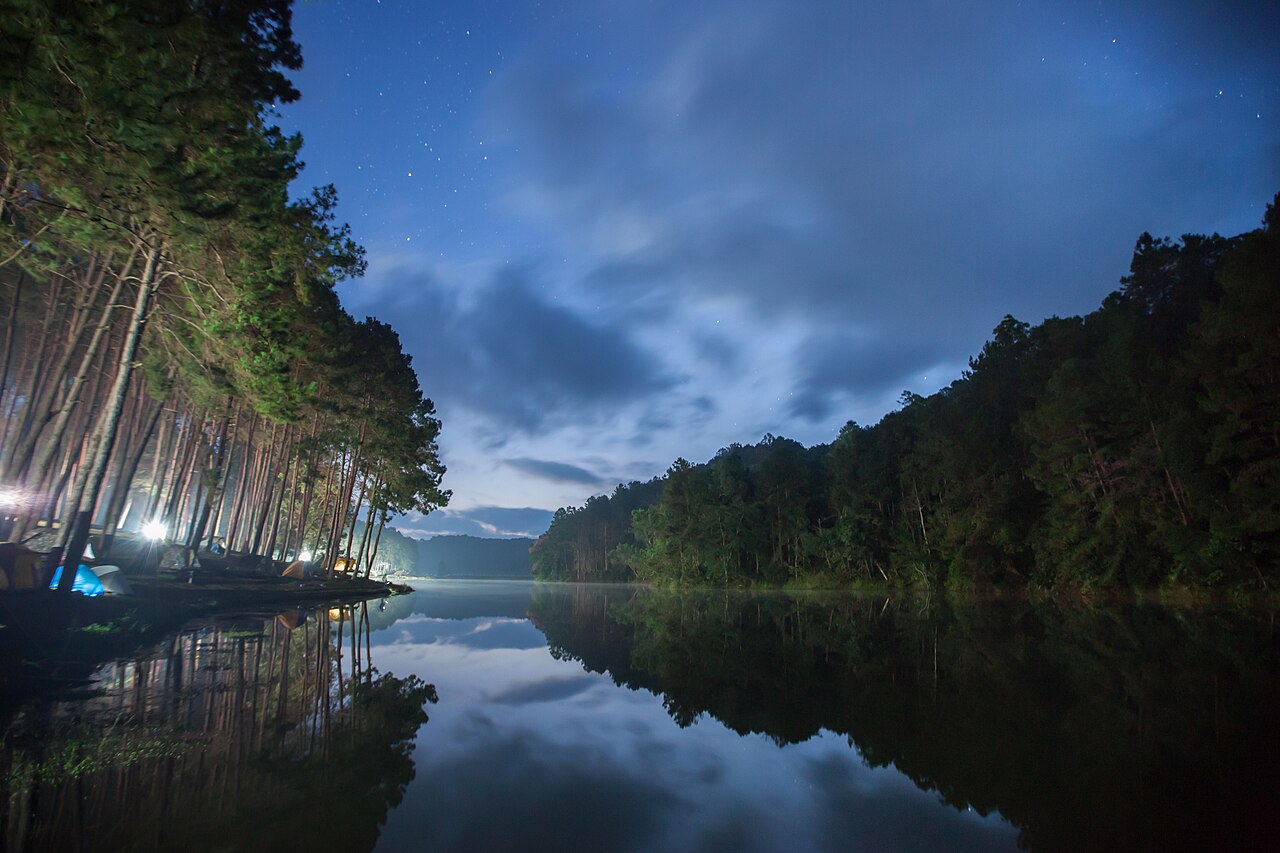
If you want the mist at Pang Ung, you have to get up genuinely early — Pang Ung is a mountain reservoir ringed by pine trees that reflect on the still water, with light mist that has earned it the nickname "the Switzerland of Thailand". It is about an hour and a half from town on mountain roads, and the light and mist are best right around sunrise (roughly 6–7 am), which means leaving town around 4:30–5:00 am to get there before it is light. There are coffee stalls and lakeside seats to sit at in the cold morning air.
Be honest, though — the mist depends on the weather. It is clearest on a cold, clear morning in the cool season (Nov–Feb) after a cold night, while in the hot months (Mar–Apr) you tend to get crop-burning haze instead. Bring a warm layer, because the pre-dawn air up here is genuinely cold. See more in the Mae Hong Son attractions guide.
Coming down from Pang Ung, stop at Ban Rak Thai, a Yunnanese-Chinese village (descended from former KMT soldiers) by a lake near the Myanmar border, with tea plantations, clay houses and tea houses to sit in over a cup of oolong, plus well-known Yunnanese food — pork-leg stew with mantou buns, black-chicken herbal soup. Its Yunnanese heritage is worth treating with respect. From there, head down towards the Su Tong Pae bamboo bridge, a long bamboo walkway across the rice paddies to a forest monastery — walk out over green paddies (rainy season into early cool season) or golden ones (late cool season) for a genuinely peaceful view.
Closer to town, Pha Sua Waterfall is a wide, tiered waterfall that is fullest in and just after the rainy season (a trickle in the dry months — that is the honest picture), good for a paddle or a photo if you have time. Today's stops sit in a continuous arc to the northwest, so you can loop them in a day, but the distances are real and the roads are mountainous — allow time to get back to town before dark. See more in the Mae Hong Son attractions guide.
After a full day in the hills, drive back into town in the evening, rest, then head out to walk around Nong Jong Kham after dark — in the cool season there is usually an evening walking street along the lake to graze along, with Wat Chong Kham and Wat Chong Klang lit up and mirrored in the water. It is a slow, cool way to round off the day.
For dinner, carry on with Shan and Yunnanese food — khao soi in a bowl, nam ngiao, gaeng hang lay or Yunnanese noodles. There are several cafés and lakeside spots in town that are good for a long, easy sit after a day on the road. See what to order in the Mae Hong Son food guide.
One more highlight before the flight home — Tham Lod Cave by bamboo raft at Pang Mapha, the Bua Tong sunflowers turning a whole hillside yellow (November only), or a relaxed morning in town before you fly.
The last day is for one more highlight. The first option is Tham Lod Cave in Pang Mapha (on the road between Pai and Mae Hong Son) — a large limestone cave with a stream running right through it. The highlight is riding a bamboo raft with a lantern-carrying guide who poles you into the cave to see the stalactites and the big chambers. At dusk, hundreds of thousands of swifts pour back to roost. You hire a local guide and rent the lantern and raft at the site — a genuinely different kind of outing.
Tham Lod is east of town towards Pai, so allow half a day to a full day there and back; if you are flying out in the afternoon or evening, plan the timing carefully. See more, and the sights around town, in the Mae Hong Son attractions guide.
If you come in November, the other rewarding option is the Bua Tong sunflower fields at Doi Mae U Kho (Khun Yuam), where the Bua Tong (Mexican sunflower) turns a whole hillside yellow — a sight people wait all year for, blooming only from around mid to late November. Khun Yuam is south of town along the loop route, a fair drive, so it suits anyone who happens to be here in bloom season. Outside the bloom, skip this one.
If your first two days were full, the last day can simply be a relaxed morning in town — browse the morning market you missed, sit at a café by Nong Jong Kham, pick up gifts (tea, coffee, woven cloth) and then head to the airport. It is an unhurried way to finish, and it suits the slow rhythm of the City of Three Mists best. See food and local produce in the Mae Hong Son food guide.
This evening you head home — the easiest way is to fly from Mae Hong Son (MHS) back to Chiang Mai (CNX). It is a short flight and the airport is close to town, so you need not arrive too far ahead. But because the planes are small and flights are limited, check the schedule and book in advance, and allow for the odd weather delay. Anyone not flying can take a minivan or drive the mountain roads, but it is long and winding and takes several hours.
If you are connecting onward to Bangkok or beyond, it is easier to spend a night in Chiang Mai and fly on the next day, because Mae Hong Son has no train and flights are limited — the main way back is by air or road to Chiang Mai. See the town and how to reach it in the Mae Hong Son guide.
This plan sleeps in Mae Hong Son town both nights, since the surrounding sights are all day trips and there is no need to move. The handiest area is around Nong Jong Kham lake — walking distance from the lakeside temples, the morning market, the walking street and the Shan restaurants. There is everything from guesthouses and lakeside boutiques to hillside resorts with a town view. See options in the Mae Hong Son guide.
The town is small and walkable, but the main sights (Pang Ung, Ban Rak Thai, Su Tong Pae, Tham Lod) are out of town on mountain roads, so you need a car, motorbike or tour — public transport and songthaews are very limited. If you drive, mind the winding roads and allow time and fuel; if you would rather not, charter a car with a driver. Mae Hong Son has no train and no BTS/MRT. See the Mae Hong Son Loop guide.
Mae Hong Son sits in a valley and signal can be patchy on the hill roads, so set up a Thai SIM or eSIM for maps and navigation — see the Thailand eSIM & SIM guide. Pack a warm layer for the cool season (pre-dawn at Pang Ung is genuinely cold) and a face mask for March–April when there is burning-season haze · and book the Chiang Mai–Mae Hong Son flights ahead, since seats are limited.
| Item | Backpacker | Mid-range | Comfort |
|---|---|---|---|
| Stay (per night) | ฿300–600 (guesthouse / dorm) |
฿800–1,800 (boutique / small resort) |
฿2,200–4,500+ (lakeside / hillside resort) |
| 3 meals | ฿150–300 (market / local) |
฿350–650 (restaurants + a café) |
฿700–1,300 (good restaurants + cafés) |
| Transport (rental / charter / tour) | ฿200–400 (motorbike + fuel) |
฿800–1,500 (car rental / join a day tour) |
฿1,800–3,000 (chartered car with driver) |
| Entry / activities | ฿50–150 (temples / Doi Kong Mu free) |
฿200–500 (Tham Lod / waterfall / Pang Ung) |
฿500–1,000 (add tours / a guide) |
| Daily total (approx.) | ฿700–1,450 | ฿2,150–4,450 | ฿5,200–9,800+ |
The big items outside the daily budget are the Chiang Mai–Mae Hong Son return flights and the chartered car or tour for the full day in the hills (distances are long and public transport is limited) · prices are approximate and vary by season — rooms are pricier and sell out fast in the cool season (Nov–Jan), so check before you go.