A six-line metro carries you from Green Lake to Changshui Airport and the South HSR station for trains on to Dali and Lijiang, with fares of just ¥2–8. The Spring City is a spread-out place — but far easier once you pair the metro with DiDi.
Kunming is the capital of Yunnan and the gateway to the whole province, sitting on a high plateau at around 1,890 m — hence its nickname, the Spring City, with mild weather almost year-round. The thing visitors should know first is that Kunming is a broad, spread-out city, with sights a fair distance apart. This is not a compact town you can walk end to end all day. Kunming Rail Transit now runs six main lines (Lines 1–6), with fares of just ¥2–8 (~฿10–40) a ride.
Good news first: station signage is bilingual, ticket machines have English menus, and Alipay QR scans you through the gate with no ticket at all. The metro reaches the points visitors actually need — Line 6 runs straight to Changshui Airport, Line 1 reaches the Kunming South HSR station, Line 3 heads out to Western Hills, and Line 2 crosses the centre by Green Lake. For the short stretches the metro doesn't reach, DiDi fills the gaps cheaply and easily.
This guide pulls together every way to get around Kunming: the fast, cheap metro; buses that cover the gaps; metered taxis and DiDi for luggage or the spots the metro misses; and walking the central district around Green Lake and Nanping Street — plus how to get in from Changshui Airport and how to use Kunming as a base for onward trains to Dali and Lijiang, with the altitude-and-UV notes you'll want from day one. Set up Alipay first — details in the Alipay & WeChat Pay guide.
Almost everyone arrives through Changshui Airport, while rail travellers alight at Kunming South, where Line 1 takes you straight into the city.
Changshui International Airport (KMG) sits about 25–30 km northeast of the city and is a major hub for southwest China. There are three ways in: Metro Line 6, the dedicated airport line, transferring to Line 3 or Line 1 at Tangzixiang (汤鸠箐) for just a few yuan; the Airport Express bus to the main downtown stops; or a taxi/DiDi for around ¥80–100 (~฿400–500), about 50 minutes depending on traffic. If you're not carrying much, Line 6 is the smoothest and cheapest.
Kunming is also the gateway to Yunnan — from here, high-speed trains reach the province's headline towns with ease: Dali (大理) ~2 hours · Lijiang (丽江) ~3–3.5 hours · Jianshui (建水) ~2 hours · Xishuangbanna/Jinghong ~3.5 hours. Shangri-La is ~4.5 hours by train/bus (or a short flight) — plan the whole Yunnan route in the Kunming & Yunnan trip planner.
Kunming has two main railway stations, and choosing the right one matters. Kunming South (昆明南站) is the principal high-speed station, taking trains to Dali, Lijiang and across the country, and it connects directly to Line 1 into the city. Kunming Railway Station (昆明站) is the older, more central station, handling some conventional services, and links to Line 1 / Line 2. See ticket-buying and advance-booking details in the China high-speed rail guide.
Your first choice for the longer hops across this spread-out city — to the airport, the HSR station and Western Hills. Clean trains, English signage throughout, and fares of ¥2–8 every ride.
Hours are roughly 06:00–22:30/23:00, though this varies by line and terminus — last trains on the longer lines and parts of the airport line leave earlier, so check the posted timetable if you're heading back late or catching an early flight. Fares are distance-based, starting at ¥2 (~฿10), with most central rides at ¥3–5 and a ceiling around ¥8 (~฿40).
| Line | Route | Key stops |
|---|---|---|
| Line 1 (the spine) | North ↔ south | 昆明南站 Kunming South HSR (trains to Dali & Lijiang) · the centre · the southern university district |
| Line 2 | Through the centre | Green Lake (翠湖 Cuihu) area · 昆明站 Kunming Railway Station · Nanping Street (transfer to Line 1) |
| Line 3 | East ↔ west | 西山公园 Western Hills Park (west end) · the centre · East Bus Station (east end) |
| Line 6 (the airport line) | Out to Changshui Airport | 长水机场 Changshui Airport (KMG) · transfer to Line 3 / Line 1 at Tangzixiang (汤鸠箐) |
| Line 4 / Line 5 | Cross-town, linking outer districts | Connect residential districts and interchange stations · transfer to Lines 1/2/3 at several points |
Easiest for visitors. Open Alipay, tap Metro or Transport, scan at the gate. No token, no card. Link a foreign card and set this up at home.
Same concept via WeChat City Service. Open WeChat, find Metro, scan at the gate. Works on every line.
Use the official Kunming Metro app, or buy a single-journey token from machines in every station. English menus, takes coins and notes.
The rechargeable Kunming Tong card (昆明通) works on metro and buses. Buy and top up at station windows — handy if you'll ride buses a lot.
Honest summary: Alipay is worth setting up even if the metro were your only reason, because it also handles buses, taxis, DiDi, restaurants and nearly every shop in the city. Read the step-by-step setup in the Alipay & WeChat Pay guide before you travel.
This is the metro's best partner in Kunming, because the city is so spread out. DiDi — China's ride-hail app — is ideal for the short stretches the metro doesn't cover, and it shows you the fare before you confirm. The interface is in English, you can type destinations in English, and payment links straight to Alipay. Metered taxis have a flag-fall of around ¥10–13 for the first 3 km, then roughly ¥1.8–2.4 per km.
Tip: street-hailed taxi drivers rarely speak English, so keep your destination in Chinese characters on your phone — or just use DiDi, which removes the need to speak at all. It's the right call when you have luggage, when it's raining in the wet season, or for spots the metro doesn't reach.
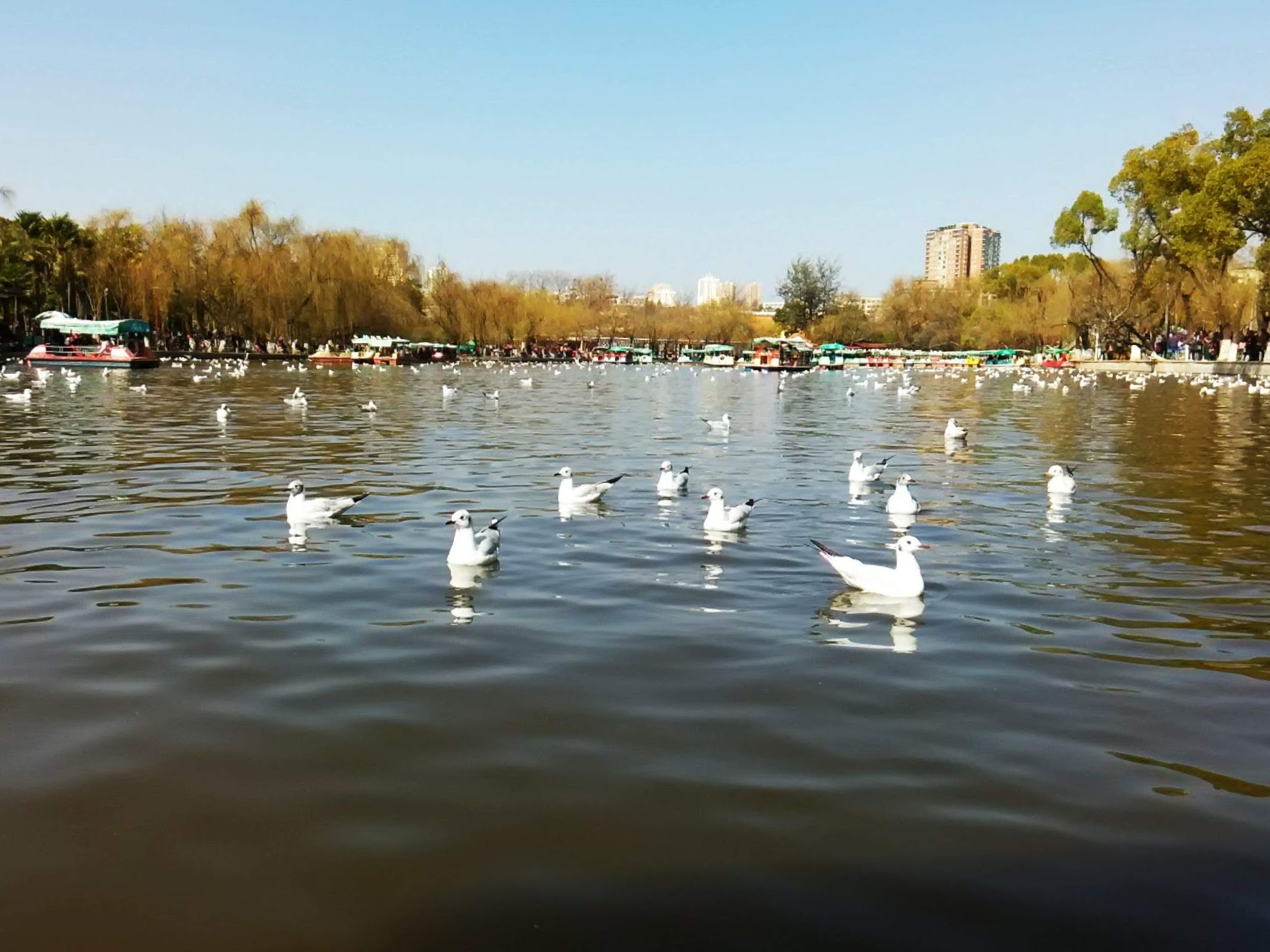
On foot
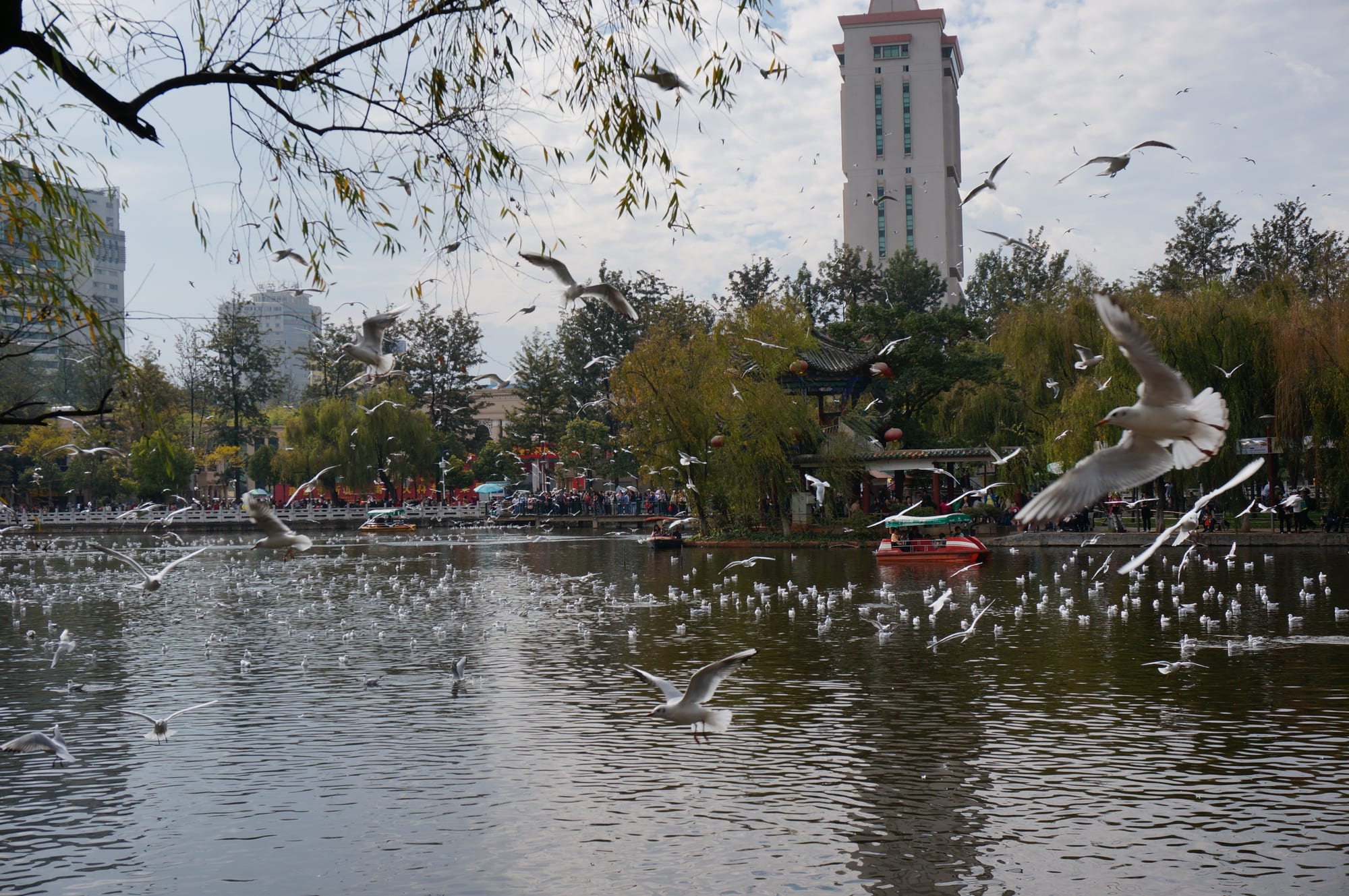
An honest truth: Kunming isn't a city you can walk between sights all day. But the central district is a pleasure to explore on foot. Around Green Lake (翠湖 Cuihu) you can stroll the waterfront watching the red-billed gulls in winter, then continue to Yuantong Temple (圆通寺) and Nanping Street (南屏街), the shopping and street-food quarter, all within walking range.
Tip: ride the metro or a DiDi to the edge of a district, then explore that area on foot; when you want to cross to another part of town, hop back on the metro or hail a DiDi. See everything to do in the Kunming attractions guide.
Kunming's buses cover the whole city and are very cheap, at just ¥1–2 (~฿5–10) a ride. They're a useful backstop for the spots the metro doesn't reach directly — corners around the lake, or the links between districts — and some routes run as sightseeing services to the outlying highlights.
Pay by scanning Alipay/WeChat, with a Kunming Tong card, or with exact-change cash. Use Amap to plan bus routes precisely — it tells you which stop to get off at and how far to walk after.
Kunming is the ideal base for Yunnan. From the Kunming South HSR station (昆明南站), high-speed trains reach Dali in ~2 hours, Lijiang in ~3–3.5 hours, Jianshui in ~2 hours, and Xishuangbanna/Jinghong in ~3.5 hours. A second-class ticket on many of these routes runs around ¥130–220 (~฿650–1,100), depending on distance.
Book ahead through Trip.com or 12306, as the popular routes sell out fast on holidays, and take Line 1 to Kunming South to board. Plan the whole Yunnan route in the Kunming & Yunnan trip planner.
Changshui Airport sits about 25–30 km northeast of the city. The smoothest and cheapest route is Metro Line 6, the dedicated airport line, transferring to Line 3/1 at Tangzixiang (汤鸠箐) to reach the centre, for just a few yuan.
With a lot of luggage or arriving late, hail a DiDi/taxi for around ¥80–100 (~฿400–500), about 50 minutes depending on traffic. The Airport Express bus to the main downtown stops is a mid-price alternative.
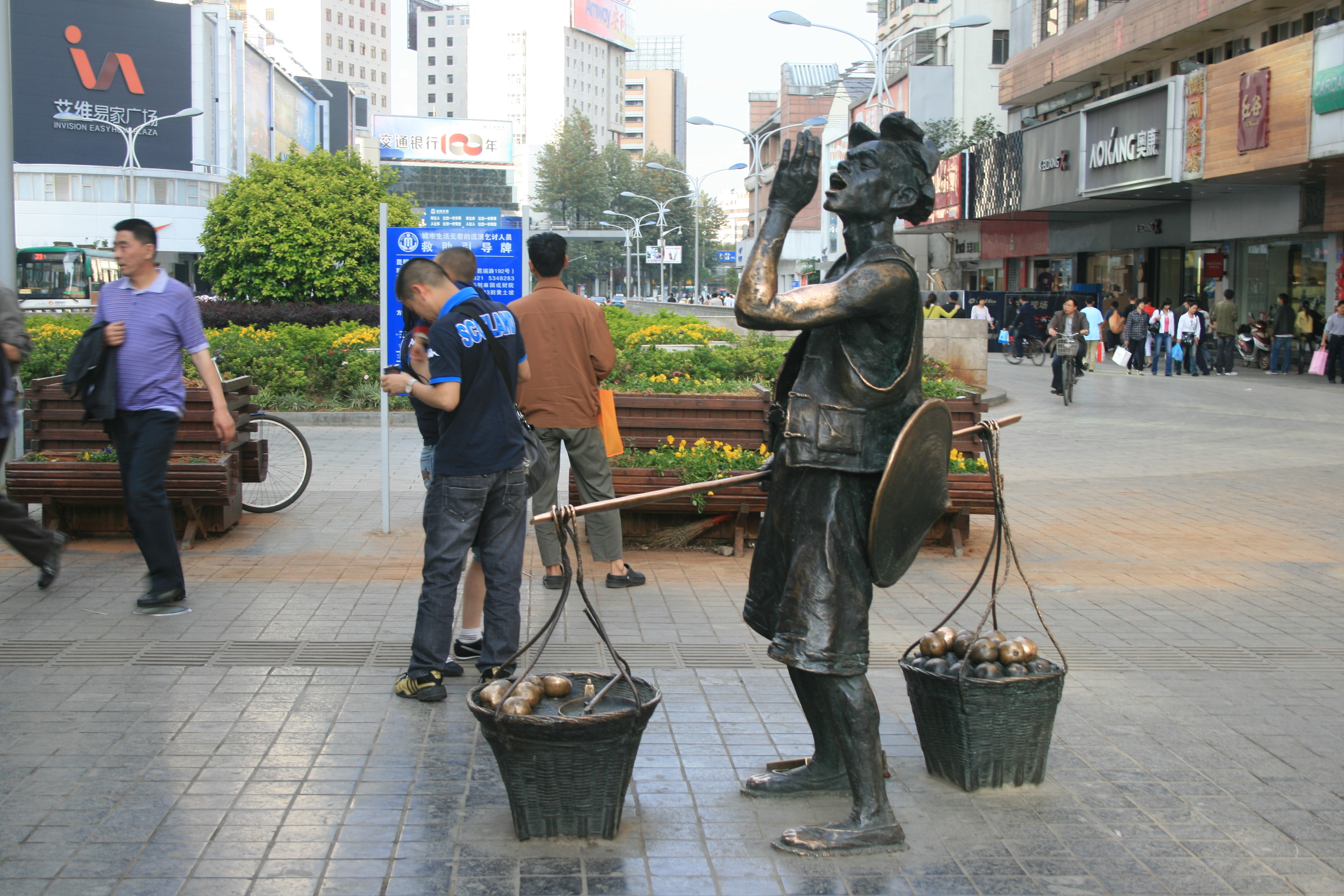
The central district
Nanping Street (南屏街) is downtown Kunming's shopping and pedestrian quarter, beside the Nanqiang (南强街巷) street-food lanes, and it links on foot to Green Lake and Yuantong Temple. Line 2 runs through this area — alight at a central station and explore from there.
This is the most enjoyable part of Kunming to wander — ride the metro to the edge of the quarter, then walk it at length without needing a car, unlike a trip out to Western Hills or Dianchi Lake, which calls for the metro or a DiDi.
This matters more than people expect. Google Maps' public transit data for mainland China is unreliable — even with a VPN, route guidance for the metro and buses is frequently wrong or simply absent. Two apps give accurate, real-time transit directions without any workaround:
Amap has accurate, live data for every metro line, bus route, and intercity train in China. You can search destinations in English, and the transit planner gives step-by-step directions down to which exit to use. Download it from the App Store or Play Store before you arrive — no VPN required to use it.
Apple Maps in China uses Amap's data as its backend, which means its transit directions for the Kunming metro are accurate. On an iPhone this is the path of least resistance — no extra app, no VPN, and it fits your existing Maps workflow.
If you want LINE, Instagram, Gmail or full Google Maps while in China, you'll need a VPN installed and tested before you fly — most VPN websites are blocked once you're inside the country. See the full breakdown in the China internet, VPN and eSIM guide.
Two preparations make the biggest difference. First, open Alipay, link your Visa or Mastercard through the international mode, and find the Metro and DiDi features in the app before you leave home. Once you land in Kunming you won't be hunting for anything — one app scans you through the metro gate, hails a DiDi and pays for dinner.
Second, pack for the sun and the altitude. At 1,890 m the sun is stronger than you'd expect, so bring sunscreen, sunglasses, a hat and a light jacket for the cool evenings. On getting around, the rule is simple: this is a spread-out city, so use the metro for the long hops (airport, HSR station, Western Hills) and a DiDi for the short final stretches, while the central cluster around Green Lake is walkable end to end.