Home Kunming China Kunming Food About
Home  ›  China  ›  Kunming  ›  Yunnan Coffee
☕ Yunnan Coffee & Pu'er Tea in Kunming · 2026

Yunnan coffee — highland beans
in a city older than any of it on tea

China grows about 98% of its coffee in Yunnan, and the Arabica off the Pu'er and Baoshan highlands is climbing into specialty cups that coffee people now seek out. Kunming, the provincial capital, has both — a young café scene in lanes by the lake, and a Pu'er tea heritage that reaches all the way back to the old Tea-Horse Road.

Why Yunnan coffee

The coffee capital most people never knew

Honestly, mention Kunming and people picture flowers, mild weather all year, and tea — not coffee. But here's the thing: China grows about 98% of its coffee in Yunnan, and almost all of it is Arabica off the province's southwestern highlands — Pu'er (普洱), Baoshan (保山), Dehong and Menglian, which land right inside the world's Coffee Belt, with volcanic soil, high altitude and big day-to-night temperature swings. As the capital and gateway of the province, Kunming is where those beans come together — both in cafés and in the pour-over glass.

It's a newer story than you'd think. The first coffee tree in mainland China came from a French missionary who arrived via Vietnam around 1904 and planted it at Zhukula village (朱苦拉) in the Dali area — a single Bourbon, a variety of Arabica. From there Yunnan grew into China's largest coffee region, especially after Nestlé set up standardised growing at Pu'er in 1988. And it's only in the past decade or so that a wave of young farmers and roasters has pushed Yunnan beans from commodity-grade up into high-scoring specialty.

But don't forget we're talking about a city where tea is older than all of it. Kunming is one of the biggest centres anywhere for trading, storing and ageing Pu'er tea (普洱茶) — an end-point of the ancient Tea-Horse Road. So this guide takes you through both sides of what Kunming drinks — the Yunnan coffee on the rise, and the Pu'er tea that's the root.

The deepest root

Pu'er tea — cakes that age for years

Before there were cafés, Kunming was a tea town, and Pu'er is the tea pressed into round cakes and kept to age until its taste changes.
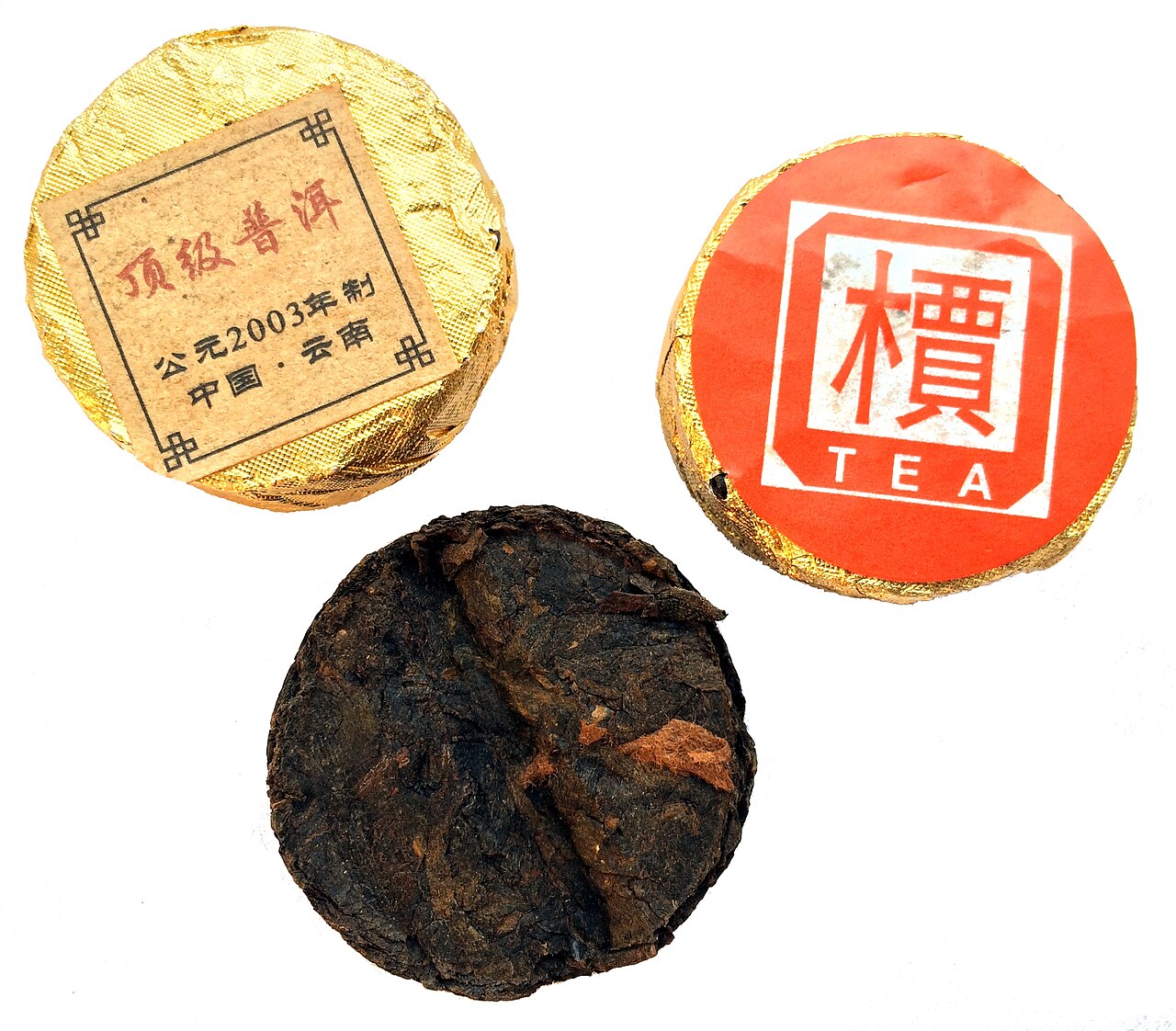
Yunnan Pu'er tea pressed into small round cakes, wrapped in gold paper printed 顶级普洱 (top-grade Pu'er) and 云南 (Yunnan), beside an unwrapped cake

What you see in a Kunming tea shop is Pu'er pressed into round cakes (饼茶 bingcha) or small bricks, wrapped in paper printed with the year and the origin. Unlike green tea, where fresher is always better, Pu'er is made to age — kept for years where the humidity and air are right, it slowly softens and grows more complex. A well-aged top-grade cake is both a drink and a collectible whose price climbs with its years.

Pu'er is grown in the south of the province, around Xishuangbanna and Pu'er, but Kunming is where it comes together — the capital and trade junction since ancient times. Today the city has nearly 20 wholesale tea markets and is one of the largest hubs for storing, ageing and trading Pu'er, second only to the growing regions themselves. If you like tea, walking the Kangle or Xiongda tea markets in Kunming is an experience that's hard to find elsewhere.
Raw vs ripe, how to tell: raw Pu'er (生普 sheng) ferments slowly and naturally — astringent and green-fresh when young, softer over years of ageing · ripe Pu'er (熟普 shou) goes through an accelerated fermentation (渥堆) for a deep, smooth, earthy taste that's easy to drink even new · most beginners start with ripe because it's the gentler one.
Know the coffee first

What to know about Yunnan coffee before you sip

From the growing regions and the origin story to the taste, and what to order in a Kunming café.

🌍1
98% of China's coffee grows in Yunnan
Pu'er · Baoshan · Dehong · Menglian

Yunnan grows about 98% of all the coffee in China, concentrated on the southwestern highlands that sit right inside the world's Coffee Belt — volcanic soil, high altitude, big day-night temperature swings, exactly what Arabica likes. Pu'er and Baoshan are the two names coffee people remember.

Main regions: Pu'er · Baoshan · Dehong · Menglian
Why it works: volcanic soil + altitude + the Coffee Belt
🫘2
Almost all Arabica
Arabica + Catimor · Baoshan GI in 2010

Almost all Yunnan coffee is Arabica and Catimor (a Caturra–Timor hybrid that resists disease well). Baoshan Arabica was registered as one of China's geographical-indication (GI) products back in 2010, and in recent years many farmers have shifted to small washed and natural lots that score higher and higher on the specialty scale.

Varieties: mostly Arabica + Catimor
Notable: Baoshan holds a GI · growing specialty lots
3
It started with a French missionary
~1904 · Zhukula village (朱苦拉)

The first coffee tree in mainland China came from a French missionary who arrived via Vietnam around 1904 and planted a Bourbon (a variety of Arabica) at Zhukula village in the Dali area. Later, in 1988, Nestlé introduced standardised growing at Pu'er, which set the Yunnan coffee industry on a properly commercial path.

Beginning: ~1904 at Zhukula, Dali
Turning point: 1988 Nestlé standardises growing at Pu'er
4
The taste — and what to order
nutty · caramel · chocolate · fruit

Light-to-medium roasted Yunnan coffee tends to be nutty, with caramel and chocolate and a clean fruit and acidity. Good beans from Pu'er or Baoshan give a round body and a lingering sweetness. To taste the place itself, order a Yunnan single-origin pour-over or a hot black coffee; if you prefer it softer, a latte made with Yunnan beans works well too.

To taste the region: a Yunnan single-origin pour-over
Price: ¥25–45 (~฿125–225) a cup
Worth understanding: Yunnan coffee was long seen as a cheap bean that went into big brands' blends, but well-made specialty lots have changed that picture a lot. If you find a café that roasts its own or works directly with Yunnan farms, ask which of their coffees is a Yunnan single-origin, then order it as a pour-over — the taste is clearly different from a generic blend.
The café scene

Kunming's cafés — where they cluster

A city that grows coffee province-wide has plenty of cafés and roasters, and most of them gather around the university and the lake.

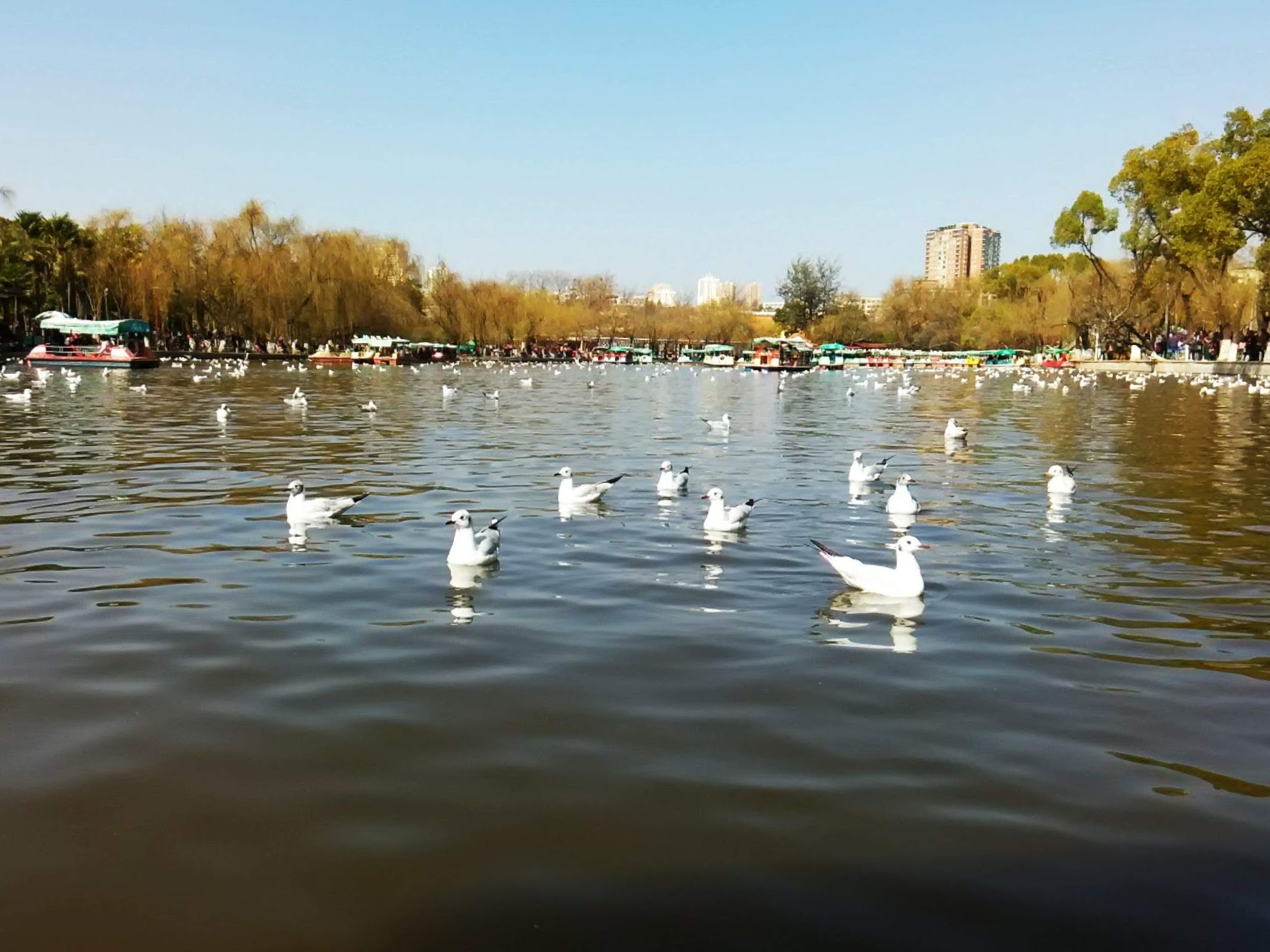
Cuihu (Green Lake) Park in Kunming, an area whose surrounding lanes hold many of the city's newer cafés, near Yunnan University

Cuihu (Green Lake) Park — the area where Kunming's café lanes and newer coffee shops cluster, near Yunnan University

Kunming is not a coffee capital on the scale of Shanghai, with its thousands of cafés. But as a city that grows coffee across the whole province and has a big student population, its specialty-coffee scene is lively and serious. Independent cafés and small roasters that work directly with Yunnan farms are easy to find — and Kunming's edge is simple: the beans that many cities have to import are grown right here in the same province.

The cafés cluster around Wenhua Alley (文化巷) and Wenlin Street (文林街) near Yunnan University — a student quarter that mixes old-town charm with newer shops. At the mouth of Wenhua Alley sits Salvador's Coffee House, one of the city's earliest Western spots still open, and it's an easy walk from there to Cuihu (Green Lake) Park, whose surrounding lanes hide several more cafés. Specialty coffee generally runs ¥25–45 (~฿125–225) a cup.

What to order

Drinks to try in Kunming

From a Yunnan single-origin pour-over to the Pu'er tea that is the city's root.

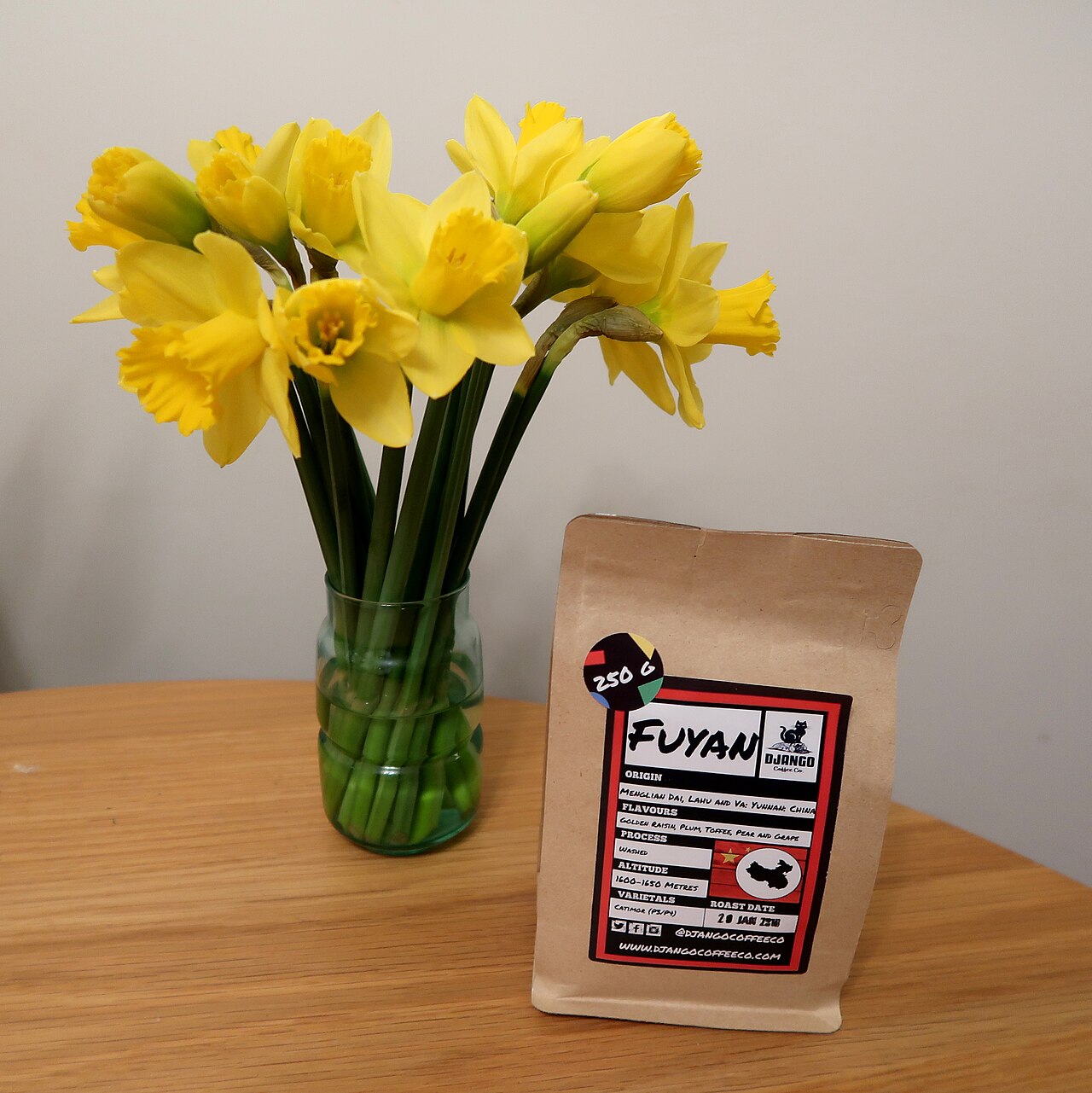
A bag of roasted Yunnan coffee (Django Coffee Co., a lot from Menglian, Yunnan) labelled as grown in Yunnan, China 1
Yunnan single-origin pour-over
云南手冲 · the local bean, brewed clear

The number-one drink to try if you want to taste the place — a single-origin from Pu'er or Baoshan, served as a pour-over that opens up the nutty, caramel, fruity character of the Yunnan bean without milk or sugar getting in the way. Tell the barista you want the Yunnan one; drinking Yunnan coffee in the province where it's grown means something a little different.

Find it at: specialty cafés around Wenhua Alley / Green Lake
Price: ¥30–45 (~฿150–225)
🥛2
Yunnan-bean latte
云南拿铁 · Yunnan espresso + milk

If you like your coffee softer, order a latte pulled from Yunnan beans — the round body and caramel sweetness of the local bean sit well with milk, and it's a good entry if you're not ready for it black. Some Kunming shops also play with Yunnan ingredients — coffee scented with rose (a flower the city is known for) or made with goat's milk — so it's worth checking the shop's signature menu.

Find it at: specialty cafés in town
Price: ¥28–42 (~฿140–210)
🍵3
Pu'er tea (raw or ripe)
普洱茶 · sheng / shou

The city's real root — Pu'er brewed in a tea shop or a tea market. Beginners usually start with ripe (熟普), deep and smooth and earthy and easy to drink, then move on to aged raw (生普), more complex, once they're into it. Most tea shops are happy to let you taste before you buy — sit down, watch them brew, hear the story. It's the best way to get Pu'er.

Find it at: tea shops in town · Kangle / Xiongda markets
Price: tasting in-shop is often free or cheap · cakes priced by grade
🌹4
Yunnan flower drinks
玫瑰 · rose and the city's flowers

Kunming is the "Spring City," home to Asia's biggest flower market, so cafés and drink shops alike turn the city's flowers into drinks — from rose lattes and flower teas to seasonal iced drinks scented with blossom, naturally sweet and fragrant without much added sugar. Try it in the city where flowers are this cheap and fresh and it really is the taste of Kunming.

Find it at: cafés and drink shops in town
Price: ¥25–45 (~฿125–225)
Following the tea

Tea markets and places worth knowing

From the biggest wholesale tea markets in the city to the newer cafés in the lanes — each gives a different mood.

Kangle tea market (康乐茶城)
large wholesale tea market · central

One of Kunming's biggest and busiest wholesale tea markets, with hundreds of Pu'er shops gathered in one place. Browse cakes aged for years, gold-wrapped bricks, and shops glad to brew a cup before you buy. The mood is real tea traders, not tourist stalls — ideal if you're serious about finding Pu'er, or just want to soak up the tea culture.

Mood: wholesale market · real traders · Try: taste before you buy · Best time: daytime
Xiongda tea market (雄达茶城)
north of the city · another big tea market

Another large wholesale tea market, in the northern part of Kunming, easy to reach. It gathers both raw and ripe Pu'er shops, from everyday drinking grades to old aged cakes at high prices. Tea people often name Xiongda and Kangle as the two main pins to hit if you've come Pu'er hunting in Kunming.

Mood: wholesale market · north side · Try: compare raw vs ripe · Best time: daytime
Wenhua Alley / Wenlin Street
文化巷 / 文林街 · café quarter by Yunnan Uni

The student quarter by Yunnan University where the cafés cluster thickest, mixing old-town charm with newer shops. At the mouth of Wenhua Alley is Salvador's Coffee House, one of the earliest Western spots still open, and the lanes around it hold plenty more independent cafés and Yunnan coffee bars. It's an easy walk from here to Green Lake Park.

Mood: student quarter · café lanes · Price: ¥25–45 / cup · Best time: late morning–afternoon
Green Lake lanes (翠湖)
Cuihu · cafés tucked in the lanes around the park

The small lanes around Cuihu (Green Lake) Park, in the heart of the city, hide several newer cafés and coffee shops. Sip a Yunnan coffee in a lane by the park, where the air stays mild all year, then stroll on around the lake — a good way to spend a late morning that fits the rhythm of this city.

Mood: by the park · mild all year · Price: ¥25–45 / cup · Best time: late morning–afternoon
Tea-market tip: most tea shops are happy to brew a cup before you buy — sit down, watch them make it, and ask whether it's raw or ripe and how many years it has aged · Pu'er prices vary enormously by grade and age, with old aged cakes especially dear · if you don't want a whole big cake, you can usually buy a small brick or a sample to try first.
The deepest heritage

The Tea-Horse Road — where it all comes from

Before roads and railways, tea from Yunnan travelled north on the backs of horses and mules, over the mountains as far as Tibet.

The reason Kunming became a Pu'er hub when the tea is grown elsewhere is the Tea-Horse Road (茶马古道) — the ancient trade network that carried pressed tea cakes from the growing regions in southern Yunnan north through Dali and Lijiang, into Sichuan and Tibet, and as far as Central Asia. Tea was pressed into round cakes precisely so it could ride on horse and mule caravans and keep over journeys that took months.

As the capital and trade junction, Kunming became the place where the tea gathered, rested and was passed on — and that heritage lives on today in the city's nearly 20 wholesale tea markets and a Pu'er ageing culture deeper than most. Tea is the old story of this city, and Yunnan coffee is the new chapter just being written. If you come to Kunming, do both — a local coffee in a lane, then a sit-down over Pu'er in a tea market — and you'll understand the city a lot better.

Before you go

Practical tips that help

Kunming is mainly cashless — cafés and many tea shops take WeChat Pay and Alipay as their main methods, and some don't take cash at all. Before you travel, set up Alipay and link a Visa or Mastercard through its international mode (it works for visitors · see our China payment guide). In the tea markets, a phone transfer is often smoother than cash.

Kunming is the "Spring City," with mild weather almost all year, so you can walk the cafés and tea markets comfortably in most seasons. The best windows are spring and autumn (Mar–May and Sep–Nov), with good sun and little rain. Avoid long holidays — especially Golden Week (early October) and Chinese New Year — when sights and markets get especially packed. The real coffee and tea regions like Pu'er and Baoshan are several hours away, a separate trip of their own.

If you want a VPN for general internet use in China (Google Maps, Instagram and the like), set it up before you travel, since most apps can't be downloaded once you're inside the country — see our China internet & VPN guide. Getting around the city is easiest by metro and DiDi, and the café quarter by the university and Green Lake is all within a walk.

Frequently asked

FAQ · what people ask before drinking Yunnan coffee and Pu'er tea in Kunming

Why does Yunnan coffee matter, and where is it grown?
Yunnan grows about 98% of all the coffee in China, on the highlands of the province's southwest — Pu'er (普洱), Baoshan (保山), Dehong and Menglian — which sit right inside the world's Coffee Belt, with volcanic soil, high altitude and big day-night temperature swings. Almost all Yunnan coffee is Arabica and Catimor. Baoshan Arabica was registered as one of China's GI products back in 2010, and in recent years many Yunnan lots have climbed from commodity-grade to high-scoring specialty coffee.
How did coffee come to be grown in Yunnan?
The first coffee tree in mainland China came from a French missionary who arrived via Vietnam in the early 1900s (around 1904) and planted it at Zhukula village (朱苦拉) in the Dali area — a Bourbon, a variety of Arabica. Later, in 1988, Nestlé introduced standardised growing, picking and processing methods at Pu'er, which set the Yunnan coffee industry on a commercial path. The past decade or so has seen far more roasters and farmers focused on specialty coffee.
Does Kunming have good coffee, and where should I drink it?
Yes, and the scene is growing fast. As the capital of a coffee-growing province, Kunming has plenty of independent cafés and in-city roasters. The cafés cluster around Wenhua Alley (文化巷) and Wenlin Street (文林街) near Yunnan University — a student quarter that mixes old-town charm with newer shops — and in the small lanes around Cuihu (Green Lake) Park. Order a Yunnan single-origin pour-over to taste the local bean straight; specialty coffee runs about ¥25–45 (~฿125–225) a cup.
What does Yunnan coffee taste like, and what should I order?
Light-to-medium roasted Yunnan coffee tends to be nutty, with caramel and chocolate, plus a clean fruit and acidity. Good beans from Pu'er or Baoshan give a round body and a lingering sweetness. To taste the place itself, order a Yunnan single-origin pour-over or a hot black coffee; if you prefer it softer, a latte made with Yunnan beans works well. Some Kunming shops also pair coffee with local ingredients like rose or goat's milk in a signature drink.
Why is Kunming a Pu'er tea hub when the tea is grown elsewhere?
Pu'er tea (普洱茶) is grown in the south of the province, around Xishuangbanna and Pu'er, but Kunming has long been the capital and the trade junction — one end of the old Tea-Horse Road (茶马古道), which carried tea north to Tibet by horse and mule caravan. Today Kunming has nearly 20 wholesale tea markets and is one of the largest centres for storing, ageing and trading Pu'er after the growing regions themselves. The big markets people visit are the Kangle (康乐) and Xiongda (雄达) tea markets.
What's the difference between raw (sheng) and ripe (shou) Pu'er?
Raw Pu'er (生普 sheng) ferments slowly and naturally; when young it's more astringent and green-fresh, then softens and grows more complex over years of ageing. Ripe Pu'er (熟普 shou) goes through an accelerated fermentation (渥堆) that gives it a deep, smooth, earthy taste that's easy to drink even when new. Most Pu'er is pressed into round cakes (饼茶 bingcha) or small bricks so it stores and ages well — well-aged top-grade cakes are both a drink and a collectible whose price rises with age.
Klook · Kunming

Explore Kunming, taste Yunnan coffee, walk the Spring City

Book tours, tickets and activities in and around Kunming — the Stone Forest, the lakes, the old towns and day trips out of the city that are easier to book ahead than to arrange yourself.

See Kunming activities on Klook →
Wherebest is a Klook affiliate partner — we may earn a commission when you book through our link, at no extra cost to you.