Bitter melon stir-fried with tofu that Okinawans have eaten for a thousand years · soba noodles that aren't buckwheat · taco rice the Americans gave rise to · and Awamori spirit twice as strong as sake — the food here tells the story between China, Japan and America better than any history book.
Let's be honest — if you come to Okinawa expecting mainland-style ramen, sushi or tempura, you'll be confused from the very first page of the menu. The Ryukyu Kingdom governed itself for over 400 years before being annexed by Japan — leaving behind a cuisine with clear Chinese and Southeast Asian influences. Then, after World War II, the United States occupied Okinawa for 27 years, embedding canned Spam, tacos and American diner culture into the island's recipes.
The result is a cuisine that is completely unique unto itself — pork belly braised in Awamori rice spirit until meltingly tender, bitter melon stir-fried with pale-yellow tofu that Okinawans have long eaten for their health, green seaweed that pops in your mouth like fish roe, and soba made from wheat instead of buckwheat. Ever eaten Taco Rice, which American soldiers created as a quick, cheap meal for young troops? This is where it began.
The dishes that tell you what Okinawa eats — ranked by how distinctly Ryukyu they are
1
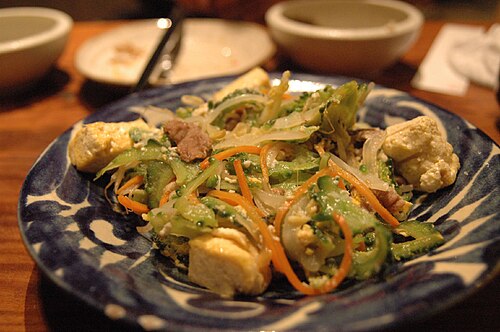
If you're brave enough to try bitter melon — this is the right place to start. Champuru means "mixed" in Ryukyu, and Goya Champuru is the culinary symbol of this island. Thinly sliced bitter melon, stir-fried hot with yellow Okinawan tofu, chicken egg and thin pork (or canned Spam — totally fine, it's part of the identity), topped with dried Katsuobushi fish flakes. It's bitter, but a bitterness that, once you get used to it, you'll want again. Okinawans have eaten it as a health food for a thousand years and believe it's part of their longevity.
2
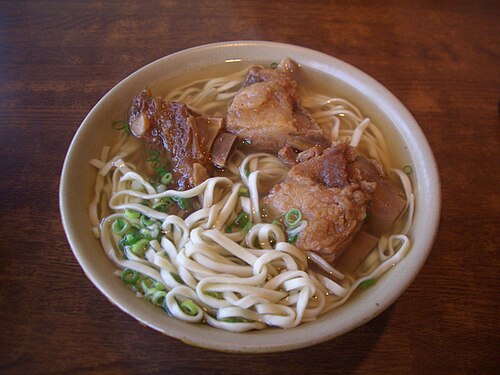
Ever wondered why the "soba" noodles here look like udon? Because they're made from pure wheat flour, without a single grain of buckwheat — the name "soba" means "noodle" in Okinawa, not the type of noodle. The broth is made from pork bones and dried tuna (Katsuobushi), simmered long until it comes out rich and sweet. On top of the bowl sit Sanmai-niku (braised pork belly), Kamaboko (fish cake) and pickled red ginger. More aromatic than ramen but not as intense — you can eat it at any meal and never tire of it.
Just like Okinawa Soba in every way except the topping — instead of pork belly it uses Soki, pork ribs braised slowly until the meat falls off the bone on its own. Deeply sweet, the fat seeping into the broth. If you love pork ribs, you'll fall in love at first sight — this is Okinawa Soba leveled up another notch. Some shops serve Tebichi Soba instead — Tebichi being pig's trotters braised so long they turn to gelatin. These two are the reason Okinawans rarely waste any part of the pig.
4
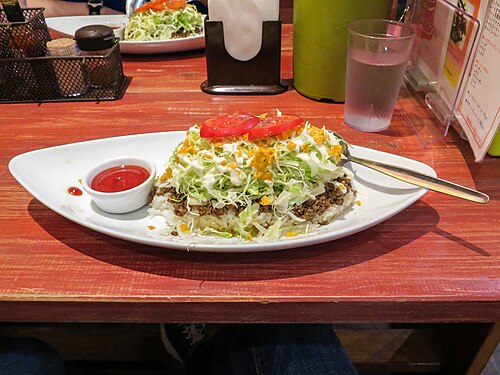
Ever eaten the tacos the American soldiers' base created? This is Okinawa's taco. In 1984, Matsuzo Gibo, owner of a shop in Kin Town next to the Camp Hansen base, wanted young soldiers to eat their fill cheaply, so he took the taco filling — seasoned Mexican ground meat, cheese, fresh vegetables, tomato — and set it on steamed rice instead of a corn taco shell. Half the price, easier to eat. The soldiers loved it, the Okinawans loved it too. Today it's sold all over the island, eaten with a spoon instead of a fork, with salsa drizzled to taste.
5
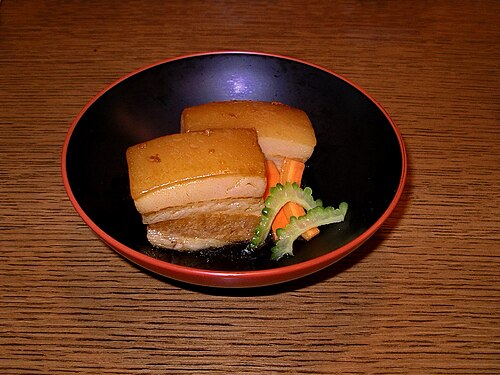
If you've ever loved Thai braised pork belly — Rafute is Okinawa's answer. Pork belly with the skin still on, braised in Awamori spirit with soy sauce, brown sugar and dashi until the skin turns to gelatin and the fat melts out to act as its own sauce. You can cut the meat with chopsticks alone, no knife needed. Eaten with mustard or pickled ginger. A plate runs ¥400–1,000, but most often it's part of a Ryukyu set meal at a traditional shop.
6
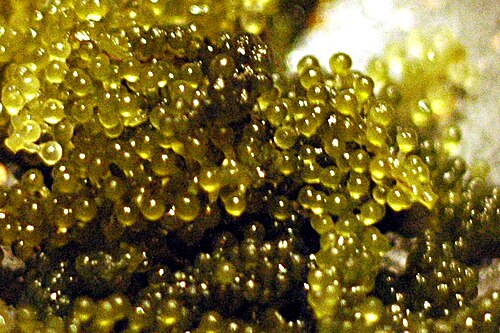
We love Umi-budo for the way it changes the minds of people who've never eaten seaweed before — it's a dark-green seaweed with tiny beads lined up like miniature grapes, and when you bite them, a mild salty seawater pops in your mouth, like green fish roe that isn't raw or fishy. Served fresh, drizzled with citrus ponzu or soy sauce, it makes a perfect first dish before the mains. You can buy it fresh on the lower floor of Makishi Market; in restaurants it runs ¥500–700 per plate.
7
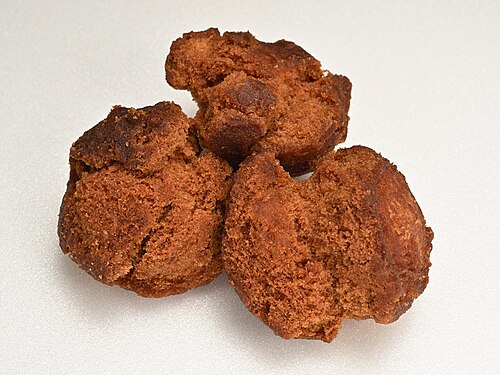
If you see round golden-brown balls sold along Kokusai-dori, that's Sata Andagi — the Okinawan-style doughnut, made from flour, egg and sugar, deep-fried in plenty of oil so the outside cracks crisp while the inside stays soft and chewy like a light mochi. Not too sweet, not too oily. The name Andagi comes from the Ryukyu language and literally means "fried in oil." Best eaten hot, straight out of the pan — easy to grab 2–3 to munch while you shop.
8
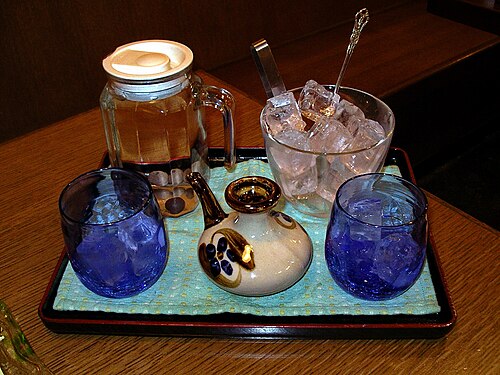
Awamori isn't sake and isn't shochu — it's a long-grain distilled rice spirit that Okinawa has made itself since the 15th century. Its ABV runs 25–43%, nearly three times stronger than sake. Unaged, it's heavy and fierce, but well-aged versions (Kusu — aged over 3 years) become very smooth and complex. The way Okinawans like to drink it is Mizuwari — diluted with 2–3 parts cold water over ice, which brings out the fragrant rice aroma, lightens the taste and makes it far more approachable.
Walk Kokusai-dori for about 10 minutes and you'll see purple souvenirs in every shop window — that's Beni-imo, an Okinawan sweet potato variety with a vivid purple colour that differs from the usual Japanese purple yam, milder and softer in sweetness. It's made into everything from Tart (the classic, the Okashigoten brand) to Blue Seal ice cream, candies, cakes, Kit Kats and mochi. It travels home easily because the baked-and-dried Tart needs no refrigeration and keeps for 2–3 weeks.
Agu is Okinawa's native pig breed — a small black pig that nearly went extinct during the war, revived through the efforts of local farmers. Agu's fat is unusually white and sweet, melting just below body temperature so it feels soft in your mouth the moment you eat it. Have it shabu-shabu style in a clear broth, cooked just right and eaten with sesame dipping sauce, or yakiniku grilled over charcoal. It's a special-occasion premium meal, but worth it if you want to try something found only in Okinawa.
Called tofu, but there isn't a single soybean in it — Jimami Dofu is made from ground peanut milk and kuzu (arrowroot) starch, giving it a texture like pudding or Japanese panna cotta, but with a clear peanut fragrance. Served cold with sweet soy sauce or grated ginger. If you're allergic to peanuts, absolutely don't order it — but if you're not, this is the eye-opener that shows Ryukyu cuisine isn't all pork — there's a delicacy of flavour here too.
The neighbourhoods and markets where Okinawa's food clusters most densely
Open for more than 60 years and rebuilt (2023), yet it keeps its original character — the ground floor is full of fresh seafood counters, colourful fish, unusual fish, lobster and fresh Umi-budo. Pick what you want to eat and carry it up to the 2nd floor, where the restaurants will cook it for you and you eat right there in the market. The cooking fee is about ¥300–500. There's also fresh Sata Andagi and other Okinawan dishes across the floor.
A 1.6 km street with everything in Naha — restaurants, souvenirs, stalls of fresh Sata Andagi, Beni-imo Tart, free Awamori tastings, Blue Seal ice cream and grab-and-go bento shops. Very touristy and pricier than the market, but handy for souvenir runs or finding food while you walk. The Yataimura alley on the left side hides cheap local eateries.
If you want "the best Taco Rice in Okinawa" — you have to come to Kin, not Naha. The King Tacos Main Store here is the mother branch of the lineage carried on from Parlor Senri, the 1984 original. The area around Camp Hansen base gives a feeling that history is still close at hand. It's about 1 hour from Naha by rental car, no train.
The local alleys that fan out from Makishi Market — here it's cheaper than Kokusai-dori and the atmosphere is genuinely local. Hanagasa Shokudo (花笠食堂) is tucked into these lanes, open from morning, serving Okinawan set meals at ¥1,000–1,100 with Rafute + Champuru + Miso + Sashimi. The people walking these alleys are often local elders out buying food to eat — a trustworthy sign that the food here is the real thing.
30 minutes from Naha by car, but the atmosphere flips completely — brightly coloured 1950s American-style buildings, Okinawan-American fusion restaurants, the main Blue Seal Ice Cream branch, Sunset Beach, and the GI flavour that still lingers in every Taco Rice and Blue Seal scoop here. Good for lunch before driving north.
The shop everyone who "knows Okinawa" recommends — an old Ryukyu-style wooden house tucked into Kumoji in central Naha. Traditional Goya Champuru, a big plate of Rafute, Tofuyo (tofu fermented in spirit) and more vegetable dishes than the average shop. Reasonably priced at ¥1,500–2,500 per person. Reserve ahead during peak times. Open evening to late only.
The shops proven worth it — pin them on the map before you go to Okinawa
An old rice diner in the style of a local canteen, tucked into Heiwa-dori near Makishi Market — no gimmicks, no English menu, but the most complete Okinawan set meal at the fairest price, ¥1,000–1,100 with Rafute + Champuru + Miso Soup + Sashimi plus rice. Open from morning until they sell out. Travellers who truly know Okinawa name this place every time.
The shop everyone who "knows Okinawa" recommends — an old Ryukyu-style wooden house in central Kumoji, Naha. The standout dishes are traditional Goya Champuru, Rafute, Jimami Dofu and Tofuyo (tofu fermented in Awamori spirit). More vegetable dishes to choose from than average, reasonably priced, open evening to late only. You should call to reserve ahead if you're going on a holiday.
The mother branch that carries on the 1984 original recipe from the now-closed Parlor Senri — located in Kin Town next to the Camp Hansen base. The surrounding atmosphere is still a military-and-local community completely different from Naha. Taco Rice Cheese Vegetable is the dish to order, eaten with a spoon, salsa drizzled to taste. It's 1 hour from Naha, but for those who really want to trace the origin, it's well worth it.
Pick an unusual fresh fish from the lower floor, then carry it up to a 2nd-floor restaurant to cook for you — this system has existed since the market opened and still works well. The cooking fee is about ¥300–500 depending on the cooking method. If you're not sure what to buy, fresh Umi-budo (sea grapes) and Sata Andagi from the 2nd floor are always a safe bet. Rebuilt in 2023, but the colour and the bustle are just the same.
Founded by the United States for soldiers after the war, but Okinawans took it and made it their own with flavours like Beni-imo (purple yam), Okinawa Salt Cookie and Shikuwasa (Okinawan lime). The branch at American Village Chatan is the biggest and has the most flavours, but there are also branches in Naha and Makishi. Beni-imo isn't sugary-sweet — the vivid purple has a mild, fragrant sweetness, perfect as the opener before you try Okinawa's other flavours.