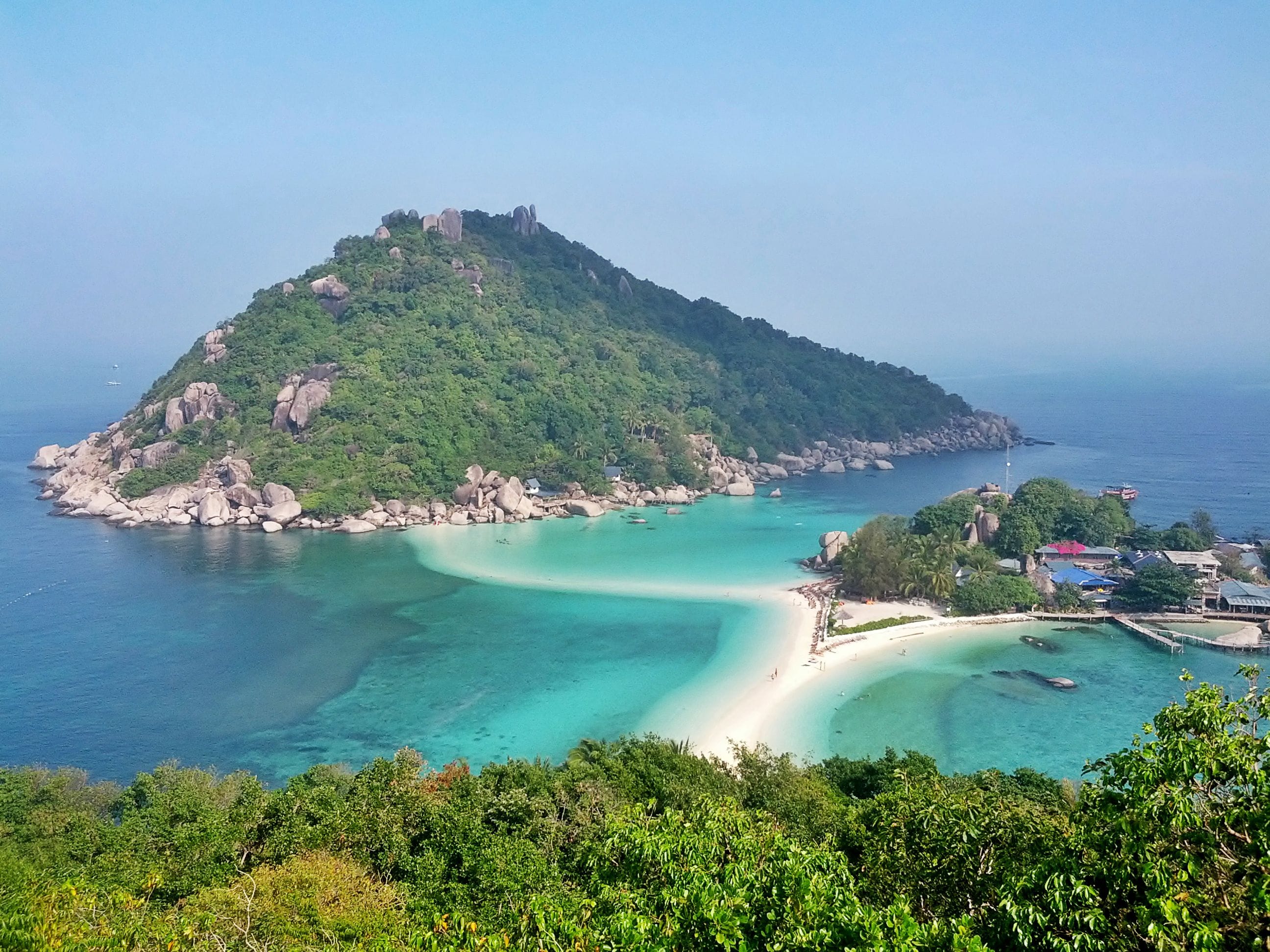
A Gulf of Thailand dive island with another side: a café scene grown around its divers and digital nomads — bright smoothie bowls, vegan plates, specialty coffee on Thai beans, fast-Wi-Fi work corners and early coffee before a dive around Sairee Beach and Mae Haad.
Most people know Koh Tao (เกาะเต่า) as Thailand's diving capital — a small island in the Gulf where people from all over come to get scuba-certified or freedive at some of the cheapest prices anywhere. What catches a lot of them off guard is the other side: a café and health-food scene bigger than the island's size would suggest. Picture a morning back from two dives, sitting at a café behind Sairee Beach with a brightly coloured tropical smoothie bowl and a flat white on Thai beans in front of you, the people around you divers and instructors who have settled in here for weeks. That's the reason Koh Tao's café scene is denser than an island this small ought to have.
Why did this scene grow here? The answer is the long-stay community — dive students, instructors and remote workers who base themselves for weeks or months while they work through their courses. With that many people based in one place, especially around Sairee Beach, the island's main beach, health-food cafés, smoothie-bowl spots, vegan kitchens and cafés set up with Wi-Fi and plugs for working all followed, until you can café-hop within walking distance. The other pole is Mae Haad, the main ferry town and the hub for dive shops, where specialty coffee shops, brunch places and local coffee shops in old shophouses sit side by side.
On the coffee itself, Thailand genuinely grows its own — arabica from the northern mountains around Chiang Rai and Chiang Mai, and robusta from the south around Chumphon, Ranong and Surat Thani, the same mainland coast this island sits off. Most specialty cafés here pull Thai-grown, Thai-roasted beans, and a flat white or a pour-over can match a big-city cup. Most drinks on the island run about ฿70–180 a cup and health plates about ฿140–280 — island-tourism prices, to be straight with you, but for an island with no airport that you can only reach by ferry, the range of cafés here is more than you'd expect.
On Koh Tao a café isn't just somewhere to drink coffee — it's part of a diver's rhythm: an early boat, a bowl back on land, a few hours of work, then sunset at Sairee Beach.
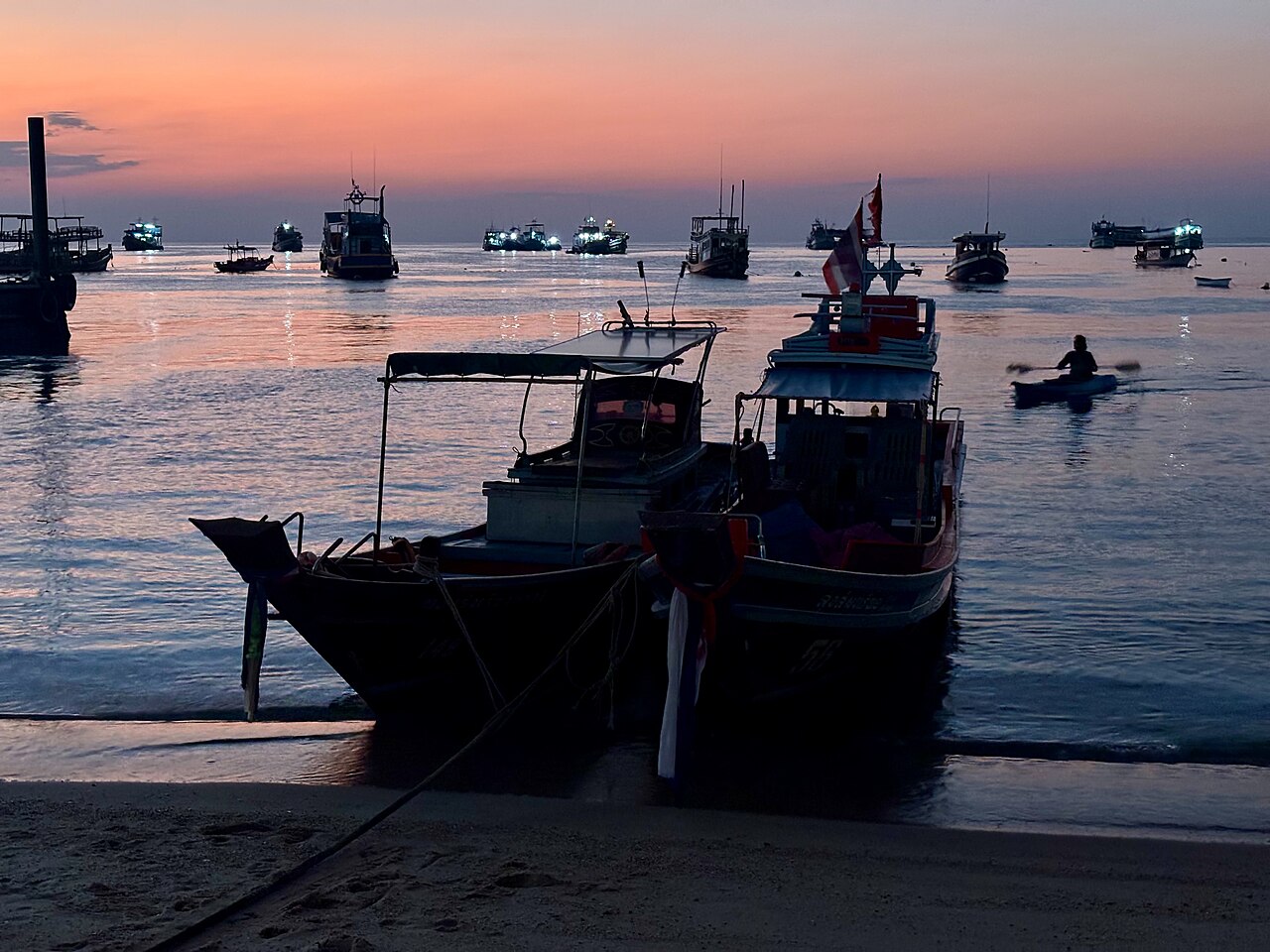
Sairee Beach at sunset — Koh Tao's main and busiest beach, where the café and dive crowds gather to close the day.
The heart of the café scene is Sairee Beach, the long west-coast beach that's the island's main strip and busiest area. Dive shops, stays, restaurants and cafés line up behind the sand, with health-food cafés, smoothie-bowl spots, coffee shops and laptop-friendly cafés all within walking distance of each other. Many open a sea breeze or tuck into gardens behind the beach. And because this is the west coast, it's the side where the sun actually sets into the sea in front of you — the beachfront cafés and bars along Sairee are where the whole area gathers to close the day.
The other pole is Mae Haad, the main ferry town where the boats come and go and the dive shops cluster. In town you'll find specialty coffee shops, brunch places and local coffee shops in old shophouses, all walkable, handy whether you've just stepped off a boat or are waiting for one. Chalok Baan Kao in the south is the quiet, dive-focused, slower-paced corner with a few good cafés of its own, and on the east-coast bays like Tanote Bay and the hillsides around the island there are view cafés scattered between them. If you're picking one base as a café lover, Sairee wins.
Get the types straight first, then decide whether today is about a health-food bowl, a work corner, a serious specialty cup, or a sea-facing seat looking west.
Koh Tao has a lot of divers, instructors and remote workers staying long-term, so the vegan and health-food scene is denser than an island this small should have, especially around Sairee Beach. Many places mark part of the menu vegan or vegetarian clearly, with dishes running from hot mains and salads to fruit bowls, alternative desserts and plant-based milks, built on local fruit and veg plus imported health-food staples. To be straight, prices sit above a regular Thai canteen — but for anyone who eats vegan or health-conscious and is on the island for several days, the range here makes it easy to eat well every meal.
The plate that's become Koh Tao's health-scene signature — thick-blended tropical fruit as a base, topped with mango, banana, shredded coconut, granola and seeds. Some places do acai and pitaya bowls in bright purple and pink, alongside fresh juices, plant-milk smoothies and cold-pressed juice. These spots sit mixed in with the vegan cafés around Sairee Beach and in Mae Haad. They make a great breakfast or light late morning back from two dives, when you're hungry but want something that won't weigh you down before the next thing. Bowls run about ฿140–240.
Koh Tao's serious-coffee scene grows every year. Around Sairee Beach and in Mae Haad you'll find shops brewing Thai-grown beans — arabica from the Chiang Rai and Chiang Mai mountains, and at some shops a quality robusta from the south around Chumphon and Ranong, the mainland coast just across from the island. A flat white, a pour-over or a cold brew here can match a big-city cup, and many roast their own or pick beans from Thai roasters with clear origin labelling. It costs less than the beachfront cafés, and these shops tend to have plugs and Wi-Fi, so they double as work corners for long-stayers. If you want genuinely good coffee at a fair price, this is the group to look for.
Koh Tao has become a base for remote workers who stay while training or working in diving, so this group of cafés is built for long sittings — faster-than-average Wi-Fi, plugs at the tables, air-conditioned or open-roof seating that catches the breeze, and no pressure on how long you stay. Some are café-plus-co-working spaces charging a day rate with unlimited coffee, with long shared desks and quiet corners for video calls, clustered around Sairee Beach and Mae Haad. To be straight, this is a small island in the sea — power and internet can drop out at times, especially on the remote bays and in the monsoon. For an important call or a big upload, stick to a spot in these two areas and ask about a backup connection first.
Koh Tao's interior is green hill and the coast is a string of small bays, so a lot of cafés open a view from the slopes over the sea and the bays in the distance. Beach cafés that set beanbags on the sand run along the beaches too, especially the west coast around Sairee Beach, the island's sunset side. Many pour coffee and smoothies by day and turn into sunset bars in the evening, since this is the side where the sun drops straight into the sea. The drinks to order are anything iced and a fresh young coconut. The trade-off for the hillside or far-flung bays is the access — many roads on the island are steep, rough and partly dirt, covered in the getting-around section below.
In Mae Haad, the island's main ferry town, local coffee shops in the shophouses still brew coffee the southern way — dark-roasted, strained through a cloth sock, poured over sweet condensed milk at the bottom of the glass, the style southern Thais call kopi (kafae boran). Hot with a fried dough stick in the morning, or iced and black as an oliang once the day heats up. These shops run about ฿25–60 a glass, several times cheaper than a health-food café, and the bonus for divers is that many open early enough to catch a boat leaving around 6:30–7:30am. The scene is plain tables and locals talking through the morning — the island's oldest coffee flavour, the cup people here actually drink. Mae Haad also mixes in newer specialty shops and brunch places, so you can choose within one town.
Four areas every coffee-and-health-food lover should know — each one a different experience.
Sairee Beach is the main beach and the centre of the island's health-food and digital-nomad scene. Vegan cafés, smoothie-bowl spots, coffee shops and laptop cafés sit close together within walking distance, so you can café-hop all day without a vehicle. Many open a sea breeze or tuck into gardens behind the beach, and because this is the west coast, the evening brings the sun setting straight into the sea — finish the day at a beach café or bar right here. If you pick one area as a café and health-food lover, this one wins.
Mae Haad is the main ferry town where the boats arrive and the dive shops cluster, and the best-stocked place after Sairee. In town you get specialty coffee shops, laptop cafés, brunch places and local coffee shops in old shophouses all mixed together, walkable without a vehicle — good for a big plate before a boat, or a stop while you wait. The bonus for divers is that some coffee shops and bakeries open early enough for an early boat, and it's the easiest place on the island to find an ATM and a convenience store.
Chalok Baan Kao on the south of the island is quieter and slower than Sairee, leaning toward divers and anyone who wants to step out of the busiest part. It has a few regular cafés and restaurants around the bay — coffee shops, brunch spots and view places looking out over the bay and the small islands offshore. It suits anyone staying down here, or a stop after the walk up to the John-Suwan viewpoint in the south. There are fewer options than Sairee and Mae Haad, but it's clearly calmer — a good area if you want good coffee without being in the busiest part.
Tanote Bay on the east and the small bays around the island are quiet corners people come to for snorkelling and calm, with a few cafés and stay restaurants on the bay. View cafés on the hillsides islandwide open a look over the sea and the bays in the distance, good for a long afternoon away from the bustle — but options are few and spread out. The trade-off is the access: the roads to the east-coast bays and up the hills are steep, rough and partly dirt. The surer way is to charter a ride or a longtail and arrange a pick-up time; don't force a scooter up unless you're genuinely experienced.
Cafés open and close fast on Koh Tao, so rather than name a shop that may have shut, we point you to the type to look for in each area — always check the latest map listing and reviews before you go.
Look for a café that marks vegan or plant-based dishes clearly in the Sairee Beach area. Most sit behind the beach or in gardens, quiet and shaded, with menus running from vegan mains and salads to fruit bowls, alternative desserts and wellness drinks like plant milks and fresh juices. Mains run about ฿140–280. To be straight, places like this sometimes close seasonally or move — check the latest map listing and reviews before you go. If the one you had in mind is shut, Sairee has several more of the same kind within walking distance.
The places known for smoothie bowls and fresh juices usually sit among the vegan cafés around Sairee Beach and in Mae Haad. Order an acai bowl, a bright pitaya bowl or a plant-milk smoothie as a breakfast or light late morning back from a dive, with fresh and cold-pressed juices the standard drink of this group. Bowls run about ฿140–240. The upside is a light meal that won't weigh you down before an afternoon dive or a day out. Pick one with fresh fruit and good reviews, since quality varies a fair bit between shops.
In Mae Haad and Sairee Beach, look for a specialty shop brewing Thai beans that's set up for working — usually air-conditioned or with an open roof for the breeze, plugs at the tables, and faster-than-average Wi-Fi. Order a good flat white, pour-over or cold brew at about ฿80–150. Some are café-plus-co-working spaces with long desks and a day rate that includes unlimited coffee, good for remote workers who need a stable connection. For a call or a big upload, stay in these two areas — internet on the remote bays and in the monsoon can be unreliable.
Koh Tao's interior is hill and the east coast is a string of quiet bays, so cafés and view spots open a look over the sea and the bays from the slopes, offering quiet that the busy beach can't. Good for a long afternoon away from the bustle. The trade-off is the access: the roads up the hills and to the east-coast bays like Tanote are steep, rough and partly dirt, so ride a scooter up only if you're genuinely experienced and stay off wet roads. The surer way is to charter a ride or a longtail up and arrange a pick-up time — and check it's open, as places like this run seasonally.
Not a single café but the run of beachfront cafés and bars along Sairee Beach on the island's west coast — many set beanbags, low wooden tables and umbrellas on the sand. Order a coffee, a smoothie or a fresh coconut by day and listen to the water; by evening many switch to sunset bars, because Sairee is the west-coast side where the sun drops straight into the sea. Drinks run about ฿100–220. The strength of this strip is zero planning and no long trip — walk the sand, pick a spot, and stay until the light is gone. It's the most natural way to close a day back from the dive.
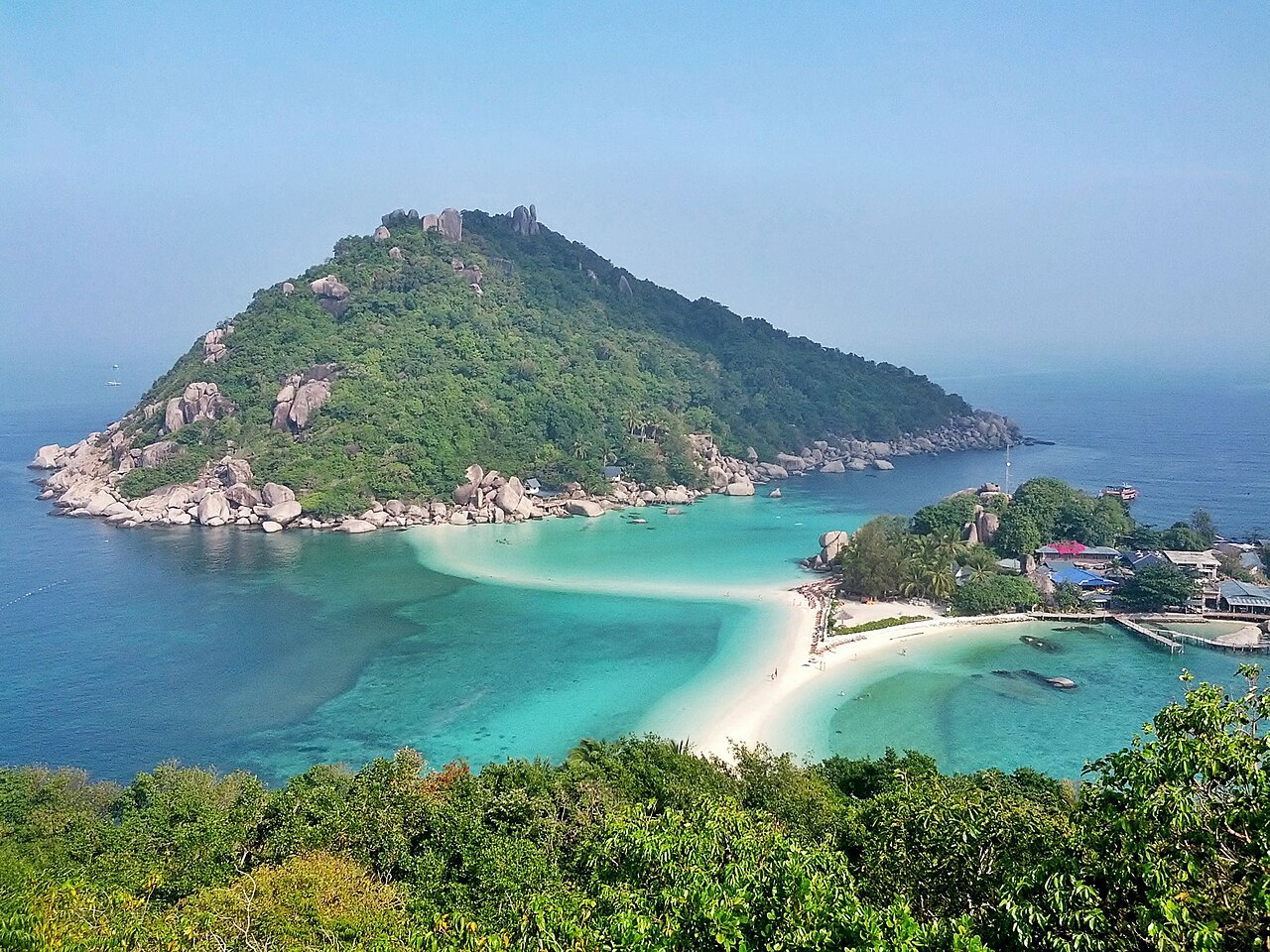
Koh Nang Yuan — the viewpoint and a popular boat trip from Koh Tao, one to slot between café days and dive days.
Four cups and plates that tell the whole Koh Tao café story — from the modern health-food scene to the southern coffee roots.
The plate that sums up Koh Tao's health-food scene in one bowl — thick-blended tropical fruit as the base, topped with mango, banana, shredded coconut, granola and seeds, arriving as a full-colour bowl. Some places do acai and pitaya bowls in bright purple and pink. It's refreshing and light enough to sit well back from two dives. Order it with a fresh coconut or a juice and take the late morning slowly. It runs about ฿140–240 a bowl, and you'll find it at the health-food cafés around Sairee Beach and in Mae Haad.
The standard light drink of the island's health-food set — fresh-blended tropical juices and cold-pressed fruit and vegetable juices that lean on fresh produce with no added sugar. Many cafés also do fresh coconut, orange juice and plant-milk smoothies in several recipes. Drink one with a health-food breakfast or to rehydrate through the day after diving in the sun, at about ฿70–140 a glass. It's the alternative to coffee for anyone who wants something light, and it fits the slow health-food rhythm a lot of Koh Tao visitors like. Find it at the vegan cafés and juice bars around Sairee Beach.
The cup that measures a specialty shop — a flat white with thin, silky milk over an espresso shot pulled from Thai beans, mostly arabica grown in the northern mountains, with some shops offering a quality southern robusta to compare. You get a clear coffee flavour with no sugar needed. If you prefer it black, try a pour-over or the bottled cold brew many shops keep ready. It's the natural partner to a brunch plate or a working session, at about ฿80–150, around Sairee Beach and in Mae Haad.
Two cups that are the island's roots — a fresh young coconut cracked open by the beach is the simplest, cheapest cooler there is, at about ฿40–100 depending on where you sit, and sipping it in the shade of a palm is the classic southern-island picture. And kafae boran in Mae Haad is the coffee islanders drank before the café era — dark-roasted, strained through a cloth sock, poured over sweet condensed milk, hot with a fried dough stick, or iced and black as an oliang. At about ฿25–60 a glass it's several times cheaper than a health-food café, and many shops open early enough to catch the dive boat — and it tastes like nothing on a modern café menu.
On coffee before an early dive: most dive boats leave very early, around 6:30–7:30am, when many health-food cafés and brunch places aren't open yet. But around Mae Haad and Sairee a few coffee shops, convenience stores and bakeries open early enough to catch a boat. The sure move is to ask the opening hours of the place you have in mind in advance, or buy a coffee and a pastry the evening before. Many dive shops already lay out coffee, tea or water at the morning meeting point. If you want serious specialty coffee, save it for after the dive in the late morning, when the cafés are all open and the mood is best. For data to navigate between cafés, see our Thailand SIM & eSIM guide.
On paying: local coffee shops and small cafés take cash and Thai PromptPay QR first — and PromptPay needs a Thai bank account, so foreign visitors should always carry cash. Health-food cafés and brunch places aimed at international visitors in Sairee and Mae Haad mostly take cards, though some set a minimum spend. Keep notes on you especially for the remote bays and hillside cafés. One thing to know: ATMs are fewer than on the mainland and charge a fairly steep per-withdrawal fee, so withdraw ahead or take out larger amounts at once to save. The other thing: the most genuine isn't the most expensive — a sock-filtered kopi in Mae Haad gives you a flavour and a scene the health-food cafés can't, at less than a third of the price. Try to collect both worlds.
On getting around: Koh Tao has no airport — access is by ferry only, from Chumphon on the mainland (fastest from Bangkok via an overnight train or bus, then a boat), Koh Samui, Koh Phangan or Surat Thani, landing at Mae Haad pier. On the island there are no public buses; your options are songthaews running by day (pricey for the far bays), walking the Sairee–Mae Haad stretch, which are within reach of each other, and rented scooters or quads, which need real care. To be straight, many of Koh Tao's roads are genuinely steep, rough and partly dirt, and the tracks up to the viewpoints and out to Tanote and Chalok are notorious for tourist accidents. Watch for inflated damage charges too — photograph the bike before you take it, rent from a shop you trust, and keep your passport on you. Plenty of people just walk and take songthaews or boats instead. The full how-to and the boat trips are in our Koh Tao travel guide. On the seasons: diving and weather are best around March–September, while October–December gets rough with some cancelled boats, though diving usually still runs year-round. In the monsoon, rain tends to come in bursts — keep a laptop café as the rainy-afternoon plan.
The Gulf of Thailand around Koh Tao — staying around Sairee Beach or Mae Haad is the easiest way to reach the cafés, health-food spots and the beach on foot.
Staying around Sairee Beach suits café and health-food lovers, while Mae Haad is handy for dive shops and getting around — both put you within walking distance of cafés and health-food spots, no ride needed for every meal.