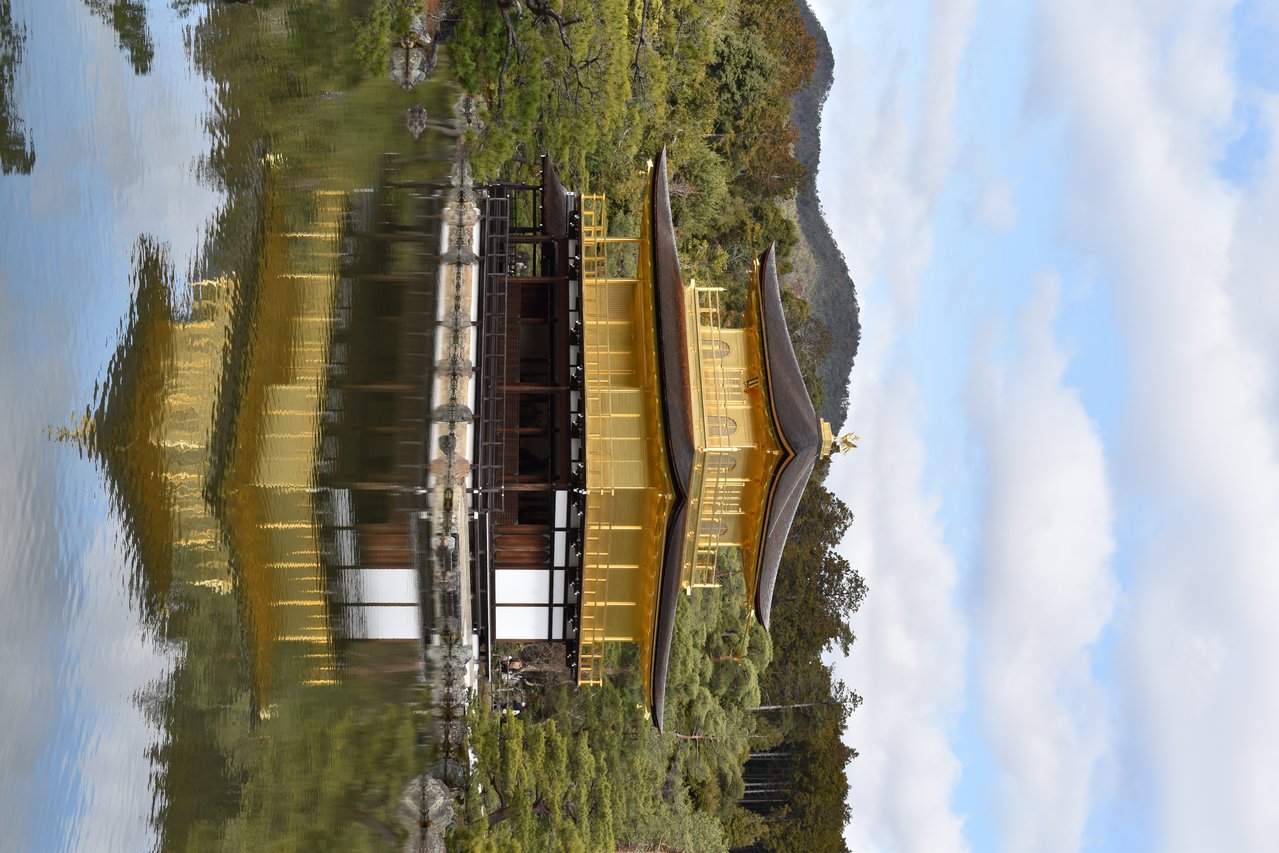
A three-storey pavilion whose top two floors are clad in real gold leaf, floating above the mirror-flat Kyoko-chi pond — the Zen temple everyone recognises the instant they see the photo. Just ¥500 to enter, open every day.
Picture this: you walk through the temple gate, follow the path round a bend, and the view suddenly opens onto something you have only ever seen on a postcard — an entire golden pavilion standing at the edge of a pond, its top two floors sheathed in gold leaf catching the light, its reflection thrown down onto water so still it forms a perfectly symmetrical twin. Dark green pines ring the pond, the sky is clear, the gold glows, the water holds steady — everything comes together in a single frame.
That is Kinkaku-ji (金閣寺), officially named Rokuon-ji, a Rinzai Zen temple in the Kita ward in Kyoto's northwest. The building first went up in the late 14th century as the retirement villa of the shogun Ashikaga Yoshimitsu, before becoming a Zen temple according to his will. The pond in front, called Kyoko-chi (鏡湖池) — literally "Mirror Pond" — was designed with small islands and carefully placed rocks in the Zen garden tradition, all so the pavilion's reflection would be as flawless as possible.
What a lot of people do not realise is that the pavilion you see today is not the original building. The old one was burned to the ground by a young monk who set fire to it in 1950 (the event Yukio Mishima turned into his famous novel). The present structure was rebuilt in 1955, and a 1987 restoration added gold leaf many times thicker than before. Today Kinkaku-ji is part of a UNESCO World Heritage Site and one of the first images the world pictures when it thinks of Kyoto.
The path through the temple is a single loop around the pond, about 30–45 minutes one way — and every corner tells a different story.
The moment you step in from the entrance, you reach the most complete view of the golden pavilion across the pond. Each of the building's three floors is a different architectural style, and a golden phoenix sits atop the roof. On a calm morning, when the water surface is at its smoothest, you get the pavilion and its reflection in perfect symmetry. You cannot go inside the building — it can only be admired from the far side of the pond.
Kyoko-chi pond is dotted with little islands and rocks arranged in the Zen garden tradition, each one with a name and a meaning — some were gifts from nobles of the day. A few of the trained pines around the pond are hundreds of years old. Walk it slowly and you start to see how everything was placed to frame the golden pavilion from a dozen different angles.
Climb the slope behind the pavilion and you reach a small waterfall with a rock standing in the middle of the stream, known as the "carp stone." It references the Chinese legend that a carp able to swim up over the dragon gate becomes a dragon — a symbol of perseverance and success. Most people walk straight past, but stop to look and you catch the detail of a Zen garden that was very deliberately designed.
A little further up you come to a small teahouse named Sekkatei, built in the Edo period. Its name means "the house of evening light," because this is the spot where you see the golden pavilion bathed in orange light in the late afternoon. The plain sukiya architecture is a textbook example of Zen aesthetics, in clear contrast to the opulence of the golden pavilion itself.
Near the exit there is a small hall called Fudo-do, which enshrines the deity Fudo Myo-o; people come here to light incense and make a wish. There is also a tea spot where you can sip matcha with a Japanese sweet while looking out over the garden. The walk finishes at a souvenir shop selling charms and golden-pavilion-themed keepsakes — and you can keep the temple's paper omamori ticket as a memento.
If we had to pick one time, we'd go for 9am, just as the temple opens. In the first 30 minutes the crowds are still thin and the morning breeze hasn't picked up, so the pond surface stays at its flattest and the golden pavilion's reflection on the water is at its sharpest and most symmetrical. The low, angled morning light also makes the gold leaf glow brighter than it does under the flat overhead sun of midday.
The temple is busiest between 10am and 3pm, when the tour groups and day-trippers all arrive at once. If you miss the morning, the other lovely window is late afternoon, around 4pm, just before closing, when the slanting evening light turns the pavilion a deeper amber-gold.
Autumn leaves in late November are the peak. The maples around the pond turn a blazing red against the gold of the pavilion and the green of the pines, and the reflection on the water becomes a three-colour scene you can only catch for a few weeks a year — though it is also the busiest time. Come on a weekday morning if you can.
And winter, with snow on the golden roof, is what many people call the most beautiful view in Kyoto: the white of the snow against the gold and the green is an image that stays with you. But it only snows a few times a year in Kyoto, so it comes down to luck and a flexible itinerary. Spring and summer are gorgeous too in their own fresh-green way — honestly, it's a comfortable visit in any season.
The main photo spot is on the opposite side of the pond, right as you walk in. Compose with the golden pavilion filling the top half of the frame and its reflection on the water filling the bottom half, so you get the symmetry. If you've come in a group there'll be a queue to stand and shoot here — be patient, your turn will come soon enough.
A wide-angle lens lets you capture both the pavilion and the pines around the pond in a single frame, while a zoom lens is good for catching the detail of the golden phoenix on the rooftop. A clear, windless day is the day you get the sharpest reflection — go ahead and check the weather forecast before you set out.
Kinkaku-ji has no train station right beside it. The main way there is the Kyoto City Bus, which runs direct from in front of Kyoto Station.
The names are so similar that people confuse them all the time, but they're two different temples on opposite sides of the city. Know this before you board the wrong bus.
In the northwest of Kyoto, with a building clad in real gold leaf, built by the shogun Ashikaga Yoshimitsu in the late 14th century. The highlight is the golden pavilion mirrored on the glass-still pond — an opulent, dramatic scene. This is the temple this page is about.
In the east of Kyoto, along the Philosopher's Path, built by Ashikaga Yoshimasa, the grandson of the man who built the Golden Pavilion. Despite the name "Silver Pavilion," it was never actually clad in silver — it leans into quiet Zen restraint, with a stunning sand garden and moss garden. It's an entirely different mood from the Golden Pavilion.
If you want to see both on one trip, allow time to cross the city, because they're on opposite sides. We'd suggest doing them on different days, or in different halves of the day, to keep it comfortable.
Keep going on the western side, or head back into town for an easy bite and a comfortable place to stay.