Home Nan Thailand Nan Hotels About
Home  ›  Asia  ›  Thailand  ›  Nan  ›  Getting Around
🛺 Nan Transport Guide · 2026

Getting Around Nan
A Walkable Town — But the Mountains Need Wheels

Nan's old town is so small and flat that Wat Phumin, the museum and the Walking Street are all within walking distance — by foot, bicycle or an easy scooter. But the best bits, like Doi Phu Kha, Bo Kluea, Pua and Ban Sapan, sit far out on mountain roads, so you'll want a rental car or motorbike, or a tour or private driver. This guide covers every way, with an honest note on the mountain roads and fuel.

Before you go

A small valley town that's walkable — but the best bits are in the mountains

If you're used to hopping on a metro or calling a Grab to get anywhere, here's the first thing to know: Nan has no train, no metro/BTS/MRT, and Grab is essentially unavailable. Nan is a small town in a river valley that moves at a slow, easy pace. Most people arrive by flying into the small Nan Nakhon Airport from Don Muang, or by bus or van from Bangkok or Chiang Mai. Once you're here, getting around splits neatly into two worlds: everything in town is within walking distance, while the mountains need a vehicle.

The most important thing to grasp from the start is this: Nan town is so small that walking or a bicycle covers it, but Doi Phu Kha, Bo Kluea, Pua and Ban Sapan sit far out on mountain roads. In the old town you have Wat Phumin, the Nan National Museum, Wat Phra That Chang Kham and the Walking Street, all easy to explore on foot. But to reach the rice terraces around Pua, the mountain rock-salt wells at Bo Kluea, or the mist over Doi Phu Kha, you'll need a rental car or motorbike, or a tour or private driver — because public transport out that way is very limited.

This guide walks through every way to get around Nan — from walking and cycling the old town, to renting a car or motorbike for the mountains (with an honest note on the roads and fuel range), through tours and chartered cars for those who'd rather not drive — then helps you match your transport to your style before you leave your accommodation. Nan is most fun when the way you travel fits exactly what you want to see.

In the town centre

Walking, cycling and an easy scooter — a small old town that's all within reach

Wat Phumin, the museum and the Walking Street are all on foot — in town you barely need a vehicle, and that's part of Nan's charm.

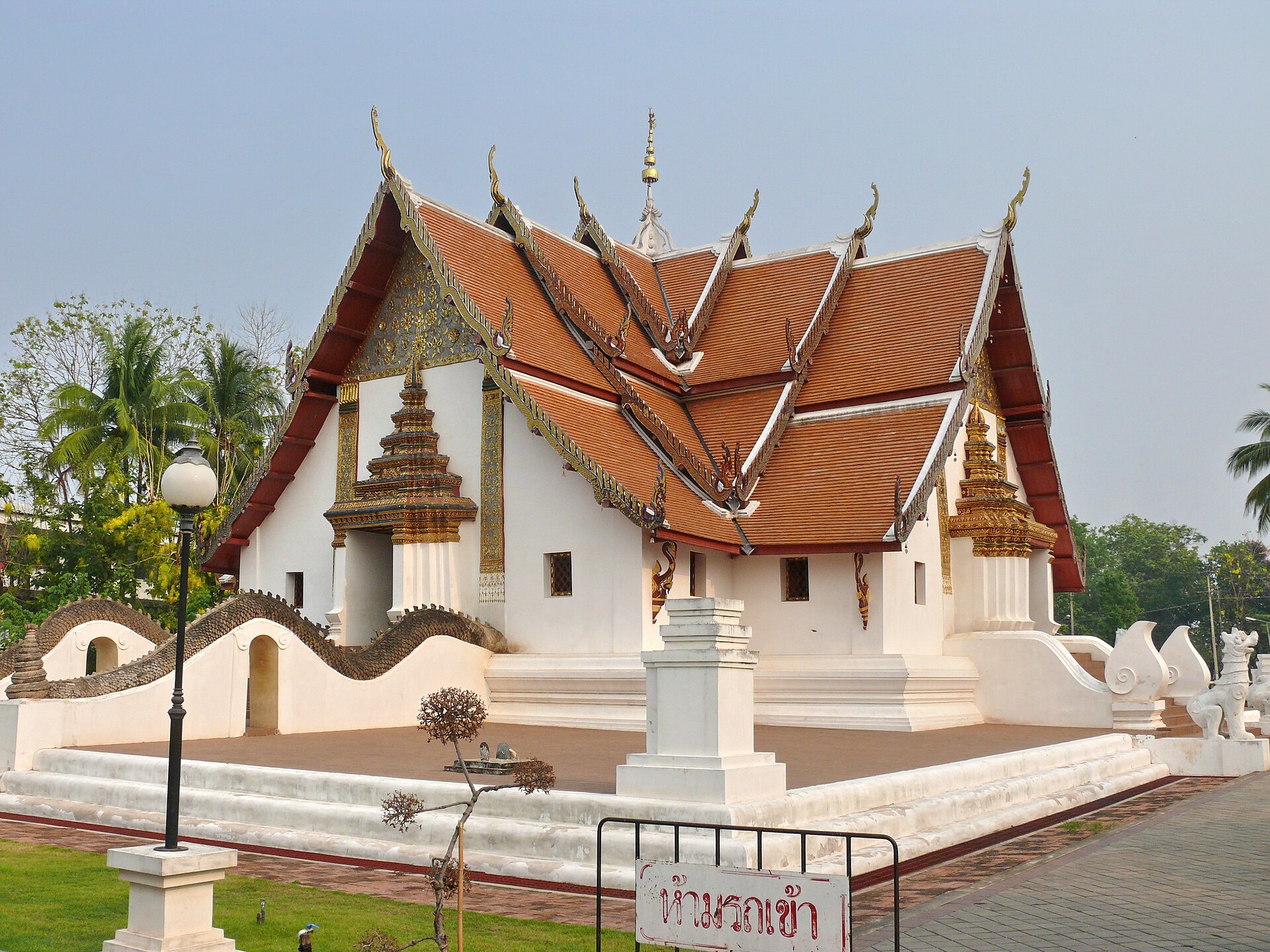
Nan's old town is small and flat, so much of it needs no engine at all. If your accommodation is in the old town or near Wat Phumin, your own two feet are plenty. Wat Phumin with its "Pu Man Ya Man" whispering-lovers mural, the Nan National Museum (home of the black elephant tusk), Wat Phra That Chang Kham, the frangipani-tree tunnel, restaurants and cafés all sit within walking distance of each other, and you can stroll the Nan riverside for the breeze. On weekend evenings the Nan Walking Street offers local food and khantoke dinners on foot. This is Nan's pace, the kind big cities just don't have.

🚶
Walking

You can cover Nan's old town in minutes — Wat Phumin, the museum, the Walking Street, restaurants and cafés sit close together. On weekend evenings the Walking Street opens for a stroll and local food.

🚲
Bicycle

Many guesthouses lend or rent bicycles cheaply. Potter around the old town, the temples and along the Nan River with ease — ideal if you'd rather not ride a motorbike but still want wheels.

🛵
Scooter rental

A cheap rental scooter is easy in town and handy for the short climb up to the Wat Phra That Khao Noi viewpoint, or out to Wat Phra That Chang Kham and Chae Haeng just outside the centre.

🛺
Local ride / charter

Flag a local ride or charter a car with driver for sights in and around town — ask your accommodation to help; the price depends on distance and the number of people, so agree it first.

Honestly, if you plan to stay in the old town or near Wat Phumin, you barely need a vehicle for sightseeing in town — you only need real transport when you head out to Doi Phu Kha, Bo Kluea, Pua or Ban Sapan. The Wat Phra That Khao Noi viewpoint sits on a hill just outside town, so a scooter or a ride up is easier than walking. Pick a base that matches your style in our where to stay in Nan guide.

Heading to the mountains — your main option

Renting a car or motorbike — the key to Doi Phu Kha, Bo Kluea, Pua and Sapan

The freest way to see the outlying sights — but these are steep, winding mountain roads with petrol stations far apart, so prepare and keep a fuel buffer.

When you head out of town and up into the mountains, the thing that gives you the most freedom is a rental car or motorbike, because Doi Phu Kha, Bo Kluea, Pua and Ban Sapan are spread out far apart with no regular public transport to use easily. A rental lets you travel at your own pace — stopping at the rice terraces around Pua, sampling the arabica coffee grown on the hills, watching brine boiled into rock salt at Bo Kluea, and climbing up for the cool air on Doi Phu Kha, all in one trip. But before you decide to rent and drive yourself, there's an honest conversation about the mountain roads to have first.

🚗
Car rental
easiest for the mountains · good for families

A sedan or SUV is the most comfortable way up to Doi Phu Kha and Bo Kluea. It keeps the sun and rain off, seats everyone comfortably, and is safer than a motorbike on winding roads. You can rent at Nan Airport or in town, and some firms deliver to your accommodation — ideal if you're travelling with several people, kids or older relatives, or you'd rather not risk two wheels on the mountains.

Tip: use a low gear on the descents so the brakes don't overheat, allow extra time because the winding roads are slower than usual, and fill up before you leave town or Pua, since petrol stations up in the mountains are scarce.

Good for: Doi Phu Kha / Bo Kluea · groups, kids, older relatives
Rent at: Nan Airport · in town (some deliver to your stay)
You'll need: a licence · credit card/deposit · extra time for the curves
🏍️
Motorbike rental — free, but you must ride well
read the mountain-road note first

A motorbike gives the most freedom and atmosphere for confident riders, but be honest: the roads up to Doi Phu Kha and Bo Kluea are steep, winding and run for tens of kilometres, with quiet stretches and petrol stations far apart. You'll want a bike with enough power (125–150cc or more is sensible), always fill the tank before you set off, and keep a fuel buffer. Wear a helmet every time.

Most important of all: if you've never ridden long or mountain roads, or you're not confident, don't force it. Doi Phu Kha is not the place to learn. Check the brakes and tyres before you go, and slow right down in the rain, when the roads turn slippery and the occasional landslide can occur. If you're not sure, a rental car or a tour/chartered car is far safer.

Hard rules: helmet · fill up before the climb · slow down in the rain
Check before renting: brakes, tyres, lights · enough power (125–150cc+)
Not confident: don't force it — rent a car or take a tour
The fuel question on the mountains — to be clear: the routes up to Doi Phu Kha, Bo Kluea and into Ban Sapan are long mountain roads where big petrol stations are far apart, and some stretches have only small roadside or village pumps. Always fill the tank before you leave Nan town or Pua, and don't let it run too low — keep a buffer for both the climb and the way back. The same rule applies whether you're driving a car or a motorbike. Budget for the rental and fuel in our Nan first-timer guide.
Other options

Tours, chartered cars and the Grab question

🚐
Day tours — for non-drivers
several stops in one trip · a driver who knows the roads

A tour is the most comfortable choice if you'd rather not drive. Nan tours are usually run as full days bundling several stops — a Doi Phu Kha and Bo Kluea route, a Pua route with the rice terraces and Tai Lue weaving villages, or a temple route around town — with a car and a driver used to the mountain roads covering it all, so you don't have to think about routes or fuel. Handy if you're short on time or just want an easy day.

Around February, when the Chompoo Phu Kha trees bloom pink, day tours up Doi Phu Kha are especially popular. Book ahead on Klook or have your accommodation arrange one. See the outlying sights in our things to do in Nan guide.

What's included: car + driver + several stops (some include a meal)
Popular routes: Doi Phu Kha–Bo Kluea · Pua rice terraces · town temples
Book via: Klook · your accommodation · agencies in town
🚙
Chartered car with driver
charter by the day · more flexible than a tour

Chartering a van or car with a local driver is more flexible than a group tour, because you set the stops and the timing yourself. The driver knows the Doi Phu Kha and Bo Kluea mountain roads and drives them with ease — ideal for a family or group who want to linger over the rice terraces at Pua, or travel several days in a row.

The easiest way is to have your accommodation arrange the ride, since local drivers know the spots and the standard fares. The price depends on distance, the number of days and the number of people, so agree the route and fare clearly before you set off. With a few people splitting it, it works out well and you avoid the risk of driving the winding roads yourself.

Good for: non-drivers · families/groups · multi-day trips
Price: by distance + days + number of people — agree first
Tip: let your accommodation arrange a local driver who knows the mountains
📵
Grab — essentially unavailable in Nan
don't plan to rely on Grab

Up front: Nan has no reliable Grab service the way Bangkok or Chiang Mai does. A car might occasionally turn up in town, but you can't count on it and there's often no driver to accept the ride — and out toward the mountains you can't get one at all. Don't plan your travel around Grab in Nan.

What actually works is walking and cycling in town, renting a car or motorbike, or hiring a local ride or chartered car with driver — and having your accommodation arrange a ride when you need to reach somewhere further out. Planning your transport ahead is much less stressful.
Grab status: essentially unavailable — don't rely on it
Use instead: walk/cycle in town · rental car · charter/tour
Tip: let your accommodation arrange a ride for the mountains
The town of Nan in its river valley — a small old town reached by flying into Nan Nakhon Airport, or by bus and van from Bangkok and Chiang Mai Getting to Nan
Reaching Nan = flight or bus
Nan Nakhon Airport · no train to Nan

To be clear: Nan has no train running to it. The nearest railway is Den Chai station in Phrae province, from where it's about a 2-hour bus or van on to Nan. So most people fly into the small Nan Nakhon Airport (NNT) from Don Muang (about 1 hr 15, a few daily), or take a bus/van from Bangkok (around 10–11 hours) or Chiang Mai (around 6 hours via Phrae, on a winding road — bring a tablet if you get carsick).

Once you're in Nan, walking, a bicycle or a scooter is enough in town, while reaching the mountains means renting a car or motorbike, or taking a tour or chartered car. See every way to arrive in our getting to Nan guide.

Flight: Don Muang → Nan Nakhon ~1 hr 15 · a few daily
Bus/van: Bangkok ~10–11 hr · Chiang Mai ~6 hr
None of these: a train to Nan (nearest rail = Den Chai, Phrae)
Driving up the mountains in the rainy and burning seasons — take care: in the rainy season, around June to October, the mountain roads up to Doi Phu Kha and Bo Kluea turn slippery and muddy in places, and the occasional landslide closes a route, so drive slower and allow extra time (though the Pua rice terraces are greenest around August to October). In the burning season, around March to April, it gets hot and crop-burning haze blankets the north, so the mountain views can turn murky — check an AQI app before you set off and carry a mask. The most comfortable season for driving and sightseeing is the cool months, November to February (the Chompoo Phu Kha blooms around February), but the early mornings up in the mountains get genuinely cold, so put on a warm layer before you set off. See the seasons in our best time to visit Nan guide.
The most important thing about getting around Nan

A walkable town — but the best bits are in the mountains, so you need wheels

This is what makes planning a Nan trip different from a big city, and it's worth understanding before you decide whether to drive yourself.

If you remember one thing from this page, make it this: Nan town is all within walking distance, but the highlights people come for are in the mountains. In town there's Wat Phumin, the museum, the Walking Street and the Nan riverside to explore on foot — but Doi Phu Kha, the Bo Kluea rock-salt wells, the rice terraces around Pua and Ban Sapan all sit far out on mountain roads, tens of kilometres away, with no regular public transport. That's exactly why people rent a car or motorbike, or charter a car or tour if they don't drive.

The town of Nan in its river valley — a small old town easy to explore on foot, while Doi Phu Kha, Bo Kluea and the Pua rice terraces lie far out on mountain roads needing a vehicle
Nan in its river valley — the old town is walkable, but the best bits like Doi Phu Kha, Bo Kluea and the Pua rice terraces sit far out on mountain roads, so you need wheels to reach them.
Distance + how to get there

From Nan town to each place

Destination Distance + how close How to get there
Nan old town (Wat Phumin / museum) In town · walk / bicycle Wat Phumin · the museum · the Walking Street — all within walking distance
Wat Phra That Khao Noi (town viewpoint) On a hill just outside town · close Scooter · chartered ride (easier than walking up the hill)
Wat Phra That Chae Haeng (gold chedi across the river) Just outside town · close Scooter · car · chartered ride
Pua (rice terraces / Tai Lue villages) Further north · on the highway Car/motorbike (easiest) · chartered car · tour
Doi Phu Kha / Bo Kluea / Ban Sapan Far · on winding mountain roads · allow time Rental car/motorbike · tour/chartered car (fill up first)
How to plan around your own style: if you can drive a car or ride a motorbike safely, one rental covers both the town and the mountains at your own pace (always fill up before the climb). If you don't drive, explore the town on foot and by bicycle, then make Doi Phu Kha–Bo Kluea and Pua a separate day by tour or chartered car with driver. See how to lay out your days in our Nan 3-day itinerary and things to do in Nan.
The real tip

Decide two things and Nan gets easy

If we had to boil it down to two points: one — ask yourself honestly whether you'll head up to Doi Phu Kha, Bo Kluea and Pua, and whether you'll drive yourself. If you can drive a car or ride a motorbike confidently, renting one is the freest, best-value way to see Nan — but fill up before the climb, allow extra time for the winding roads, and slow down in the rain. If you've never driven mountain roads or you're not confident, don't force it, because the road up Doi Phu Kha is steep and long. Use a tour or a chartered car with driver instead — you'll see the same sights, far more comfortably.

Two — pick a base that matches how you'll get around. If you're focused on the temples and the Walking Street, staying in Nan's old town lets you explore on foot with barely any vehicle. But if you're focused on the rice terraces and the mountains, staying around Pua puts you closer to Doi Phu Kha and Bo Kluea. Sorting this before you book your accommodation saves a lot of hassle.

For first-timers in Nan: you reach Nan by flying into the small Nan Nakhon Airport from Don Muang (about 1 hr 15), or by bus/van from Bangkok (around 10–11 hours) or Chiang Mai (around 6 hours) — there's no train to Nan (the nearest railway is Den Chai in Phrae) — see every way to get there in our getting to Nan guide, and start planning at our Nan first-timer guide.
Frequently asked questions

FAQ · Getting around Nan

Do I need a car or motorbike to visit Nan?
It depends where you're going. If you only explore Nan town — Wat Phumin, the Nan National Museum, Wat Phra That Chang Kham and the Walking Street — the town is so small that walking or a bicycle covers it, and you don't need a vehicle. But to reach Doi Phu Kha, Bo Kluea, Pua or Ban Sapan, which sit far out on mountain roads, you need a rental car or motorbike, or a tour or chartered car with driver, because songthaews and public transport out to the mountains are very limited and impractical for sightseeing stop by stop. See the sights in our things to do in Nan guide.
Is Nan town walkable?
Easily. Nan's old town is small and flat — Wat Phumin, the Nan National Museum (home of the famous black elephant tusk), Wat Phra That Chang Kham, the frangipani-tree tunnel, restaurants, cafés and many guesthouses are all within walking distance of each other, and you can stroll along the Nan River too. On weekend evenings the Nan Walking Street offers local food on foot. If your accommodation is in the old town, you barely need a vehicle, and you can rent a bicycle to potter around. The Wat Phra That Khao Noi viewpoint sits on a hill just outside town, so a scooter or a ride up is easier than walking. Compare areas in our where to stay in Nan guide.
If I don't drive, how do I reach Doi Phu Kha or Bo Kluea?
By a tour or a chartered car with driver, because songthaews and public transport out to Doi Phu Kha, Bo Kluea and Pua are very limited and not practical for sightseeing stop by stop. Non-drivers usually book a day tour that bundles several stops into one trip, or charter a van or car with a local driver used to the mountain roads. The price depends on distance and the number of people, so ask your accommodation to arrange a ride, or book a tour ahead on Klook. With a few people splitting it, it works out well and is far less stressful than driving the winding roads yourself.
Is it safe to ride a motorbike up to Doi Phu Kha and Bo Kluea?
If you're a confident rider and well prepared, yes — and it's a very free way to travel. But be honest with yourself: the roads up to Doi Phu Kha and Bo Kluea are steep, winding mountain roads that run for tens of kilometres, with quiet stretches and petrol stations far apart. Always fill up before you leave Nan town or Pua and keep a fuel buffer. Wear a helmet every time, check the brakes and tyres before you set off, and slow right down in the rain, when the mountain roads turn slippery and the occasional landslide can occur. If you've never done long mountain rides or you're not confident, don't force it — a rental car, a tour or a chartered car is far safer.
Does Nan have a train or a metro?
No to both. Nan is a small valley town with no metro, no BTS/MRT and no train running to it. The nearest railway is Den Chai station in Phrae province, from where it's about a 2-hour bus or van on to Nan. Most people reach Nan by flying into the small Nan Nakhon Airport (NNT) from Bangkok's Don Muang, or by bus/van from Bangkok or Chiang Mai. Once you're in Nan, walking, a bicycle or a scooter is enough in town, while reaching the mountains means renting a car or motorbike, or taking a tour or chartered car. See how to arrive in our getting to Nan guide.
Are there tours to Nan and Doi Phu Kha?
Yes, and they suit anyone who'd rather not drive. Nan tours are usually run as full days bundling several stops — a Doi Phu Kha and Bo Kluea route, a Pua route with the rice terraces and Tai Lue weaving villages, or a temple route around town — with a car and a driver used to the mountain roads covering it all so you don't have to think about routes or fuel. Around February, when the Chompoo Phu Kha trees bloom pink, day tours up Doi Phu Kha are especially popular. Book ahead on Klook or have your accommodation arrange one. For a group, chartering a car with driver for the whole day is more flexible and good value. See the seasons in our best time to visit Nan guide.