Hua Hin has no BTS or MRT like Bangkok — but green songthaews run along Phetkasem for about ฿15 a ride, with motorbike taxis, Grab and rental scooters to fill the gaps. And the town does have the Southern Line train from Bangkok, with the gorgeous Hua Hin station waiting as the first landmark you'll see.
If you're used to hopping on the BTS or MRT to get around Bangkok, here's the first thing to know: Hua Hin has no BTS, MRT or subway. This laid-back beach town on the upper Gulf coast moves at a slower pace and runs almost entirely on the road. It sounds like a hassle, but it's easier than you'd think — the town itself is small, and many of the main sights are walkable or a short ride away.
The workhorse of public transport in town is the green songthaew, which runs along Phetkasem Road from Khao Takiab in the south up to the airport area in the north for just about ฿10–20 a ride. Backing it up are motorbike taxis, tuk-tuks (always agree the fare first), Grab and Bolt that you can hail in the app. If you want more freedom you can rent a scooter, though there are some real safety points to weigh up.
And don't overlook one key fact: Hua Hin does sit on the SRT Southern Line. It is not without rail, as some people assume. The train isn't an in-town transport mode, but it's one of the nicest ways to arrive from Bangkok — and Hua Hin Railway Station, in cream-and-red Victorian-Thai style, is one of the prettiest in the country. This guide walks through every way to move around Hua Hin, then helps you decide what to use on which day.
Cheap, running all day, along the town's main strip — for visitors in Hua Hin, this is the real pairing.
In a town with no metro, the two best stand-ins are the green songthaew for the beachfront strip and a ride-hailing app for everything off the route. The green songthaew is Hua Hin's main public transport, running a fixed-ish loop that's very cheap. Grab and Bolt suit the moments you have luggage, are heading back late, or want somewhere the songthaew doesn't pass.
The green shared pickup trucks run the main route from Khao Takiab in the south, past the Night Market, along Phetkasem Road, up to the airport area in the north. The shared fare is about ฿10–20 per ride (often around ฿15). They run roughly 06:00–21:00/22:00, every 10–15 minutes — flag one down on the main road, then press the buzzer to get off.
The honest truth: after they finish at night, the driver becomes a charter and the price jumps a lot, so agree the fare before you get in. And for spots out of town (Pranburi, the vineyard, Phraya Nakhon Cave) the songthaew won't reach — you'll need another option.
Both Grab and Bolt work in Hua Hin — you see the fare before you book and pay in the app, with no haggling like a tuk-tuk. They suit the times you're loaded with luggage, heading back late, or going somewhere the songthaew doesn't pass. Foreign visitors tend to lean on them.
But to be straight: there are fewer cars on the system than in Bangkok. At busy times or in farther-out areas (Khao Takiab, Pranburi) you may wait a while or see the price surge. Weekend evenings and around the markets are busiest, so open the app and compare against a songthaew or motorbike taxi each time.
Beyond the songthaew and ride-hailing apps, Hua Hin also has tuk-tuks and motorbike taxis you can flag on the street. But both have no meter, so you must agree the fare before you get in — otherwise you risk being quoted far too much at the other end.
To be blunt: Hua Hin tuk-tuks are known for being pricey. Short trips around town often start from about ฿100–200 and up, with no meter. There are fewer of them than in other towns, and they mostly come out at night around the Night Market after the songthaews finish — more of a night option than a daytime one.
Tip: get a clear price before you board, and compare with Grab in the app first. Often a Grab works out cheaper and less stressful. If you want a tuk-tuk for the experience, lock in the exact number — and don't be afraid to walk away if the price is too high.
Motorbike taxis (riders in numbered vests at fixed stands) are faster and cheaper than a tuk-tuk for a solo short hop, roughly ฿40–100 in town. They're handy when you're in a rush, traffic is heavy, or you want a nearby spot without waiting for a songthaew. You'll find stands around town and by the markets.
Like tuk-tuks, you should always ask the price before you get on, since there's no meter. Ask for a helmet too (most riders carry one). If you're going far or have luggage, a motorbike isn't the right choice — use Grab or charter a songthaew instead.
Hua Hin has plenty of scooter rental shops, and many people use one because it's flexible — you can reach far-out spots like Khao Takiab, the Monsoon Valley vineyard, or Maruekhathaiyawan Palace without waiting for a ride. Daily rental runs about ฿200–300 plus fuel. Shops cluster near the markets and the main hotel areas.
But to be straight with you: you should carry an international driving permit or a motorcycle licence, and always wear a helmet, and watch out for fast traffic on Phetkasem Road and slippery sand along the beachfront. If you've never ridden a motorbike before, Grab or a songthaew is far safer.
If you're a group, travelling with kids or older relatives, or want to reach the scattered out-of-town sights (Pranburi, Sam Roi Yot National Park, the vineyard, Pa La-U Waterfall), a self-drive hire or a car with driver is the easiest. Self-drive runs about ฿1,000–1,500 a day, while a car with driver for the day is widely available around town.
Many Bangkok families simply drive down in their own car, since Hua Hin is only about 2½–3 hours away via Rama II then Phetkasem. With your own car you can roam the surrounding sights freely without relying on public transport for every leg.
This is what people get wrong — Hua Hin is not without rail. The train isn't in-town transport, but it's one of the nicest ways to arrive from Bangkok.
If you remember one thing from this page, separate these two: what Hua Hin doesn't have is a BTS, MRT or subway for getting around town. In town you'll lean on the songthaew, motorbike taxis and Grab. But what Hua Hin does have is the SRT Southern Line, which runs through town and stops at Hua Hin Station — a long-distance railway, not an urban metro, used for arriving from Bangkok and for day trips to neighbouring towns.
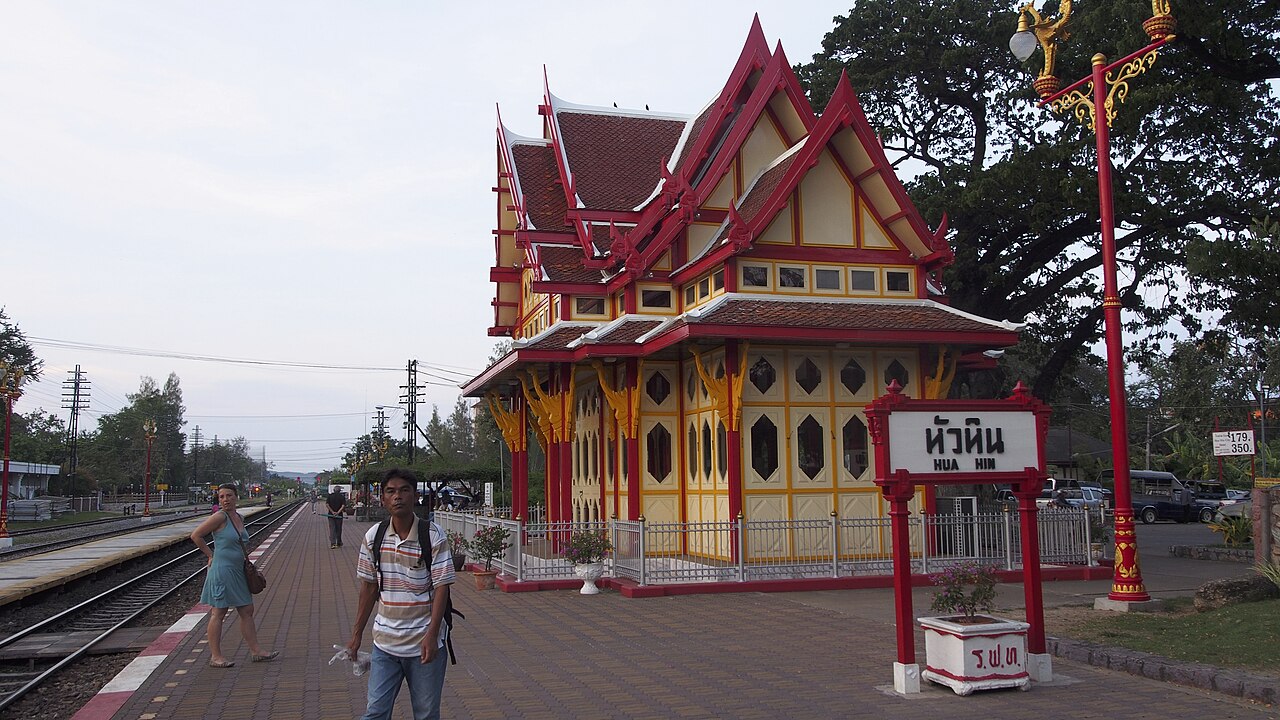
The Southern Line from Krung Thep Aphiwat Central Terminal (Bang Sue Grand Station) to Hua Hin Station takes about 3 to 3¾ hours, with several departures a day and fares of roughly ฿94–980 by class (from fan to air-conditioned), bookable up to 30 days ahead. It's a scenic option with a landmark waiting at the end. The station itself is a free photo stop everyone drops by — its standout feature is the Phra Mongkut Klao royal waiting pavilion (built for Rama VI).
| Mode | In Hua Hin? | What it's for |
|---|---|---|
| BTS / MRT / subway | None | — (in town, use songthaew/Grab/motorbike instead) |
| Green songthaew | Yes (main local transport) | Along Phetkasem, Khao Takiab–airport, ฿10–20/ride |
| Grab / Bolt | Yes (fewer cars than Bangkok) | Late returns, heavy bags, off the songthaew route |
| SRT Southern Line train | Yes (long-distance, not urban) | Arriving from Bangkok ~3–3¾ hr · day trips nearby |
| Hua Hin Airport (HHQ) | Yes (limited, changeable flights) | Some domestic flights · most still arrive by road/train |
Several of Hua Hin's best sights aren't in town — they're scattered around the outskirts, where the green songthaew doesn't reach. You need to plan the transport spot by spot. Common examples:
The Monsoon Valley vineyard is about 45 minutes inland, and Maruekhathaiyawan Palace sits between Hua Hin and Cha-am (in Phetchaburi). Both have no direct public transport, so you'll need a hire car, a rented scooter, a chartered songthaew/taxi, or a tour. Browse vineyard tours on Klook's Hua Hin vineyard tours.
Phraya Nakhon Cave and Khao Sam Roi Yot National Park are about 40–60 minutes south (in Prachuap Khiri Khan). You'll want your own car, a chartered ride, or a tour, since public transport is awkward — go early to catch the sunbeam through the cave. Browse tours on Klook's Sam Roi Yot tours.
One — in town, lean on the green songthaew, backed up by Grab. By day, along the Phetkasem–beach–market strip, the songthaew is the cheapest and most frequent. For late returns, heavy bags, or going off the route, hail a Grab or Bolt. This is the cheapest, most comfortable mix for visitors.
Two — tuk-tuks, motorbike taxis and chartered night songthaews always need a price agreed first, because there's no meter. If you'd rather not haggle, make a habit of opening Grab to compare — often the app price is cheaper and removes the guesswork.
Three — the out-of-town sights need your own wheels or a tour. The vineyard, Maruekhathaiyawan Palace, Phraya Nakhon Cave and Sam Roi Yot all sit off the songthaew route, so plan a hire car, scooter, chartered ride or a booked tour in advance — it saves a lot of time.