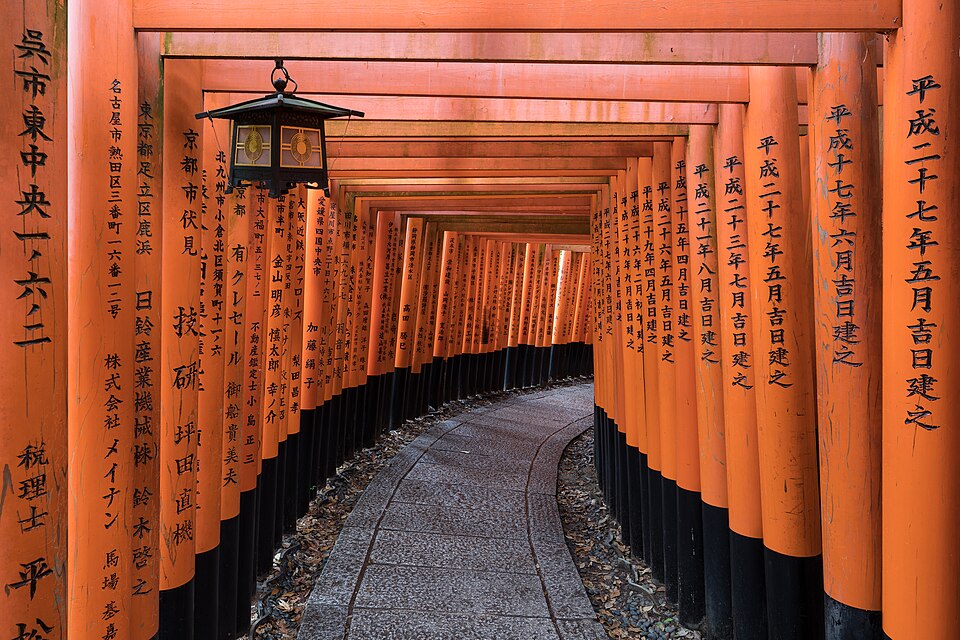
Senbon Torii — vermilion gates lined up into a tunnel that seems to never end, carrying you up Mount Inari one step at a time. Free, open 24 hours, and just a 5-minute JR ride from Kyoto Station to the entrance.
You have seen the photo — thousands of red gates lined up into a tunnel that runs on forever. It is the image on the cover of nearly every Japan guidebook ever printed. That is Senbon Torii at Fushimi Inari. Picture it: you step into a tunnel where two rows of vermilion pillars stand shoulder to shoulder, sunlight slipping through the gaps between the black Japanese characters painted on the posts, and the path climbing gently higher and higher — every step with a fresh torii waiting up ahead.
This is Fushimi Inari Taisha — the head Shinto shrine for the deity Inari across all of Japan (there are over thirty thousand branch shrines). It sits at the foot of Mount Inari in the Fushimi ward, in southern Kyoto. What sets it apart is the roughly 10,000 vermilion torii gates arranged into tunnels that climb the 233-metre mountain. Each one was donated by a company or an individual praying for success in business, and the characters on the posts are the donor's name and the date.
And the best part for travellers: free entry, 24 hours a day. No ticket queue, no closing time — you can walk up at any hour, from five in the morning to midnight. Add the 5-minute JR ride from Kyoto Station that drops you right at the gate, and you have one of Kyoto's must-see sights that is easy to reach and does not cost a single yen.
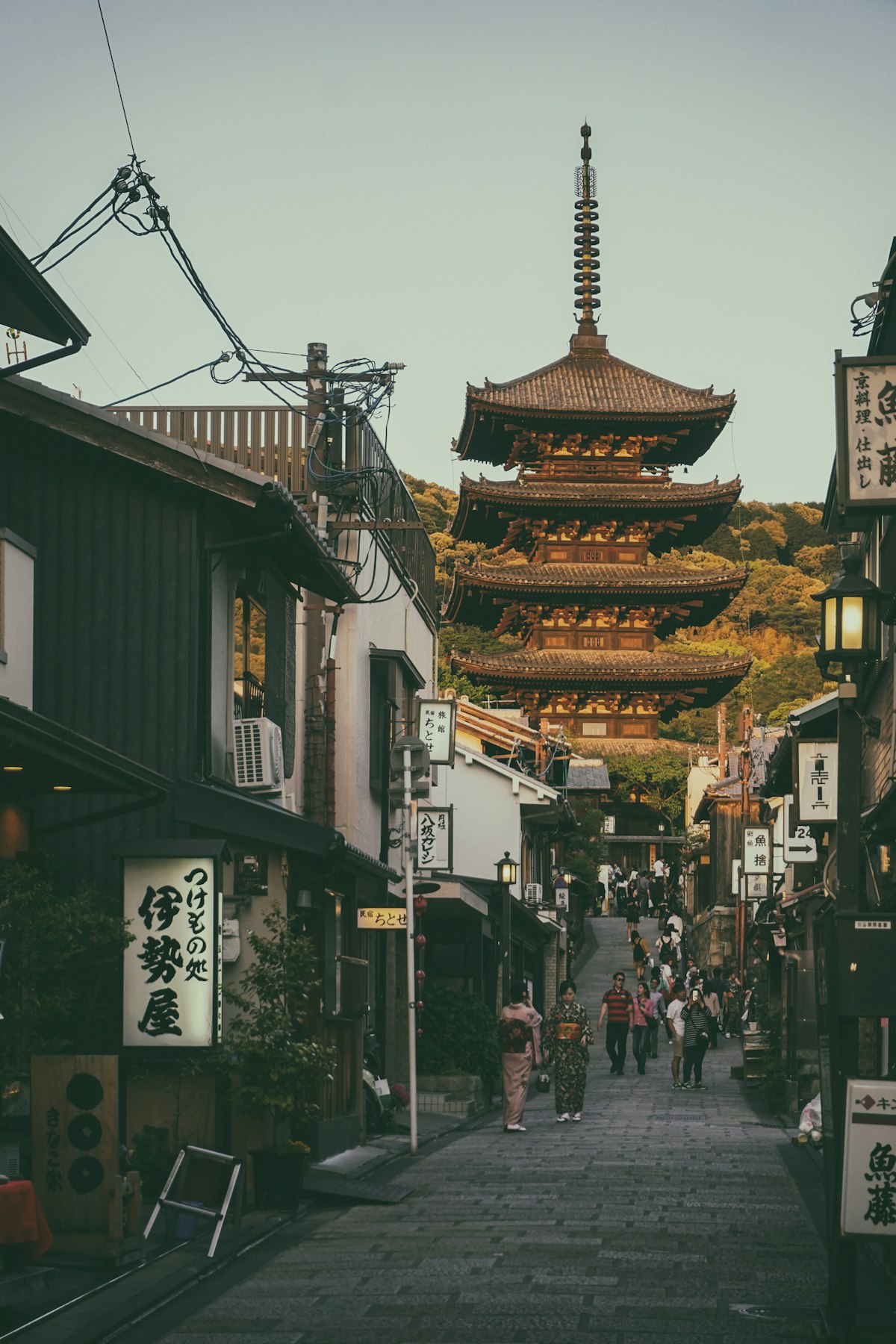
From the Romon Gate at the entrance, climbing the mountain stage by stage — each spot has a meaning hidden in it.
The big red gate that greets you the moment you step out of the station. The story goes that the warlord Toyotomi Hideyoshi paid for it as a prayer for his mother's recovery from illness. Beyond it is the main hall (Honden), where people come to pray for business and a good harvest. Look for the pair of fox statues guarding the entrance — each holds something different in its mouth.
"The thousand torii gates" — the stretch where the torii stand densest, splitting into two parallel rows so you walk up one and down the other. The red tunnel runs on until the light slips through in stripes. This is where every iconic shot is taken, and if you want a clear frame with no one in it, you really do have to come at dawn — by mid-morning, people queue up for photos in a long line.
Walk out the far end of the Senbon Torii tunnel and you reach the Okusha shrine clearing, where most people stop to buy a fox-faced ema plaque and draw their own expression on it. Behind it sit two "Omokaru-ishi" stones: make your wish, then lift a stone — if it feels lighter than you expected, your wish will come true; if heavier, you will have to try harder.
Around 30–45 minutes up from the entrance you reach the Yotsutsuji intersection, an open clearing with a sweeping view out over Kyoto. This is where most visitors choose to turn around and head back down. There is a drink stand and somewhere to sit and rest, and if you come in the late afternoon the sunset view here is gorgeous. Anyone with the energy can carry on up to the summit.
From Yotsutsuji it is another hour or so of looping trail to the summit at the Ichinomine shrine. Along the way there are small shrines and stretches of torii tunnel, far fewer people, and a calm, quiet atmosphere you do not get lower down. The full loop up and down takes about 2–3 hours in total — wear comfortable walking shoes and bring water.
The question everyone asks is "do I have to walk all the way to the top?" The answer is no, not at all. Most people only walk the first 30–45 minutes through Senbon Torii, which is where the red gate tunnel is densest and where you get all the shots you came for. If you want to go further, the popular turnaround is the Yotsutsuji intersection at roughly the halfway point, with its city view. Anyone who wants to conquer the full loop to the summit should allow 2–3 hours up and down.
The trail is stairs and gentle inclines that keep rising — not steep, but tiring enough near the top. Wear trainers or comfortable walking shoes, skip the heels, and carry water; the higher you go, the fewer shops there are.
This is the heart of getting the most out of Fushimi Inari, because between 9 am and 4 pm it is packed — especially at Senbon Torii, where people queue for photos in a long line. If you want a clean shot of the red tunnel with no one in the frame, there are two golden windows: dawn, before 7 am, when the light is soft and it is peaceful, or the evening after sunset, when the lanterns along the path light up and give the place a mysterious atmosphere you do not get in daylight.
Because the shrine is open 24 hours, you can walk up at any time. If you are staying in Kyoto and can manage an early start, set an alarm and arrive just as the sky is brightening — it is well worth the lost sleep.
Throughout the shrine you will see fox statues (kitsune) everywhere, because the fox is the messenger of Inari, the deity of rice, prosperity and commerce. Notice what each fox holds in its mouth — some carry a granary key, others a scroll or a sheaf of rice, each with its own meaning.
As for the thousands of vermilion torii gates, every one of them came from a donation. The black characters on the posts are the name of the company or individual who donated, along with the date. The donation cost for a single gate starts at around ¥400,000 (~฿92,000) and runs to over ¥1 million for the larger ones. If you want a souvenir, the fox-faced ema plaque at the Okusha shrine lets you draw your own expression on it — a charming keepsake you will not find anywhere else.
Fushimi Inari is one of the easiest sights in Kyoto to reach, because the train takes you straight to the gate.
Staying around Kyoto Station makes the JR ride to Fushimi Inari easiest — find a well-located place in your budget right here.