Home Sapporo Japan About
Home  ›  Japan  ›  Sapporo  ›  Sapporo Soup Curry Guide
🥣 Sapporo Soup Curry · 2026

The Curry Sapporo
Invented for Itself

Not the thick brown curry you know — a thin, spiced, soup-like bowl with chunky vegetables and a whole chicken leg, rice on the side, and a spice level you pick yourself. Here's how it works and where to eat it.

Why this dish matters

A Curry That Could Only Come From Sapporo

If you order curry anywhere else in Japan, you get kare raisu — a thick, glossy brown sauce ladled over rice. Sapporo does something else entirely. Soup curry is exactly what the name says: a thin, fragrant, deeply spiced broth you eat almost like a soup, with big chunky vegetables and usually a whole or half chicken leg sitting in the bowl, and the rice served on the side instead of underneath. You spoon up a little rice, dip it into the soup, and go back and forth.

It's a genuine local invention. Soup curry came together in Sapporo around the 1970s, and the restaurant Ajanta is usually credited as the originator — its early version leaned closer to a spiced herbal soup before the format we know now settled into place. For decades it stayed a Hokkaido thing; only later did it spread to the rest of Japan. Sapporo is still where the dish lives, with the original shops and the deepest concentration anywhere.

This guide walks through what's actually in the bowl, how to eat it, how to choose your spice level without regretting it, and the legendary shops — Ajanta, Suage, GARAKU, Lavi and Picante — that keep the queues long. Treat it as the deep-dive companion to our full Sapporo food guide.

What's in the bowl

The parts of a soup curry

Six things make up a proper bowl — once you know them, you can read any shop's menu
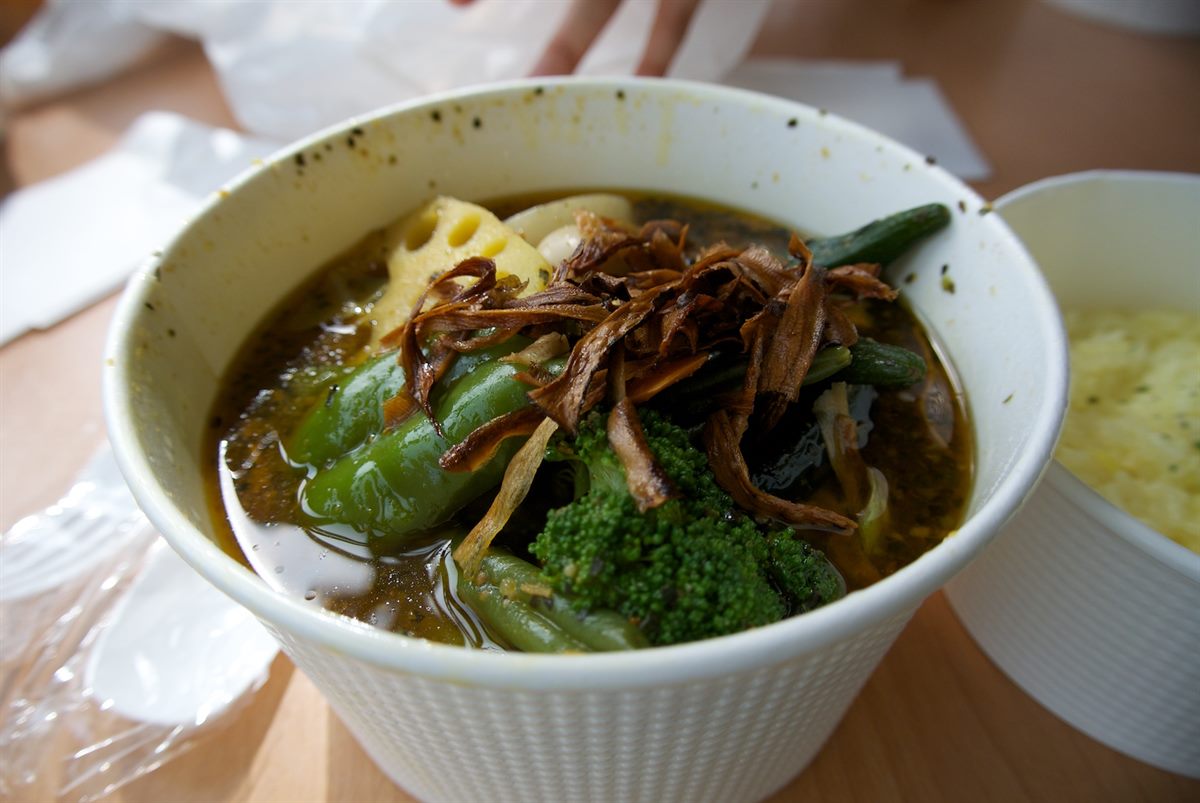
A bowl of Sapporo soup curry — thin spiced broth with chunky vegetables and chicken
The spiced soup base
スープ · the broth

The heart of the dish. Unlike the thick roux of ordinary Japanese curry, this is a thin, clear-ish broth built on Japanese dashi (often chicken or fish stock) blended with a big spice mix that leans toward South and Southeast Asian flavours — cumin, coriander, turmeric, cardamom and more. Each shop guards its own recipe, so two bowls in the same city can taste completely different. Some lean tomato-rich, some go nutty with coconut, some stay light and herbal.

Flavour notes: fragrant and layered · spice-forward rather than sweet · varies a lot shop to shop
Tip: the broth, not the chicken, is the thing to judge a shop on
🍗2
A whole or half chicken leg
チキンレッグ · chicken leg

The signature protein. Most shops drop in a whole chicken leg — thigh and drumstick still attached — slow-cooked until it slides off the bone. You don't need a knife; the meat breaks apart with the edge of a spoon against the bowl. It's the version almost every first-timer orders, and it's the benchmark a shop is judged by. Some places do a half leg, a crispy fried leg, or boneless chicken if you'd rather not wrestle with the bone.

Standard order: chicken-leg soup curry, the default at most shops
Swaps: pork, lamb, seafood, fried shrimp or vegetable-only on many menus
🥕3
Big chunky fried vegetables
野菜 · the vegetables

This is where Hokkaido shows off. The vegetables come big and barely cut — a whole roasted-fried potato, thick slices of carrot, halves of bell pepper, eggplant, broccoli, pumpkin, lotus root, okra — usually flash-fried first so they hold their shape in the soup. Hokkaido grows superb produce, and a good bowl can feel like a vegetable feast as much as a curry. Many shops list a vegetable-only option that piles on whatever's in season.

Common veg: potato · carrot · bell pepper · eggplant · broccoli · pumpkin · lotus root
Why fried first: keeps the chunks intact and adds a roasted edge
🍚4
Rice on the side
ライス · served separately

The detail that surprises everyone: the rice doesn't go in the soup. It arrives in its own bowl, often shaped into a mound, sometimes dusted with sesame or topped with a small pickle. The classic move is to spoon a little rice, dip it into the broth and eat the two together — not to pour the soup over the rice. Many shops let you pick the rice size for free, and some offer brown rice or a turmeric rice as an upgrade.

How to eat: dip spoonfuls of rice into the soup, alternate bites
Often free: choose your rice portion (small / regular / large)
🌶️5
Your chosen spice level
辛さ · pick your heat

Nearly every shop hands you a numbered spice scale, and the scales don't match each other — one shop might run 1 to 5, another far higher. The heat is built on a complex blend, so even a low number carries the full flavour without scorching you. If you eat spicy food regularly, ask the staff where the mid-point of their own scale falls and start there. Very high levels usually carry a small surcharge and can be genuinely fierce, so work up rather than diving in.

Safe start: low-to-mid level for most travellers · full flavour, manageable heat
Note: top spice tiers often add ¥100–200 and are no joke
🧀6
Optional toppings & swaps
トッピング · build your bowl

Half the fun is customising. Most menus run a topping list — melted cheese, a soft-boiled egg, extra Hokkaido vegetables, cheese-stuffed something, natto, or an extra scoop of the chicken. You can often swap the protein entirely, bump the rice size, or add a side of pickles. A common first-timer combo is the chicken leg plus a cheese topping and a soft egg, which rounds out the spice. Order at the counter or tick boxes on a slip, depending on the shop.

Popular adds: cheese · soft-boiled egg · extra vegetables · extra chicken
Typical price: toppings ¥100–300 each
Where to find it

Districts for a soup curry crawl

The areas where the soup curry shops cluster — easy to reach on the subway

Tanukikoji & Susukino
狸小路・すすきの · the central core

The downtown core around the Tanukikoji arcade and the Susukino nightlife district is the densest hunting ground for soup curry — several of the best-known shops, including GARAKU, sit a short walk apart here. It's the easy choice if you want to compare a couple of bowls in one trip, and it doubles as the heart of the city's dining and bar scene once the sun goes down.

Getting there: Subway Nanboku Line, Susukino Station, or walk from Odori · Best for: first bowl, easy access, late hours
Odori & Nijo Market area
大通・二条市場 · central downtown

Around Odori Park and the Nijo Market end of downtown you'll find more central soup curry shops within an easy stroll of the city's main subway hub. It's a handy area to slot a bowl into a sightseeing day, since you're already near the park, the TV Tower and the morning seafood market. Many shops here open through lunch, so it's good for an early bowl before the evening queues build.

Getting there: Odori Station (Nanboku / Toho / Tozai Lines) · Best for: lunch, sightseeing-day stops
Maruyama & the west side
円山 · the local favourite

West of the centre, the leafy Maruyama neighbourhood and the streets around it hold a clutch of soup curry shops that locals rate highly — quieter, more residential, and often a notch less touristy than the downtown names. It pairs well with a visit to Maruyama Park or the Hokkaido Shrine. Worth the short subway hop if you want a bowl without a long line.

Getting there: Subway Tozai Line, Maruyama-koen Station · Best for: avoiding queues, a local feel
Sapporo Station underground
札幌駅 · rainy-day option

If the weather's bad or you're killing time before a train, the dining floors and underground passages around Sapporo Station include soup curry counters and branches of the bigger names. It's not the atmospheric way to eat the dish, but it's warm, dry and convenient, and a perfectly good introduction if you can't make it to a flagship shop. Handy on a snow day or with luggage in tow.

Getting there: Sapporo Station (JR / subway) · Best for: bad weather, quick stops, travel days
Legendary shops

The soup curry shops worth the queue

Five names that come up again and again — pin them before you go

1
Ajanta — Where Soup Curry Began
アジャンタ · the originator

The shop usually credited as the birthplace of soup curry. Ajanta started serving its spiced, soup-like curry in Sapporo and is widely pointed to as the dish's origin — its early bowls were closer to a medicinal-style herbal soup than the format that later spread. If you care about eating the original rather than the trendiest version, this is the pilgrimage stop. The style here is more traditional and herb-driven than the photogenic modern shops.

Area: Sapporo (a longtime local institution)
Why go: the origin story · a more traditional, herbal take on the broth · Note: opening days/hours can be limited — check before you go
2
GARAKU — The Central Crowd-Pleaser
スープカリー GARAKU

Probably the most famous soup curry name with visitors, and the easy first bowl. GARAKU sits right in the central Tanukikoji area, runs a rich dashi-and-spice broth, and is well used to travellers, with picture menus and clear spice levels. The trade-off is the queue — it's popular enough that you'll usually wait, especially at peak meal times. Come early or off-peak and it's smooth. If you only have time for one shop and want it reliable and central, this is it.

Area: central Tanukikoji, Chuo-ku, Sapporo
Why go: central, beginner-friendly, consistently good · Note: expect a queue at lunch and dinner
3
Suage — Grilled Chicken & a Tower of Vegetables
スアゲ · Suage+

The photogenic favourite. Suage is known for grilled (rather than just simmered) chicken and a generous stack of big, char-edged Hokkaido vegetables standing up out of the bowl. The presentation is part of the draw, and the produce-forward style makes it a great pick if you want the vegetable side of the dish to shine. Like GARAKU it's central and popular, so a wait is normal at busy times.

Area: central Sapporo (Susukino / Tanukikoji side)
Why go: grilled chicken · big roasted vegetables · the most photo-friendly bowl · Note: popular, can queue
4
Soup Curry Lavi — A Long-Running Local Name
スープカレー Lavi

A well-established Sapporo soup curry name that locals know well, with more than one location around the city. Lavi is the kind of shop people return to rather than queue at once for the photo — a dependable, full-flavoured bowl with the usual chicken-leg and vegetable options and a clear spice scale. A solid choice if the downtown flagships are slammed and you want a proven bowl without the longest line.

Area: Sapporo (multiple locations)
Why go: reliable, long-running, less of a tourist scrum · Note: check which branch is nearest you
5
Picante — Build-Your-Own Bowl
ピカンティ · Picante

Another famous Sapporo soup curry shop, known for letting you build the bowl your way — choosing your broth style, your protein and your spice level so the result is genuinely yours. That make-it-your-own approach has earned it a loyal following and a spot on most "best soup curry in Sapporo" shortlists. Good for a second or third bowl once you know how you like the dish and want to dial it in exactly.

Area: Sapporo (near the Hokkaido University side)
Why go: customisable broth + protein + spice · a local favourite · Note: great as a return visit once you know your preferences
Frequently asked questions

FAQ · soup curry, explained

How is soup curry different from regular Japanese curry?
Regular Japanese curry (kare raisu) is a thick, sticky, stew-like sauce poured over rice. Sapporo soup curry is the opposite — a thin, fragrant, spiced broth you eat almost like a soup, with big chunky vegetables and usually a whole or half chicken leg sitting in it, and the rice served separately on the side. You pick up a spoonful of rice, dip it into the soup, and alternate. The spicing leans toward South and Southeast Asian spice blends rather than the milder roux of ordinary Japanese curry.
Was soup curry really invented in Sapporo?
Yes — soup curry is a genuine Sapporo invention from around the 1970s. The restaurant Ajanta is usually credited as the originator: it served a spiced, soup-like curry (originally marketed closer to a medicinal herbal soup) that locals took to, and over the following decades dozens of shops developed their own versions. The dish stayed mostly a Hokkaido specialty until the 1990s and 2000s, when it spread to the rest of Japan. Sapporo is still where you find the deepest concentration and the original shops.
How do you actually eat soup curry?
The rice comes in a separate bowl, not in the soup. Most people spoon a little rice, dip it into the broth and eat the two together, then break the chicken and vegetables apart in the bowl as they go. The chicken leg is usually cooked until it falls off the bone, so a spoon and the edge of the bowl are enough — no knife needed. Take your time: the vegetables are big on purpose so the bowl works as one slow, warming meal.
How spicy should I order, and what level suits most travellers?
Most shops let you pick a spice level on a numbered scale, and the scales differ from shop to shop — some go 1 to 5, others run far higher. For most travellers a low-to-mid level delivers the full spice flavour without burning, because the heat is built on a complex blend, not just chilli. If you eat spicy food often, ask the staff where the mid-point of their own scale sits and start there. Very high levels often cost a small extra charge and are genuinely fierce, so work up gradually.
Can you get soup curry without chicken or meat?
Often, yes. Many shops offer a vegetable-only bowl piled with seasonal Hokkaido vegetables, and some do pork, lamb, seafood or a fried-shrimp version instead of the standard chicken leg. The base broth itself is frequently meat- or fish-based, though, so strict vegetarians should ask before ordering. If chicken-leg-on-the-bone isn't your thing, look for the boneless chicken or vegetable options that most menus list.
Which Sapporo soup curry shop should a first-timer choose?
GARAKU near Tanukikoji is the easy crowd-pleaser — central, hugely popular and used to visitors, though it usually means a queue. Suage is the photogenic favourite with grilled chicken and a stack of vegetables. Ajanta matters if you care about the origin story, since it's the shop usually credited with inventing the dish. Lavi and Picante round out the list of long-running local names. If it's your first bowl and you want it central and reliable, start with GARAKU or Suage.
🟠 Klook

🥣 Sapporo Food Tours & Hokkaido Experiences on Klook
Susukino food crawl · ramen · Otaru day trip

Pair your soup curry hunt with a Susukino food tour, a Sapporo ramen crawl, or an Otaru day trip (seafood + LeTAO sweets + canal views) — from ~¥7,500/person · book ahead in peak winter weeks

🛒 See Sapporo tours on Klook →
Wherebest is an affiliate partner of Klook — we may earn a commission when you book through our links, at no extra cost to you.