A whole park on the edge of Sapporo, shaped by sculptor Isamu Noguchi as a single work of land art — a Glass Pyramid, a man-made hill you can climb, a huge water fountain, and geometric mounds laid out across reclaimed land. It's free to enter, easy to roam by bike, and unlike anything else in the city.
Picture a huge open space on the northern edge of Sapporo where the hills, the pyramid and the fountains weren't just placed in a park — the whole place is the artwork. That's Moerenuma Park. It was designed by the Japanese-American sculptor Isamu Noguchi, who treated the entire 188-hectare site as one single sculpture rather than a collection of separate attractions. The land was once a waste landfill, reclaimed and reshaped into smooth grass hills, a glass pyramid, water shows and geometric mounds.
Noguchi drew up the master plan in 1988 and died that same year; the park was carried through and opened fully in 2005. The result is a place that feels calm and almost otherworldly — clean geometric lines against open sky, with the Sapporo skyline in the distance. People who've been will tell you to give yourself a half-day here, rent a bike, climb the hill of Mt Moere for the view, and time your visit around one of the Sea Fountain shows. This page walks you through what to see, when to come, and how to get out here.
Every feature is part of one connected work of land art, spread across a big open site. This table helps you see what each piece is, when it's at its best, and roughly where it sits in the park.
| Feature | Type | Known for | Best time | Where in park |
|---|---|---|---|---|
| Glass PyramidHIDAMARI | Building | Glass-and-steel hub · gallery, café, shop | Any time | West side |
| Mt MoereMt Moere | Land form | Man-made 62 m hill, panoramic view | Sunset | North |
| Sea FountainSea Fountain | Water show | Choreographed jets, a few shows a day | Showtimes (warm season) | Centre, by the marsh |
| Play MountainPlay Mountain | Land form | Stepped earth pyramid with stone stairs | Daytime | South |
| Tetra MoundTetra Mound | Sculpture | Three steel legs over a grass mound | Daytime | East side |
| Cherry ForestSakura no Mori | Garden | ~3,000 cherry trees, play structures | Early May (blossoms) | East |
From the glass pyramid to the man-made hill and the fountain show, here's what makes the park worth the trip out. People who've been agree on one thing: time your visit around a Sea Fountain show and climb Mt Moere for the view.
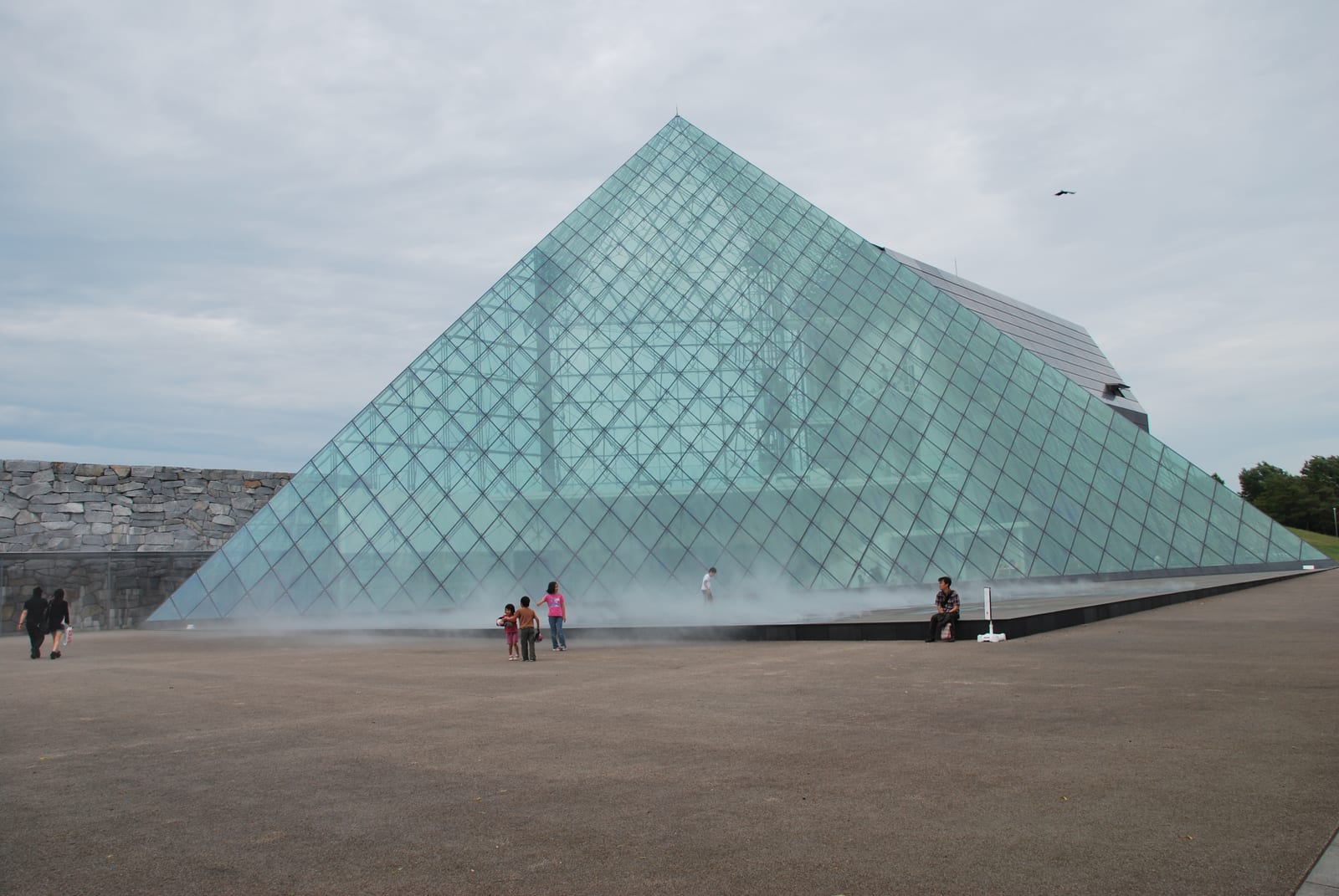
🔺 Building1
The park's centrepiece building — a glass-and-steel pyramid whose name, HIDAMARI, means "a sunny spot". Inside is a bright atrium that fills with daylight, plus a small gallery on Isamu Noguchi, a café and a shop. It's the natural place to start, get oriented, and warm up in winter. The glass faces catch the light beautifully at the start and end of the day.
Sapporo Attractions →
⛰️ Land form2
A man-made hill about 62 metres tall, shaped from the reclaimed land and crowned with a flat lookout. Walk up the path and stone steps — about 10–15 minutes — and the whole park spreads out below you: the Glass Pyramid, the fountain, the geometric mounds, with the Sapporo skyline and the mountains beyond. It's a local favourite for sunset, and in winter people ski and sled down its slopes.
Sapporo Travel Guide →The park's signature water feature — a huge fountain by the marsh that runs a choreographed show of jets and shapes a few times a day, the tallest reaching dozens of metres into the air. Each full program lasts around 15–40 minutes depending on the time slot. It only runs in the warmer months, roughly late April to mid-October, and the showtimes change by season, so plan around one.
Sapporo Attractions →A stepped earth pyramid that grew out of a much earlier Noguchi idea — one face is a long flight of stone stairs, the other a smooth grass slope you can walk or roll down. It's a clean, satisfying piece of geometry to look at and to climb, and it pairs visually with Mt Moere across the park. A quiet spot most of the year, and a sledding hill in winter.
Sapporo Attractions →A striking sculpture set on a small grass mound — three big stainless-steel legs joined at the top into a tripod, mirror-bright against the sky. You can stand right underneath and look up through it, and the polished surfaces throw back distorted reflections of the park and clouds. It's one of the most photographed spots after the Glass Pyramid, and it sits well on its own little rise.
Sapporo Attractions →The park's Cherry Forest holds around 3,000 cherry trees mixed with playful sculptural play structures, and in early May it turns into one of the city's nicer, less crowded spots for blossoms. The park is big and flat, so the easy way to take it all in is to rent a bicycle near the entrance and loop the whole site — pyramid, fountain, hills and forest — at your own pace.
Sapporo Day Trips →Moerenuma Park is out on the north-east edge of the city, so it's not a five-minute hop — plan for about an hour each way. Here are the three ways most visitors get there.
The standard route. Ride the Toho subway line to Kanjo-dori Higashi Station, then catch a Chuo bus toward Moere Koen Higashiguchi for about 25 minutes to the park. Allow roughly an hour each way from the centre. Check the bus times before you set off — they're not super frequent.
More direct, and worth it if you're short on time or in a group. A taxi from central Sapporo takes around 30–40 minutes depending on traffic. There's plenty of free parking on site if you're driving yourself — handy in winter when buses are slower.
Coming from New Chitose Airport, head into Sapporo first (JR or subway to the centre), then take the subway-and-bus route above. There's no direct line from the airport to the park, so it's easiest to base yourself in the city and visit from there.
The park itself keeps food simple — a café in the Glass Pyramid and warm-season stands. Save the serious eating for back in the city, where Sapporo's signature dishes await. Here's what to know.
See how the pieces sit across the site — the Glass Pyramid HIDAMARI on the west, Mt Moere to the north, the Sea Fountain in the centre by the marsh, and the main entrance to the south.
The park is on the city's edge, so it makes sense to base yourself centrally and visit out and back. Pick an area near a subway line for the easy ride to Kanjo-dori Higashi.
Where to stay, what to see, and how to get around the whole of Sapporo — pick the right area for your trip.
Open the Sapporo Guide →The subway, buses and IC cards explained — exactly how to ride out to Kanjo-dori Higashi and the park bus.
Getting Around Sapporo →Search and compare Sapporo hotels on Agoda for your dates and budget before you decide to book.
Search on Agoda →A whole-city overview — sights, hotels, transport, and the districts beyond the parks.
Open the Sapporo Guide →The best of Sapporo's sights, in the city and beyond, with how to get there and opening hours.
Sapporo Attractions →Miso ramen, soup curry, jingisukan, Hokkaido crab, and dairy desserts — a deep dive into the best places.
Sapporo Food Guide →Easy escapes from the city — Otaru, Lake Toya, Noboribetsu and more, with how to get to each.
Sapporo Day Trips →The whole prefecture — cities, nature, hot springs and seasons, with links into every area.
Hokkaido Guide →Every region and city, with links into city guides, hotels, and attractions across Japan.
Japan Guide →Pick a hotel near Sapporo Station or Odori for the smoothest ride out to the park, with the city's food and nightlife on your doorstep. Open our full Sapporo guide, or compare prices on Agoda for your dates and budget.