Climb to a basin 800 metres up that has been the heart of Shingon Buddhism for over a thousand years — sleep in a working temple, eat the monks' shojin-ryori vegetarian cuisine, wake for the morning prayers, then walk the Okunoin cemetery under lantern light at dusk. One of the quietest, most haunting trips in all of Japan.
Picture this: this morning you're still wedged into a packed Osaka train, but two hours later you're standing in a forest of cedars hundreds of years old, the only sounds running water and the distant chant of monks drifting from a temple — that's Koyasan (Mount Koya), a basin set on a mountain around 800 metres high in Wakayama Prefecture, where the monk Kobo Daishi (Kukai) chose to found the centre of Shingon Buddhism back in 816 CE. Today more than 110 temples cluster into this one small town, and the whole area is a UNESCO World Heritage Site.
What sets Koyasan apart from other destinations is that you don't just come to look — you come to live in a temple. You sleep in a shukubo (a temple's lodging) on tatami mats, eat shojin-ryori vegetarian food the monks cook themselves, rise early to join the prayer service and fire ceremony, and walk into Okunoin, one of the most haunting cemeteries in all of Japan. This page covers it all — the sights you can't miss, how a temple stay works, the food, and how to get up the mountain from Osaka.
The main gateway is Osaka — ride the Nankai Koya Line up the mountain, then connect to the cable car and a bus, about 2 hours all in. No rental car needed (2026 prices and times may change — check the Nankai site before you travel).
| Leg | How | Time | Approx. fare |
|---|---|---|---|
| Namba → GokurakubashiOsaka → foot of the mountain | Nankai Koya Line — Limited Express (Koya / newer trains) | ~80 min | ~1,880–2,030 yen (incl. reserved-seat fee) |
| Namba → Gokurakubashibudget option | Express / rapid express, change at Hashimoto | ~100 min | ~930 yen |
| Gokurakubashi → Koyasancable car up the mountain | Nankai Koyasan Cable Car (very steep) | 5 min | ~390 yen |
| Koyasan Station → town centreinto town | Nankai Rinkan bus to Senjuinbashi | ~10 min | ~460 yen |
Everything sits in one small town, easy to reach on foot or by bus. Roughly speaking, Okunoin cemetery is to the east, and the Danjo Garan / Kongobu-ji temple complex is to the west. Start with the most haunting spot of all.
The largest cemetery in Japan, with more than 200,000 graves and memorial stupas for samurai, lords, and notable figures, lining a cedar-forest path some 2 kilometres long where the trees are hundreds of years old. At the end lies the mausoleum of Kobo Daishi, who Shingon followers believe is still "in meditation". Before you reach it you pass through the Torodo (Lantern Hall), where over ten thousand lanterns burn without ever going out.
See other Japan travel towns →
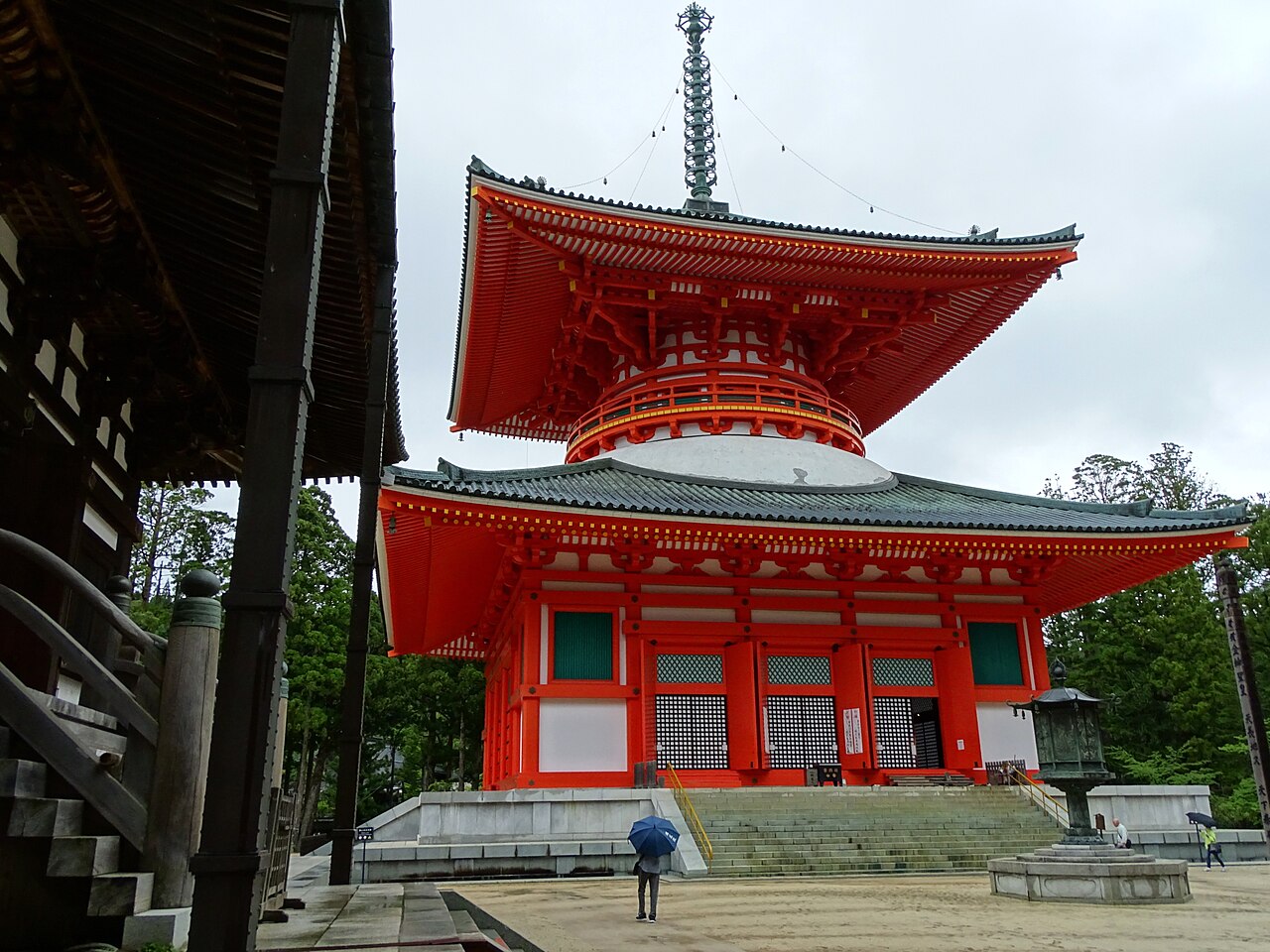
🛕 West side2
Danjo Garan is the first sacred temple complex Kobo Daishi laid out, and its standout is the Konpon Daito, a vermilion pagoda around 48 metres tall (the one in this photo). Inside, Buddhist statues and a mandala arrangement let you walk through the Shingon vision of the cosmos. The grounds are free to wander, but entering the pagoda itself costs around 500 yen.
Osaka Attractions (Gateway) →The head temple and headquarters of the Koyasan branch of Shingon Buddhism. Inside are rooms decorated with sliding-screen paintings (fusuma) by the Kano school, and the most famous feature is the Banryutei rock garden — one of the largest in Japan, where rocks and raked white gravel form a pair of dragons swimming through a sea of clouds. They often serve tea and a sweet so you can sit and take in the garden.
Osaka Attractions (Gateway) →The highlight that makes people climb the mountain to stay over — sleeping in a real temple on tatami mats, laying out your own futon, eating a shojin-ryori vegetarian dinner and breakfast. Many temples have their own bath or shared bathing room and a Japanese garden. In the morning you can join the prayer service and the goma fire ceremony on a voluntary basis. Read up on vegetarian/vegan options before you book.
Japan vegetarian / halal guide →The great vermilion gate on the western edge is Koyasan's original welcoming gateway — a two-storey wooden structure around 25 metres tall (the current building was rebuilt in 1705), with carved Nio guardian deities on either side. At sunset the light streaming through the gate is gorgeous, and on a clear day you can see the mountains stretching off into the distance. Free to walk through.
Osaka Attractions (Gateway) →Home to more than ten thousand pieces of Koyasan's Buddhist art — statues, mandala paintings, and old scriptures, many of them National Treasures and Important Cultural Properties. Worth a stop if you want to understand the roots of Shingon art more deeply, either before or after you walk the temples themselves.
Japan Travel Guide →Koyasan has no big hotel chains — "accommodation" here means a shukubo, a temple that opens its doors for the night, and there are dozens to choose from. Rates are per person and include dinner and breakfast. Here's how the night unfolds before you book.
You arrive in the afternoon, and a monk or staff member shows you to your tatami room and serves green tea and a sweet. Change into the temple's robes, wander the Japanese garden, then take a bath to relax before dinner — some temples have an onsen or a shared bathing room.
Several vegetarian dishes arrive on a low tray, from koya-dofu tofu to seasonal mountain vegetables, pickles, and vegetable tempura — no meat, no fish. Afterwards, head out to walk the Okunoin cemetery under lantern light, the most atmospheric hour of the day.
Wake around 6 am and join the prayer service in the hall. Some temples hold a goma fire ceremony, the Shingon ritual of burning wooden prayer sticks (you join voluntarily), then come back for a Japanese-set breakfast. Checkout is early, around 9–10 am.
The food up here is part of the experience, not just a meal to fill you up. Shojin-ryori is a meticulous Buddhist culinary heritage, every dish considered. Worth knowing a little before you sit down.
A small town with sights spread across two sides — Okunoin cemetery to the east, and Danjo Garan, Kongobu-ji, and the Daimon Gate to the west. See the layout and it's easy to plan a sensible walking order.
Kegon Falls, Lake Chuzenji, and the Senjogahara plateau — the mountains above Nikko, beautiful for both autumn leaves and onsen.
Oku-Nikko Guide →The Japan Alps valley — Kappa Bridge, the Hotaka peaks, and the crystal-clear Azusa River — a paradise for hikers.
Kamikochi Guide →Koyasan's gateway city — where to stay, what to see, and how to connect to the Nankai train up the mountain, start to finish.
Osaka Guide →Osaka Castle, Dotonbori, Shinsaibashi, and the best of Kansai — pair them with Koyasan in a single trip.
Osaka Attractions →How to eat vegan, vegetarian, and halal in Japan without the headache — a natural follow-on from the shojin-ryori up the mountain.
Vegetarian Guide →How to bathe, the etiquette, and the tattoo question every first-timer should know — add an onsen to your slow, quiet trip.
Onsen Guide →Koyasan rewards those who stay over — early morning and late evening are when it's most haunting and least crowded. Start by opening the Osaka guide to plan your Nankai route, or lock in lodging up the mountain before it fills.