Home Fukuoka Japan About
Home  ›  Japan  ›  Fukuoka  ›  Yatai Guide
🏮 Fukuoka Yatai Guide · 2026

The Red-Lantern Stalls by the River —
Fukuoka's Yatai, Japan's Last Great Street-Food Night

Yatai are open-air food stalls the owner wheels out fresh every night — and Fukuoka has more of them than anywhere else in Japan, over 100. The neon row along the Nakasu river is the most iconic night-food scene in the country. Here's where to go, what to order, and exactly how to do it right.

Why yatai

Yatai — Fukuoka's Most Iconic Night-Food Culture

Picture this: a row of little stalls along a riverbank, each one no bigger than a van, red paper lanterns glowing, steam rising off a stove, and eight people crammed shoulder to shoulder on stools eating ramen at midnight. That's a yatai (屋台) — an open-air mobile food stall — and Fukuoka is the only place in Japan where you can still live this every single night.

Yatai used to be everywhere in postwar Japan, but city after city regulated them out of existence. Fukuoka fought to keep them, building a special licensing system and even an open-call programme for new owners — which is why this one city now holds more than 100 stalls, over half of all the yatai left in the country. They cluster in three districts: the famous red-lantern riverside at Nakasu, the after-work alleys of Tenjin, and the port-side ramen stalls of Nagahama.

This guide is the one we'd hand a friend before their first night out: what to order, which district fits you, the unwritten rules that make the owner smile, and the legendary stalls worth queuing for. Eat at a yatai once and you'll understand why people fly to Fukuoka just for this.

What to order

8 things to eat at a yatai

From the tonkotsu ramen that built Fukuoka to the little plates you order between drinks
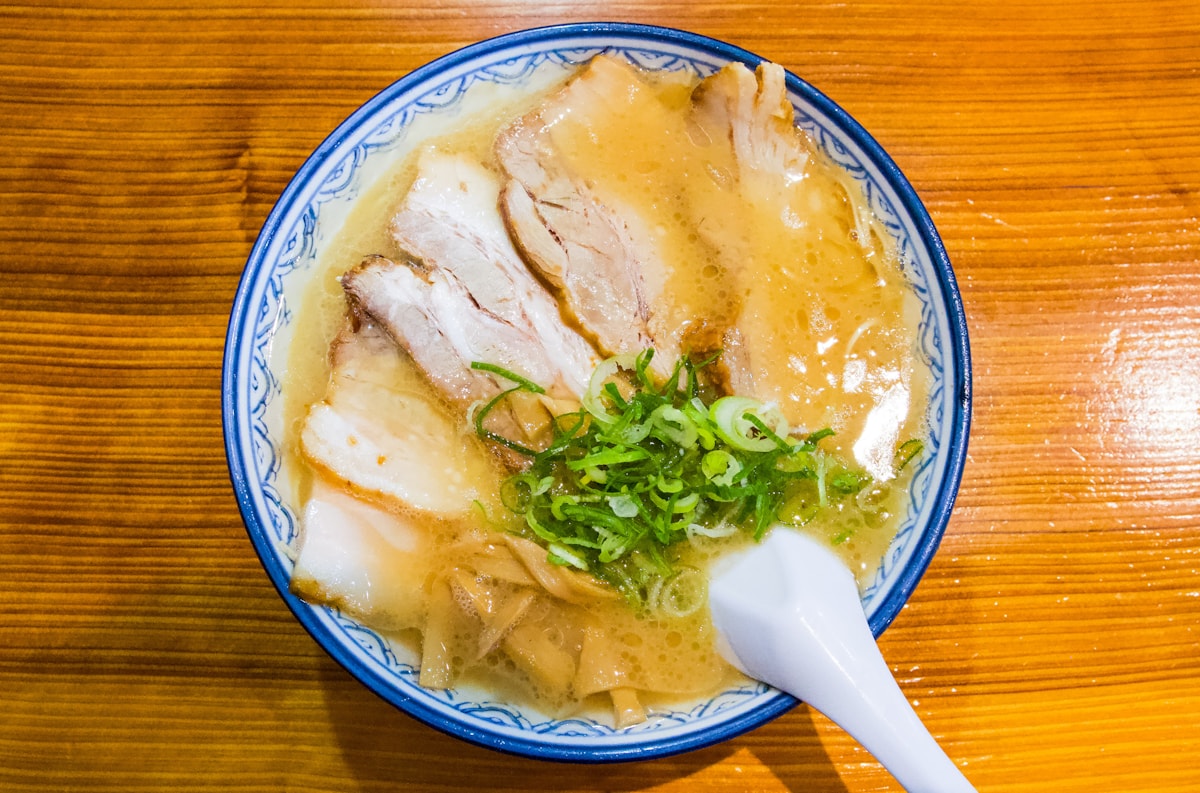
A bowl of Hakata tonkotsu ramen served at a Fukuoka yatai — white thick pork-bone broth, thin straight noodles, chashu pork and fresh spring onion
1
Tonkotsu Ramen · the Yatai Headliner
豚骨ラーメン

This is the dish most people come to a yatai for, and it tastes different eaten on a stool by the river. A white, thick pork-bone broth simmered for hours, thin straight Hakata noodles cooked for under a minute so they keep their bite, a couple of slices of chashu and fresh spring onion. When you've slurped through the noodles but the broth is still there, order a kaedama — a fresh refill of noodles — for a few hundred yen. That's the proper Hakata way.

Best at: Nagahama stalls (ramen is the star) · Nakasu riverside stalls
Price: ¥600–1,000 / bowl · Kaedama (extra noodles) +¥100–200
🍢
2
Oden · the Slow-Simmered Comfort Pot
おでん

Every good yatai has a big partitioned pot bubbling away with oden — daikon radish, boiled eggs, konnyaku, fish cakes, beef tendon and gyu-suji, all stewed for hours in a dashi broth that gets deeper as the night goes on. You point at what you want and they ladle it out piece by piece. On a cold night, paired with a hot sake or a cold beer, oden at a yatai is the most comforting thing you'll eat in Fukuoka. Order a few pieces to share while you wait for your ramen.

Best at: Tenjin alley stalls · any stall with a partitioned oden pot out front
Price: ¥100–300 / piece (you order item by item)
🍗
3
Yakitori & Kushiyaki · Skewers off the Grill
やきとり · 串焼き

Half the fun of a yatai is watching the owner grill skewers an arm's length from your face. Negima (chicken and spring onion), tsukune (meatballs), crispy torikawa chicken skin, and — very Fukuoka — pork-belly and vegetable skewers too, since this region grills more than just chicken. Order tare (sweet soy glaze) or shio (salt), pick a handful, and wash them down with a draft beer. At most stalls each skewer is ¥100–200, so it's cheap to graze through several.

Best at: Tenjin and Nakasu stalls with a charcoal grill out front
Price: ¥100–250 / skewer
🍤
4
Tempura · Fried-to-Order at the Counter
天ぷら

Some stalls run a small fryer and turn out tempura to order — prawns, squid, sweet potato, lotus root and seasonal vegetables, dropped in fresh and handed over hot and crackling. Because Fukuoka has its own fishing port, the seafood pieces are genuinely good. It's a perfect between-rounds snack: light, crisp, easy to share, and a nice contrast to the heavy tonkotsu broth. Dip it in a little salt or the tentsuyu sauce on the counter.

Best at: stalls with a fryer at the counter (look for the oil pot)
Price: ¥150–400 / piece
🥟
5
Tetsunabe Gyoza · Iron-Skillet Dumplings
鉄鍋餃子

Hakata gyoza come out in a screaming-hot iron skillet — the whole pan, not a plate — and that's the local difference. They're smaller and thinner-skinned than Tokyo gyoza, filled with pork, ginger, garlic and finely chopped cabbage, and fried until the bottoms turn crust-crisp. Dip them in vinegar with a drop of chilli oil and you'll finish a pan before you notice. Many Tenjin yatai keep gyoza on the menu, and it's the ideal thing to order alongside a beer.

Best at: Tenjin yatai · stalls that also serve ramen
Price: ¥500–900 / pan (about 8–10 pieces)
🥘
6
Yaki Ramen · the Dish a Yatai Invented
焼きラーメン

This one was born at a yatai and you can still barely find it anywhere else. Tonkotsu ramen noodles stir-fried on a screaming-hot iron griddle with minced pork, vegetables and Worcestershire sauce, finished with a splash of pork broth instead of water — so it ends up somewhere between fried noodles and ramen, smoky from the hot iron. It's said to have started at a Nagahama stall and is now most famously cooked at Kokinchan in Tenjin. If you see it on the menu, order it.

Best at: Kokinchan (Tenjin Showa-dori · believed to have invented it) · some Nagahama stalls
Price: ¥700–1,000 / plate
🍳
7
Mentaiko Tamagoyaki · Cod-Roe Omelette
明太子玉子焼き

Fukuoka's signature ingredient, mentaiko (spicy pollock roe), shows up at the yatai folded into a soft rolled omelette. The egg is sweet and warm, the mentaiko salty and gently spicy, and together they're one of the easiest, most crowd-pleasing things on a stall menu. Some stalls also grill whole mentaiko on a skewer or serve it on rice. If you only try one mentaiko dish on your trip, having it here, fresh off the pan, is a lovely place to start.

Best at: Nakasu and Tenjin stalls (look for mentaiko on the posted menu)
Price: ¥400–700 / plate
🍲
8
Motsunabe · Offal Hot Pot for the Table
もつ鍋

A few of the larger yatai will set up a motsunabe — Fukuoka's beloved offal hot pot — right on the counter for a small group. Pork or beef offal simmered in a shoyu or miso broth with a mountain of cabbage, garlic and red chilli, the offal turning meltingly tender as it cooks. It's a warming, sharing dish best ordered with a couple of friends, and you finish it with chanpon noodles dropped into the leftover broth. Not every stall does it, so it's a treat when you find one that does.

Best at: larger stalls with table space · ask before you sit down
Price: ¥1,200–2,000 / person
How to eat at a yatai

The unwritten rules · know them before you sit

6 simple things that turn a yatai night from awkward to unforgettable

What a yatai is, in one paragraph

A mobile food stall the owner sets up fresh every evening — a roof, a stove and roughly 7–8 stools, sometimes 10 — open from about 18:00 until 01:00 or 02:00. There's no toilet, no card machine and very little room, and that's exactly the point. You're eating in the open air, elbow to elbow, often chatting with the strangers next to you. Get the etiquette right and you'll be welcomed like a regular.

One drink minimumOrder at least one drink per person — the stalls survive on drink sales. A beer, a chu-hi or a hot sake is all it takes.
Order food too, not just drinksIt's polite to order a dish or two as well. Ramen, oden, a few skewers — the owner cooks it right in front of you.
Don't put bags on the stoolsWith only 7–8 seats, every stool counts. Keep your bag on your lap or under your own stool, especially when a queue is waiting.
Free your seat when you're doneIf you've finished and people are lining up outside, settle up and move on. That's the etiquette that lets everyone get a turn.
Cash onlyMost stalls don't take cards. Bring yen — ¥2,000–4,000 per person covers a good couple of hours of food and drink.
Prices are posted outsideBy law every yatai must display its prices. If a stall has no posted menu, just pick another one — there are plenty.
Where to go

Which district for your yatai night

Three main yatai areas — each with its own crowd, prices and mood

Nakasu
中洲 · the red-lantern riverside

This is the picture you've seen of Fukuoka: a long row of stalls lined up along the Naka River, red lanterns and neon reflecting on the water, steam drifting up into the night. It's the most photogenic yatai district and the easiest place for a first night — atmosphere guaranteed. Because the location is so pretty, prices here usually run 20–30% above Tenjin, and you'll share the row with plenty of other visitors. Come early (around 19:00) to get a seat before the crowd builds.

Good for: the iconic riverside view · photos · your first night · Hours: 18:00–02:00 · Getting there: Subway Nakasu-Kawabata, Exit 5
Tenjin
天神 · the city-centre alleys

Fukuoka's main shopping and business hub hides its yatai in the alleys between office towers and department stores — and that's where the locals actually eat. The crowd is office workers winding down after work, the prices are friendlier than Nakasu, and the menus are often more varied and adventurous. The Showa-dori area has several of the best stalls, including Kokinchan, the yatai credited with inventing yaki ramen. If you want real local life over a postcard view, start here.

Good for: local crowd · cheaper prices · yaki ramen · Hours: 18:30–01:30 · Getting there: Subway Tenjin, Exit 16
Nagahama
長浜 · the port stalls

Down by the fishing port, Nagahama is where dock workers and fishermen have long come to eat after the late shift — so the stalls here are rawer, cheaper and ramen-focused, with the strongest kaedama culture of any district. The Nagahama style of thin noodles and light-but-rich broth is its own local legend. It's the least touristy of the three, a bit further out, and the best choice if you want a yatai night that feels genuinely working-class and unpolished.

Good for: cheap ramen · the most local feel · late nights · Hours: 18:00–03:00 · Getting there: bus or taxi from Tenjin, ~10 min
Best time to go
when to show up

The sweet spot is a clear weekday or a Friday/Saturday evening between about 19:00 and 22:00 — late enough for the lanterns to glow, early enough to grab one of the few seats before the queues form. Many stalls close on Sundays and on rainy nights, since they cook in the open air, so don't pin your only free evening on a wet forecast. If your first-choice stall is full, the etiquette is to wait in line politely or simply move to the next one — there are over a hundred to choose from.

Good for: planning your evening · avoiding closed nights · Best window: 19:00–22:00 · Avoid: Sundays & rainy nights (many close)
Legendary stalls & spots

Stalls and rows worth seeking out

A few that locals point first-timers toward · go with the area as much as the name

1
The Nakasu Riverside Row · the Postcard Yatai
中洲屋台 · along the Naka River

Not one stall but a whole row of them strung along the river — this is the image of Fukuoka yatai that draws people to the city. Stroll the bank, read the posted menus, and pick the stall whose food and atmosphere you like; ramen, oden, yakitori and tempura are all here. It's busier and a touch pricier than elsewhere, but for a first night the view of the lanterns on the water is worth it. Arrive around 19:00 for the best chance of a seat.

Where: Naka riverside, Nakasu, Hakata Ward · Nakasu-Kawabata Station, Exit 5
Hours: most stalls 18:00–02:00 · Order: tonkotsu ramen · oden · yakitori · cash only
2
Kokinchan · the Yaki Ramen Yatai
こうきん · Tenjin Showa-dori

The Tenjin stall widely credited with inventing yaki ramen — the iron-griddle stir-fried ramen you'll struggle to find outside Fukuoka. It draws a queue for good reason, but the wait is part of the night. Old-school yatai atmosphere, a chatty owner, and they'll seat solo diners happily. Order the yaki ramen and a plate of gyoza, and you've got the Tenjin yatai experience in one go.

Where: Showa-dori, Tenjin, Chuo Ward · walk from Tenjin Station
Hours: roughly 18:30–00:30 · closed Mondays · Order: Yaki Ramen ~¥900 · Gyoza ~¥600 · cash only
3
The Tenjin Alley Stalls · the Locals' Choice
天神屋台 · Watanabe-dori & the back streets

Spread through the alleys around Watanabe-dori and Showa-dori, the Tenjin stalls are where after-work Fukuoka eats. Cheaper than Nakasu, more varied menus, and a crowd of regulars who'll happily nod you toward a free stool. This is the row to choose when you want to feel the everyday rhythm of the city rather than pose for a photo — oden, skewers, ramen and whatever the owner is cooking that night.

Where: alleys off Watanabe-dori & Showa-dori, Tenjin, Chuo Ward · Tenjin Station, Exit 16
Hours: most stalls 18:30–01:30 · Order: oden · yakitori · gyoza · ramen · cash only
4
The Nagahama Port Stalls · for Ramen Purists
長浜屋台 · near the fishing port

Out by the port, the Nagahama stalls are the spiritual home of fast, cheap, thin-noodle ramen and the kaedama refill habit. The crowd skews to night-shift workers and ramen die-hards, the prices are the lowest of the three districts, and the feel is wholly unpolished. It's a little out of the way, but if your trip is short and you want the most genuinely local yatai night, this is the row to seek out.

Where: near the fish market, Nagahama, Chuo Ward · bus/taxi ~10 min from Tenjin
Hours: most stalls 18:00–03:00 · Order: Nagahama-style tonkotsu ramen · kaedama · cash only
5
A Clustered Stall Row · the Easy Way to Start
屋台横丁 · grouped yatai rows

If wandering the streets feels intimidating, look for a clustered row where several stalls sit side by side — easier to compare posted menus, easier to hop between for a drink at one and ramen at another. These spots are friendlier to first-timers and to small groups, and you'll often find owners who are used to visitors. Read the prices, pick the stall that's busy with locals, and you really can't go wrong.

Where: Nakasu riverside & central Tenjin (look for grouped red lanterns)
Hours: evening until late · Order: start with a drink + oden, then ramen · cash only
Frequently asked questions

FAQ · Things People Often Ask

How many yatai are there in Fukuoka, and why are there so many here?
Fukuoka has more yatai than any other city in Japan — over 100 stalls, more than half of all the yatai left in the country. Yatai have disappeared from most Japanese cities because of postwar regulations, but Fukuoka created a special licensing system that let them survive. Today the city even runs an open-call programme for new stall owners, which is why the culture is still alive and renewing here while it has vanished elsewhere.
What time do yatai open, and which nights are they closed?
Most yatai open from about 18:00 and run until 01:00–02:00 (a few in Nagahama stay open until 03:00). The busiest, best-atmosphere window is roughly 19:00–22:00. Many stalls close on Sundays and on rainy days, since they cook and serve in the open air, so a clear weekday or Friday/Saturday evening is the safest bet.
How much does it cost to eat at a yatai, and do they take cards?
Budget about ¥2,000–4,000 per person for a couple of hours of eating and drinking. Most yatai are cash only, so bring enough yen — there are convenience-store ATMs nearby but not at the stalls. By law every yatai must display its prices outside; if a stall has no posted prices, choose another one.
Which yatai district should I choose — Nakasu, Tenjin or Nagahama?
Nakasu, the red-lantern row along the Naka River, is the most photogenic and the easiest first night, but it is pricier and busier with visitors. Tenjin, tucked into the alleys of the city centre, has a more local, after-work crowd, cheaper prices and more varied menus. Nagahama, near the fishing port, is the rawest and cheapest, famous for ramen and the strongest kaedama culture. First-timers should start at Nakasu for the atmosphere; for real local life, go to Tenjin or Nagahama.
What are the unwritten rules of eating at a yatai?
There are a few that matter. Order at least one drink per person — the stalls survive on drink sales (one-drink minimum). Don't put your bag on an empty stool when a queue is waiting outside. If you've finished and people are lining up, settle the bill and free your seat. And it's polite to order something to eat as well, not just drink. Get these right and the owner will warm to you straight away.
Can I eat at a yatai if I'm a vegetarian or don't eat pork?
It is difficult, because the headline dishes — tonkotsu ramen and most oden broth — are built on pork. That said, you can usually order grilled vegetable skewers, plain tamagoyaki (rolled omelette), some tempura, and edamame, and a few stalls keep a non-pork broth. Always ask the owner before ordering. If you have strict dietary needs, the Daimyo district near Tenjin has many international restaurants that are an easier fit than the stalls.
🟠 Klook

🏮 Fukuoka Yatai & Hakata Ramen Night Food Tour on Klook
Eat the Riverside Stalls with a Local Guide

A 3-hour guided yatai (street-stall) food tour through the Nakasu and Tenjin rows — order with confidence and taste tonkotsu ramen, oden, yakitori and mentaiko, from ~¥6,500/person · private or small-group options available

🛒 See Fukuoka food tours on Klook →
Wherebest is an affiliate partner of Klook — we may earn a commission when you book through our links, at no extra cost to you.