Home Japan Osaka About
Home  ›  Japan  ›  Osaka  ›  Food Guide
🐙 Osaka Food Guide · 2026

Eat Till You Drop — Kuidaore
This City's Philosophy

Takoyaki served piping hot straight off the griddle in front of you · okonomiyaki you cook yourself on an iron plate · kushikatsu you can only dip once · square sushi that came before fancy nigiri — Osaka isn't just a food city, it's a city with a philosophy about eating.

Why eat here

Ever heard the word Kuidaore?

Kuidaore (食い倒れ) literally means "to eat yourself into ruin" — a word Osakans have used to describe themselves since the Edo period, when this city was "Japan's Kitchen" (天下の台所), the place that gathered goods and ingredients from across the whole country. That history still lives in every market alley, every waft of soy sauce drifting out of a tiny shop down a side street, and every queue Osakans line up in without a shred of embarrassment.

Honestly — you won't go hungry in Osaka. The problem is the opposite: knowing when to stop. One takoyaki ball makes you reach for a second; the first okonomiyaki shop makes you want to try a second; and Dotonbori at night makes every single stall look irresistible. We've picked 12 dishes you won't find anywhere else, with shops we can confirm are real and genuinely good.

Signature dishes

12 must-try dishes

Dishes unique to Osaka and Kansai — ordered by how "original" they are to a city that should be proud of them
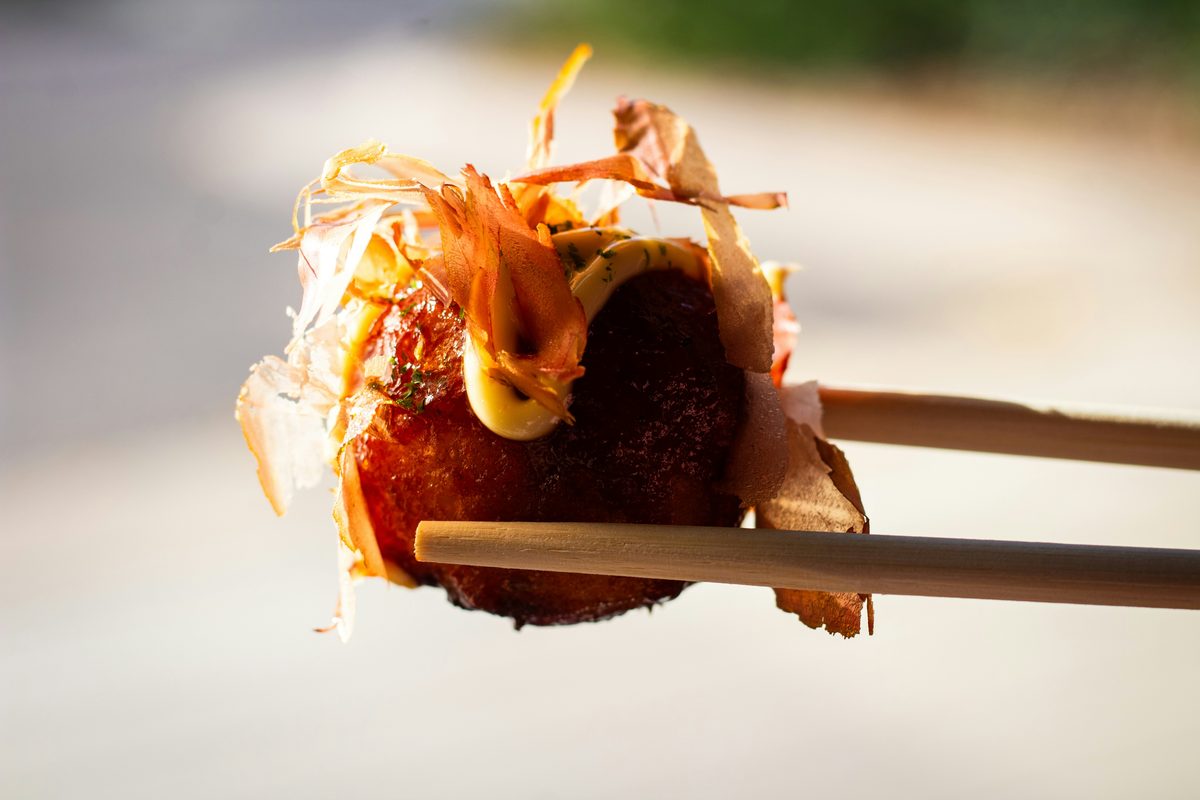
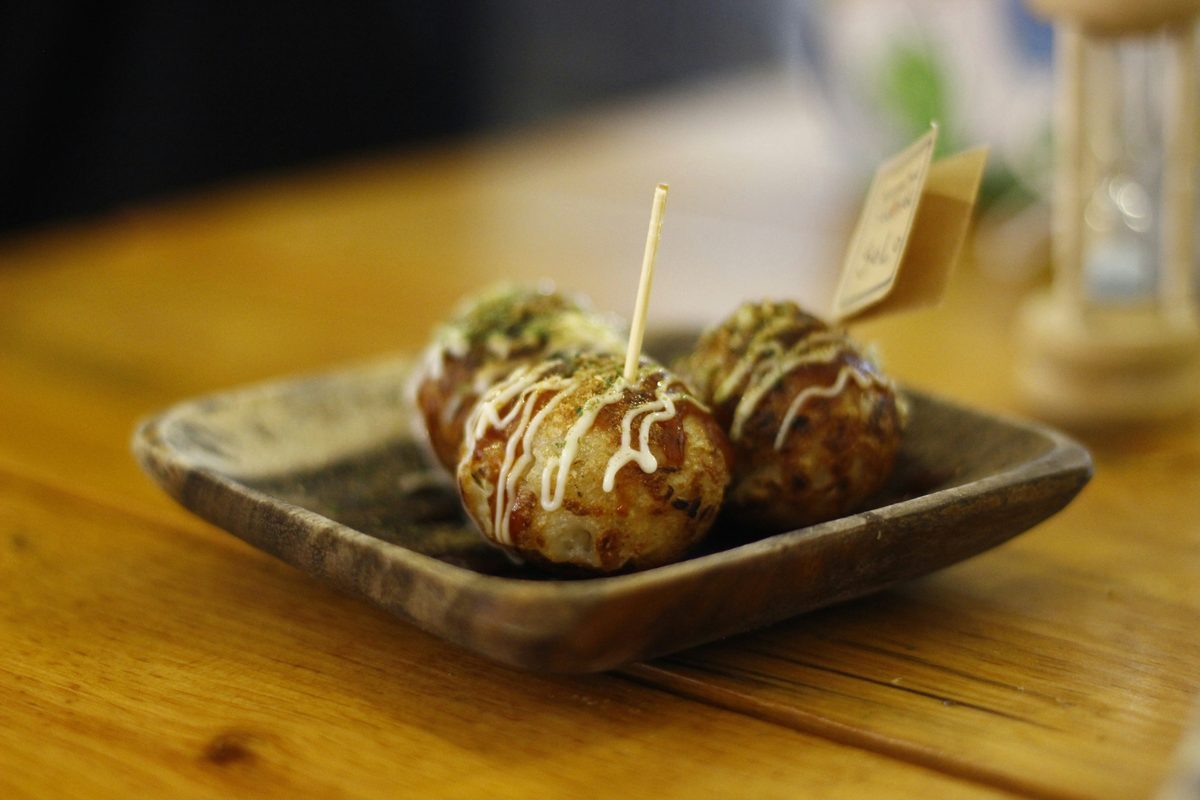
Takoyaki, golden-yellow round balls topped with sauce, mayonnaise and bonito flakes, Osaka 1
Takoyaki
たこ焼き · Takoyaki

If Osaka had an official city dish, it would be this round ball — batter with a big chunk of octopus, baked in a dimpled round pan, turned with a single skewer, slightly crisp outside and a semi-liquid molten cream inside that can burn your mouth if you're not careful. Drizzled with sweet Worcester sauce, ribbons of white mayonnaise, bonito flakes dancing in the rising heat, and powdered seaweed. Wanaka in Dotonbori has been open for decades and still has long queues every day. Aizuya near Namba is the shop food historians call the "birthplace" of modern takoyaki.
Where: Wanaka Honten (わなか本店) Dotonbori · Aizuya (会津屋) Namba · Kukuru Dotonbori
Price: ¥500–700 / 8 pieces
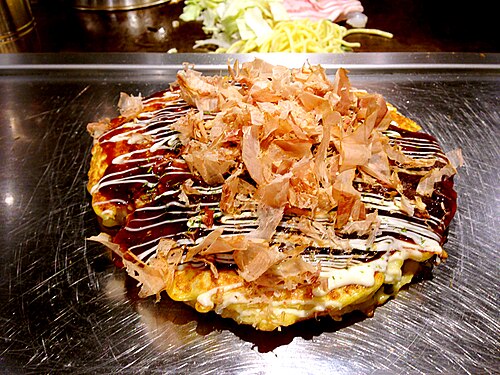
Osaka-style okonomiyaki on a golden-brown iron griddle, topped with sauce, mayonnaise and bonito flakes 2
Okonomiyaki
お好み焼き · Okonomiyaki

It means "grill whatever you like" — batter mixed with cabbage, egg, pork, shrimp, squid, or whatever you order, poured onto a hot iron griddle, pressed flat, left until the edges crisp, then flipped. Finished with okonomi sauce, mayonnaise, bonito flakes and powdered seaweed. The Osaka style mixes everything into the batter before frying (unlike Hiroshima's layered version). Mizuno on Dotonbori has been open since 1945 and often has queues that run all day. Chibo has several branches around the city.
Where: Mizuno (美津の) Dotonbori · Chibo (千房) various branches · Fukutaro near Namba
Price: ¥900–1,600 / plate
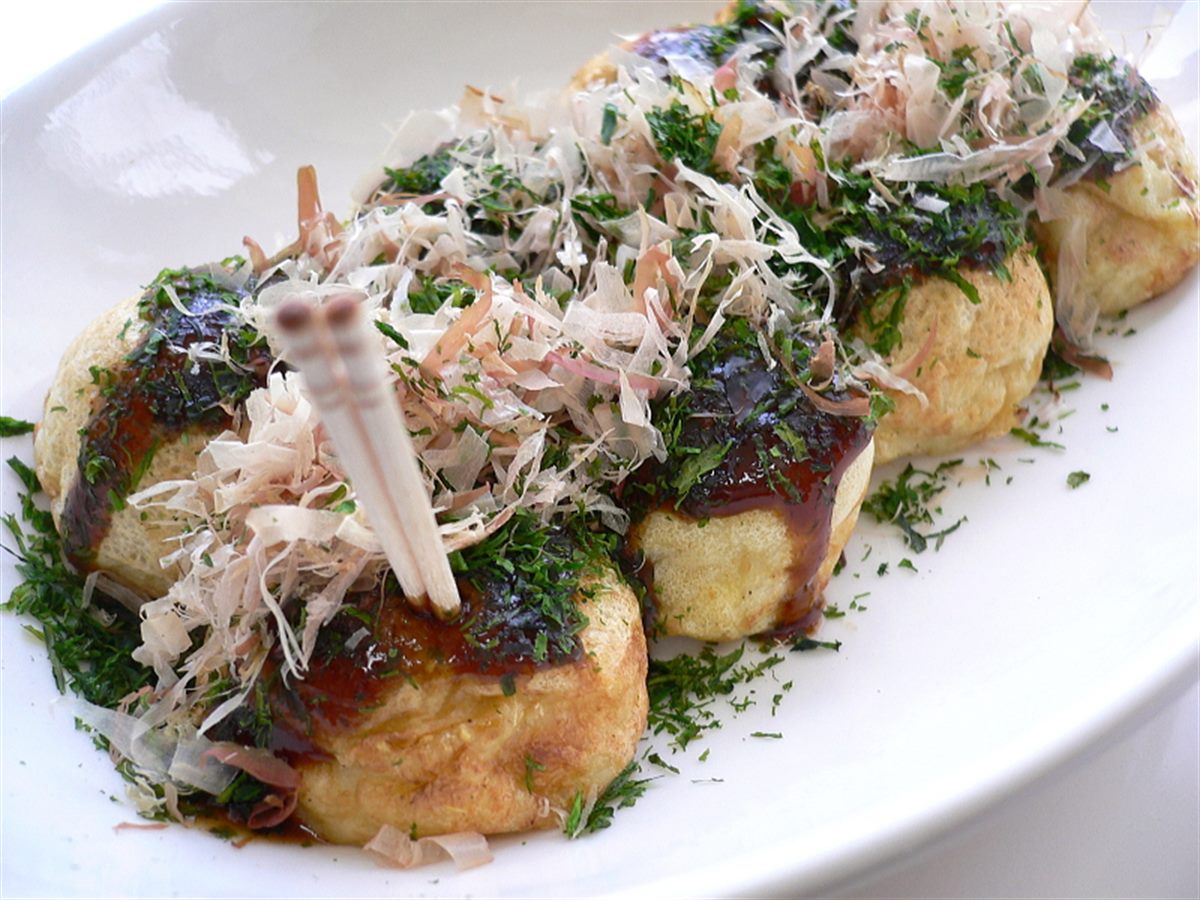
Crispy golden deep-fried kushikatsu skewers in Shinsekai, Osaka 3
Kushikatsu
串カツ · Kushikatsu

Skewered, breaded and deep-fried in hot oil — the sizzle is the soundtrack of the Shinsekai district. There are hundreds of options, from beef, shrimp and pork to peanuts, pickled ginger, cheese, gourd and quail eggs. Each skewer is ¥90–200, eaten with a dip in the brown Worcester sauce in the communal pot. The iron rule is absolutely no double-dipping. If you want more sauce, use the raw cabbage to scoop it on. Kushikatsu Daruma is the most famous chain and you'll find branches all along Shinsekai's main street. Yaekatsu is a cheaper local spot.
Where: Kushikatsu Daruma (だるま) Shinsekai branch · Yaekatsu (八重勝) Shinsekai · Yakko (やっこ) Shinsekai
Price: ¥90–200 / skewer · ¥1,500–3,000 / person
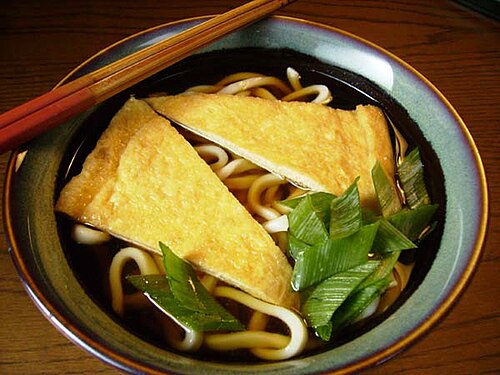
Kitsune udon in a clear amber-gold broth, topped with brown fried tofu 4
Kitsune Udon
きつねうどん · Kitsune Udon

Ever heard how different Kansai-style udon is from Tokyo's? Tokyo's broth is dark and sharply salty, while Osaka's is a clear amber gold made from seaweed and bonito dashi — warm, soft and deep in flavour. The udon noodles here are thicker and chewier. Kitsune (meaning "fox") refers to the sweet, golden-brown fried tofu laid on top, soaking up the broth inside. Legend says Dotonbori Imai created the recipe in 1949. Usami-tei Matsubaya is also one of the oldest origins of the recipe.

Where: Dotonbori Imai (道頓堀今井) · Usami-tei Matsubaya (うさみ亭マツバヤ) Minamisemba
Price: ¥550–900 / bowl
🐡5
Fugu (Pufferfish)
ふぐ · Fugu

If you're going to eat pufferfish anywhere in Japan, Osaka is the best answer — this city consumes more fugu than anywhere else in the country, and has the most shops licensed to handle this dangerous fish. Pufferfish carries tetrodotoxin in certain organs, and chefs must train for 3 years before earning a licence. The flesh is translucent and paper-thin, mild in flavour, like distilled sea. Eaten as eye-wateringly thin sashimi (tessa) or in a hot pot (tecchiri). Takoyasu, open since 1929, is recognised by the Michelin Guide.

Where: Takoyasu (鯛よし百番) ← check it's open before you go · Zuboraya (づぼらや) Dotonbori — the giant pufferfish-lantern sign
Price: ¥3,000–8,000+ depending on the set
🍱6
Hakozushi
箱寿司 · Hakozushi

Before fancy nigiri rose to fame from Tokyo, Osakans ate box-pressed sushi — sushi rice packed tight into a square mould, topped with fresh boiled shrimp, fish roe, sea bream, sweet egg, or a colourful work of art made from the ingredients, then cut into even pieces, beautiful as carving. The flavour is softer than nigiri because the components meld together during pressing. Yoshino Sushi in the Honmachi district has over 170 years of history and still makes the original recipe every day. The Michelin Guide has recognised this shop.

Where: Yoshino Sushi (吉野寿司) Honmachi · Sushitsune (寿し常) Temma
Price: ¥1,500–3,500 / set
🍣7
Battera
バッテラ · Battera

The name comes from the Portuguese word for "boat" — because of its little-boat shape. Battera is pressed sushi using mackerel cured in salt and vinegar (saba) laid over sushi rice, then pressed with a thin, translucent sheet of kombu seaweed and cut into square pieces. The taste is gently salty fish balanced with the rice vinegar — a dish you'll see in every Kansai sushi shop. History records it was created at Sushitsune in the Temma district in 1891. Good battera uses fish fresh that day, not frozen.

Where: Sushitsune (寿し常) Temma · local sushi shops across Namba and Dotonbori
Price: ¥200–350 / piece
🍢8
Doteyaki
どて焼き · Doteyaki

If you're sitting in an izakaya in Osaka and don't know what to order, order doteyaki first — beef tendon and joints simmered in red miso with sake, sugar and dashi until meltingly tender, deep brown and richly fragrant, served on a block of white tofu with spring onion. The flavour is heavy, warm and intense, perfect for chilly weather and a canned beer. Nonkiya in the Ebisuhigashi district is a Tachinomi (stand-and-drink) spot Osakans drop by regularly. Order doteyaki and an Osaka beer — nothing's better after work.

Where: Nonkiya (のんきや) Ebisuhigashi · izakaya all over Namba and Tenma
Price: ¥400–700 / plate
🟡9
Akashiyaki
明石焼き · Akashiyaki

Honestly — if you liked takoyaki, try akashiyaki. It's an octopus ball that's softer and fluffier, made from a batter that's almost all egg with barely any wheat flour, coming out golden-yellow and soft as pudding. It isn't drizzled with sauce, but dipped in a warm dashi broth before eating. It originated in the town of Akashi (near Kobe), but in Osaka there are shops selling it around various neighbourhoods. It's a dish non-Japanese visitors often don't know, but fall in love with the moment they taste it.

Where: Akashiyaki shops around Dotonbori and Kuromon Ichiba market · shops by the train stations
Price: ¥500–700 / 10 pieces with dashi broth
🥟10
551 Pork Buns
551蓬莱の豚まん · 551 Nikuman

Osakans don't need anyone to explain what 551 is — the pork-bun shop with a queue at every Osaka train station. Soft-doughed buns with a juicy filling of minced pork and onion, faintly fragrant with ginger, twice the size of an ordinary bun. Eaten hot out of the steamer, a little oil-soaked underneath, the juices running out inside. There's a saying among Osakans: "When the smell of 551 drifts through the train, you know home is close." Buy at branches in JR Osaka Station, Namba, Shinsaibashi and dozens of other spots.

Where: 551 Horai (551蓬莱) JR Osaka Station branch · Namba · Shinsaibashi · and Shin-Osaka
Price: ¥220–240 / bun
🦀11
Giant Crab Dotonbori
かに道楽 · Kani Doraku

The giant moving crab sign on Dotonbori is one of the most photographed images in Osaka — but honestly, the food inside is good too, not just a photo backdrop. Kani Doraku (かに道楽) serves snow crab, horsehair crab and other crabs prepared dozens of ways, from steamed crab legs and crab sashimi to crab hot pot and crab sushi rice. The setting inside is a traditional Japanese dining room that isn't cheap, but if you're going to eat crab once in Osaka, this is the place that makes it feel worth it.
Where: Kani Doraku (かに道楽) Dotonbori branch — booking ahead recommended
Price: ¥4,000–12,000 depending on the set
A deep bowl of ramen in a clear golden broth with chashu pork, bamboo shoots and a boiled egg 12
Osaka Ramen
大阪ラーメン · Shio / Shoyu Ramen

Osaka isn't a ramen city on the level of Sapporo or Fukuoka, but it has its own style — a clear or light-coloured broth (shio/shoyu) that emphasises clean flavour, neither heavy nor greasy, perfect for someone who's eaten plenty all day and wants to finish with something light. Many Osaka ramen shops also serve gyoza (crispy dumplings) as a regular pairing. The Osaka style leans into a clear dashi flavour, without forcing in truffle or other foreign gimmicks.

Where: Local ramen shops around Namba and Umeda · Kinryu Ramen (金龍ラーメン) Dotonbori — open very late
Price: ¥700–1,200 / bowl
Markets & food zones

Where to eat

6 neighbourhoods and markets where Osaka eats well within walking distance

Dotonbori
道頓堀 · Dotonbori

The heart of Osaka eating — a canal-side strip lit up with neon signs: the Glico Man, the giant Kani Doraku crab, the giant Takohachi octopus. Every signature dish of the city is within a 10-minute walk. Best in the early evening when the lights are at their brightest and the queues at their longest. If you want great photos, come before 18:00; if you want to eat, come after 20:00 when the queues thin out a little.

Getting there: Osaka Metro Midosuji Line, Namba Station (M20) · Hours: shops open from 11:00 until late
Shinsaibashi & Namba
心斎橋 · Namba

Much wider than Dotonbori, taking in Shinsaibashi Shopping Street (a covered shopping arcade), American Village and several food alleys. Mid-range restaurants, reasonably priced izakaya, and far fewer tourist-style shops than Dotonbori. If you want to escape the long queues, walk into the side alleys around Namba — there are often delicious shops hidden away.

Getting there: Osaka Metro Shinsaibashi Station (M19) or Namba (M20) · Hours: 11:00–23:00
Kuromon Ichiba Market
黒門市場 · Kuromon Ichiba

The true "Kitchen of Osaka" — a covered market arcade of around 170 stalls, open since the early 19th century. Wagyu beef, fresh seafood, fresh vegetables, pork and izakaya-style fried snacks you can eat as you walk. Visit in the morning, 9:00–11:00, when the produce is freshest and the stalls busiest. In recent years more tourists have come and prices have risen somewhat, but quality is still good.

Getting there: Osaka Metro Namba Station (M20), 5-minute walk · Hours: 09:00–18:00 · some shops closed on certain days
Shinsekai & Tsutenkaku
新世界 · Shinsekai

The district that best preserves "old Osaka" — built in 1912 as a modern entertainment quarter, now a kingdom of kushikatsu. Walk a few steps and you'll hit a kushikatsu shop, cheaper than other tourist areas. A charming retro atmosphere, cheap draft-beer joints, old arcade games, and Osakans who are mostly older than the typical tourist.

Getting there: Osaka Metro Ebisucho Station (K18) or Daikokucho · Hours: mostly 11:00–22:00
Tsuruhashi (Korean Town)
鶴橋 · Tsuruhashi

The largest Korean district in western Japan — a Korean community that has lived here for generations. Walk in and the smell of kimchi and grilled meat drifts over, and it feels like you've crossed a border in an instant. Korean barbecue is clearly cheaper than in Namba, with homemade kimchi you can buy to take away, and hot Pajeon (scallion pancakes). Perfect if you want a change from Japanese food after several days.

Getting there: JR Osaka Loop Line, Tsuruhashi Station · Hours: market open morning to evening, restaurants until late
Ura-Namba
裏なんば · Ura-Namba

The back alleys of Namba that most tourists walk right past without realising — small izakaya seating 10–15 people, where real Osakans go to sit and drink after work. Cheaper than the main front, with a relaxed atmosphere, no English menus (but there are photos) and good food. If you can't find it, search for "Hozenji Yokocho" as a reference point, then keep wandering off the main path.

Getting there: walk west from Dotonbori · near Hozenji Yokocho · Hours: mostly 17:00–01:00
Legendary shops

Shops not to miss

Shops that have been around for decades until their names are on every Osakan's lips · pin them in your plan before you set off

1
Wanaka Honten — Takoyaki
わなか本店 · Dotonbori

A takoyaki shop with a consistent queue every day, every season — the balls here are especially crisp outside while still creamy within, with big chunks of octopus, loaded with sauce, mayonnaise and bonito flakes. ¥580 / 8 pieces, best eaten while strolling along the Dotonbori canal. Open all day with no break; the afternoon has the shortest queue.

Address: 11-19 Dotonboricho, Chuo-ku, Osaka · along Dotonbori street
Hours: 10:00–22:00 daily · Signature: 8 takoyaki ¥580 · cash / card
2
Mizuno — Okonomiyaki
美津の · Dotonbori

Open since 1945 in the same spot on Dotonbori — if you want okonomiyaki that has stood the test of time and is still delicious, this is the first place that comes to mind. The iron griddle out front billows with smoke, guests cook on their own grill or have the chef do it. The special is "Naniwa-yaki" with shrimp, pork and squid all together. The weekend queue can be 30–60 minutes, but it's worth the wait.

Address: 1-4-15 Dotonbori, Chuo-ku, Osaka · across from the Dotonbori canal
Hours: 11:00–22:00 (irregular closing days) · Signature: Naniwa-yaki ¥1,600 · open since 1945
3
Kushikatsu Daruma — Kushikatsu
串カツだるま · Shinsekai & Dotonbori

A kushikatsu shop with a big chef statue standing out front — easy to spot as you walk through Shinsekai. This chain has many branches, but the Shinsekai branch is the original and has the best atmosphere. Crispy fried skewers, umami brown sauce, raw cabbage, cold beer, and no-double-dipping signs at every table. Order a set or order skewer by skewer as you like — great for a group that wants to try lots of things.

Address: main branch Shinsekai 2-3-9 Ebisuhigashi, Naniwa-ku · branches in Dotonbori and across the city
Hours: 11:00–22:30 · Signature: kushikatsu ¥90–200 / skewer · cash
4
Dotonbori Imai — Kitsune Udon
道頓堀今井 · Dotonbori

An udon shop said to be one of the origins of kitsune udon — open since 1946. A light, clear amber-gold dashi broth made from kombu seaweed and fresh katsuo (bonito), with no heavy dark soy sauce, thick chewy udon noodles and sweet fried tofu, ¥750 a bowl. The shop is clean and quiet, not bustling like the street out front — perfect for a lunch when you want a break from the chaos.

Address: 1-7-22 Dotonbori, Chuo-ku, Osaka
Hours: 11:00–21:30 (closed Wednesdays) · Signature: Kitsune Udon ¥750 · open since 1946
5
Yoshino Sushi — Hakozushi
吉野寿司 · Honmachi

A box-sushi shop that's been around for over 170 years in the Honmachi district — the hakozushi here is a work of art, with pink shrimp, yellow sweet egg and green seaweed arranged neatly in a wooden box before cutting. The Michelin Guide once awarded it a Bib Gourmand. The shop opens only at lunchtime and closes on Sundays and holidays — come before 12:00 as it sells out easily. The best souvenir if you're travelling during the day.

Address: 3-4-14 Honmachi, Chuo-ku, Osaka · near Honmachi Station (M18)
Hours: 09:00–13:30 · closed Sundays and Japanese holidays · Signature: hakozushi ¥1,800–3,500 / set
FAQ

FAQ · things people ask

Is cash or credit card better in Osaka?
Most traditional shops in Osaka take cash only, especially takoyaki stalls, the old kushikatsu shops in Shinsekai, and back-alley udon places. Keep ¥5,000–10,000 in cash per day for snacking through the day. Mall restaurants and Michelin-listed spots mostly take cards now. The most convenient ATMs that accept foreign cards are inside 7-Eleven and Lawson convenience stores.
What's the best one-day eating route through Osaka?
Start the morning at Kuromon Ichiba market (opens 9:00) for fresh seafood and a breakfast bowl of kitsune udon. In the afternoon walk to Dotonbori and try the takoyaki at Wanaka, picking up a 551 pork bun on the way. In the evening take the Osaka Metro to Shinsekai for kushikatsu at Daruma, then wander the Hozenji Yokocho alley after dark for izakaya and doteyaki. The whole route is easy with an Osaka Metro Day Pass (¥820).
How reliable are Tabelog and Google Maps for Osaka?
Tabelog is the benchmark Japanese diners actually use — a 3.5+ score is very good, 3.8+ is outstanding. Google Maps has more English reviews, but sometimes scores run high because of tourists. To know which shop is genuinely good, check the Tabelog score first, then use Google Maps to confirm whether it's open and whether there's parking.
What are stand-and-eat shops in Osaka like?
Osaka has plenty of Tachigui (立ち食い), or stand-and-eat shops — stand-up udon at train stations, stand-up sushi at Kuromon. They're clearly cheaper than sit-down restaurants, with no service charge, short queues, eat and go. It's a culture that shows just how much Osaka values eating well for cheap. Try a ¥350 bowl of stand-up udon at a train station once — it's an experience that's well worth it.
What is the no-double-dipping rule for kushikatsu?
The iron rule of kushikatsu in Osaka is never to put a skewer you've already bitten back into the central sauce, because the sauce is shared by every table in traditional shops. If you want more sauce, use the raw cabbage served alongside to scoop it on. Warning signs are in every kushikatsu shop — some even warn in Thai and English. Breaking it won't get you arrested, but the owner will give you a look.
Is Osaka good for vegetarian travellers?
Honestly — Osaka is fairly challenging for vegetarians. Most dishes contain pork, fish, or an animal-based dashi broth. The safest options are certain udon shops that use a pure seaweed dashi (ask the staff first), vegetarian ramen shops, and Shojin Ryori (Buddhist temple cuisine). The "HappyCow" app is great for finding vegetarian shops in Osaka — there are dozens of verified spots.
🟠 Klook

🍜 Dotonbori Food Tour + Cooking Class in Osaka on Klook
Takoyaki · Okonomiyaki · Kushikatsu, all in one go

A 3-hour Dotonbori night food tour with a guide (8 signature dishes) + a 2-hour hands-on cooking class making takoyaki, ramen and okonomiyaki — from ~¥5,500/person · choose any day.

🛒 See Osaka Food Tours on Klook →
Wherebest is a Klook affiliate partner — we may earn a commission when you book through our links, at no extra cost to you.