Home Destinations Taiwan Taipei Guide Taipei Attractions Taipei 101 Guide About 🇹🇭 ไทย🇬🇧 English🇨🇳 中文🇪🇸 Español🇫🇷 Français
🛕 Attraction Deep-Dive · Updated 2026

Taipei's Oldest Temple
The Complete Longshan Worship Guide

Incense drifting sweet on the air, the murmur of evening sutras, a small waterfall trickling in the courtyard, and quiet hopefuls tossing moon blocks to ask the matchmaker god about love — Longshan Temple is the spiritual heart of old Taipei, nearly three centuries deep. We walk you through it all: the deities, how worship works, the etiquette to know, and how to collect a red thread from Yue Lao.

Introduction

One temple where Buddhism, Taoism and folk religionhave shared a roof since 1738

In Wanhua, the oldest district of Taipei, there is a broad stone courtyard where worshippers have come without pause since long before dawn — and that place is Longshan Temple (艋舺龍山寺, Mengjia Longshan Temple), one of the city's oldest and most famous temples. It was founded in 1738 by Chinese settlers from Fujian Province, who modelled it on the Longshan Temple of their hometown and built it here as a branch temple, a place of worship and a gathering point in a new land.

Across nearly three centuries the temple has been rebuilt several times, after both earthquake and war. On 31 May 1945 it was struck during an Allied air raid and the main hall was badly damaged — yet, as the story goes, the statue of Guanyin survived unharmed, and the temple was raised again. It remains a living, working temple to this day. What makes Longshan special is that it is not a purely Buddhist temple nor a purely Taoist one — it gathers both faiths, along with Chinese folk religion, under a single roof. This page tells you everything to know before you visit: the deities, how to worship, the etiquette that matters, and what to explore in the Wanhua neighbourhood around it.

🛕
Nearly 300 years old
Founded in 1738 — one of the oldest and most revered temples in Taipei.
🪷
Buddhist + Taoist + folk
Guanyin, Mazu, Guan Yu and many more deities share one roof.
❤️
Pray to Yue Lao for love
The Old Man Under the Moon, matchmaker god, hands out red threads of fate.
🐉
Masterful architecture
Carved stone dragon columns, an ornate roof, and a courtyard waterfall.
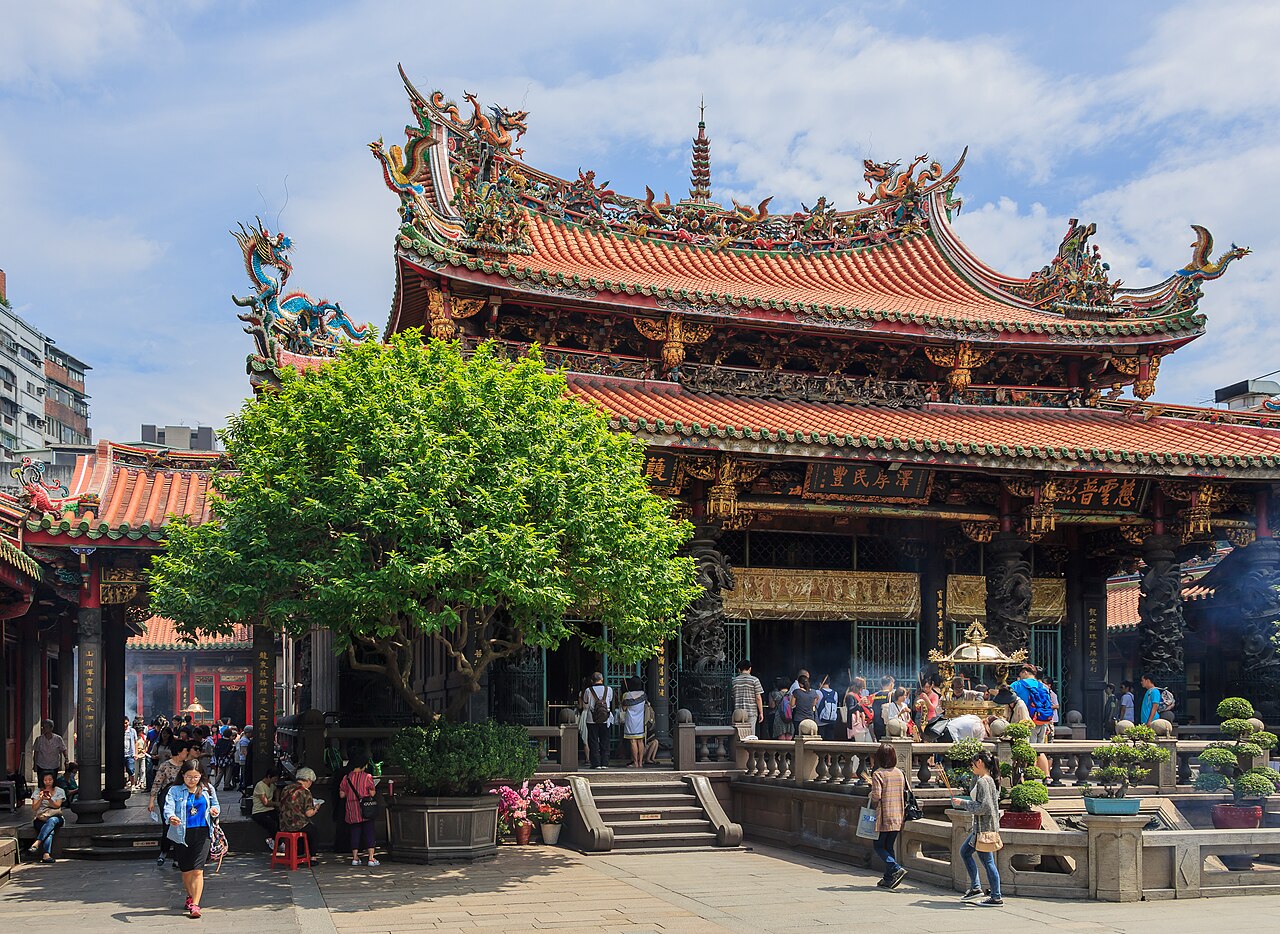
The front courtyard of Longshan Temple, Taipei, with green trees and worshippers, the ornately carved roof of the main hall behind
The front courtyard of Longshan Temple — beneath the elaborately carved roof of the main hall, worshippers come and go all day long.
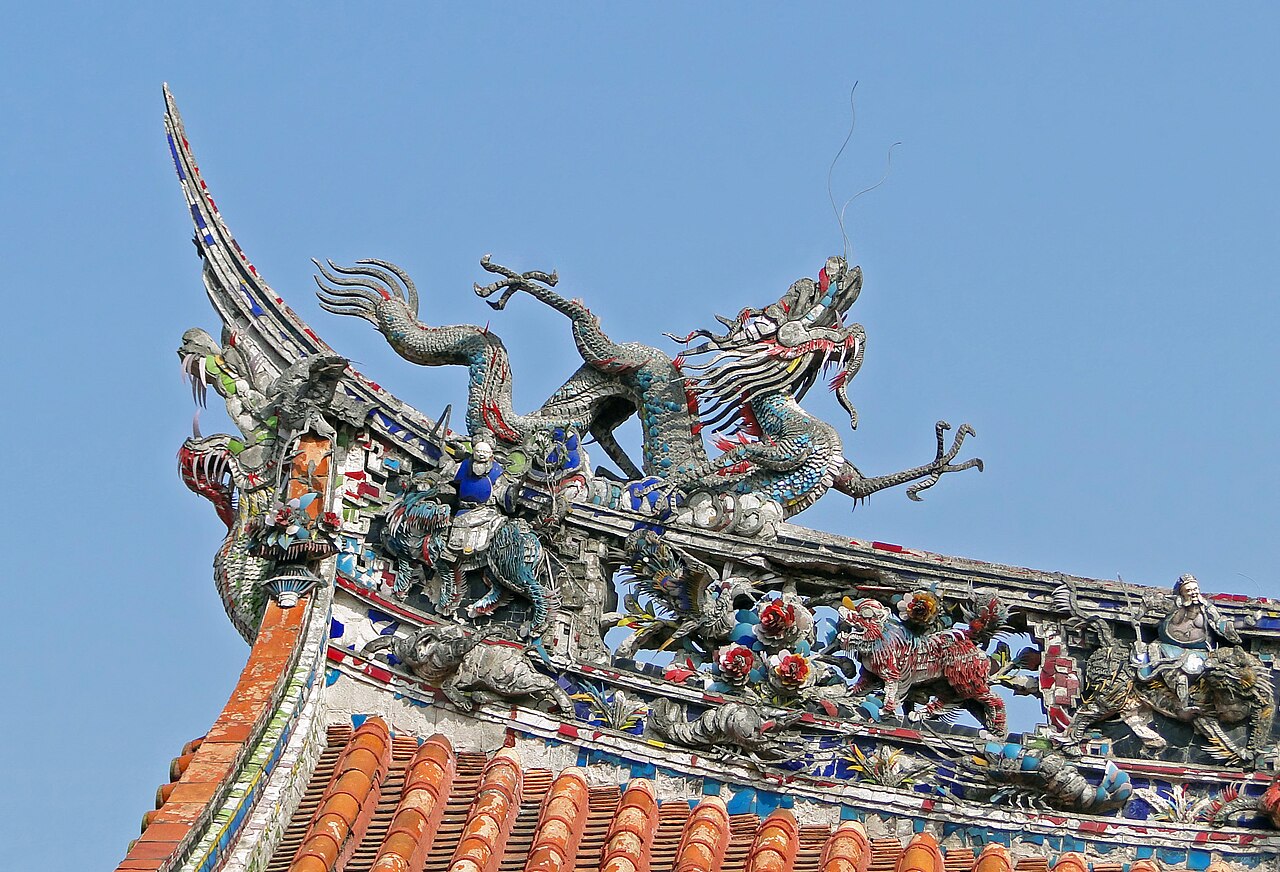
Close-up of colourful ceramic dragon figures on the ridge of Longshan Temple's roof in Taipei, jiannian cut-porcelain craftsmanship
Dragons on the roof ridge — vivid "jiannian" cut-porcelain work by master craftsmen, one of the highlights worth looking up for.
Getting There · Hours

There's an MRT station right outsideand admission is free, every day

Longshan Temple is one of the easiest Taipei attractions to reach — there is an MRT station of the same name immediately next to it, and there is no entry fee at all.

🚆 Getting there

  • 🚇Take the MRT Bannan Line (Blue Line) to Longshan Temple Station (龍山寺) and leave via Exit 1 — walk a few steps up and the temple is right in front of you.
  • 🚉From Taipei Main Station it is just two stops away — extremely convenient for visitors.
  • 🌳In front of the temple is Bangka Park and an open plaza — a handy place to get your bearings or rest before heading in.
  • 🚕Taxis and ride-hailing are easy too, since the temple is a landmark every driver knows.

🕙 Hours · Admission

  • 🎟️Free admission — no entry fee. Longshan is a living temple, open to everyone to worship and to visit.
  • 📅Open daily, roughly 06:00–21:45, from before dawn until late evening — check the latest hours, as they can shift around festivals.
  • 🌅Early morning and evening bring sutra-chanting ceremonies led by clergy and devotees — the most atmospheric, moving time to be here.
  • ⏱️Walking through and observing the temple takes about 45 minutes to an hour, but allow a half-day for the wider Wanhua district.
💡

Tip: For the best atmosphere, come around 07:00–08:00 when the light is soft and crowds are thin, or in the evening during the chanting. Avoid the 1st and 15th days of the lunar month and festival days, when the temple fills with devotees.

The Deities · What to Pray For

Over a hundred deities under one roofand what visitors come to ask of them

Longshan is laid out as three halls — a front hall, a main hall and a rear hall — each shrine dedicated to different deities, so worshippers move shrine to shrine according to what they hope for.

Principal Deity

Guanyin, the Bodhisattva of Compassion (觀世音菩薩)

The temple's principal deity, enshrined in the main hall. Guanyin is the Bodhisattva of mercy in Mahayana Buddhism — and it was to honour her that Longshan Temple was first built back in 1738.

People pray for: peace of mind, good health, the protection of their families, and relief from hardship.

Rear Hall

Mazu, Goddess of the Sea (媽祖)

The goddess of the sea and protector of seafarers — a deeply beloved deity of the Fujianese, who carried her with them when they crossed the strait to settle in Taipei.

People pray for: safe travels, success in trade, and a smooth-running life.

Rear Hall

Wenchang, God of Literature (文昌帝君)

The god of learning, literature and examinations. During university-entrance and civil-service exam seasons, students crowd this shrine to pray for success.

People pray for: study, exams, wisdom, and progress in their careers.

The Temple Favourite · Rear Hall

Yue Lao — the Old Man Under the Moon (月老)

The shrine visitors seek out most. Yue Lao is the deity of love and matchmaking. Legend says he keeps the register of everyone's destined partner and ties an invisible "red thread of fate" connecting two souls meant to meet — so the single, and those hoping for a smoother love life, come here to pray.

People pray for: love, a soulmate, a steady relationship — and take home a red thread as a token (see how, in the next section).

🧭

Good to know: Beyond these four, Longshan houses dozens more deities — including Guan Yu (god of loyalty) and Zhusheng Niangniang (a goddess associated with pregnancy and childbirth), more than a hundred in all. If you are unsure which shrine is which, look for the signs or ask a temple attendant — they are kind and often happy to explain in English.

How to Worship · Temple Etiquette

How worship worksand how to collect Yue Lao's red thread

You don't need to be Buddhist or Chinese to take part — only to do so with a respectful heart. Here is the process, simply explained for visitors.

Enter by the Dragon Gate, exit by the Tiger Gate

The temple has three doorways. Enter through the right-hand door (the Dragon Gate) and exit through the left-hand door (the Tiger Gate) as you face the temple. The central door is reserved for the deities — visitors should not walk through it.

Light incense, or simply press your palms together

The temple once had incense pots for offering joss sticks, but it has greatly reduced incense burning to protect air quality — pressing your palms together with a calm heart is enough. If you do have incense, hold it as you bow, then place it in the designated pot.

State your name, birthday and wish before the deity

Standing before a shrine, say your name, your date of birth, your address and what you wish for — silently or softly — then bow three times. Tradition holds that introducing yourself helps the deity "know" the person praying.

Cast the jiaobei moon blocks

The moon blocks are a pair of red, crescent-shaped wooden pieces, kept on tables near the shrines. Toss them to the ground three times, asking a question about your future — one block up and one down means "yes". A favourable result each time means the deity has granted consent.

At the Yue Lao shrine — collect a red thread

Leave a sweet or candy as an offering on the red plate, tell the deity what kind of partner you hope for, cast the moon blocks for a favourable answer — and then take one red thread from the box in front of the shrine. The red threads are free.

Draw a fortune stick and read it

The temple has fortune sticks (kau cim) to shake — once you have a number, confirm it with the moon blocks, then collect the matching fortune slip. English explanations are sometimes available, or simply ask an attendant for help.

❤️

Red-thread tip: Tradition says to keep the red thread in your wallet rather than tying it in a knot — a knot is thought to represent an obstacle. And if your wish for love comes true, you should return to the temple to thank Yue Lao.

🤫

The etiquette that matters most: Longshan Temple is not a photo set — it is a working temple used by real worshippers every day. Keep your voice low, don't stand in the way of those praying, and photograph discreetly, especially during chanting. There is no strict dress code (shorts, sleeveless tops and sandals are all fine), but dress reasonably modestly and don't go barefoot.

Architecture

Look upat the craftsmanship that makes Longshan a work of art

Longshan isn't remarkable only for faith — the building itself is one of the finest examples of southern-Chinese temple architecture in Taiwan.

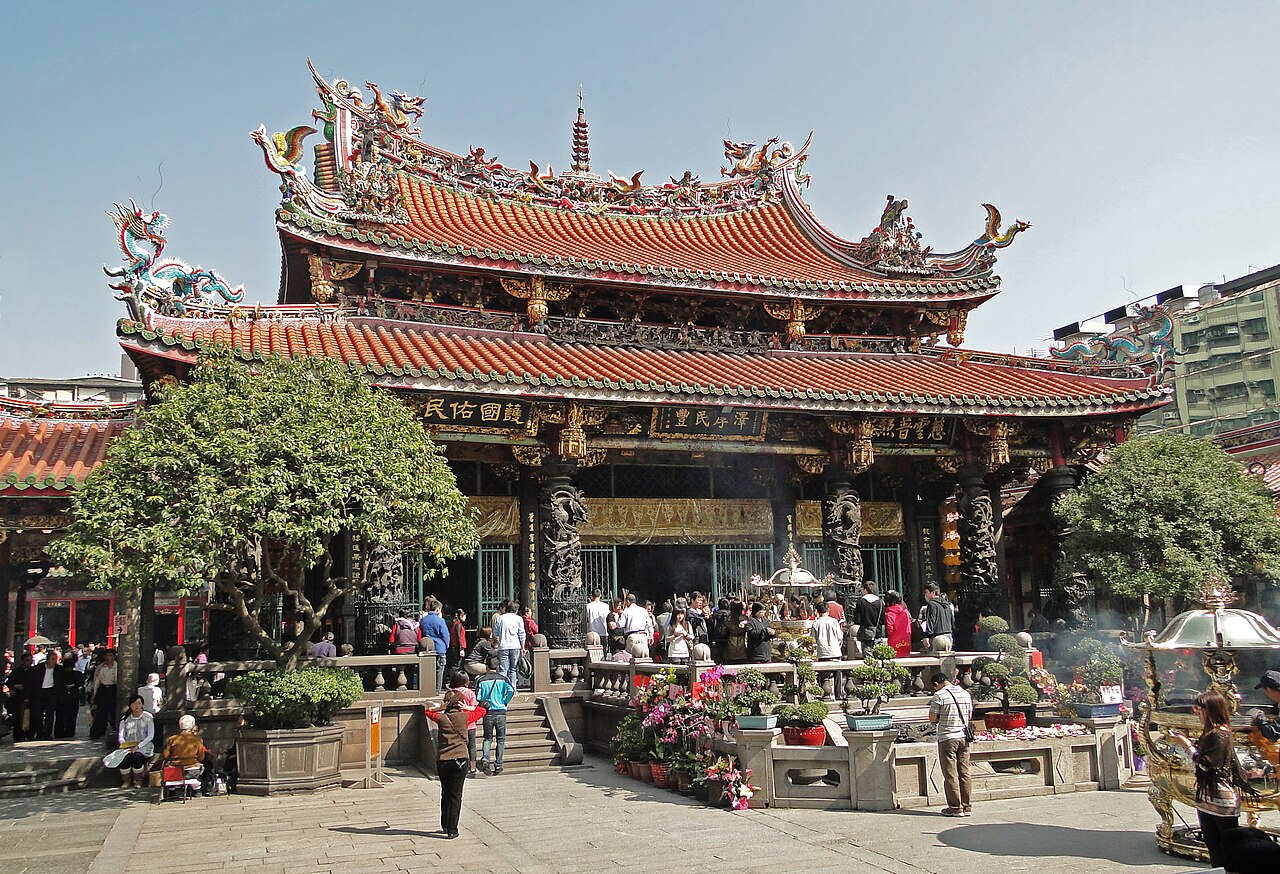
The main hall of Longshan Temple, Taipei, with carved stone columns and incense burners, worshippers gathered in the courtyard
The main hall of Longshan Temple — carved stone columns, brass incense burners, and a courtyard where worshippers gather from dawn to dusk.

🐉 What to stop and look at

  • 🐲Stone dragon columns at the front hall — a famous pair carved from single blocks of stone, dragons coiling around them, among the best-known in Taiwan.
  • 🏯The carved roof, crowned with dragons, phoenixes and figures from legend, built up in vivid multi-coloured "jiannian" cut-porcelain.
  • 💧The waterfall and carp pond in the front courtyard — an artificial waterfall whose trickle adds a touch of coolness and calm.
  • 🪵Woodcarvings on the beams, ceilings and doors — auspicious motifs, flowers and scenes drawn from Chinese literature.
Explore More in Wanhua

Around the templeold Taipei waits for another half-day of walking

Wanhua (Bangka) is where Taipei began — a few minutes' walk from Longshan Temple brings you to places that tell the story of the old city all day long.

3-minute walk

Bopiliao Historic Block (剝皮寮)

A beautifully restored street of Qing-era shophouses, now home to small museums, galleries and exhibitions on Taipei's history — a favourite photo spot with the full atmosphere of the old town.

Beside the temple

Herb Alley · Qingcao Lane (青草巷)

A tiny lane beside the temple lined with shops that have sold Chinese medicinal herbs and herbal teas for generations — stop for a cup of cooling herbal tea, a slice of old life still very much alive.

5-minute walk

Huaxi Street Night Market (華西街夜市)

One of Taipei's oldest covered night markets, with local street food and foot-massage parlours — raw, old-Taipei character, a world away from youthful Ximending.

In front of the temple

Bangka Park (艋舺公園)

The broad park plaza in front of Longshan Temple — a good place to rest, regroup or watch local life. Wanhua also holds other historic temples, like Qingshan and Qingshui, within easy walking distance.

Optional · Not Required

Want to understand Wanhua more deeply?
Consider a guided old-Taipei walking tour

Longshan Temple is free and easy to explore on your own — but if you'd like to hear the history, beliefs and daily life of the Wanhua district told in depth, a guided walking tour with a local is a good option. Browse Wanhua / old-Taipei walking tours on Klook.

🚶 See Wanhua walking tours on Klook →
Wherebest is an affiliate partner of Klook — we may earn a commission if you book through this link, at no extra cost to you. Visiting Longshan Temple itself is free.
Insider Tips

6 tipsfor a meaningful visit — and good photos

🌅
Come morning or evening
07:00–08:00 brings soft light and thin crowds; evening brings the chanting and the most atmospheric mood.
📅
Skip lunar 1st & 15th
On the 1st and 15th days of the lunar month, and on festival days, the temple is packed with devotees.
🤫
Respect the worshippers
This is a living temple — speak softly, don't block the way, and photograph discreetly, especially during chanting.
❤️
Bring a sweet for Yue Lao
Hoping to pray for love? Bring a small candy as an offering, and remember the red-thread steps.
🚇
Use MRT Exit 1
Longshan Temple Station, Exit 1, opens right onto the temple — no searching, no wasted time.
🍵
Pair it with all of Wanhua
After the temple, walk on to Bopiliao, Herb Alley and Huaxi Street — a rewarding half-day in all.
Plan the Rest

Fit Longshan Templeinto your Taipei trip

Explore more of Taipei, open the full city guide, or move on to Taipei 101 and the National Palace Museum.

📍

Top 10 Taipei Attractions

Longshan Temple, Taipei 101, the National Palace Museum, Elephant Mountain and more — plan your whole Taipei trip on one page.

See Taipei attractions →
🏙️

Taipei 101 Guide

A guide to the Taipei 101 observatory — which ticket to pick, which floor to visit, and how to catch the golden sunset hour.

See the Taipei 101 guide →
🏛️

National Palace Museum Guide

Make the most of 700,000 imperial treasures in a day — the Jadeite Cabbage, how to get there, and how to dodge the tour groups.

See the museum guide →
🟠 Klook

🛕 Longshan + Bopiliao Walking Tour
2.5h Local Guide

Explore Longshan Temple's incense-filled courtyards alongside the ancient Bopiliao Historic Block with an English-speaking guide who explains the deities, the rituals and the history of Taipei's oldest neighbourhood. A 2.5-hour small-group tour that goes far beyond what you'd discover alone.

🛒 Check Price on Klook →
Wherebest is a Klook affiliate partner — we may earn commission at no extra cost to you
Frequently Asked Questions

What to know beforevisiting Longshan Temple, Taipei

Is there an entry fee for Longshan Temple, and what are the opening hours?
Longshan Temple is free to enter — there is no admission charge. It opens daily from early morning to late evening, generally around 06:00 to 21:45. Early morning and evening bring sutra-chanting ceremonies led by clergy and devotees, which are the most atmospheric times to visit. Check the latest hours before you go, as they can shift around festivals.
How do I get to Longshan Temple? Is there an MRT station?
Very easy — take the MRT Bannan Line (Blue Line) to Longshan Temple Station, leave via Exit 1, and the temple is right outside, just steps away. From Taipei Main Station it is only two stops away, making it one of the most accessible attractions in the city.
How do I pray for love at Longshan Temple and collect Yue Lao's red thread?
In the rear courtyard there is a shrine to Yue Lao (月老), the Old Man Under the Moon, the deity of love and matchmaking. The steps are: offer a sweet on the red plate, then stand before the shrine and tell the deity your name, birthday, address and the kind of partner you hope to meet. Throw the crescent-shaped jiaobei moon blocks three times, asking a question each time. If the answer is favourable, take one red thread from the box in front of the shrine. Keep it in your wallet rather than tying it in a knot, and return to thank Yue Lao if your wish comes true. The red threads are free.
Which deities are housed in Longshan Temple?
Longshan Temple blends Buddhism, Taoism and Chinese folk religion under one roof. The principal deity in the main hall is Guanyin, the Bodhisattva of compassion. The rear hall houses many other deities, including Mazu (goddess of the sea), Guan Yu, Yue Lao (the matchmaker), Wenchang (god of literature and exams) and Zhusheng Niangniang (a goddess associated with childbirth). In all, more than a hundred deities are venerated here, so visitors come to pray for many different things in one place.
Is there a dress code for Longshan Temple?
There is no strict dress code — shorts, sleeveless tops, skirts, hats and sandals are all fine. Just dress reasonably modestly and avoid swimwear or bare feet. Far more important than clothing is your behaviour: this is an active place of worship used by real devotees every day, so keep your voice low, do not block worshippers, and photograph discreetly.
How long should I spend at Longshan Temple, and what else can I see nearby?
The temple itself takes about 45 minutes to an hour to walk through and observe. But the surrounding Wanhua district has enough to fill a half-day: the Bopiliao Historic Block, Herb Alley (Qingcao Lane), Huaxi Street Night Market and Bangka Park are all within a short walk. Allow roughly half a day for the temple and its neighbourhood together. See more ideas on the Taipei attractions page.
Ready to Go

Stay near Ximending or the MRT Blue Line
and walk to Longshan Temple with ease

Pick a hotel near Ximending or close to an MRT Blue Line station, and reaching Longshan Temple and exploring Wanhua becomes effortless, even early in the morning. Open the full Taipei guide to plan every day, or start searching for a place to stay.

📍 Taipei Attractions Taipei Guide