🌏 Destinations · All 🇯🇵 Japan · Full guide Kyoto Kyoto Attractions Arashiyama 🏯 Northwest Temples 🧭 Travel Prep About Contact 🇹🇭 ไทย🇬🇧 English🇨🇳 中文🇪🇸 Español🇫🇷 Français
🏯 Northwest Temple District · Kyoto

Kyoto's Northwest Temples the Golden Pavilion, Ryoan-ji and Ninna-ji

Kyoto's northwest corner hides the densest cluster of World Heritage temples in the city — a golden pavilion mirrored in a pond, the zen rock garden where you can never count all the stones, and a five-story pagoda in a sea of blossom. We've mapped a route that catches them all in one day, with an easy tram link straight on to Arashiyama.

Start Here

The Densest Cluster of World Heritage Temples in Kyoto

Picture a corner of the city where you can walk from Kyoto's most iconic golden pavilion, to the most famous zen rock garden in Japan, and on to a five-story wooden pagoda set among cherry trees — all within walking distance of each other. This is northwest Kyoto, the neighbourhood that packs in more World Heritage temples than anywhere else in the city. Kinkaku-ji, Ryoan-ji and Ninna-ji are all part of the UNESCO World Heritage site "Historic Monuments of Ancient Kyoto," and they sit in a near-straight line along the road called Kinukake-no-michi.

The point of this guide is to help you see the whole district in a single day — which temple to start with, how to walk between them without backtracking, the entry fees and opening hours for each, and a closing trick to ride the Randen tram on to Arashiyama in the same trip. And if you want to go deep on the Golden Pavilion itself, we have a dedicated Kinkaku-ji guide you can read next.

🏯 Straight up, before anything else: the heart of this area is the three World Heritage temples in a line — Kinkaku-ji → Ryoan-ji → Ninna-ji, all within walking distance. Start early at Kinkaku-ji right on opening (09:00) when the crowds are thin and the light is best, then work your way south. That leaves plenty of afternoon for Kitano Tenmangu shrine or the Myoshin-ji zen complex.
🏯
Kinkaku-ji Golden Pavilion
Gold from top to bottom, mirrored in its pond — Kyoto's most iconic image. World Heritage.
🗿
Ryoan-ji Rock Garden
Fifteen stones on raked sand — the most famous zen garden in Japan.
🌸
Ninna-ji Five-Story Pagoda
World Heritage, and the late-blooming Omuro cherries — early April, the city's last.
🚋
Continue to Arashiyama
The Randen Kitano Line tram runs straight on to the Arashiyama bamboo grove.
Compare Before You Go

The Temples Here Hours · Entry · What They're Known For

A quick reference for timing your day — the first three temples sit in a line within walking distance, while Kitano Tenmangu and Myoshin-ji are on the south side of the district. Prices and hours are 2026 figures and may change, so check the official sites before you go.

Temple / ShrineStatusHoursEntry (adult)Known for
Kinkaku-jiKinkaku-ji · Golden PavilionWorld Heritage09:00–17:00500 yenGold pavilion mirrored in a pond
Ryoan-jiRyoan-jiWorld Heritage08:00–17:00 (Dec–Feb to 16:30)600 yenZen rock garden of 15 stones
Ninna-jiNinna-jiWorld Heritage09:00–17:00 (last entry 16:30)~500–800 yenFive-story pagoda · Omuro cherries
Kitano TenmanguKitano TenmanguShrinearound 06:30–17:00Free (plum garden separate)God of learning · 25th-of-month market · plum
Myoshin-jiMyoshin-jiZen complexFree to walk · sub-temples ~09:00–17:00Free (sub-temples charge)Largest Rinzai zen complex · Taizo-in
📅 How to sequence it for the best value: start at Kinkaku-ji at 09:00 opening (before the tour buses arrive, fewest crowds) → walk about 18 minutes to Ryoan-ji and sit a while in front of the rock garden → walk another 12 minutes or so to Ninna-ji. All of this is comfortably done before noon, leaving the afternoon for Kitano Tenmangu (especially if you're here on the 25th for the Tenjin-san market) or a stroll through the Myoshin-ji complex.
What to See

6 Highlightsof Kyoto's Northwest Temples

Everyone who's been here says the same thing — this is the Kyoto you pictured: glittering gold, quiet zen gardens, and a wooden pagoda among cherry trees. We've listed them in the order you'd actually walk them, north to south.
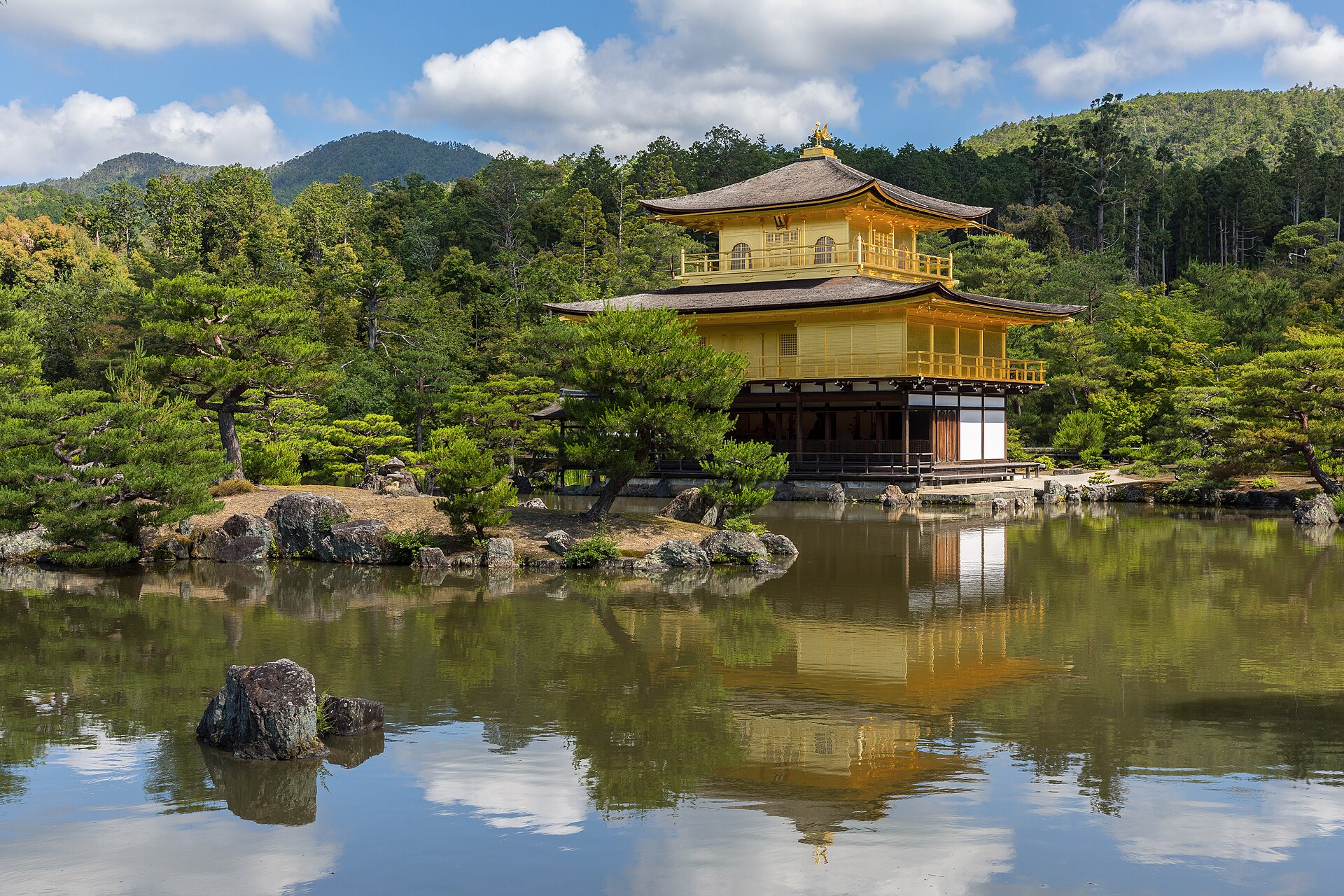
Kinkaku-ji, the Golden Pavilion, reflected in its pond in Kyoto 🏯 World Heritage1
Kinkaku-ji (Golden Pavilion)
Kinkaku-ji · 金閣寺

The star of the district and the postcard image of Kyoto itself — a three-story hall, its top two floors covered in gold leaf, reflected so cleanly in the Kyoko-chi (Mirror Pond) that it looks like two buildings stacked together. A one-way path loops the pond in about 30–45 minutes, and the best photo spot is straight across the water from the entrance.

📍Location: Kita-ku · the northern tip of the district — start your route here
🕘Open: 09:00–17:00 daily · adult entry 500 yen
🚌Getting there: City Bus 101/205 to Kinkakuji-michi, 3-min walk
💡Tip: Arrive at 09:00 opening for the smallest crowds and the gold catching the morning sun. For the full history and photo angles, read our dedicated Kinkaku-ji guide.
In-depth Kinkaku-ji guide →
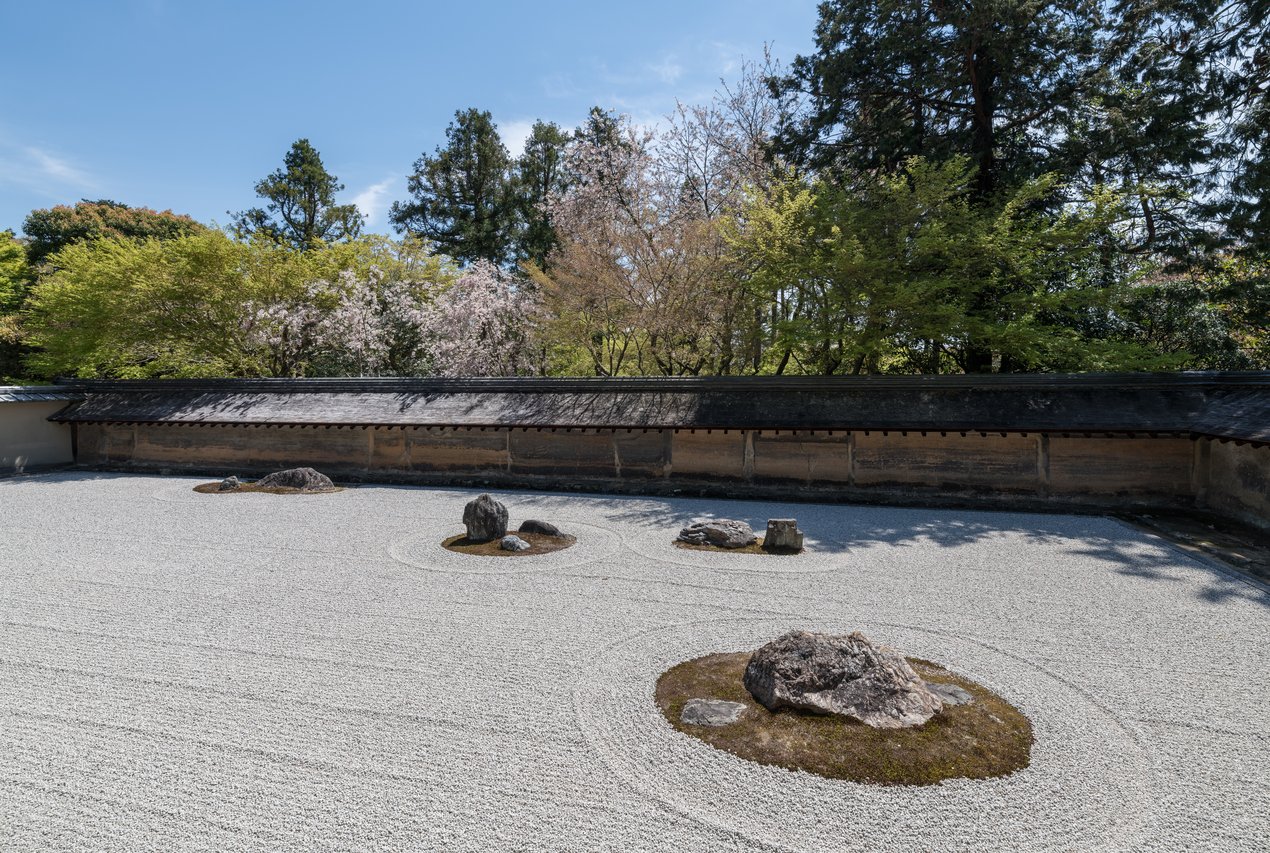
Ryoan-ji zen rock garden — 15 stones on raked white sand in Kyoto 🗿 World Heritage2
Ryoan-ji
Ryoan-ji · 龍安寺

The most famous zen rock garden (karesansui) in Japan — 15 stones set on a bed of white gravel that the monks rake into wave patterns every day. No trees, no water, just stones and sand, yet that very emptiness keeps people sitting and staring for an hour. Try counting the stones — from any viewpoint you'll never see all 15.

📍Location: about 18 minutes on foot from Kinkaku-ji (stop 2 on the route)
🕘Open: 08:00–17:00 (Dec–Feb 08:30–16:30) · 600 yen
🚋Getting there: Randen tram to Ryoanji Station, 7-min walk — or walk on from Kinkaku-ji
💡Tip: Sit quietly on the wooden Hojo veranda for a while before you get up to take photos. The grounds also include the Kyoyochi pond and a stroll garden.
All Kyoto attractions →
🌸 🌸 World Heritage3
Ninna-ji
Ninna-ji · 仁和寺

A former imperial temple where retired emperors once lived, best known for its five-story wooden pagoda and its short Omuro-zakura cherry trees — about 200 of them (around 550 across the whole temple) that bloom later than other varieties in Kyoto. It's the last place to catch the blossoms after everywhere else has dropped, and the classic shot is the pagoda's roof rising above a sea of pink.

📍Location: about 12 minutes on foot from Ryoan-ji (stop 3 on the route)
🕘Open: 09:00–17:00 (last entry 16:30) · entry roughly 500–800 yen by section
🌸Omuro cherries: peak early–mid April · during the festival the temple opens 08:30–17:30
💡Tip: Some areas (pagoda and main hall) are free to view, but the Goten residence and cherry garden need a ticket. Check 2026 prices on the official site.
On to Arashiyama (Randen tram) →
⛩️ ⛩️ Shrine4
Kitano Tenmangu Shrine
Kitano Tenmangu · 北野天満宮

A major shrine dedicated to Sugawara no Michizane, the god of learning and calligraphy, founded back in 947 — Japanese students stream in to pray before exams. It has a plum grove of nearly 2,000 trees that flower in late February to March, and another highlight is the Tenjin-san flea market on the 25th of every month, when around 1,000 stalls sell antiques, second-hand kimono and street food across the grounds.

📍Location: the east side of the district · walk from Myoshin-ji or hop a bus
🕘Open: around 06:30–17:00 · shrine free (plum garden charges in blossom season)
🚌Getting there: City Bus 50/101 to Kitano-Tenmangu-mae
💡Tip: If your trip falls on the 25th, get to the Tenjin-san market early (it starts around 06:00) — it's liveliest then and the good stuff is still out.
Kyoto travel guide →
🧘 🧘 Zen complex5
Myoshin-ji
Myoshin-ji · 妙心寺

The largest Rinzai zen temple complex in Japan, founded in 1337 on the old palace grounds of Emperor Hanazono. Inside are roughly 40–50 sub-temples, and you can walk the stone lanes between their walls for free — so quiet it feels like stepping out of the city. The star sub-temple is Taizo-in, with a 1400s rock garden and one of the finest Showa-era pond gardens around.

📍Location: the south side of the district, between Ninna-ji and Kitano Tenmangu
🕘Open: free to walk the complex · sub-temples (e.g. Taizo-in) open ~09:00–17:00, charge separately
🚋Getting there: Randen tram to Myoshinji Station, a few minutes' walk
💡Tip: It holds Japan's oldest temple bell (a national treasure cast in 698). Stop by Taizo-in if you want to sit and watch a garden in peace, away from the crowds.
All Kyoto attractions →
🚋 🚋 Connecting route6
Randen Kitano Line Tram
Randen Kitano Line · 嵐電北野線

Not a temple, but the trick that makes this district so much more fun — a vintage tram, over 100 years old, that stops right outside Ninna-ji (Omuro-Ninnaji) and Ryoan-ji (Ryoanji). The Kitano Line meets the Arashiyama Line at Katabiranotsuji and runs straight to the end at Arashiyama, so you can do the temples in the morning and ride the tram out to the Arashiyama bamboo grove in the afternoon, all in one day.

📍Route: Kitano-Hakubaicho → Omuro-Ninnaji → Ryoanji → Katabiranotsuji → Arashiyama
🎟️Fare: a single flat fare for the whole line (check 2026 rates at the station)
🚋Connection: change to the Arashiyama Line at Katabiranotsuji — no need to leave the system
💡Tip: Sit on the left heading into Arashiyama for the better view. Temples in the morning to midday, Arashiyama in the afternoon — the timing works out just right.
Arashiyama guide (bamboo grove · Tenryu-ji) →
Eat, Drink + Stay Nearby

Refuel Between Temples then Pick a Base in the City

This temple district is a quiet residential area — restaurants aren't as thick on the ground as in central Kyoto. Knowing that in advance helps you plan your meals and your base to fit the route.

Eat & Drink
Lunch around the temples

In front of Kinkaku-ji and along Kinukake-no-michi you'll find soba and udon shops plus green-tea cafés to rest your legs. The classic sweet treat is a matcha parfait with Kyoto-style yuba (tofu skin). For something more substantial and varied, head into Nishiki Market or central Kyoto — see our full things-to-do guide.

Where to stay
Best base

The northwest temple zone is quiet and far from the major stations, so most people base themselves in central Kyoto (Karasuma / around the station), where City Bus 101/205 or the Randen tram bring you out here easily. Do the district in a morning and you're back in the city without trouble — see the recommended areas and hotels in our Kyoto guide.

Book a room
Compare before you lock it in

Kyoto rooms sell out fast during cherry-blossom season (April) and autumn leaves (November) — book several months ahead and choose free-cancellation rooms to be safe. Compare accommodation across Kyoto with the button below.

🏨 Choosing where to stay in Kyoto: read our area and hotel rundown in the Kyoto travel guide, or check out the 10 Kyoto hotels guests recommend most · compare live room rates now on Agoda (Kyoto) →
Getting There — Station / Bus

Reach the Temple Districtby Bus or Randen Tram

There's no major train station in this area — the two main options are a city bus straight to Kinkaku-ji, or the Randen tram that stops outside Ninna-ji and Ryoan-ji and continues on to Arashiyama.

🚌
City Bus 101 / 205
From Kyoto Station take Bus 101 or 205 to Kinkakuji-michi, about 40 minutes for 230 yen — the easiest direct route to Kinkaku-ji.
🚋
Randen Kitano Line tram
The tram stops right at Omuro-Ninnaji (Ninna-ji) and Ryoanji (Ryoan-ji) — handy if you want to start from the southern temples and walk up to Kinkaku-ji.
⛩️
Bus 50 to Kitano Tenmangu
For the shrine of learning, take Bus 50 or 101 to Kitano-Tenmangu-mae · the Randen terminus at Kitano-Hakubaicho is also within walking distance.
🚶
Walk the three temples in a line
Kinkaku-ji → Ryoan-ji ~18 min → Ninna-ji ~12 min along Kinukake-no-michi — an easy walk with no need to change transport.
🎫
One-day bus/subway pass
If you'll ride several buses in a day, check Kyoto's one-day pass (2026 rates may change) — better value than paying fare by fare.
🌳
Continue to Arashiyama
Ride the Randen from Ninna-ji / Ryoan-ji, change at Katabiranotsuji, and run straight to the Arashiyama bamboo grove on the one line.
Map

The Northwest Templeson One Map

See just how close together the four points sit — Kinkaku-ji, Ryoan-ji and Ninna-ji line up within walking distance, while Kitano Tenmangu is over to the east. Walk them in this order and you'll never double back.

Tips Before You Go

6 Things That Make the Temple DistrictWorth It and Worry-Free

🌅
Start Early at Kinkaku-ji
Arrive at 09:00 opening, before the tour buses — fewest crowds and the gold catching the morning sun. By mid-morning it's so packed that photos get hard.
🧭
Walk North to South
Kinkaku-ji → Ryoan-ji → Ninna-ji runs neatly southward with no backtracking. Save Kitano Tenmangu and Myoshin-ji for the afternoon.
🗿
Leave Time at Ryoan-ji's Garden
The rock garden isn't a walk-past. The people who really get it are the ones who sit quietly on the veranda for 15–20 minutes. Try counting all 15 stones.
📅
The 25th = Tenjin-san Market
On the 25th of each month, Kitano Tenmangu hosts an antiques flea market of ~1,000 stalls. If your trip lands on it, get there early while the goods are plentiful.
🚋
Plan the Arashiyama Add-On
Temples in the morning, the Randen tram out to the Arashiyama bamboo grove in the afternoon — the best-value day you can build on Kyoto's west side.
💴
Carry Cash and Coins
Entry to the first three temples adds up to about 1,600–1,900 yen per person, and some points take cash only — keep small notes and coins on hand. 2026 prices may change.
Related Guides

Keep Exploring Kyoto — Other Districts, Temples and Prep

🏯

In-Depth Kinkaku-ji Guide

The history, the best photo angles, opening hours, entry fees and crowd-dodging tricks for the Golden Pavilion in full.

Kinkaku-ji Guide →
🎋

Arashiyama Guide

The bamboo grove, Tenryu-ji temple, the Togetsukyo Bridge, the monkey park and the Sagano train — continue here from this district on the Randen tram.

Arashiyama Guide →
🚶

Southern Higashiyama (Gion)

Kiyomizu-dera, the Ninenzaka lanes, Yasaka Shrine and the Gion district — the old temple zone on Kyoto's east side.

Higashiyama-Gion →
⛩️

All Kyoto Attractions

Fushimi Inari, the Philosopher's Path, Nishiki Market and the legendary temples of the old capital, all in one place.

Kyoto Attractions →
🏨

Kyoto Travel Guide

Where to stay, recommended hotels, getting around, and where to eat and explore — plan your whole Kyoto trip from here.

Kyoto Guide →
ℹ️

Japan Travel Prep

Visa · eSIM · IC card · JR Pass · yen · power plugs · etiquette — everything to sort before you fly.

Travel Prep →
Frequently Asked Questions

Questions AboutKyoto's Northwest Temples

Can you see Kyoto's northwest temples in a single day?
Easily — Kinkaku-ji, Ryoan-ji and Ninna-ji line up along the same road within walking distance. It's about an 18-minute walk from the Golden Pavilion (Kinkaku-ji) to Ryoan-ji, then another 12 minutes or so on to Ninna-ji. Start at Kinkaku-ji in the morning and work your way south and you can see all three before noon, leaving the afternoon free for Kitano Tenmangu shrine or the Myoshin-ji zen complex.
What are the entry fees and opening hours for Kinkaku-ji, Ryoan-ji and Ninna-ji?
Kinkaku-ji (the Golden Pavilion) opens 09:00–17:00, adult entry 500 yen · Ryoan-ji (the zen rock garden) opens 08:00–17:00 from March to November and 08:30–16:30 from December to February, adult entry 600 yen · Ninna-ji's Goten/garden areas open 09:00–17:00 (last entry 16:30), entry roughly 500–800 yen depending on the section. Prices may change in 2026 — check the official sites before you go.
Why can't you see all 15 stones at the Ryoan-ji rock garden?
Ryoan-ji's rock garden lays out 15 stones on a bed of raked white gravel, but they're arranged so that from any viewing point along the veranda you can see at most 14 — at least one stone is always hidden. It's said to be a deliberate expression of imperfection. Count them yourself when you visit and you'll see it for real.
When do the Omuro cherry blossoms at Ninna-ji bloom?
Ninna-ji is famous for its short Omuro-zakura cherry trees — about 200 of them (and around 550 cherry trees across the whole temple) — which bloom later than other varieties in Kyoto, peaking around early to mid-April. That makes it the place to catch the last of the blossoms after everywhere else has dropped. The signature sight is the five-story pagoda rising above a sea of blossom; during the festival the temple opens 08:30–17:30.
How do you get to Kyoto's northwest temples?
From Kyoto Station take City Bus 101 or 205 to the Kinkakuji-michi stop, about 40 minutes for 230 yen. The other option is the Randen Kitano Line tram, which stops right at Omuro-Ninnaji (Ninna-ji) and Ryoanji (Ryoan-ji). That same line continues on to Arashiyama, so it's ideal if you want to carry on to Arashiyama in the same trip.
Can you continue from the northwest temples to Arashiyama?
Yes. The Randen Kitano Line that passes Ninna-ji and Ryoan-ji connects to the Arashiyama Line at Katabiranotsuji Station and runs straight to the end at Arashiyama. Many people spend the morning on the northwest temples and then ride the Randen in the afternoon out to the bamboo grove and Tenryu-ji temple in Arashiyama, all in one day.
Ready for Kyoto?

Do the Northwest Temples This Morning
then Carry On to Arashiyama

Plan your whole Kyoto trip from the city guide — where to stay, what to see, and how to get around — or start hunting for a central Kyoto base early, because rooms sell out fast in cherry-blossom and autumn-leaf season.

🔴 Book Hotels in Kyoto Kyoto Guide