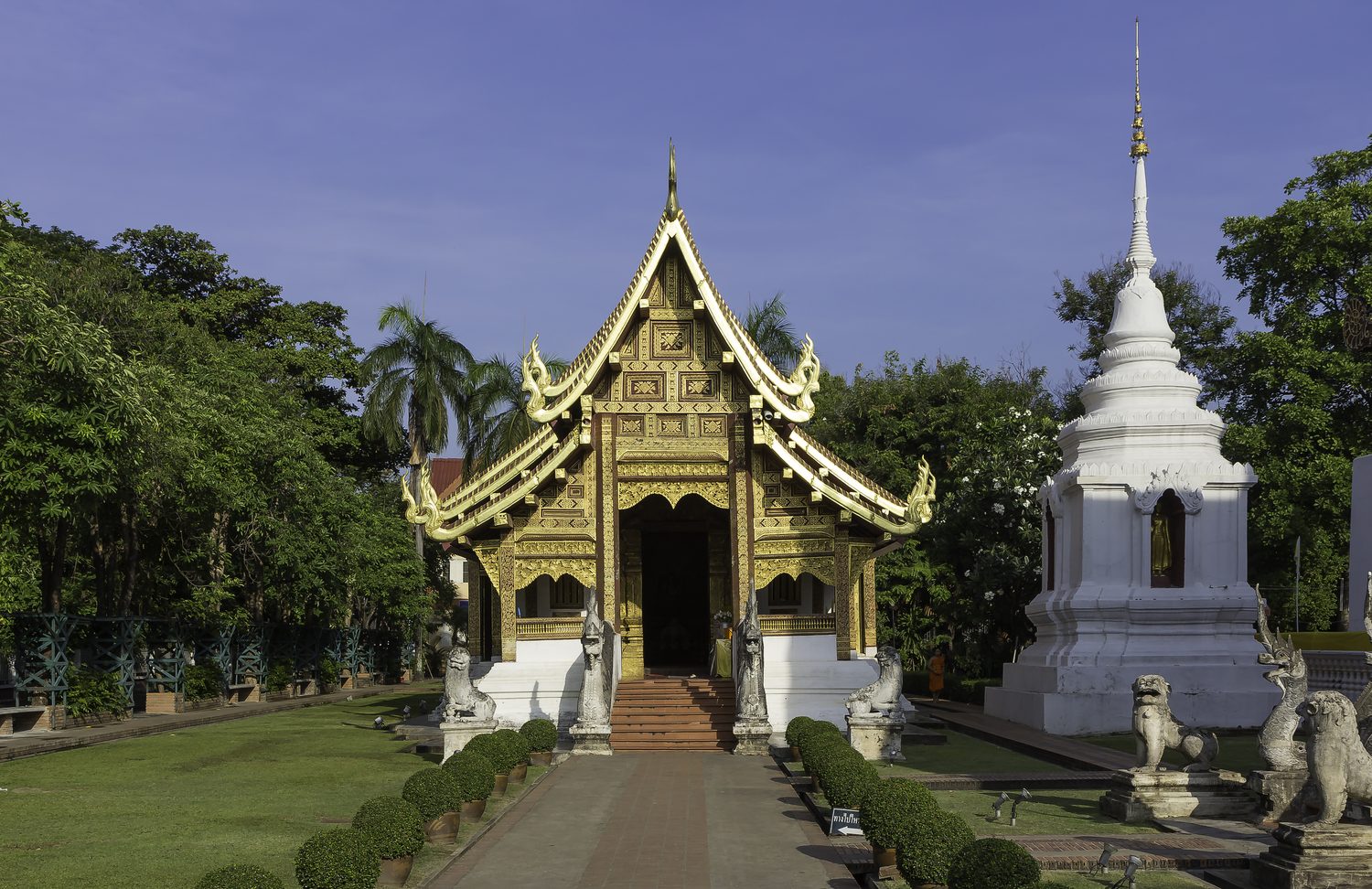
Walk to the western end of Ratchadamnoen Road and you reach the temple locals call the heart of the Old City — a gilded gable, the gold-stencilled Wihan Lai Kham, and the Phra Singh Buddha that people have come to honour for nearly 700 years.
There is a moment, walking into the square moated Old City at eight in the morning, when the light is still soft and monks are sweeping the courtyard, and ahead of you stands a large viharn with its entire gable sheathed in gold, naga finials curling up into the sky. This is Wat Phra Singh — the temple locals call the soul of the Old City, and where most visitors begin to understand Chiang Mai.
Wat Phra Singh Woramahawihan was founded in 1345 under King Phayu of the Mangrai dynasty, built first to hold his father's ashes and growing over time into one of the most important temples of the Lanna kingdom. It sits right at the western end of Ratchadamnoen Road — an easy landmark to navigate by as you explore inside the moat. Its full royal-temple status, the highest grade of royal monastery, reflects how much it still means to both the city and the northern monkhood.
What makes Wat Phra Singh more than another beautiful temple is the depth of genuine Lanna craftsmanship gathered in one place: the Wihan Lai Kham, its walls covered in gold-on-lacquer stencilling and storytelling murals; the Phra Singh Buddha, the city's revered image at the centre of the Songkran festival; and a gilded bell-shaped chedi behind the main viharn. One slow loop takes you through architecture, painting and living faith all at once.
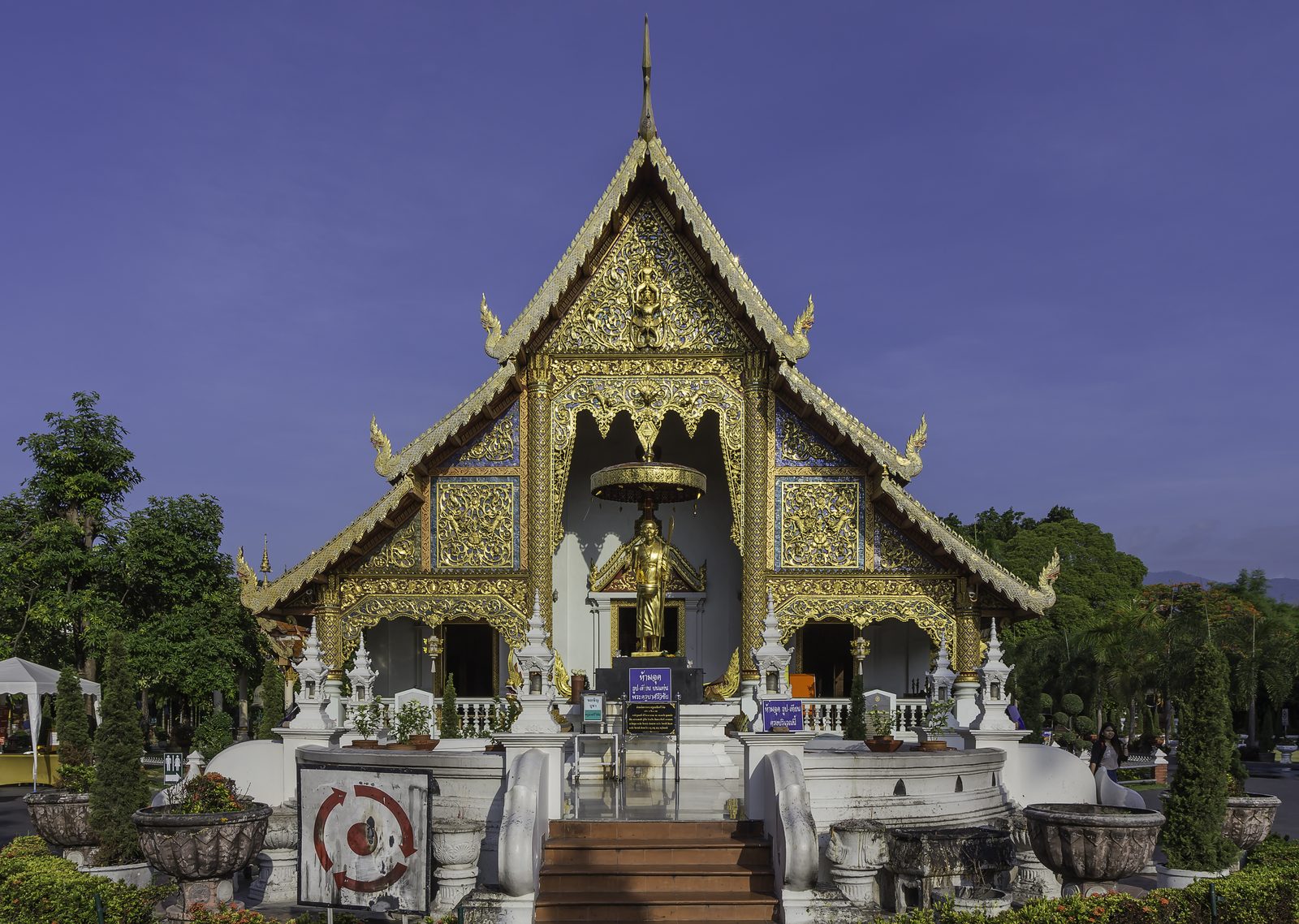
From the Wihan Lai Kham to the gilded chedi — work through them all on one visit.
The small viharn at the back that many people walk past is the most beautiful thing in the complex. Inside, it houses the Phra Singh Buddha, and its interior walls are covered in lai kham — fine gold stencilling on red lacquer worked by Lanna craftsmen — along with murals telling the tales of Sang Thong and Suwannahong, painted by Chiang Mai artists more than a century ago and still vivid. Come to this temple and skip the Wihan Lai Kham, and you have missed the real treasure.
The Phra Singh Buddha is a seated, subduing-Mara image in the Chiang Saen style that Chiang Mai holds in deep reverence. It is believed to have been brought here to enshrine, giving the temple its name. Each year during Songkran the image is carried in procession around the city so that people can pour water over it — one of the most important rituals in the local calendar. Visit during the festival and you see the temple in a wholly different, crowded and devout mood.
The large viharn you see from the entrance is the defining image of Wat Phra Singh: a gable entirely gilded and carved with foliate patterns, with finials shaped as nagas curling skyward in the Lanna manner. Inside sits a large principal Buddha beneath a wooden ceiling painted in gold. When morning or late-afternoon light strikes the gable at an angle, the gold catches fire — it is the most popular photo spot in the temple.
Walk past the grand viharn and you find the temple's bell-shaped Lanna chedi, gilded from top to base, its lower tier set with stucco elephants emerging from the wall in the Lanna-Sukhothai tradition. It stands at the centre of the courtyard among smaller chedis, and is where people like to walk clockwise around it three times for good fortune. In the late afternoon the golden light on the stupa is lovely.
Beyond the viharns and the chedi, look for the ho trai — the raised scripture library — with its walls of delicate stucco devata figures, and the carved woodwork over windows and door arches throughout the grounds. All of it is the work of Chiang Mai craftsmen handed down through generations. Walk slowly and notice these small details and you realise the whole temple is a museum of Lanna craft that is still very much in use, not a relic set aside to look at.
The best windows are early morning, around 7 to 9 am, or late afternoon, 4 to 6 pm. In both the sun is gentle, the air is pleasant, there are far fewer people than at midday, and the low angled light makes the gilded gable and the chedi glow. The early slot also lets you catch the monks' routines and a genuinely calm temple before the tour groups arrive.
If you can plan for November to February, you get Chiang Mai's coolest, most comfortable weather and can wander temples all day without tiring. To be honest, though, from late February into April the region often has smoke haze from agricultural burning — the sky can turn dull and photos suffer compared with the cool season. It is worth knowing before you plan.
Wat Phra Singh is a working temple, not just a sight, so dress respectfully: shoulders and knees covered for both men and women, with no vests, spaghetti straps or short shorts and skirts. Before entering any viharn you must take off your shoes, and once seated inside you should sit with your feet tucked away from the principal Buddha — never point your feet at the image or turn your back to it for a photo.
Carrying a light shawl or scarf makes all of this easy, and if you forget one there are usually wraps to borrow or rent at the entrance. Keeping your voice down and photographing discreetly is a courtesy to the place and to the people who have come to make merit.
The best thing about Wat Phra Singh is its location — inside the moated Old City, where the major temples line up within walking distance. The classic route runs along Ratchadamnoen Road from Wat Phra Singh to Wat Chedi Luang, with its huge partly-ruined chedi, only about 700 metres away. Along the way are smaller temples worth a look, such as Wat Phan Tao.
With a spare half-day, walk the whole of the Chiang Mai Old City — from Tha Pae Gate and the moat to the cafés and shops in the little lanes — so you take in the temples and the Lanna atmosphere together. Or see the full picture of Chiang Mai's attractions to plan the whole trip.
Wat Phra Singh sits at the western end of Ratchadamnoen Road inside the square moated Old City. It is very easy to reach because it is right in the centre. Chiang Mai has no metro — walking and the red songthaews are how you get around.
All in the Old City or near Chiang Mai — easy to combine in one day.